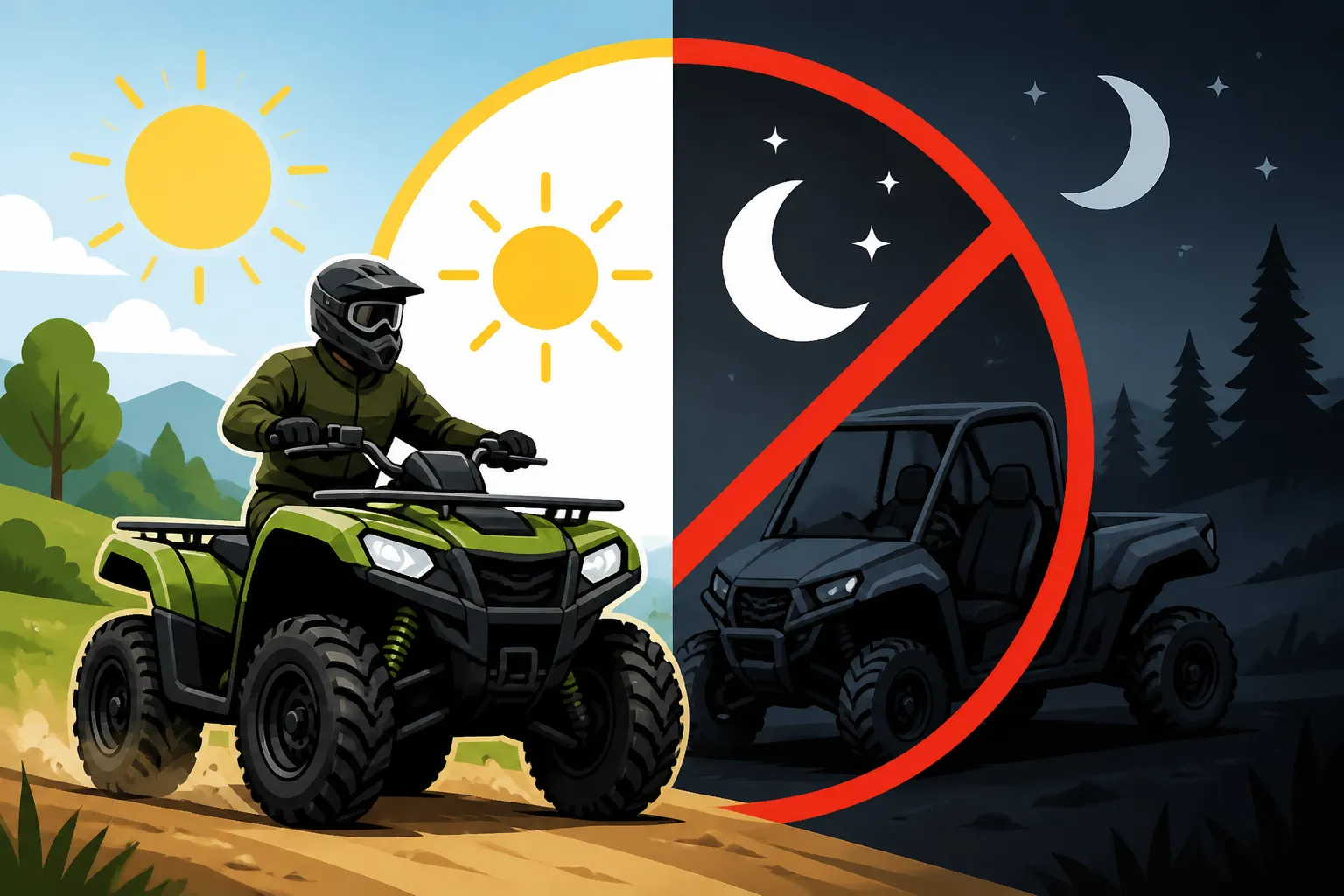
Daylight Hours Only Under Tennessee Law
Many of us, myself included, have felt that nagging uncertainty about taking our beloved ATVs or UTVs out on a Tennessee road. It's not always clear where you can ride, and a huge part of that confusion often revolves around when you can ride. The law is quite specific in Tennessee: if you're venturing onto a public road, your ride needs to happen exclusively during daylight hours, a rule that can certainly throw a wrench in those early morning or late evening plans. This guide will unravel what "daylight hours only" truly means for off-highway vehicle (OHV) operators in Tennessee and explain all the other critical rules you need to know to stay legal and safe.
The Core Rule: Daylight Hours Only for OHV Road Use in Tennessee
This is the big one, the fundamental truth that often catches riders off guard. While the idea of strapping on a powerful light bar from, say, SuperATV, might make you feel invincible after dusk, Tennessee law has a very firm stance: if your OHV is on a public road, it must be between sunrise and sunset. This isn't just a suggestion; it's a critical component of the state's efforts to ensure safety for OHV operators and other motorists. Ignoring this can quickly turn a fun outing into a costly mistake, potentially leading to a [Tennessee's $50 Fine] or worse.
Understanding the "Sunrise to Sunset" Mandate
So, what exactly does "daylight hours" mean? It's pretty straightforward, really. You can operate your ATV or UTV on designated public roads starting at civil twilight in the morning, which is generally about 30 minutes before the sun officially rises, and you must be off those roads by civil twilight in the evening, roughly 30 minutes after sunset. It's not about how bright your headlights are or how visible you feel you are; it's a hard and fast rule tied to the natural light cycle. Think of it as a clear window of time, and outside that window, public road use for OHVs is simply not permitted. This rule is particularly important when planning longer rides, especially if you're traversing areas that might require road sections to connect trails or access fuel. Always check your local sunrise and sunset times to be absolutely sure, especially if you're riding in one of the state's popular adventure tourism districts like [Scott, Anderson and Campbell Counties].
The intention behind this rule is pure and simple: safety first. OHVs, by their very nature, are designed for off-road environments. They don't always have the same visibility features, turn signals, or braking distances as traditional street-legal vehicles. Even with aftermarket lighting upgrades, like those high-output LED kits you might find from companies such as SuperATV, the state errs on the side of caution. Reduced visibility, whether from fog, heavy rain, or simply the encroaching darkness, significantly increases the risk of accidents, not just for the OHV operator, but for other vehicles on the road that might not expect an ATV or UTV to be present.
Why This Rule Exists: Safety and Visibility
The state's primary concern with restricting OHV road use to daylight hours is reducing the risk of collisions. ATVs and UTVs have a different profile than cars and trucks; they're often narrower, sit lower, and can be harder to spot, especially in low light conditions. Even the most cautious driver can miss an OHV if it blends into the shadows or if its lights are mistaken for something else. Furthermore, many OHVs don't come standard with the same comprehensive lighting and signaling systems as street vehicles. While many riders add aftermarket turn signals, brake lights, and mirrors, these aren't always universally installed or as robust as those on a car.
Consider a scenario where you're just trying to get from one part of a trail system to another, perhaps crossing a county road at dusk. Even if you're incredibly careful, the driver of an oncoming car might not see your machine until it's too late. Their expectation is to see cars, trucks, and motorcycles, not necessarily an OHV. This mismatch in expectation and visibility is precisely why the "Daylight Hours Only Under Tennessee Law" stipulation is so strictly enforced. It removes a significant variable of danger, ensuring that when OHVs are on public roads, they are doing so during the safest possible window. It's a pragmatic approach to a complex issue, prioritizing the well-being of all road users over the convenience of a late-night ride.
What it Means for Your Ride Planning
This "daylight hours only" rule profoundly impacts how you plan your rides, especially if your route involves any public road segments. You can't just head out on a whim if you expect to be out past sunset. Instead, every outing needs a schedule. This means checking the weather forecast not just for rain, but also for clear skies that will give you maximum daylight. If you're riding in a group, it adds an extra layer of responsibility, as everyone needs to be aware of the clock. Think about those long loops that crisscross [Morgan, Jackson and Johnson Counties]—if you misjudge the time or get delayed, you could find yourself needing to either cut your ride short or risk a citation.
For example, imagine you're planning a multi-day trip and need to ride a few miles of a gravel [Tennessee Rules for Riding a County Road] to get from your campsite to a specific trailhead. If you don't account for the sun setting at 5:30 PM in late autumn, and your group is running behind schedule, you might have to backtrack or find an alternative, non-road-based route to avoid breaking the law. It also means you need to be realistic about your average speed and how long various trail sections truly take. This isn't about rushing your adventure, but rather about respecting the law and ensuring you're not caught off-guard. Planning ahead, with an eye on the clock, becomes just as important as checking your fuel and tire pressure. Remember, it's not just about getting off the road, it's about being off the road by the time the sun goes down, because [Riding Home After a Tennessee Sunset] is a definite no-no on public thoroughfares.
Navigating Tennessee's OHV Road Use Laws
Understanding the "daylight hours only" rule is just one piece of the puzzle when it comes to riding your OHV on Tennessee roads. The broader landscape of road use laws for ATVs and UTVs in the state can be pretty complex, especially since it involves a blend of statewide statutes and local ordinances. It's not a free-for-all, and it's certainly not the same as driving your truck. Tennessee has worked to clarify some of these rules, but riders still need to be diligent in understanding where and how they can legally operate.
Identifying Approved Roads and Areas
Tennessee's approach to OHV road use is largely built around the concept of designated or approved roads. What this means in practice is that you generally cannot just take your ATV or UTV on any public road you choose. The state has specific regulations, and individual counties and municipalities have the authority to designate certain roads as open for OHV use. This is particularly prevalent in the state's "adventure tourism districts," which include [The Ten Counties Named in Tennessee Law]. In these areas, local governments have recognized the economic benefit of OHV tourism and have taken steps to create a legal framework for road connectivity.
So, how do you know if a road is approved? The best way is to check with the local county clerk's office or sheriff's department in the area you plan to ride. Many of these counties, especially those with large trail systems like Windrock or Brimstone, will have maps or lists of approved roads. You might find signs indicating designated OHV routes, but relying solely on signs you happen to spot might not be sufficient. A prime example is [Unincorporated Scott County's Open Roads], which has specific designated routes that riders must adhere to. Assuming all roads are open is a surefire way to run into trouble.
How to Determine Local Road Designations
This is where the real legwork comes in, but it's absolutely crucial. Before you even load your machine onto the trailer, you should investigate the specific road rules for your destination. Many counties that permit OHV road use will publish lists or maps of designated roads. These can often be found on the county's official website, at the county clerk's office, or even at popular OHV parks and resorts in the area. For instance, if you're planning a trip to the Brimstone area, you'll want to specifically look up [Finding the Restricted Road List Your County Published] to ensure you're on the up-and-up. Some areas, like [LaFollette's Designated Streets Since 2017], have been clear about their open routes for years.
Beyond official county resources, talking to local riders, shop owners (like a local SuperATV dealer or parts supplier), or even trail resort staff can be incredibly helpful. They often have firsthand knowledge of current regulations and any recent changes. However, always cross-reference this anecdotal information with official sources if possible. The fines for illegal road use can be substantial, and ignorance of the law is rarely an acceptable defense. Remember, these designations can change, so what was legal last year might not be this year. Staying informed is your best defense against unexpected citations.
State Highways Versus County Roads
A critical distinction in Tennessee's OHV road use laws is between state highways and county roads. Generally speaking, state highways (those prefixed with "SR" or "US") are much more restrictive, and in most cases, OHVs are prohibited from operating on them. There are some very limited exceptions, such as crossing a state highway at a ninety-degree angle, or specific segments designated by the Tennessee Department of Transportation (TDOT) for crossing, but continuous travel on state routes is generally not allowed. This includes major arteries like [SR 63 and US 27 Stay Closed in Huntsville] for most of the year, with only [SR 63's Two Open Weekends a Year] being an exception.
County roads, on the other hand, offer more flexibility, though they are still subject to local county commission approval. A county legislative body can, by a two-thirds vote, designate certain county roads, or portions thereof, as open for OHV use. This is how many of the popular riding areas have created connectivity for riders. The key takeaway here is never to assume that because you can ride on one county road, you can ride on all county roads, or any state highway. Always verify the specific designation for each road segment you intend to use. An example of a restricted crossing on a state highway is [Crossing a Two-Lane at Ninety Degrees in Tennessee], which highlights the very precise nature of these exceptions.
Essential Equipment for Road-Legal OHVs
Just because a road is designated for OHV use doesn't mean you can roll onto it without proper equipment. Tennessee law mandates specific requirements for any ATV or UTV operating on public roads, and these go well beyond just having a running engine. These requirements are in place to ensure your machine is as visible and safe as possible when sharing the road with traditional vehicles. Forgetting something as simple as a mirror can land you a ticket, and even if you're [Riding a Road Posted 45 mph or Under], you still need to be fully equipped.
Beyond Just Headlights: What Tennessee Requires
While functional headlights are an absolute must for any vehicle on the road, Tennessee's requirements for OHVs extend further. Your machine needs to be equipped with at least one, and preferably two, working headlights that emit white light, visible from a specific distance. But it doesn't stop there. You'll also need a tail light that emits red light, visible from the rear. These lights aren't just for you to see; they're for other drivers to see you. This becomes even more critical when operating during those permissible daylight hours, as even in bright sun, a smaller vehicle can be harder to spot.
Beyond the basic lighting, a working brake light that illuminates when the brakes are applied is also required. This crucial safety feature alerts drivers behind you to your deceleration. While many OHVs come standard with some form of headlights and tail lights, aftermarket accessories are often needed to meet all road-legal requirements. For instance, a basic trail machine might not have turn signals, but you'll need them for road use. Companies like SuperATV offer a range of universal turn signal kits that can be adapted to most OHV models, helping riders meet these specific legal requirements without having to buy a whole new machine.
Reflectors, Brake Lights, and Turn Signals
To make your OHV truly road-ready in Tennessee, you'll likely need more than just a basic lighting setup. Reflectors are critical for passive visibility, especially if your primary lights fail or if you're pulled over and your engine is off. These should be mounted on the rear and sides of your machine. As mentioned, a clearly visible brake light is non-negotiable, activating when you slow down. This is distinct from your tail light, which stays on constantly.
Perhaps one of the most common additions for road-legal OHVs are turn signals. Unlike dedicated road vehicles, many ATVs and UTVs don't come equipped with factory-installed turn signals. However, when you're making a turn onto a designated road, indicating your intentions is paramount for safety. You'll need amber-colored turn signals visible from both the front and rear of the machine. Beyond lighting, your OHV also needs functional mirrors, typically at least one rearview mirror, to allow the operator to see traffic approaching from behind. These additions are not just about compliance; they are about integrating safely into the flow of traffic, however limited that may be on designated OHV routes. [Tennessee Equipment Rules for Road Use] covers many of these specifics.
Specific Requirements for Helmets and Eyewear
Tennessee takes head safety seriously, especially when it comes to OHVs on public roads. The law mandates that both the operator and any passengers on an ATV or UTV riding on a public road must wear a securely fastened protective helmet. This isn't just a suggestion; it's a legal requirement designed to protect riders in the event of an accident. This rule applies regardless of age, though [Tennessee Helmets for Operator and Passengers] outlines more comprehensive helmet laws, including off-road use for minors.
In addition to helmets, appropriate eye protection is also required. This means wearing goggles or a face shield that is integrated into the helmet. Regular sunglasses or prescription glasses alone often don't meet this requirement, as they don't provide sufficient protection against debris, dust, or impact. The combination of a helmet and proper eye protection significantly reduces the risk of serious injury in a collision or roll-over, making it a cornerstone of safe OHV operation on any public thoroughfare. Even if you're just [Crossing a Two-Lane Road in Scott County], these rules apply.
Operator and Passenger Requirements for Road Use
Beyond the machine itself, Tennessee also has clear rules for who can operate an OHV on public roads and who can ride as a passenger. These regulations are designed to ensure that operators have the necessary skills and legal standing, and that passengers are transported safely. Just like driving a car, operating an OHV on a road comes with responsibilities that extend to everyone on board.
Driver's License and Age Restrictions
If you're going to operate an ATV or UTV on a public road in Tennessee, you absolutely need a valid driver's license. This isn't an option; it's a requirement, just as it would be for driving a car or truck. This ensures that the operator has passed the state's driving examination and is deemed capable of handling a motor vehicle in traffic, however limited. The minimum age for holding a driver's license in Tennessee is 16, which means [Tennessee Minimum Age to Ride a Road] applies directly to OHV road use.
This minimum age is a significant point for families. While younger riders might be perfectly competent on private trails or in designated off-road parks, they cannot legally operate an OHV on a public road. If your 15-year-old is a skilled rider, they'll still need to wait until they are 16 and have obtained their driver's license before they can take the controls on any road where OHV use is permitted. This rule is non-negotiable and strictly enforced, so be sure everyone in your riding party meets the age and licensing criteria before hitting those designated routes.
The Importance of Insurance Coverage
Just like any other motor vehicle, if your OHV is going to be used on public roads in Tennessee, it must be covered by liability insurance. This is a critical legal requirement designed to protect you and others in the event of an accident. While many OHV parks or private lands might not explicitly require insurance, once you cross onto a public road, the rules change. Having proper insurance demonstrates financial responsibility and provides coverage for damages or injuries you might cause to others.
It's crucial to check with your insurance provider to ensure your policy specifically covers OHV use on public roads. Not all ATV/UTV policies are the same, and some might only cover off-road recreational use. You'll want to make sure your coverage extends to instances where you're legally operating on a designated county road. Carrying proof of insurance, just like your driver's license, is also a must. A deputy making a roadside stop will certainly check for [Tennessee UTV Insurance Requirement], and not having it can lead to significant fines and penalties.
Passenger Rules and Responsibilities
Tennessee law also has specific guidelines for carrying passengers on OHVs, especially when on public roads. Generally, if an OHV is designed by the manufacturer to carry only one operator, it should not be carrying a passenger on a public road. If the machine is designed for two or more occupants, such as many side-by-sides, then passengers are permitted, provided they have a seat designed for them and are wearing a helmet and eye protection.
For example, a two-seat UTV is built for two, so carrying a passenger in the designated second seat is fine, assuming all other rules are followed. However, trying to squeeze three people onto a two-seat machine, or carrying a passenger on a single-rider ATV, is illegal and highly dangerous, especially on a public road. The stability and handling of the machine are engineered for its designed capacity. Overloading it, or allowing passengers to ride in non-designated areas, significantly increases the risk of an accident. Everyone's safety depends on adhering to these rules, so always make sure your passengers are properly seated and protected. [Tennessee Rules for a Passenger on a Road] outlines these protections clearly.
Exceptions and Special Considerations for Road Use
While the general rules for OHV road use in Tennessee are quite strict, there are specific situations where exceptions or special considerations apply. These aren't loopholes to exploit, but rather recognition of practical needs for certain groups or specific operational circumstances. Understanding these nuances can save you a headache and ensure you're always operating within the bounds of the law.
Agricultural Exemptions: Farm to Field
One of the most common and important exceptions to the general OHV road use rules in Tennessee applies to agricultural purposes. Farmers and those engaged in bona fide agricultural operations often use ATVs and UTVs as essential tools for their work. Tennessee law provides for this, allowing OHVs to be operated on public roads for agricultural purposes, even outside of designated areas, under specific conditions. This typically involves traveling between fields, accessing livestock, or transporting equipment related to farming activities.
However, this isn't a carte blanche to ride anywhere. The OHV must be directly related to an agricultural operation, and it must be operated safely. For instance, you might be allowed to cross a road or travel a short distance on it to get to another parcel of land, but it doesn't mean you can take your farm machine on a joyride through town. There are often requirements for slow speeds, clear visibility, and proper lighting, even if it's during daylight hours. [Tennessee's Agricultural Exception] is a key provision for many rural residents who rely on their machines daily. This exemption allows them to keep working without undue burden, recognizing the practical realities of farming.
Emergency and Utility Vehicle Privileges
Another set of important exemptions applies to emergency services personnel and utility workers. These individuals often rely on ATVs and UTVs to access remote areas, especially during emergencies, natural disasters, or for essential infrastructure maintenance. Firefighters, law enforcement, utility company employees, and authorized search and rescue teams often have privileges to operate OHVs on roads, including state highways, when performing their official duties. This allows them to respond quickly and efficiently to situations where traditional vehicles might be hampered.
These vehicles are typically clearly marked and equipped with appropriate emergency lighting and signaling devices, ensuring they are highly visible to other motorists. Their use of OHVs on public roads is directly tied to their official functions and is not for recreational purposes. For example, a power company might use a UTV to access a downed power line along a rural road shoulder after a storm, even if that road isn't otherwise open to recreational OHV traffic. These exemptions are vital for public safety and the efficient operation of essential services.
Crossing Highways and Designated Intersections
While continuous travel on state highways is generally prohibited for OHVs, Tennessee law does make provisions for crossing them. This is often necessary to connect designated county road segments or to access trails on the other side of a state route. The key here is that any crossing must be done at a right angle (90 degrees) to the highway and at an intersection designated by the Tennessee Department of Transportation (TDOT) or the local authority. You can't just cross anywhere you please.
This means if you're riding a designated county road and it dead-ends at a state highway, you might be permitted to cross to another designated county road on the opposite side, but only if that specific intersection is approved for such a maneuver. The crossing must be made quickly and safely, yielding to all traffic. It's a precise operation, not a casual drive across. Always look for signage or consult local maps to confirm which intersections allow OHV crossings. This is a crucial detail for planning routes that might involve brief encounters with major roads, such as [Crossing a Multi-Lane Where TDOT Designates].
Here's a table summarizing the basic requirements for OHV road use in Tennessee:
| Requirement | Detail | Notes |
|---|---|---|
| Operating Hours | Daylight Hours Only (approx. 30 mins before sunrise to 30 mins after sunset) | Strictly enforced for safety. |
| Road Type | Designated County Roads; Specific Intersections for Crossing State Hwys | Check local county ordinances and maps. State highways generally prohibited. |
| Operator License | Valid Driver's License Required | Minimum age 16 for road use. |
| Insurance | Liability Insurance Required | Must cover OHV road use. Carry proof. |
| Helmet | Required for Operator and all Passengers | DOT-compliant, securely fastened. |
| Eye Protection | Required for Operator and all Passengers | Goggles or face shield. |
| Headlights | At least one, white, visible from prescribed distance | Functional and clearly visible. |
| Tail Lights | One red, visible from prescribed distance to rear | Functional and clearly visible. |
| Brake Lights | One red, activates on braking, visible from rear | Essential for warning following traffic. |
| Turn Signals | Amber, front and rear, visible from prescribed distance | Often an aftermarket addition. |
| Mirrors | At least one rearview mirror | Essential for seeing traffic from behind. |
| Spark Arrestor | Required for all OHVs (general trail rule) | Prevents fires. Good practice for any off-road use. |
| Muffler | Required (general trail rule) | Keeps sound within legal limits. |
| Speed Limit | Follow Posted Limits (or 35 mph if unposted, or 45 mph for specific roads) | Usually lower than for regular vehicles. Respect posted limits. |
| Other Equipment | Horn, windshield (if equipped), seatbelts (if equipped) | Standard safety features recommended/required. |
Disclaimer
This article is for general informational purposes only and does not constitute professional advice. Laws, prices and regulations vary by location and change over time. Consult a qualified professional for guidance on your specific situation.