Tennessee Rules for Agricultural Road Use
It can be incredibly frustrating to figure out the maze of rules surrounding ATV and UTV use on Tennessee roads, especially when your machine is a vital part of your farm operations. You're not looking to joyride; you're just trying to get from one field to another, or haul feed to the barn, and the last thing you need is a citation for what feels like common sense. This guide is here to untangle those specific rules for agricultural road use, helping you understand your rights and responsibilities so you can focus on your work without worry.
Understanding Tennessee's Agricultural Exemption for OHVs
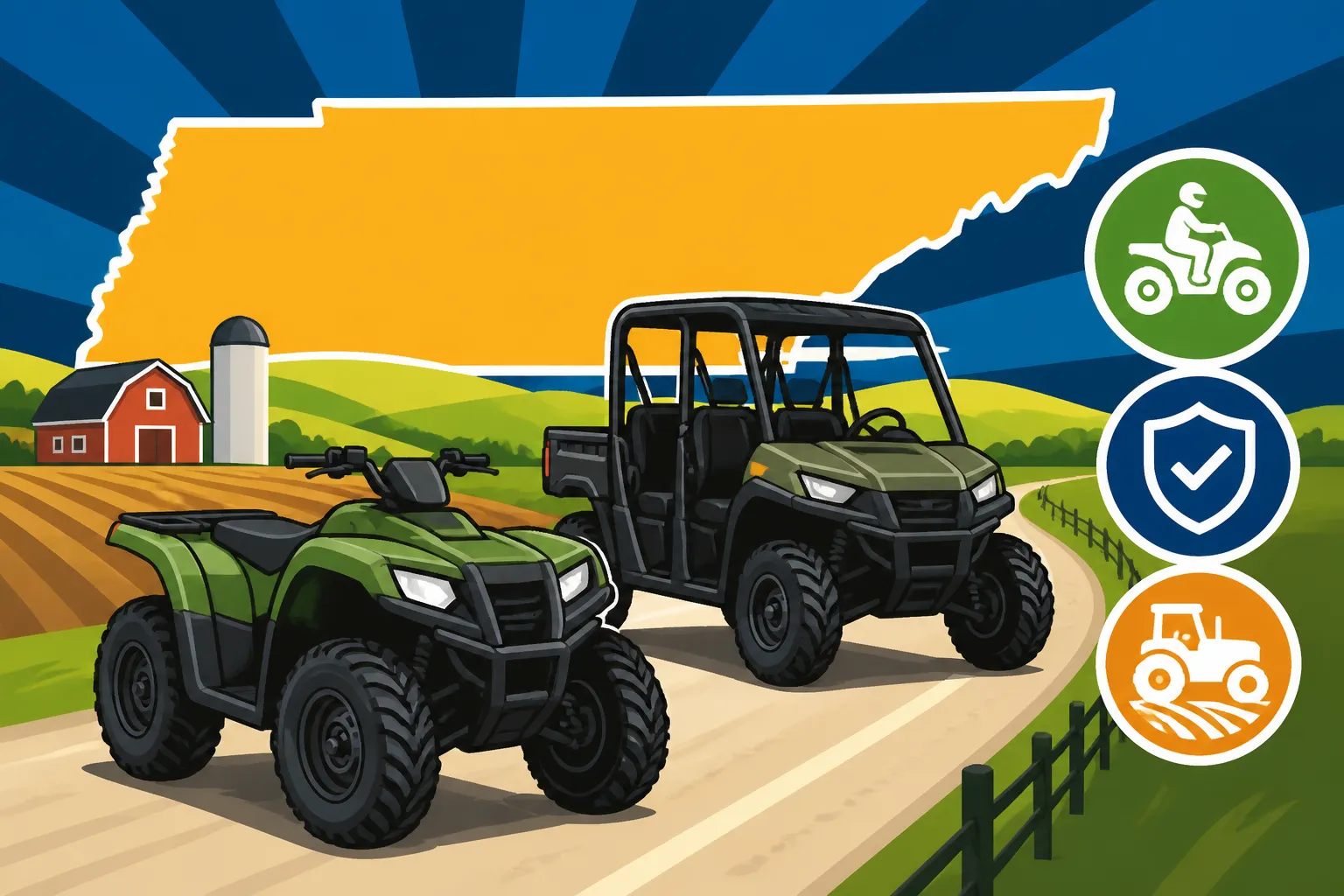
Tennessee recognizes that off-highway vehicles (OHVs) aren't just for recreation; they're workhorses on farms across the state. Because of this, there are specific exemptions and rules that apply when you're using your ATV or UTV strictly for agricultural purposes. It’s not a free pass to ride anywhere, but it certainly offers more flexibility than typical recreational use. This distinction is crucial, as misinterpreting it can lead to fines and headaches.
Defining "Agricultural Use" in the Volunteer State
So, what exactly does "agricultural use" mean in the eyes of Tennessee law when it comes to your ATV or UTV? Generally, it refers to the operation of an OHV on public roads strictly for the purpose of farming, ranching, or other agricultural operations. This isn't just about driving across your own acreage. It extends to necessary travel between fields, to a local feed store, or even to a neighboring property for shared farm tasks, as long as that travel is directly related to the agricultural enterprise. It’s about the purpose of the trip. If you're hauling fencing materials, checking on livestock in a distant pasture, or transporting produce from your garden to a roadside stand, you're likely operating under this exemption. However, if you're taking a scenic drive with your family after the chores are done, even if it's on a country road near your farm, that shifts from agricultural use to recreational, and the rules change dramatically.
Who Qualifies for This Special Status?
The agricultural exemption isn't just for anyone with a patch of land. It's specifically for those engaged in farming, ranching, timber harvesting, or similar operations. This means if you're a full-time farmer, a hobby farmer with genuine agricultural activities, or someone employed to perform farm work, you're the target audience for these rules. It's not designed for the weekend warrior who occasionally helps a friend bale hay. The spirit of the law is to facilitate the essential work of agricultural production. You don't necessarily need a specific permit or registration as an agricultural vehicle, but your activities must genuinely align with what the state considers farming. This also means the machine itself needs to be suitable for agricultural work, often equipped with things like a hitch for trailers, cargo beds, or even specialized implements that are less common on purely recreational machines. Sometimes, folks look to enhance their machines for this kind of work, perhaps with heavy-duty suspension or stronger axles, and companies like SuperATV offer a range of parts designed for just that kind of demanding use.
The Fine Line Between Farm Work and Recreational Riding
This is where many people get tripped up. The agricultural exemption is a narrow lane, not a wide-open highway. If you're using your ATV or UTV to move hay bales from one field to another on a county road, that's agricultural use. If, after dropping off the hay, you decide to take a detour for a quick trail ride through the woods for fun, that portion of your journey no longer falls under the exemption. Suddenly, you're subject to the full suite of [Tennessee Rules for Riding a County Road] or [Tennessee Road Use Rules for ATVs], which are much stricter. The key is intent and direct relation to farm tasks. A good rule of thumb is: if you can't immediately justify the trip as being essential to your farming operation, it's probably recreational. This is why many farmers will have a dedicated work machine and a separate machine for purely recreational riding, or at least be very mindful of when and how they use their multi-purpose vehicles.
Navigating Tennessee Roads with an Ag-Designated OHV
Even when you're legitimately using your OHV for agricultural purposes, there are still rules about where and how you can operate it on public roads. It's not a free-for-all, and understanding these specifics can save you from an unexpected interaction with law enforcement.
What Roads Can You Use, and When?
For legitimate agricultural use, you generally have more leeway than recreational riders. You can often use county roads and, in some cases, even state highways (though with more stringent restrictions) to move between agricultural properties or access necessary services like a mechanic or feed store. However, these movements are typically limited to direct routes and during daylight hours. You're not meant to be cruising through town or using high-traffic thoroughfares if an alternative, less disruptive route is available. The underlying principle is minimal impact and necessity. For instance, if you're moving equipment from your farm in Unicoi County to a leased field just across the county line, you're likely allowed to use the most direct county roads. However, using a major state route like a four-lane highway would typically be frowned upon, or outright prohibited, unless there is absolutely no other way. This is different from the general [Tennessee UTV Road Requirements] which apply to non-agricultural use.
Speed Limits and Right-of-Way Considerations
When operating an OHV for agricultural purposes on a public road, you are still expected to adhere to reasonable speed limits and yield to other traffic. While there might not be a specific "agricultural OHV speed limit," you should travel at a speed that is safe for the conditions and does not impede the flow of traffic more than necessary. Remember, these machines are generally slower than cars and trucks, especially when loaded with tools or produce. You should drive defensively, be aware of faster-moving vehicles, and pull over when safe to allow others to pass if you are holding up traffic. Respecting the right-of-way of other vehicles is paramount for safety and maintaining a good reputation for agricultural OHV users. It's not uncommon for farm equipment, including ATVs and UTVs, to share the road, but safety is always the top priority.
Crossing Highways and State Routes
Sometimes, agricultural operations require you to cross a state highway or even a multi-lane road. Tennessee law does provide some allowance for this, but it’s not an invitation to drive down the highway for miles. Generally, you can cross a two-lane highway at a ninety-degree angle, making the crossing as direct and quick as possible. For multi-lane highways, crossings are often restricted to specific intersections or designated points where safety can be better managed, and these might be determined by the Tennessee Department of Transportation (TDOT). Always ensure maximum visibility and yield to all oncoming traffic before attempting to cross. This is a moment where flashing lights and bright colors are your best friends. It’s a very different scenario from simply riding on a county road, and demands extreme caution.
| Feature | Recreational Road Use (General) | Agricultural Road Use (Exempted) |
|---|---|---|
| Purpose | Leisure, sport, non-essential travel | Directly related to farming, ranching, timber, etc. |
| Roads Typically | Limited to designated roads, often specific districts, or crossing at 90 degrees | County roads, some state highways (direct travel), private access |
| Daylight Only? | Yes | Generally yes, but with some operational allowances for farm work |
| Helmets | Mandatory under 18 on public roads | Exempt for operator/passenger when engaged in farm work |
| License | Mandatory driver's license for public roads | Not explicitly required if solely on private land; implied for public road use |
| Insurance | Required for road use | Required for road use |
| Title/Sticker | Required for machines using public roads (TDR Sticker) | Required for machines using public roads (TDR Sticker) |
| Equipment | Specific lights, horn, mirrors, turn signals, etc. | Basic lighting, SMV sign, possibly less stringent road-specific gear |
Essential Equipment and Safety for Farm-Bound OHVs
Even with agricultural exemptions, safety remains paramount. While some of the typical "street legal" requirements might be relaxed, there are still crucial equipment and safety considerations you need to be aware of when using your OHV for farm work on public roads.
Lighting, Reflectors, and Visibility Needs
You might not need the full suite of turn signals and brake lights required for a street-legal conversion, but you absolutely need to be visible. This means working headlights and taillights, especially if you anticipate needing to operate near dawn or dusk, or even during the day in low-visibility conditions. A Slow Moving Vehicle (SMV) sign displayed prominently on the rear of your ATV or UTV is often a mandatory requirement for any farm equipment traveling on public roads and is a non-negotiable item for safety. Reflectors on the sides and rear are also critical to ensure you're seen by other drivers, particularly from a distance. If you're frequently traveling on roads, you might consider adding auxiliary lighting or extra reflectors for maximum visibility, especially if your machine is typically covered in mud or dust from field work. Aftermarket solutions from brands like SuperATV can provide robust lighting upgrades, like LED light bars, that serve dual purposes: illuminating your work at night and making you more visible on the road.
Helmet and Passenger Rules for Agricultural Use
Here’s a significant difference: Tennessee's helmet law, which mandates helmets for OHV operators and passengers under 18 on public roads, often has an explicit exemption for agricultural use. [Tennessee Helmet Law for ATV Riders] and [Tennessee Helmet Law for Passengers] typically apply to recreational riders. However, if you are operating an OHV for legitimate agricultural purposes, you and your passengers (if the machine is designed for them) may be exempt from the helmet requirement. This doesn't mean safety goes out the window, though. Many farmers still choose to wear helmets, especially when operating on rough terrain or at higher speeds, simply because it’s a smart safety practice. Similarly, while there might be some leniency for carrying passengers who are actively involved in the farm work, always ensure the machine is rated for the number of people and the total weight, and that everyone has a secure place to ride.
Insurance and Other Important Considerations
Regardless of agricultural exemptions, if your OHV touches a public road, even for a short cross, you generally need to have liability insurance. This protects you in case of an accident involving another vehicle or property damage. While [Tennessee UTV Insurance Requirement] typically covers recreational use, it's a good idea to ensure your policy explicitly covers agricultural road use. You should always carry proof of insurance with you. Additionally, even though your OHV isn't fully "registered" like a car, if it's considered an Off-Highway Vehicle (OHV) in Tennessee, you will likely still need to obtain a title and a TDR sticker. This sticker doesn't mean it's street legal for recreational use, but it verifies ownership and acknowledges the machine's existence in the state's system. Knowing [Tennessee TDR Sticker Requirements] and understanding [Titling an OHV in Tennessee] are important steps for all owners, even those primarily engaged in farm work.
Avoiding Missteps: Common Questions and Scenarios
Navigating these exemptions can be tricky, and even experienced farmers sometimes find themselves scratching their heads. Let's look at some common scenarios and questions to help you stay on the right side of the law and avoid unnecessary fines.
What Happens if You Deviate from Farm Use?
Imagine you're done moving equipment, and on your way back, you decide to swing by a friend's house a few miles out of the way just to say hello, or maybe even head to the local store for a snack. At that point, you've deviated from the "agricultural use" purpose. Your brief errand, while seemingly harmless, converts your OHV operation from an exempted agricultural activity to general recreational use on public roads. This means you are now subject to the standard [Tennessee Rules for Riding a County Road] which might require specific equipment like mirrors, turn signals, and potentially stricter helmet laws for all occupants regardless of age. If a deputy stops you, the agricultural exemption won't protect you for that detour, and you could face fines for lacking the necessary street-legal equipment, having underage passengers without helmets, or for simply operating an unregistered OHV on a public road for non-agricultural purposes. The consequence for illegal road use can range from a fine, like [Tennessee's $50 Fine], to a Class C Misdemeanor, depending on the specifics.
Transporting Tools, Crops, and Livestock
One of the primary reasons for using an ATV or UTV for agricultural road use is to transport items vital to the farm. Whether it's a small trailer loaded with fence posts, a cargo bed full of harvested vegetables, or even moving a few chickens from one coop to another, these are classic examples of legitimate agricultural use. When doing so, always ensure your load is secure, properly balanced, and does not exceed the OHV's weight capacity. Overloaded machines are dangerous and difficult to control. Visibility is also key; make sure your cargo doesn't obscure your lights or SMV sign. Many farmers invest in heavy-duty utility racks or trailer hitches, and you can find many robust options from companies like SuperATV that are built to handle the rigors of farm work, ensuring your load stays put.
Distinguishing from Other Special Vehicle Categories
It's important to understand that the agricultural exemption is distinct from other special vehicle categories that Tennessee defines, such as Low Speed Vehicles (LSVs) or Medium Speed Vehicles (MSVs). An LSV, for example, is often a golf cart-like vehicle that can be driven on roads with speed limits up to 35 mph, but it has to meet specific federal safety standards, including seatbelts, headlights, tail lights, stop lights, turn signals, and a windshield. An MSV is a bit more robust, with different speed limits and requirements. Your ATV or UTV, even if used for agriculture, does not automatically become an LSV or MSV. It remains an OHV, operating under its own set of rules and exemptions. Trying to pass off an agricultural UTV as an LSV to go to the grocery store would be a misinterpretation of the law and could lead to problems. Always remember [Tennessee's Four Vehicle Categories] and ensure you're operating your machine according to its correct classification.
Disclaimer
This article is for general informational purposes only and does not constitute professional advice. Laws, prices and regulations vary by location and change over time. Consult a qualified professional for guidance on your specific situation.