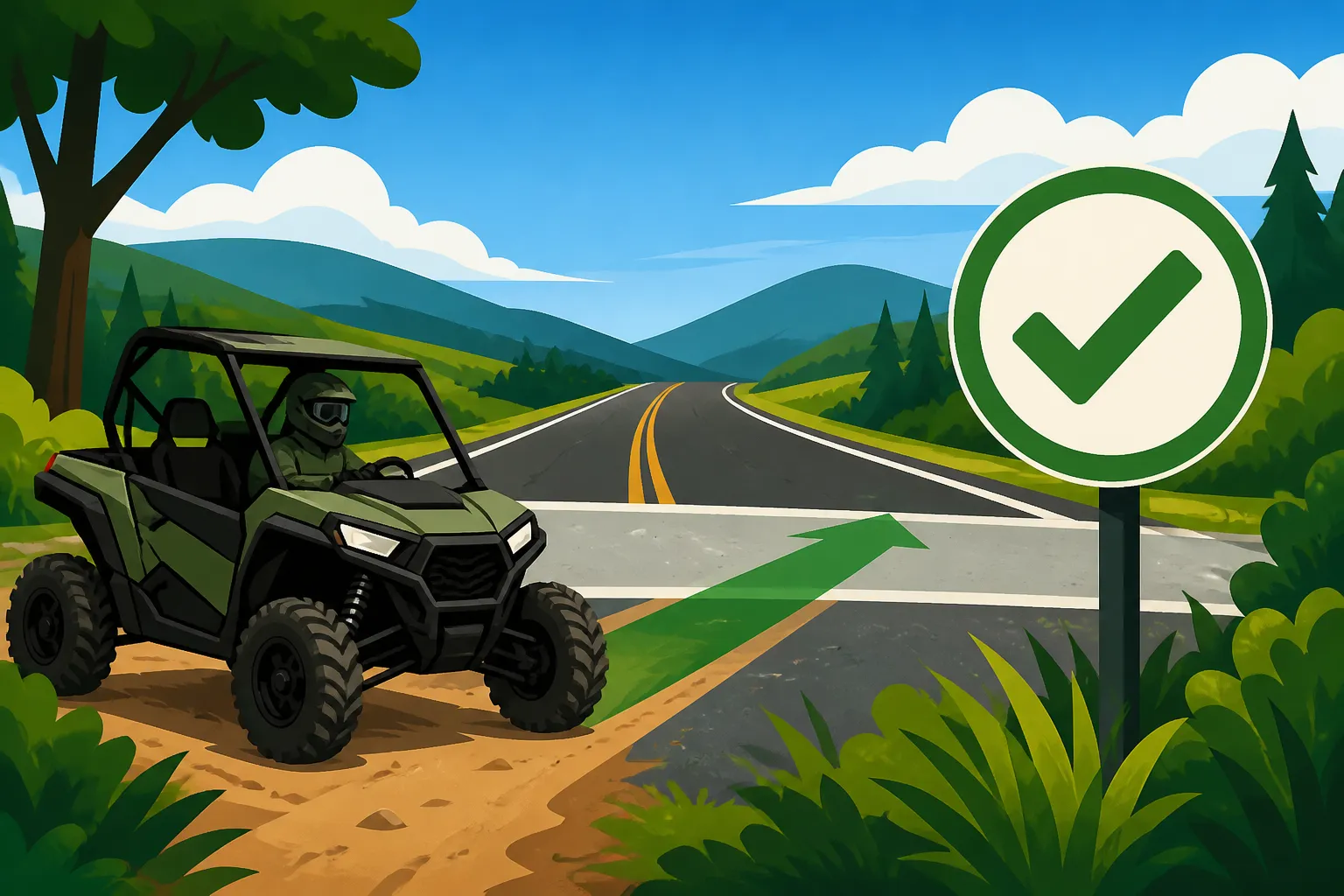
Crossing Where TDOT Says You May
It can feel incredibly frustrating when you're out enjoying the beautiful Tennessee wilderness on your ATV or UTV, only to hit a paved road and wonder, "Can I even cross this, or am I breaking the law?" Tennessee's rules about getting off-highway vehicles (OHVs) across public roads can be a real head-scratcher, especially when it comes to state routes maintained by the Tennessee Department of Transportation (TDOT). This guide is here to help you unravel the mystery, clarifying where and how you might be able to cross these roads legally and safely.
Understanding Tennessee's Road-Use Landscape for OHVs
Let's be honest, navigating the rules for ATVs and UTVs on Tennessee roads can feel like trying to solve a puzzle with half the pieces missing. Many riders come from states with different regulations, leading to a lot of confusion and, unfortunately, sometimes unintentional violations.
The General Rule: No Unrestricted Road Use
First and foremost, it's crucial to understand that Tennessee generally doesn't allow ATVs and UTVs unrestricted access to public roads. These machines are designed and manufactured for off-highway use – think dirt trails, gravel paths, and rugged terrain. The state's primary stance is that public paved roads are for cars, trucks, and other traditional motor vehicles, not for the roaring fun of your side-by-side. This can be a tough pill to swallow, especially when you see riders in other states seemingly cruising down main streets. You might feel like Tennessee is holding out on the fun, but these laws are in place for safety, both for OHV riders and other motorists. While the laws have evolved, especially with recent changes, the fundamental principle remains: your OHV is largely an off-road machine in Tennessee.
The Critical Distinction: Crossing vs. Riding
This is where a lot of the confusion really sets in. Many riders mistakenly believe that if they can cross a road, they can also ride on it for a short distance, perhaps to get to another trail. Let me tell you, this is a dangerous assumption, both legally and physically. In Tennessee, there's a world of difference between legally crossing a paved road and riding on it. Crossing typically implies a direct, perpendicular movement from one side to the other, often at a designated point or a specific intersection. It's about minimizing the time your OHV spends in vehicular traffic. Riding on the road, even for a few hundred feet, is usually prohibited unless explicitly allowed by specific local ordinances or state statutes for designated areas. The fines and safety risks associated with blurring this line are significant. If you're on a public road in Tennessee, unless it's a very specific, locally designated route, you're almost certainly breaking the law if you're not crossing directly.
The Role of TDOT in OHV Road Crossings
When we talk about state roads, the Tennessee Department of Transportation (TDOT) enters the picture. Their role is pivotal, especially when you're trying to navigate from one amazing trail system to another that happens to be bisected by a major state highway.
TDOT's Authority Over State Highways
TDOT is the agency responsible for maintaining and regulating Tennessee's state routes and highways. These are the major arteries that connect our towns and cities, often with higher speed limits and greater traffic volumes than your typical county road. Because of this, TDOT's involvement in regulating any OHV activity on these roads is taken very seriously. Unlike county roads, where local commissions might have more flexibility in creating ordinances for OHV use, state highways fall under a more stringent, statewide purview. This means that if you're trying to cross a state route, you're looking at a different set of considerations than if you were just crossing a quiet, two-lane county road. The state's emphasis is on ensuring the safe and efficient flow of traffic, and introducing OHVs into that mix requires careful thought and, often, explicit allowance.
Identifying Designated TDOT Crossing Points
Now for the million-dollar question: how do you know where "TDOT says you may" cross? This isn't always as clear-cut as finding a big, green sign that says "OHV Crossing Here." In many cases, TDOT's allowance for crossing state routes is implied rather than explicitly marked everywhere. These designated crossing points often coincide with areas where major off-road trail systems meet state highways, or at well-defined intersections that connect two county roads bisected by a state route.
It's a frustrating reality for riders: there isn't a comprehensive, easily accessible map or list published by TDOT specifically outlining every single OHV crossing point on state highways. What you're often looking for are intersections where it makes logical sense for trails or designated county OHV roads to meet a state highway. Sometimes, the allowance is part of a broader agreement with a park or a land management agency. For example, within an Adventure Tourism District, you might find more flexibility, but even then, specific state highways might remain off-limits or have very limited crossing zones.
The best way to determine if a crossing is permitted is to:
- Check with the specific trail system you are visiting: Many major parks like Windrock Park or Brimstone Recreation will have information regarding how to legally access or cross state roads in their vicinity.
- Look for local signage: While rare on the open highway, some specific, sanctioned crossing points might have limited signage.
- Consult local county clerk offices or sheriff's departments: For particularly ambiguous areas, they might be able to offer guidance, especially if a county road that does allow OHV use needs to cross a state route.
Remember, when you're dealing with a multi-lane state highway, [Crossing a Multi-Lane Where TDOT Designates] is not an open invitation to ride the shoulder. It's a precise maneuver meant to get you from one side to the other as quickly and safely as possible, minimizing your interaction with high-speed traffic. If you're unsure, it's always safer to assume it's not allowed than to risk a citation or, worse, an accident.
Practicalities and Safety for TDOT-Designated Crossings
Alright, so you've done your homework and believe you've identified a spot where TDOT allows you to cross a state route. Great! But the job isn't done. Safe and legal crossing involves more than just knowing where you can do it; it's also about how you do it.
Preparing for a TDOT-Approved Crossing
Safety should be your absolute top priority. Even if you're only on the pavement for a matter of seconds, you're sharing that space with vehicles traveling at much higher speeds. Think about what you'd do if you were merging onto a busy interstate – the same level of vigilance applies here.
- Visibility is Key: Ensure your OHV is as visible as possible. This means working headlights, taillights, and ideally, a bright flag. Wearing brightly colored gear, like a high-visibility vest, can also make a huge difference. While custom parts from a company like SuperATV can make your rig look awesome and perform great on the trails, they don't always come with the necessary road safety equipment built-in, so double-check your setup.
- Approach with Caution: Always slow down significantly as you approach a crossing point. Scan for traffic in both directions, just as you would at any intersection. Never assume that oncoming traffic sees you or will yield.
- Check Local Rules: Even if TDOT greenlights a crossing, the county or local municipality on either side might have specific rules for the connecting roads leading up to or away from that crossing. Make sure you're compliant with those as well. Being surprised by a local ordinance just after a state highway crossing can quickly sour your day.
What to Do (and Not Do) at a Crossing
Once you're at the designated crossing point, execute the maneuver with precision and care. This isn't the time for sightseeing or casual rolling.
- Direct, Perpendicular Crossing: The golden rule for any OHV road crossing in Tennessee is to cross as directly and perpendicularly as possible. Think of it as making a ninety-degree turn across the lanes of traffic. [Crossing a Two-Lane at a Right Angle] is the model here – it minimizes your time in the travel lanes. Do not ride along the shoulder, even for a few feet, before turning across. Do not meander. Get across and off the pavement promptly.
- Yield to All Traffic: You are essentially an unexpected vehicle in the flow of traffic. You must yield to all other vehicles on the highway. Wait for a clear, safe gap in traffic before initiating your crossing. Never pull out in front of an oncoming vehicle, no matter how far away they seem.
- No Lingering: Once you've crossed, get your machine completely off the paved surface and onto the connecting trail or dirt road. Do not idle on the shoulder, adjust your gear, or chat with your buddies while still on the asphalt. The goal is to be on the state highway for the absolute minimum time required to safely traverse it. Deviating from this direct, perpendicular, no-lingering approach can easily lead to a citation for illegal road use, regardless of whether the crossing itself was technically allowed.
Common Misconceptions and Local Variances
The rules can feel like they're constantly shifting, especially when you factor in local control and ongoing legislative changes. It's easy to get caught up in rumors or misunderstandings, so let's clear up a few points.
The Difference Between State and County Roads
This is a critical distinction that trips up many riders. As we've discussed, TDOT holds sway over state highways. But county roads? Those are a different beast entirely. Each of Tennessee's 95 counties has the authority to create its own ordinances regarding OHV use on its county-maintained roads. This is why you'll find such a patchwork of rules across the state. One county might open all its unpaved roads to OHVs, while the very next county over might prohibit all OHV use on any county road.
This means that even if you legally cross a TDOT-designated state highway, you still need to know the rules for the county road you're entering or exiting. Don't assume that because you've successfully crossed a state road, the connecting county road is fair game. Always research the local county ordinances for your specific riding area. Understanding [Tennessee Rules for Riding a County Road] is just as important as knowing the state highway rules.
Why Local Ordinances Still Matter
Even with state laws governing certain aspects of OHV use, local ordinances can still impose additional restrictions or provide specific allowances that are crucial to your ride. For instance, the creation of "Adventure Tourism Districts" in certain counties (like Scott, Anderson, Campbell, Morgan, and others) has granted these areas more flexibility to open county roads to OHVs. This was largely facilitated by [What House Bill 810 Changed in 2025], which provided a framework for these counties to designate roads.
However, even within these districts, there are often designated routes and specific rules about speed limits, times of day, and equipment requirements. A designated TDOT crossing might lead you right into a town or a specific stretch of county road that has its own unique regulations. It's a lot to keep track of, and it certainly contributes to rider frustration. Many riders find themselves constantly checking county websites or calling local sheriff's offices to ensure they aren't inadvertently breaking a rule.
The Limits of "Common Sense" on Tennessee Roads
It's natural to think, "If it feels safe and nobody's around, it's probably fine." But when it comes to legal road use for OHVs in Tennessee, "common sense" can unfortunately lead you astray. The laws are often rigid and don't always align with what feels intuitive or what you might observe other riders doing (who may or may not be riding legally themselves).
Just because a path seems like a logical shortcut across a road, or because a state highway appears quiet, doesn't mean it's a legal crossing point. Relying on anecdotal evidence or simply following another rider can land you in legal trouble. Remember, law enforcement officers are tasked with enforcing the letter of the law, not necessarily what feels like common sense on the ground. When it comes to outfitting your machine for rugged trails, companies like SuperATV provide fantastic products, but always remember that their expertise is in performance and durability, not in the intricacies of Tennessee's ever-evolving road-use laws. Always verify the legalities through official channels.
Comparing State vs. County Road Rules for OHV Crossings
To help clarify the distinctions, here's a brief comparison of how state and county roads generally handle OHV crossings in Tennessee:
| Feature | State Highways (TDOT Authority) | County Roads (Local Authority) |
|---|---|---|
| Primary Authority | Tennessee Department of Transportation (TDOT) | County Commission/Government for each individual county |
| General Road Use | Generally prohibited, with very few exceptions. | Varies wildly by county; some allow limited use, many prohibit. |
| Crossing Designations | Often implied at logical intersections; sometimes part of broader park agreements. Explicit signage rare. | Designated by local ordinance; may or may not have signage. More flexibility to create. |
| Maneuver Required | Strictly direct, perpendicular crossing. No riding along shoulder. | Typically direct, perpendicular crossing, unless local ordinance specifies otherwise. |
| Traffic Volume | Generally higher speeds and traffic volumes. | Varies from busy main roads to quiet, unpaved lanes. |
| Information Source | Trail park resources, local law enforcement for specific points. | County clerk, county sheriff, local government websites. |
Disclaimer
This article is for general informational purposes only and does not constitute professional advice. Laws, prices and regulations vary by location and change over time. Consult a qualified professional for guidance on your specific situation.