Where a County Road Meets a State Route
The moment you pull your UTV or ATV off a gnarly trail, the question of hitting the pavement often pops up. It’s one thing to navigate a vast, open riding park, but an entirely different beast when that dirt path suddenly spits you out onto a county road, only to find a state highway just ahead. The confusion about where your machine can and can't go, especially at these critical intersections, is a real headache for many Tennessee riders. This guide is here to clear up that confusion, helping you understand the rules for where a county road meets a state route in our beautiful state.
Understanding Tennessee's UTV Road Use Landscape
For years, the idea of legally riding your UTV or ATV on public roads in Tennessee felt like a distant dream for many. The laws were incredibly strict, often confining these machines solely to private land or designated off-road parks. However, the winds of change have definitely blown through the Volunteer State, bringing with them new possibilities and, let's be honest, a fresh layer of complexity.
The Evolution of Tennessee's UTV Road Laws
Historically, Tennessee's stance on ATVs and UTVs on public roads was largely prohibitive. Unless you were using your machine for agricultural purposes, an emergency, or on a private road, you were generally out of luck. This led to a lot of frustration for riders who simply wanted to get from one trail to another, or even run a quick errand in a small town. The biggest game-changer arrived recently with [What House Bill 810 Changed in 2025], which significantly expanded the permissible use of UTVs on certain public roads. This legislation recognized the growing popularity of side-by-sides and the economic impact of off-road tourism, paving the way for a more rider-friendly environment, albeit with very specific conditions. It wasn't a free-for-all, but a carefully carved-out path.
The Core Principle: Designated Roads Only
Despite the more relaxed laws, it’s crucial to understand that Tennessee doesn't have a blanket "street legal" rule for UTVs. The fundamental principle remains: you can only ride your UTV on roads that have been specifically designated for such use by the local county or state authority, or under very limited circumstances for crossing state routes. This means you can’t just assume every rural road is open season. You have to do your homework. Some counties have enthusiastically embraced the new laws, opening up many miles of roads, while others remain more cautious. This patchwork of rules is precisely why navigating a junction where a county road meets a state route can feel like a legal minefield. It’s not just about your machine; it's about the specific stretch of asphalt you're on at any given moment.
Key Vehicle Categories and Road Use
While this discussion primarily focuses on UTVs due to their expanded road access, it's worth a quick reminder about [Tennessee's Four Vehicle Categories] for off-highway vehicles. UTVs often fall under [Tennessee's Class I OHV Definition] if they are under 2,500 pounds and 80 inches wide, and designed for four passengers or less. Larger machines or those with different configurations might be [Tennessee's Class II OHV Definition]. The specific classification can sometimes impact equipment requirements or even local ordinance interpretations, though the general road-use rules for designated roads typically apply broadly to both classes when permitted. Always know your machine's classification to ensure you're in compliance.
Navigating County Roads: The Rules and Regulations
When you're out riding, county roads often feel like the most accessible arteries for your UTV. They connect trail systems, link small communities, and generally offer a less intense riding experience than busier state highways. However, "county road" isn't a universally open invitation. There are distinct rules and local decisions that dictate where and how you can ride.
Local Authority and Permitted Roads
The power to open county roads to UTV traffic largely rests with the individual counties. Under Tennessee law, county legislative bodies, typically the county commission, can pass ordinances to allow UTVs on certain county-maintained roads. This means that one county might have a vast network of open roads, while its neighbor might have none, or only a very limited selection. [Tennessee Counties That Allow UTVs on Roads] are those that have taken the necessary steps to review the law and enact their own local ordinances. This process often involves public hearings, safety assessments, and careful consideration of local traffic patterns and community needs. It's not a quick decision, and the exact roads permitted can vary wildly. For instance, you might find that all unpaved county roads are open, or perhaps only roads within a certain speed limit.
Knowing which county you're in and checking their specific regulations is paramount. Websites for county clerks or local law enforcement agencies are often good starting points, or you can call the county commission office. Sometimes, you'll even see signage indicating designated UTV routes. Outfitters like SuperATV often offer accessories like GPS units or trail mapping apps that can be invaluable for understanding the legal routes as you explore different areas.
Specific County Ordinances: What to Look For
When a county decides to open its roads, it doesn't usually mean every single county road is fair game. They typically designate specific roads or types of roads. This could include:
- Roads Posted Forty-Five or Less in Tennessee: Many ordinances will restrict UTV use to roads with a posted speed limit of 45 mph or less. This is a common safety measure to keep UTVs off faster, higher-traffic routes.
- Daylight Hours Only Under Tennessee Law: Most counties will limit UTV road use to between sunrise and sunset. Riding at night usually requires additional lighting that might not be standard on your machine, plus it generally increases safety risks.
- Unpaved Roads: Some counties might only open their unpaved or gravel roads, preserving paved roads for traditional vehicle traffic. This is particularly common in areas with extensive forestry or mining roads.
- Designated Road Lists: In many cases, counties will publish an explicit list of roads that are open or restricted. This list is your bible for that specific county. [Finding the Restricted Road List Your County Published] is a crucial step before you even put a wheel on the pavement. These lists can sometimes be found on county websites or at the county clerk's office.
For example, [LaFollette's Designated Roads Since 2017] might look very different from the open roads in an unincorporated area of Scott County. These local nuances highlight why generalized advice about road use can be misleading; you need to know the specific rules for your immediate area.
Equipment Requirements for County Roads
Even on a legally designated county road, your UTV needs to meet certain minimum equipment standards to ensure safety and compliance. These requirements are generally consistent across the state for any road use:
- Headlights and Taillights: Functional headlights and taillights are non-negotiable, especially if you're riding near dawn or dusk, even if the ordinance specifies daylight hours. Your stock lighting might be perfectly adequate, but many riders upgrade with brighter LED bars from companies like SuperATV for better visibility both for themselves and to other drivers.
- Brake Lights: Essential for signaling your deceleration to vehicles behind you.
- Turn Signals: While not always explicitly required by every county ordinance, they are a wise addition for safety and clearer communication on any public road.
- Horn: A working horn is necessary to alert others.
- Rearview Mirrors: At least one functional rearview mirror is typically required. Again, SuperATV offers a variety of mirrors, including those that attach to your roll cage, to ensure you have good visibility behind you.
- Windshield: A windshield isn't always mandated, but it's a very good idea for protection from debris and bugs. If you do have one, ensure it's made of safety glass or an equivalent shatter-resistant material.
- Seat Belts: Your UTV must have seatbelts for all occupants, and they must be worn.
- Driver's License: The operator must possess a valid driver's license. [Tennessee Driver's License Rules for UTVs] clearly state that you can't just hop on with a learner's permit.
- Insurance: You need proof of financial responsibility, typically in the form of liability insurance. [Tennessee UTV Insurance Requirement] applies to all road use.
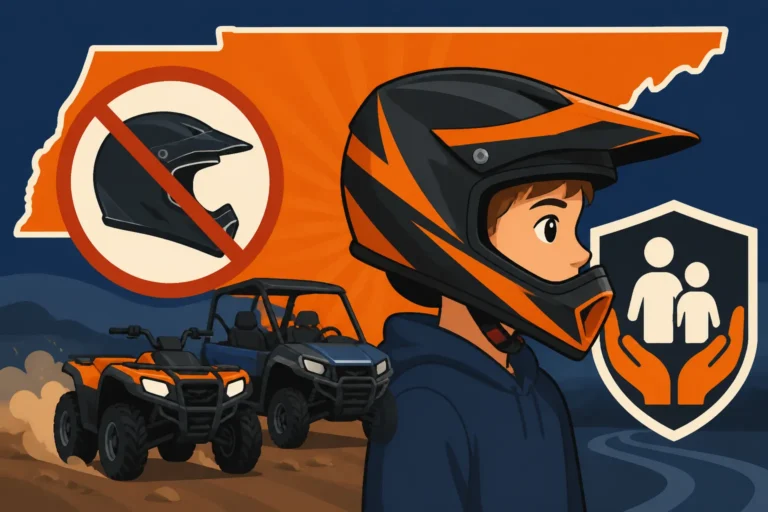
- Helmets: While the [Tennessee Helmet Law Off-Road] might vary, for any public road use, Tennessee law generally requires helmets for operators and passengers under 18 years of age. Some exceptions exist for farm use, but for recreational road use, it's best to err on the side of caution. [Tennessee Helmet Law for ATV Riders] also applies to UTVs on public roads.
Always double-check the specific county ordinance, as they might add additional requirements beyond the state minimums.
State Routes and Highways: What's Allowed and What's Not
Moving from a county road to a state route in Tennessee is where the rules get significantly tighter and require a lot more caution. State routes, often identified by route numbers (like SR 63 or US 27), fall under the jurisdiction of the Tennessee Department of Transportation (TDOT) and have different rules than locally maintained county roads.
General Restrictions on State Routes
For the most part, UTVs are not permitted to be operated on state highways. This is a critical distinction from county roads. Simply put, don't plan on taking a long cruise down a major state route on your UTV. [Tennessee Rules for Riding a State Highway] are generally very restrictive, and for good reason: these roads are designed for faster, heavier traffic, and UTVs, by their nature, are typically slower and less protected. The fines for illegal road use can be substantial, often involving a [Tennessee's $50 Fine] and even a [A Class C Misdemeanor in Tennessee] in some cases. It's a risk not worth taking.
The "Crossing" Exception: A Crucial Distinction
This is where the title of our article really comes into play. While you generally cannot ride on a state route, Tennessee law does provide a very specific exception for crossing one. This is absolutely vital when a legally open county road suddenly dead-ends or intersects with a state highway. The law states that a UTV can cross a highway with two or fewer lanes, or a multi-lane highway only at an intersection where a traffic signal is present, and only if the crossing is done at a right angle (ninety degrees) to the flow of traffic.
Let's break that down:
- Two-Lane Highways: If you're on a designated county road and need to get to another designated county road on the other side of a two-lane state route, you can [Crossing a Two-Lane at Ninety Degrees in Tennessee]. You must proceed directly across at a right angle, essentially making the shortest path possible, and, of course, yielding to all traffic. You cannot drive down the state route, even for a short distance.
- Multi-Lane Highways: Crossing a multi-lane state highway is even more restrictive. It's only permitted [Crossing a Multi-Lane Where TDOT Designates] and where a traffic signal (stop light) is present. Again, the crossing must be at a ninety-degree angle. This means you can't just cross a four-lane highway at an unmarked rural intersection, even if traffic is clear. TDOT has to have specifically designed that intersection for such a crossing. This is a very important safety measure.
Always approach these crossings with extreme caution, and make sure your UTV is highly visible. Bright colors, flags, and good lighting from SuperATV can help.
The "Adventure Tourism District" Nuance
Tennessee has a unique provision for certain counties designated as "Adventure Tourism Districts." These districts, typically found in mountainous areas popular for off-road recreation, have slightly different rules regarding state routes. [Tennessee's Adventure Tourism Districts] include counties like [Scott, Anderson and Campbell Counties], along with Morgan, Jackson, Johnson, Perry, Unicoi, Fentress, and Hickman Counties.
Within these specific counties, the local county legislative body can designate certain state routes (or portions thereof) for UTV use, provided the Tennessee Department of Transportation (TDOT) agrees and the speed limit is 45 mph or less. This is a powerful exception, allowing for connections between trail systems that might otherwise be cut off by a state route. [Why an Adventure Tourism District Matters] is that it enables a more integrated trail and road network.
However, even within these districts, there are usually specific restrictions:
- Designated Only: Only state routes explicitly approved by both the county and TDOT are open. These are usually limited access roads or those with very low traffic volumes.
- Specific Hours: Use might still be limited to daylight hours.
- Seasonal Restrictions: Some roads, like [SR 63's Two Open Weekends a Year] in Scott County, are only open for UTVs on specific dates or for special events. This is why you need to check current advisories.
- Speed Limits: UTVs on these state-designated roads are generally restricted to a [Tennessee's 45 mph Road Rule].
So, while adventure tourism districts offer more flexibility, they still demand vigilance and adherence to precise local and state rules. Don't assume that just because you're in an Adventure Tourism District, all state roads are open. They're not.
Practical Considerations for Intersections
Navigating the point where a county road meets a state route isn't just about knowing the law; it's about practical safety and preparation. These junctions can be dynamic and demand your full attention.
Identifying Road Types on the Fly
One of the biggest challenges for riders is knowing whether they are on a county road, a state route, or even a city street. Here are some tips:
- Road Signs: State routes are typically marked with black-on-white shield signs (for US routes) or black-on-white rectangular signs (for Tennessee state routes) with the route number. County roads generally don't have these distinct markings, often just a simple street name sign.
- Road Maintenance: State routes are usually well-maintained, often wider, and have clear lane markings. County roads, especially in rural areas, can range from freshly paved to gravel, and may have less clear signage or markings.
- Maps and GPS: Before you head out, study a detailed map or use a GPS app that differentiates between road types. Some off-road specific mapping apps are incredibly helpful for this, showing designated UTV routes versus prohibited roads.
- Local Knowledge: If you're in an unfamiliar area, asking locals or checking online forums specific to that riding spot can provide invaluable real-time information.
Knowing [Where a County Road Meets a State Route] before you even get there allows you to plan your route and avoid illegal sections.
Safety Protocols at Junctions
When you approach an intersection where a county road meets a state route, especially if you intend to cross the state route, safety is paramount.
- Slow Down and Be Alert: Reduce your speed significantly as you approach any intersection. State routes often carry faster-moving traffic.
- Look Both Ways, Multiple Times: Traffic on state routes can approach quickly. Take extra time to scan for oncoming vehicles, both cars and trucks. Don't assume others see you.
- Signal Clearly: If your UTV has turn signals, use them. If not, use clear hand signals to indicate your intentions well in advance.
- Choose Your Moment: For crossings, wait until there is a significant gap in traffic. Do not try to rush across. It's better to wait a few extra minutes than to take an unnecessary risk.
- Maintain a Straight Path: If crossing, stick to the ninety-degree rule. Do not attempt to turn onto the state route, even for a split second, unless it is specifically designated for UTV travel in an Adventure Tourism District, and you are absolutely certain of the current regulations.
- Visibility Enhancements: Consider adding aftermarket lights, reflective tape, or a safety flag to your UTV, especially if you ride in areas with mixed traffic. Companies like SuperATV offer a wide range of lighting and safety accessories that can significantly improve your visibility to other drivers on public roads.
Carrying Necessary Documentation
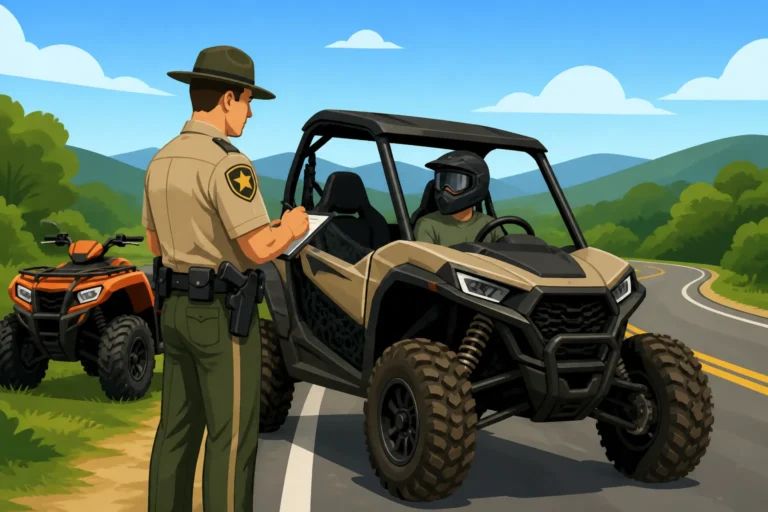
When you're operating your UTV on any public road, even briefly at an intersection, you need to be prepared for a potential interaction with law enforcement. Always carry the following:
- Your Driver's License: As mentioned, this is non-negotiable for road use.
- Proof of Insurance: Keep your [Tennessee UTV Insurance Requirement] card handy.
- Title or Registration Documentation: While Tennessee does not register OHVs for road use in the traditional sense, having your [Titling an OHV in Tennessee] paperwork, which typically includes the [What the TDR Sticker on Your Title Means], can prove ownership and legitimacy. Some counties might want to see it.
- Permit (if applicable): If you're riding in a specific area that requires a permit (like within an Adventure Tourism District or a park that leases road access), have that permit readily available.
Being organized and prepared with your paperwork can make any roadside stop much smoother.
Here's a quick reference table for navigating road types at intersections:
| Road Type You're On | Road Type You're Approaching | Action Allowed | Key Restrictions / Considerations |
|---|---|---|---|
| Designated County Rd | Designated County Rd | Full travel allowed (if compliant with local ordinance). | Must meet county-specific equipment & safety rules. Check local speed limits & hours of operation. |
| Designated County Rd | Two-Lane State Route | You may cross the state route at a ninety-degree angle to get to another designated county road on the other side. | No riding on the state route. Cross only when safe and traffic is clear. Yield to all vehicles. |
| Designated County Rd | Multi-Lane State Route | You may cross the state route at a ninety-degree angle only at an intersection with a traffic signal to get to another designated county road on the other side. | No riding on the state route. Crossing only permitted at signalized intersections and where TDOT allows. Extremely cautious, yield to all vehicles. |
| Designated County Rd | State Route (Adventure Tourism District) | You may ride on specifically designated state routes within Adventure Tourism Districts, but only if that specific section of road has been opened by both the county and TDOT. You may also cross as per the two-lane/multi-lane rules above. | Check specific local ordinances and TDOT designations carefully. Speed limit usually 45 mph or less. May have seasonal or time-of-day restrictions. [Finding the Restricted Road List Your County Published] is essential here. |
| Any Road | Interstate Highway | Never allowed. [Why Tennessee Bars Interstates] applies to all OHVs. | Interstates are strictly prohibited. |
The key takeaway is that Tennessee is becoming more accommodating for UTV riders on certain public roads, but it’s a privilege with strict rules. Understanding where a county road meets a state route, and what you're legally allowed to do at that junction, is crucial for safe and lawful riding. Always prioritize safety, check local ordinances, and ensure your machine is properly equipped.
Disclaimer
This article is for general informational purposes only and does not constitute professional advice. Laws, prices and regulations vary by location and change over time. Consult a qualified professional for guidance on your specific situation.