What Tennessee’s 2025 UTV Law Changed
For years, navigating the maze of UTV road legality in Tennessee felt like a wild goose chase. One county might say yes, the next a hard no, and everywhere in between, you were left guessing. It was a constant headache for riders who just wanted to enjoy their machines responsibly. This guide is here to finally cut through that confusion, breaking down exactly what Tennessee's 2025 UTV law changed and what it means for you when you want to take your side-by-side or ATV onto public roads.
The Murky Waters Before 2025: A Patchwork of Rules
Before the much-anticipated 2025 UTV law took effect, riding your side-by-side or ATV on Tennessee roads was, to put it mildly, a logistical nightmare. It wasn't just a challenge; it was an exercise in frustration that many enthusiasts simply gave up on. You might drive from one county into the next, crossing an invisible line, and suddenly find yourself in violation of rules you didn't even know existed. This inconsistent legal landscape led to a lot of anxiety and confusion for riders, often making them question if it was even worth the effort to try and be "street legal."
County-by-County Confusion
Imagine planning a weekend ride with friends, excited to explore a new part of the state, only to spend hours researching county ordinances. One county might have designated specific roads, another might have a blanket ban, and a third might not even have a clear policy on the books. This meant that what was perfectly legal in, say, Anderson County, could get you a hefty fine just a few miles down the road in Morgan County. There was no single, cohesive statewide standard, leaving riders to navigate a literal patchwork quilt of local laws. It was enough to make anyone throw their hands up in exasperation, wondering why a simple pleasure had to be so complicated.
This lack of uniformity wasn't just inconvenient; it created significant risk. Without clear guidelines, riders were often unknowingly breaking the law, leading to citations, impounded vehicles, and a general distrust of the system. Trying to figure out where you could and couldn't ride felt like a game of chance, and the stakes were too high for most to play. Many riders simply confined their machines to private land or dedicated parks, missing out on the opportunity to connect trails or access amenities by road.
Ambiguous Interpretations and Enforcement
Adding to the frustration was the ambiguity in how the existing, often sparse, laws were interpreted and enforced. A local deputy might interpret a rule differently than a state trooper, or even differently from an officer in a neighboring jurisdiction. This inconsistent enforcement meant that even if you thought you were doing everything right, you could still be stopped and questioned, leading to delays and potential legal trouble. There was no single source of truth, no definitive "rulebook" that every law enforcement officer could reference, making compliance a moving target.
This ambiguity often put both riders and law enforcement in a difficult position. Officers might not have been fully trained on the nuances of UTV laws, especially when they varied so wildly from one area to another. Riders, on the other hand, often felt unfairly targeted because the rules weren't clear to begin with. It wasn't uncommon to hear stories of riders being pulled over for something that was explicitly permitted in another part of the state, highlighting the urgent need for a more standardized approach. It became clear that for the safety and enjoyment of all, a legislative overhaul was not just desired, but essential.
House Bill 810: The Game Changer for Tennessee UTVs
The introduction and passage of House Bill 810 marked a pivotal moment for UTV and ATV owners across Tennessee. This wasn't just a minor tweak to existing regulations; it was a comprehensive legislative effort designed to bring clarity, consistency, and expanded opportunities for responsible road use of these machines. For years, the rallying cry from the off-road community had been for a statewide standard, and HB 810 finally delivered on that promise, fundamentally reshaping the legal landscape. It essentially said goodbye to the days of guessing and welcomed a new era of defined parameters.
Establishing a Statewide Framework
The core achievement of House Bill 810 was the creation of a uniform, statewide legal framework for UTVs and ATVs on public roads. This means that instead of a scattered assortment of county-specific rules, there's now a baseline set of regulations that applies across all of Tennessee. This new approach aims to eliminate the geographical lottery that riders previously faced, ensuring that the rules of the road are consistent whether you're riding in the mountains of East Tennessee or the farmlands of West Tennessee. It's a significant step towards simplifying compliance and encouraging more riders to experience what the state has to offer.
This statewide framework provides much-needed peace of mind. Riders no longer have to worry about unknowingly violating a local ordinance simply by crossing a county line. The law sets clear expectations for vehicle equipment, operator requirements, and general road use, allowing enthusiasts to plan their trips with confidence. This uniformity is a huge win for the off-road community, fostering a more predictable and enjoyable riding environment. Now, whether you're passing through a small town or cruising on a rural route, you'll know what's expected of you and your machine.
Defining "Street Legal" for UTVs
Perhaps one of the most impactful changes brought by HB 810 is its clear definition of what constitutes a "street legal" UTV in Tennessee. Before this law, the term was loosely applied and often subject to local interpretation, leading to endless debates and uncertainty. Now, the legislation spells out specific requirements that a UTV must meet to be considered eligible for road use, effectively standardizing the criteria across the state. This clarity is crucial for owners looking to equip their machines properly and for law enforcement tasked with verifying compliance. You can find many of the parts you might need to convert your machine at a place like SuperATV.
This new definition includes mandated safety equipment, such as headlights, taillights, brake lights, turn signals, rearview mirrors, a windshield, and a horn. It also addresses specific performance and dimensional requirements, ensuring that machines on public roads are capable of operating safely alongside other vehicles. By clearly outlining these prerequisites, the law empowers owners to make the necessary modifications with confidence, knowing they are meeting a consistent, statewide standard. This removes much of the guesswork and provides a clear roadmap for anyone aiming to make their UTV road-ready, allowing them to ride with confidence that their machine meets the updated requirements for [Tennessee Equipment Rules for Road Use].
Statewide Road Use Rules Under the New Law
With the passage of House Bill 810, Tennessee has ushered in a new era of standardized road use rules for UTVs and ATVs, replacing the old, confusing patchwork system. This is a massive relief for riders who were constantly in limbo, unsure of where they could legally operate their machines. The new law provides a foundational set of regulations that apply across the state, making it far easier to understand what's permissible and what's not. It's all about making riding more predictable and, ultimately, more enjoyable for everyone.
Roads Posted 45 mph or Less
One of the most significant changes is the statewide rule permitting UTVs on roads with a posted speed limit of 45 mph or less. This is a crucial distinction, as it immediately clarifies which roads are generally accessible and which are strictly off-limits. This rule acknowledges that UTVs, while capable, are not designed for high-speed highway travel and helps to ensure the safety of all road users. It means you can now confidently plan routes that utilize lower-speed county and state roads, connecting trails or reaching local businesses without fear of being on an unauthorized route. Many local roads in rural areas fall under this speed limit, opening up vast possibilities for exploration. [Tennessee's 45 mph Road Rule] details this further.
This particular provision truly unlocks the potential for UTVs to be more than just off-road machines. It allows riders to travel between trailheads, access gas stations, or even run quick errands to a general store, significantly enhancing the utility and convenience of owning a UTV in Tennessee. However, it's vital to always respect the posted speed limits and be aware of your surroundings, as these lower-speed roads are often shared with residential traffic, bicycles, and pedestrians. Operating a UTV responsibly on these roads is paramount to maintaining good relations with local communities and ensuring the long-term viability of these new privileges.
Daylight Hours Only
The new law also explicitly states that UTVs are permitted on public roads only between sunrise and sunset. This "daylight hours only" restriction is a common safety measure for recreational vehicles used on public roads, especially those not designed with the same extensive lighting systems as conventional automobiles. While many modern UTVs come equipped with powerful lights, this rule provides an added layer of safety by ensuring maximum visibility for UTV operators and other drivers during peak daylight conditions. It's a straightforward rule that helps prevent accidents and keeps everyone safer on the road.
This restriction means planning your rides carefully, ensuring you have enough time to complete your journey before dusk. It emphasizes the recreational nature of UTV road use and avoids the complexities of nighttime visibility, which can be significantly reduced, especially on unlit rural roads. Even if your machine has excellent headlights, the law is clear: once the sun begins to set, it's time to be off public roads. This rule helps manage risk and maintains a clear boundary for when UTVs can be safely and legally operated on state and county routes.
Crossing Highways and Interstates
While UTVs can now be used on many county and state roads, the new law maintains strict limitations regarding high-speed highways and interstates. Specifically, UTVs are generally prohibited from operating on interstates. When it comes to state highways that might exceed the 45 mph speed limit, the law allows for direct crossings at approximately a ninety-degree angle, but generally not for sustained travel. This specific provision acknowledges the need for riders to occasionally traverse higher-speed routes to connect to other roads or trails while still prioritizing safety and the differing operational capabilities of UTVs compared to cars and trucks.
These crossing rules are critical for avoiding dangerous situations. Imagine needing to get from one side of a major state highway to another to access a trail system; the law now provides a legal, albeit limited, way to do that. However, this is not an invitation to travel along these highways. It's a quick, direct crossing, requiring extreme caution and awareness of fast-moving traffic. Always be on high alert, signal clearly, and ensure it's safe to proceed before attempting any such crossing. The spirit of the law is to allow connectivity, not to encourage UTVs on roads where they are fundamentally outmatched by the speed and volume of traffic.
Designated Roads and Local Implementation
While House Bill 810 established a statewide framework for UTV road use, it also empowered local authorities to play a crucial role in its implementation. This balance ensures that while there's a consistent baseline, counties and municipalities still have the flexibility to manage traffic and safety within their unique geographical and community contexts. It's not a free-for-all; rather, it's a structured approach that involves local decision-making to finely tune the new rules.
How a County Designates or Restricts Roads
Under the new law, counties have the authority to designate specific roads for UTV use, or conversely, to restrict their use on certain roads even if they fall under the 45 mph speed limit. This process typically involves a local legislative body, like a county commission, voting on specific resolutions. They might consider factors such as traffic volume, road conditions, proximity to schools or residential areas, and local safety concerns. For example, a county might open up several miles of gravel roads connecting popular trail systems but choose to restrict UTVs from busy paved roads within a town's limits. This localized control allows for a tailored approach that best suits the community's needs, as highlighted in [Tennessee Rules for Riding a County Road].
This designation process is vital because it allows local communities to have a say in how the statewide law impacts their specific areas. It’s not just about opening roads; it's about doing so responsibly. Riders should actively monitor their local county commission meetings or check official county websites to stay informed about which roads are designated or restricted in their area. This proactive approach ensures compliance and helps foster positive relationships between the riding community and local residents. It also provides a mechanism for local input, allowing residents to raise concerns or propose areas for UTV use.
The Two-Thirds Vote for Unpaved Roads
A specific provision within the law allows counties to permit UTVs on unpaved roads with a two-thirds vote of their legislative body, even if those roads might technically exceed the 45 mph speed limit. This particular clause recognizes the unique nature of many rural Tennessee roads, which are often unpaved, less traveled, and frequently used by agricultural or recreational vehicles. It provides a pathway for counties to open up these often scenic and historically significant routes for UTV use, further enhancing recreational opportunities while still maintaining local control. This is particularly relevant in areas rich in natural beauty and trail systems, such as parts of Scott County or Campbell County, where unpaved roads are a common sight.
This specific voting threshold ensures that any decision to open unpaved roads to UTVs is made with broad local consensus. It's not a simple majority; it requires substantial agreement among local leaders, reflecting a careful consideration of the implications. This provision is especially beneficial for connecting smaller, remote communities or providing access to vast tracts of natural land that might otherwise be cut off from UTV access. For riders, this means more potential routes to explore, often leading to more immersive outdoor experiences. However, always remember that even on unpaved roads, responsible riding, adherence to equipment requirements, and respect for other users are paramount.
Required Equipment for Street Legal UTVs
So, you're excited about the new possibilities the 2025 law brings for Tennessee UTV road use. That's fantastic! But before you hit the blacktop, your machine needs to be properly equipped. The new law has clear, consistent requirements that your UTV must meet to be considered "street legal." This isn't just about avoiding a ticket; it's fundamentally about ensuring your safety and the safety of everyone else on the road. Think of it as preparing your machine for a whole new level of adventure.
Essential Lighting and Signaling
First and foremost, your UTV needs to be clearly visible and capable of communicating your intentions to other drivers. This means outfitting it with a full complement of functional lighting and signaling equipment. You'll need working headlights, taillights, and brake lights – no flickering bulbs or broken lenses allowed. Furthermore, turn signals on both the front and rear are absolutely essential. This isn't just a suggestion; it's a legal requirement that allows you to indicate turns and lane changes safely, just like any other vehicle on the road. Many UTVs come from the factory with some of these components, but often, aftermarket kits are needed to achieve full compliance. Brands like SuperATV offer complete turn signal kits and accessory lights designed specifically for UTVs, making the upgrade process much smoother.
These lighting and signaling requirements are not just for show; they are critical safety features. Imagine trying to make a left turn on a busy county road without working turn signals—it's incredibly dangerous. The new law emphasizes the importance of these features because UTVs will now be sharing roads with a wider variety of traffic, from passenger cars to agricultural vehicles. Ensuring your machine's lights are bright, visible, and fully operational is your responsibility as a road-using UTV owner. Don't cut corners here; your safety and the safety of others depend on it.
Mirrors, Horn, and Windshield
Beyond lighting, your UTV must be equipped with at least one rearview mirror, providing you with a clear view of the road behind you. While many UTVs come with a single center rearview mirror, some riders prefer to add side mirrors for enhanced visibility, especially given the typically open nature of a UTV's cabin. A functional horn is also mandatory, allowing you to alert other drivers or pedestrians to your presence when necessary. This is a basic safety device that's standard on virtually all road-going vehicles. Finally, a windshield is now required. This can be a full-size, DOT-approved windshield, or a half-windshield, depending on the specific language and interpretation, but the intent is to provide protection from road debris and weather. Again, SuperATV is a great resource for aftermarket mirrors and windshields designed to fit various UTV models.
These additions bridge the gap between an off-road-only machine and one capable of safely navigating public thoroughfares. A windshield protects you from bugs, dust, and small projectiles, dramatically improving comfort and safety. The mirrors are crucial for situational awareness, allowing you to monitor traffic approaching from behind without having to constantly turn your head. And a horn, while hopefully used infrequently, is a vital tool for preventing accidents. Each of these components works together to make your UTV more predictable and safer for road use, bringing it closer to the standards expected of other vehicles.
Other Safety Considerations
While the law specifies certain equipment, it's also wise to consider other safety components to make your UTV truly road-ready. While not always explicitly mandated by the letter of the law for UTV road use, functional seatbelts for all occupants are a given for safety, and most modern UTVs come with them standard. Also, ensuring your tires are appropriate for road use, offering good traction on pavement while still performing off-road, is important. Some off-road specific tires might wear quickly or handle poorly on asphalt. Consider also a visible license plate bracket if required by your county's titling process for the state sticker. Lastly, regularly checking your brakes, steering, and suspension is critical, as road use puts different stresses on these components than trail riding.
These additional considerations enhance the overall safety profile of your machine and demonstrate a commitment to responsible riding. A UTV that is safe for the trail isn't automatically safe for the road; the dynamics are different. Making sure your machine is in top mechanical condition, with all safety systems functioning properly, is part of being a responsible UTV owner. These proactive steps not only protect you and your passengers but also contribute to a positive public perception of UTVs on public roads, ensuring that the new privileges are maintained and enjoyed by the entire community.
Operator Requirements and Responsibilities
The new 2025 Tennessee UTV law doesn't just focus on the machine itself; it also places clear responsibilities and requirements on the operator. Just like driving a car, operating a UTV on public roads comes with specific obligations. These rules are designed to ensure that anyone behind the wheel is competent, licensed, and prepared to share the road safely with other vehicles. It's about accountability and promoting a responsible riding culture.
Valid Driver's License and Minimum Age
One of the most fundamental requirements for operating a UTV on Tennessee public roads is possessing a valid driver's license. This means you must have a current, unexpired driver's license issued by Tennessee or any other state. A learner's permit or an off-road specific permit generally won't suffice for public road use. This rule ensures that operators have demonstrated basic driving proficiency and knowledge of traffic laws. Additionally, the law typically sets a minimum age for operating a UTV on public roads, often aligning with the minimum age for a standard driver's license, which in Tennessee is 16 years old. This is a crucial detail for parents and younger riders alike, establishing a clear threshold for road access. [Tennessee Minimum Age to Ride a Road] covers this in more detail.
This requirement is a significant departure from off-road riding, where age and licensing rules can be more relaxed, especially on private property or designated trails. By mandating a driver's license, the state ensures that UTV operators have a baseline understanding of road rules, defensive driving techniques, and the legal implications of operating a vehicle on public thoroughfares. It's a common-sense measure that helps integrate UTVs safely into the existing traffic ecosystem, mitigating risks associated with inexperienced or unlicensed drivers.
Insurance and Registration (TDR Sticker)
Just like any other vehicle operating on Tennessee roads, your street-legal UTV will need proof of financial responsibility, typically in the form of vehicle insurance. This means carrying liability insurance that meets the state's minimum requirements, protecting you and others in case of an accident. It's not an optional extra; it's a critical component of responsible road use, offering vital protection against potential damages or injuries. Always carry proof of insurance with you when operating your UTV on public roads. Beyond insurance, the state also requires a specific "TDR sticker" issued by the Tennessee Department of Revenue, which serves as proof that your UTV is titled in the state and recognized for potential road use. [Tennessee TDR Sticker Requirements] explain this process in detail.
The TDR sticker is not a traditional registration plate, but rather a unique identifier that is affixed to your machine after the titling process. It signifies that your UTV has met the state's administrative requirements for legal ownership and has been classified as an OHV eligible for the road use provisions of the new law. This sticker, along with your valid driver's license and proof of insurance, forms the trifecta of documentation you'll need to present if ever stopped by law enforcement. Failure to have any of these could result in fines or other penalties, reinforcing the importance of being fully compliant before venturing onto public roads.
Helmet Rules and Passenger Safety
Safety remains a top priority, and the new law addresses helmet usage and passenger safety when UTVs are on public roads. Generally, helmet laws for UTVs on public roads in Tennessee align with existing motorcycle or OHV helmet regulations. This often means that all occupants, especially those under a certain age (typically 18), are required to wear a DOT-approved helmet. Some provisions may even extend helmet requirements to all operators and passengers regardless of age when on designated public roads, ensuring maximum protection. This is a significant consideration, as many riders may not habitually wear helmets for casual trail riding. [Helmet Rules for Tennessee Riders] offers more detailed information.
Furthermore, ensuring the safety of passengers is paramount. This includes making sure all passengers are properly seated, using available seatbelts, and adhering to the manufacturer's recommendations for passenger capacity. Overloading a UTV or allowing passengers to ride in unsafe positions (e.g., standing up, riding on the cargo bed) is not only illegal but extremely dangerous, especially on public roads where speeds and interactions with other vehicles are a factor. As the operator, you are responsible for the safety of all your passengers, and understanding these rules is crucial for preventing injuries and avoiding legal repercussions. Always prioritize safety over convenience or perceived fun.
Navigating Tennessee's Adventure Tourism Districts
Tennessee's 2025 UTV law introduces a fascinating concept: Adventure Tourism Districts. These aren't just arbitrary lines on a map; they are specifically designated areas, primarily in East Tennessee, where the economic impact of off-road recreation is highly recognized. Within these districts, the law provides for unique opportunities and considerations for UTV road use, offering an even broader scope for riders who frequent these popular destinations. Understanding these districts is key to unlocking the full potential of your UTV in these specific regions.
Counties Named in the Statute
The Tennessee law specifically names ten counties as part of these Adventure Tourism Districts: Scott, Anderson, Campbell, Morgan, Jackson, Johnson, Perry, Unicoi, Fentress, and Hickman. These counties were chosen because they have significant existing off-road trail systems, a robust tourism infrastructure catering to riders, or a strong local economy tied to outdoor recreation. For instance, counties like Scott, Anderson, and Campbell are already synonymous with world-class riding destinations such as Windrock Park, Brimstone Recreation, and Ride Royal Blue. The inclusion of these counties in the statute provides a legal framework to further support and expand responsible UTV road use within these established recreational hubs. [Tennessee's Adventure Tourism Districts] provides a full list of these locations.
The designation means that within these specific counties, local governments have additional flexibility and encouragement to establish UTV-friendly road networks. This can include more proactive designation of roads for UTV use, or even special provisions for connecting trail systems via public roads. The goal is to enhance the overall rider experience, allowing for seamless travel between lodging, fuel stops, restaurants, and trailheads, all while contributing to the local economy. Riders planning trips to these areas should pay close attention to local ordinances, as these districts may have tailored regulations that complement the statewide law.
Special Rules for Designated Roads in Districts
Within these Adventure Tourism Districts, the law allows for even greater local flexibility in designating roads for UTV use. For example, in certain areas, there might be provisions for specific state routes, such as portions of SR 63 near Huntsville, to be opened for UTVs on certain weekends or during special events. While generally state highways might have stricter restrictions, the Adventure Tourism District designation allows for a more nuanced approach in these specific areas, recognizing their unique recreational draw. This means riders might find more opportunities to connect trails and access amenities directly from their UTVs in these counties than in others.
However, this increased flexibility comes with the expectation of heightened awareness from riders. It's crucial to always check for specific signage, local announcements, or county websites for the most current information on designated roads within these districts. For example, a particular stretch of road might be open to UTVs only during daylight hours, or only on certain days of the week, or even during specific events. Ignorance of these hyper-local rules won't be an excuse. The aim is to create a dynamic environment that supports recreation while maintaining safety and local peace, which often means adhering to specific, sometimes temporary, conditions.
Comparing Old Rules vs. New 2025 Law
To truly understand the impact of Tennessee's 2025 UTV law, it's helpful to look at how things were versus how they are now. This comparison highlights the significant shift from a chaotic, localized approach to a more unified and rider-friendly system.
| Feature / Rule | Pre-2025 Landscape (Old Rules) | Post-2025 Landscape (New Law) |
|---|---|---|
| Road Use Standard | Largely county-by-county ordinances; inconsistent and confusing. | Statewide framework; UTVs generally allowed on roads posted 45 mph or less. |
| "Street Legal" Definition | Ambiguous, subject to local interpretation; varied equipment requirements. | Clearly defined statewide equipment requirements (lights, turn signals, mirrors, horn, windshield). |
| Operator License | Varied; often not explicitly required for limited road use if allowed. | Valid driver's license required for all operators on public roads; minimum age typically 16. |
| Insurance | Inconsistent enforcement; sometimes not mandated for limited local use. | Mandated liability insurance for all UTVs on public roads. |
| Registration/Sticker | Not standardized for road use; focus on titling for ownership. | Tennessee Department of Revenue (TDR) sticker required as proof of title/eligibility for road use. |
| Roads Above 45 mph | Generally prohibited; no clear statewide guidance for crossings. | Generally prohibited for sustained travel; direct, ninety-degree crossings of certain highways may be permitted where safe and legal. |
| Night Riding | Local rules varied; often prohibited or heavily restricted. | Strictly daylight hours only (sunrise to sunset) on public roads. |
| Helmets | Varied by local ordinance; sometimes only for minors or specific types of roads. | Generally aligns with OHV helmet laws; often required for all occupants, especially those under 18, on public roads. |
| Adventure Districts | No specific legal recognition or provisions for enhanced UTV access. | Ten specific counties designated with additional flexibility for local road designation and UTV tourism support. [The Ten Counties Named in Tennessee Law] |
| Enforcement | Highly variable; dependent on individual officer interpretation and local knowledge. | More standardized enforcement based on clear statewide statute, reducing ambiguity for officers and riders. |
This table makes it clear that the 2025 law represents a significant step forward, bringing much-needed clarity and consistency to UTV road use in Tennessee. It shifts the burden from riders having to research every local rule to understanding a foundational statewide standard, with local nuances still managed by county bodies. This means less guesswork and more confident, legal riding for everyone.
Common Misconceptions and FAQs About the New Law
Even with clear new laws in place, misconceptions can linger, especially after such a significant change in regulations. It's easy to misunderstand specific details or to confuse the new statewide rules with old local ordinances. Let's tackle some of the most common questions and clear up any lingering confusion about Tennessee's 2025 UTV law.
"Can I Ride My UTV Anywhere Now?"
A common misconception is that the new law opens up all roads to UTVs, allowing riders to go anywhere they please. This is simply not the case. The law specifically limits UTV use to roads with a posted speed limit of 45 mph or less. This means major state highways, interstates, and any roads with speed limits above 45 mph are generally off-limits for sustained travel. While direct crossings of higher-speed roads may be permissible under specific conditions, you cannot cruise on them. The intent is to provide access to rural and secondary roads, not to turn UTVs into highway vehicles. Always check the posted speed limits and be aware of any local county restrictions, as counties can still designate specific roads as off-limits, even if they're 45 mph or less. [Are UTVs Street Legal in Tennessee?] will help you understand this more.
This distinction is critical for both safety and legal compliance. Attempting to ride your UTV on a 55 mph highway, for example, puts you and others at severe risk and will likely result in a citation. The law aims to integrate UTVs safely into the existing road network, which means respecting their operational limitations and the design of the roads. Always remember that "street legal" doesn't mean "car equivalent." It means meeting specific conditions for specific types of roads.
"Does My ATV Get the Same Privileges as a UTV?"
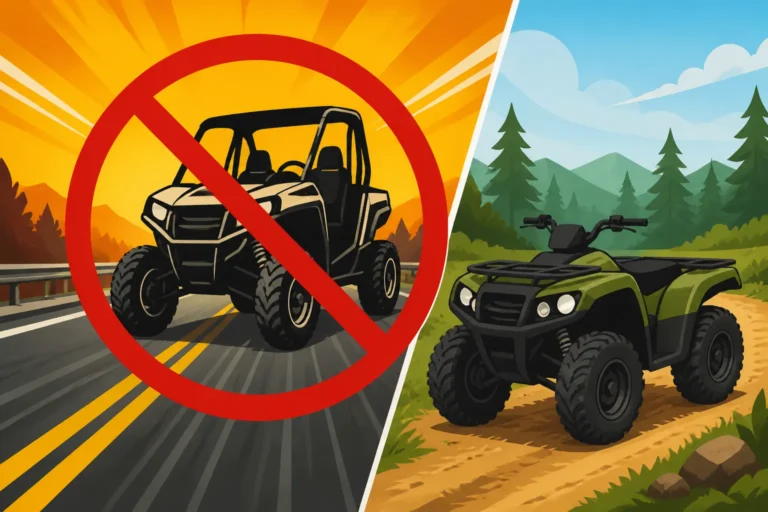
Another frequent question revolves around ATVs. While the new law often lumps "OHVs" (Off-Highway Vehicles) into its language, the primary focus and expanded privileges for road use under House Bill 810 are specifically tailored for UTVs (Utility Task Vehicles), also commonly known as side-by-sides. ATVs (All-Terrain Vehicles), with their single-rider or two-rider straddle-seat design, typically face stricter limitations for public road use due to their inherent design characteristics, such as stability and handling at road speeds. Generally, the broad road access granted to UTVs does not extend in the same way to ATVs. Always refer to specific language regarding "Class I" or "Class II" OHVs in the statute, as this differentiates the vehicle types.
This distinction is important because while some ATVs might technically meet certain equipment requirements (like lights and mirrors if aftermarket parts are added, perhaps from a company like SuperATV), their fundamental design makes them less suitable for regular road interaction compared to UTVs. The stability of a four-wheeled vehicle with a steering wheel and side-by-side seating makes UTVs inherently more compatible with road traffic. Therefore, while ATVs are still beloved off-road machines, their public road use remains far more restricted than their UTV counterparts, often limited to agricultural exceptions or very specific, limited crossings.
"Is There an Annual Permit or Sticker I Need Beyond the TDR Sticker?"
Some riders might wonder if, in addition to the TDR sticker required for titling and road eligibility, there's another annual road-use permit or sticker needed, similar to state park permits for trail riding. For road use specifically, once your UTV is titled, has its TDR sticker, and meets all equipment and operator requirements, there isn't typically a separate annual road-use permit issued by the state beyond that. The TDR sticker essentially fulfills the "registration" aspect for road eligibility in Tennessee for OHVs.
However, it's crucial not to confuse this with permits required for actual trail riding within state-managed parks or WMAs (Wildlife Management Areas) like the North Cumberland WMA. Those are entirely separate permits that grant you access to specific trail systems and are often required annually or for multi-day use. So, while your UTV might be street legal to drive to a trailhead, you'll still need the appropriate trail permit to actually ride on the trails within those managed areas. The road-use provisions are about getting to places, not about using the road as a trail itself.
Disclaimer
This article is for general informational purposes only and does not constitute professional advice. Laws, prices and regulations vary by location and change over time. Consult a qualified professional for guidance on your specific situation.