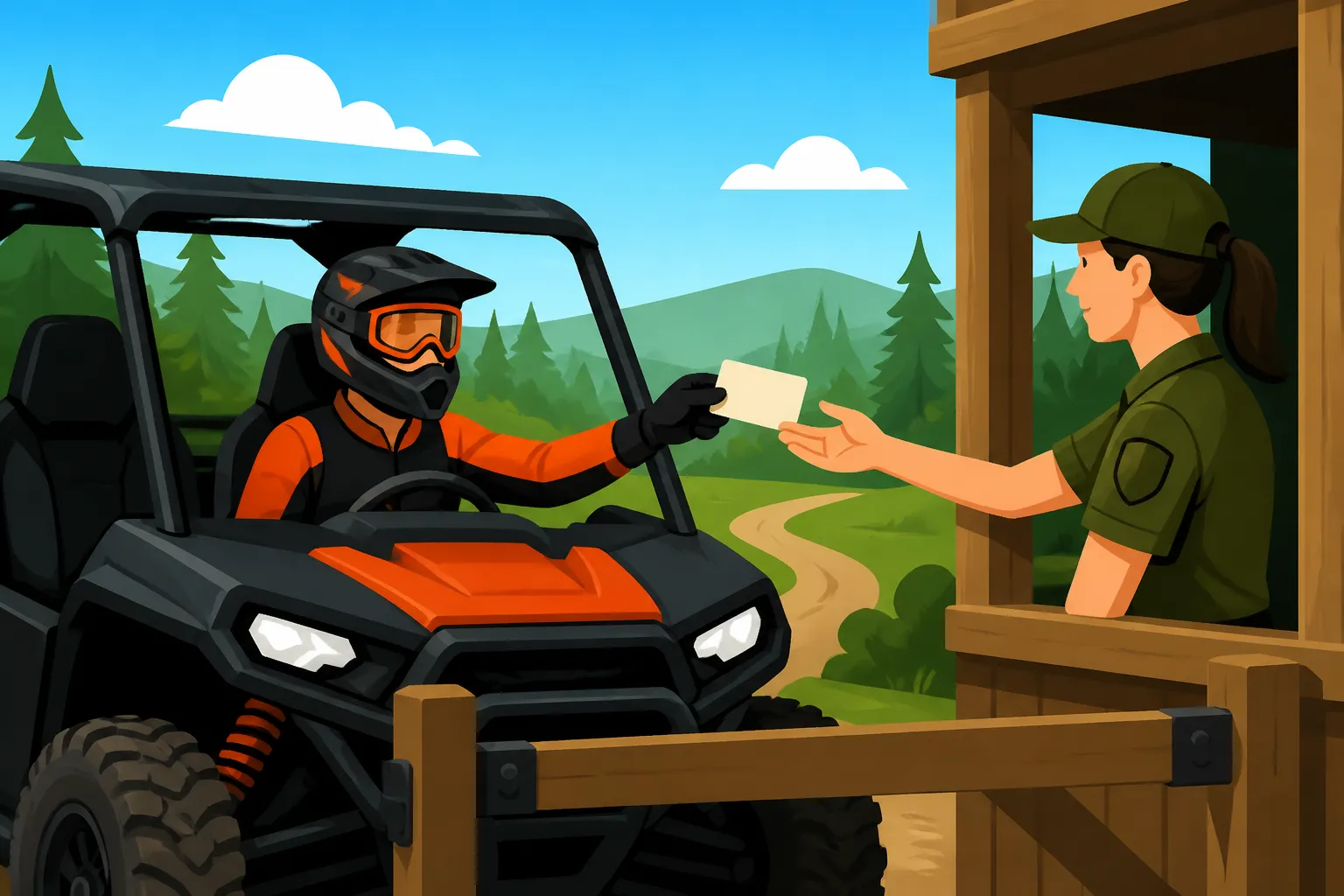
Showing a Permit at a Tennessee Gate
Showing a permit at a Tennessee gate can be confusing when your ride involves a vehicle, a driver, and more than one kind of sticker or permit. The key is to know which riding area you’re entering, which permit applies to each vehicle, and what proof you can readily access. Here’s how to prepare for a North Cumberland Wildlife Management Area (NCWMA) ride and avoid common mix-ups.
Which permit should be ready at the gate?
Start by identifying the place where you plan to ride. A permit for a private riding park is not automatically the permit for a wildlife management area, and a title sticker is not a trail permit. These documents serve different purposes, even when you may need more than one for the same machine.
For recreational OHV riding at NCWMA, the Tennessee Wildlife Resources Agency (TWRA) requires a special use permit, subject to stated exceptions. TWRA says the new NCWMA OHV permit requirements take effect July 1, 2026, and permits will be available through its customer portal beginning July 1. For permit types and how the system fits together, see Tennessee Trail Permits Explained and Buying a Permit Through the State Portal.
Before you set out, make sure you know whether your destination is NCWMA or another designated wildlife management area. TWRA says OHV riders using designated wildlife management areas outside NCWMA still need the High Impact Habitat Conservation Permit. An NCWMA permit is not a universal Tennessee trail pass, so don’t assume that a permit for one riding area covers another. Why Tennessee Has No Statewide Trail Sticker explains why checking the specific destination matters.
The permit requirement is tied to the vehicle, not simply to the driver or group. TWRA says permits are required on a per-vehicle basis, and at least one adult per vehicle must possess a valid permit at NCWMA. If your group brings several machines, check that each vehicle is covered rather than relying on one permit holder to cover the whole group. Why One Adult per Vehicle Needs a Tennessee Permit provides more detail on that distinction.
| What you have | What it generally establishes | Does it replace the NCWMA riding permit? |
|---|---|---|
| NCWMA OHV riding permit | Authorization for the covered vehicle to ride at NCWMA | It is the riding permit for NCWMA, subject to the applicable requirements |
| High Impact Habitat Conservation Permit | Permit used at designated wildlife management areas outside NCWMA | Not for NCWMA when purchased on or after July 1, 2026 |
| Tennessee Department of Revenue sticker | Evidence that a title has been issued for an OHV not registered for road operation | No |
| Private park permit | Permission under that park’s own permit system | No; a park permit does not travel to another riding area |
TWRA says High Impact Permits and annual licenses purchased before July 1, 2026, will be honored at NCWMA until they expire. TWRA also says High Impact Permits and licenses purchased on or after that date will not be valid for riding at NCWMA. That transition can make an older permit look usable even though a newer one of the same general type is not. Check the purchase date and expiration, not just the permit name. See Why Old High Impact Permits Expired for the transition issue and Why a Tennessee Park Permit Does Not Travel for a related example of area-specific permits.
What proof should you have available?
TWRA’s information explains which permit is required and where it can be purchased, but it does not specify here whether a gate accepts a digital screen, a printed copy, or a particular display location on the vehicle. Avoid assuming that a purchase confirmation alone is enough, or that the permit must be attached to the machine. Confirm the current presentation instructions with TWRA before your trip.
A practical approach is to have the permit information available in a way you can retrieve without searching through messages or relying on a weak cell signal. If you have access to a printed copy, keeping it with your ride documents can be useful; if you plan to show a digital copy, save it for offline access and confirm that this format is accepted. These are preparation tips, not a substitute for TWRA’s current instructions.
Before leaving home, check that the information you have matches the vehicle you’re bringing. If a permit record identifies a vehicle or other details, compare those details with your machine and resolve any mismatch through the permit portal or TWRA before arriving. Don’t wait until you’re at the entrance to discover that you bought the wrong permit type or selected the wrong vehicle.
It also helps to keep your riding permit separate from your title paperwork. The Tennessee Department of Revenue says a TDR sticker is evidence that a title has been issued when an OHV is not registered for road operation. The department says County Clerks issue these stickers, which must be affixed to OHVs or ATVs operated in many federal or state-owned facilities, such as parks and game reserves. That title-related sticker is not the same thing as an NCWMA riding permit.
The difference matters even if both items are relevant to your trip. A TDR sticker does not grant access to NCWMA, and an NCWMA permit does not prove that the machine has a Tennessee title. For more on the sticker, see What the TDR Sticker on Your Title Means. The Tennessee Department of Revenue also says a TDR sticker is non-renewable and non-transferable, and becomes invalid when the vehicle is sold or dismantled. If you bought a used machine, don’t assume its old sticker or the previous owner’s trail permit settles your own paperwork.
Match the permit to the vehicle and rider
A gate check can be harder to sort out when the group arrives in multiple vehicles, or when an adult and a young rider are sharing the trip. Make a simple vehicle-by-vehicle list before departure: which machine is going, who will operate it, and what permit or exception applies. That makes it easier to spot an uncovered vehicle before you reach the gate.
TWRA says that an individual aged 17 or younger operating an OHV alone does not need a permit, but must follow the manufacturer’s age limits. TWRA also states that a special use permit is required for ATV riders at NCWMA unless they are properly licensed hunters or under age 13. Because age and activity can affect which rule applies, don’t treat one exception as a blanket exemption for every young rider or every trip. If a minor will ride with an adult, clarify how the adult-per-vehicle requirement applies to that setup with TWRA before leaving.
A valid Annual or Lifetime Sportsman license does not, by itself, include the NCWMA OHV riding permit, according to TWRA. TWRA says holders of those licenses may purchase a Sportsman Supplemental Annual OHV Permit. This is a separate permit category, so check that the permit you have is specifically valid for OHV riding at NCWMA. Does One Permit Cover Every North Cumberland Unit? can help with questions about coverage across the area.
Don’t assume that a machine with a road-legal registration or a set of plates is exempt from the trail permit. TWRA says highway-legal vehicles such as Jeeps and trucks also need the required NC OHV permit when used on the trails. Likewise, a disability license does not remove the requirement: TWRA says individuals with a disability license must still purchase an NCWMA OHV riding permit. If you’re unsure whether a vehicle or rider falls under an exception, verify the exact situation with TWRA rather than relying on how the machine is classified elsewhere.
Also separate the riding permit from road-use paperwork. The Tennessee Department of Revenue defines Class I and Class II off-highway vehicles, and it has separate requirements for low-speed and medium-speed vehicle registration. Those classifications and title processes do not answer whether a machine has the permit needed for an NCWMA trail. For title questions, see Tennessee’s Four Vehicle Categories and Tennessee OHV Title Paperwork.
A gate-ready checklist and common problems
A little preparation reduces the chance of holding up your group while you search for a receipt, compare permit types, or call someone for clarification. Use this checklist before loading:
- Confirm the destination. Check that you’re entering NCWMA and not a different wildlife management area or a private park with its own permit rules.
- Check every vehicle. TWRA says permits are required per vehicle. Make sure the permit or applicable exception is accounted for machine by machine.
- Verify the permit category. Don’t mistake a High Impact permit, a Sportsman license, a private park permit, or a TDR sticker for the NCWMA OHV permit.
- Review the purchase and expiration details. If you’re relying on an older High Impact permit or annual license, check that it was purchased before July 1, 2026, and has not expired.
- Have proof accessible. Follow TWRA’s current instructions for showing or displaying the permit. Don’t rely on a format you haven’t confirmed.
- Check the rest of the riding rules. A permit does not authorize riding on a closed trail or override other requirements for the area.
Some common problems have simple fixes. If you bought a permit for the wrong area, contact the relevant agency before traveling instead of assuming the permit will be accepted at NCWMA. If your permit is in another person’s name or vehicle details do not match, ask TWRA how to correct the record. If your phone has no service, use the agency’s guidance on offline or printed proof rather than expecting to download a confirmation at the gate.
A permit is also not a substitute for observing trail rules. TWRA sets the area-wide speed limit at 25 mph and requires at least 500 square inches of daylight fluorescent orange during deer and elk gun and muzzleloader seasons. Those rules come from the Tennessee Wildlife Resources Agency and apply separately from the permit check. Check TWRA’s current notices before riding, especially if your visit overlaps a hunting season or a closure.
Finally, don’t treat reaching the gate as the time to work out what you bought. Confirm the permit scope, vehicle coverage, and proof format before your trip. If a detail is uncertain, contact TWRA or the permit portal in advance. The right permit in hand, with the relevant vehicle and area clearly matched, is the simplest way to start your ride without a preventable delay.
Sources
- Tennessee Department of Revenue — Off Highway Vehicles (checked November 3, 2026)
- Tennessee Wildlife Resources Agency — North Cumberland OHV Riding Area (checked November 3, 2026)
- Tennessee Wildlife Resources Agency — New OHV Permit Requirements to Take Effect July 1, 2026 (checked November 3, 2026)
- Tennessee Wildlife Resources Agency — ATVs: Rules of the Off-road by Paul E. Moore (checked November 3, 2026)
Disclaimer
This article is for general informational purposes only and does not constitute professional advice. Laws, prices and regulations vary by location and change over time. Consult a qualified professional for guidance on your specific situation.