Riding a Road Posted 45 mph or Under
The thrill of taking your ATV or UTV off-road in Tennessee is unmatched, but when it comes to riding on public roads, the rules can feel like a tangled mess of "can I?" and "can't I?". You've likely heard whispers about certain speed limits or specific counties, leaving you wondering exactly where your machine is welcome and what you need to do to stay legal. This guide is here to clear the mud, detailing exactly what it means to ride your off-highway vehicle on a Tennessee road posted 45 mph or under, so you can ride with confidence and keep your adventures within the bounds of the law.
Unpacking Tennessee's 45 MPH Road Rule for ATVs and UTVs
For years, the rules around riding ATVs and UTVs on Tennessee roads were a patchwork, often left up to individual counties and cities. This created a lot of confusion and frustration for riders just trying to get from one trail to another, or even run a quick errand. Thankfully, recent legislative changes have brought a bit more clarity, especially regarding roads posted 45 mph or under. However, it's crucial to understand that simply being "45 mph or under" isn't the only requirement.
Understanding the Speed Limit Constraint
The headline rule is that you can operate your off-highway vehicle (OHV) on roads with a posted speed limit of 45 mph or less. This applies generally to county roads and city streets, provided the local government has explicitly designated them for OHV use. It's not just about how fast you drive, but the actual posted speed limit of the road itself. If a road's sign says "50 MPH," even if you only plan to crawl along at 20 mph, that road is off-limits for OHV use. This distinction is paramount and often where riders inadvertently get into trouble.
Think of those quieter, winding county roads that connect small towns, or the residential streets within a community. These are the types of roads most likely to fall under this speed category. However, this rule does not automatically open up every state highway that happens to be posted 45 mph or less. State routes often have separate regulations that prohibit OHV use, regardless of their speed limit. The intent of the law, greatly influenced by [What House Bill 810 Changed in 2025], was to give local authorities the power to integrate OHVs into their local transportation networks, not to allow free-range riding across all public roads. So, while the 45 mph speed limit is a necessary condition, it's often not the only condition.
The "Daylight Hours Only" Mandate
Even when you find a road that meets the 45 mph or under speed limit and is otherwise permissible, your riding window is strictly limited. Tennessee law specifies that OHVs can only be operated on these designated roads during "daylight hours." This means from sunrise to sunset, no exceptions. As the sun begins its descent, or before it fully rises, your off-road machine should be off the public road.
This isn't just an arbitrary rule; it's a critical safety measure. OHVs, by their very nature, are designed for off-road conditions and often lack the same visibility and sophisticated lighting systems as traditional street-legal vehicles, even with modifications. Visibility for both the OHV operator and other motorists is significantly reduced in low light. Moreover, the reflective signage and road markings that help drivers navigate at night are often less effective or non-existent on the types of rural roads OHVs might traverse. Sticking to daylight hours ensures everyone on the road has the best chance to see and react to each other, minimizing the risk of accidents. You can find more detail on this in [Tennessee Rules for Riding After Dark].
Prohibited Roads and General Restrictions
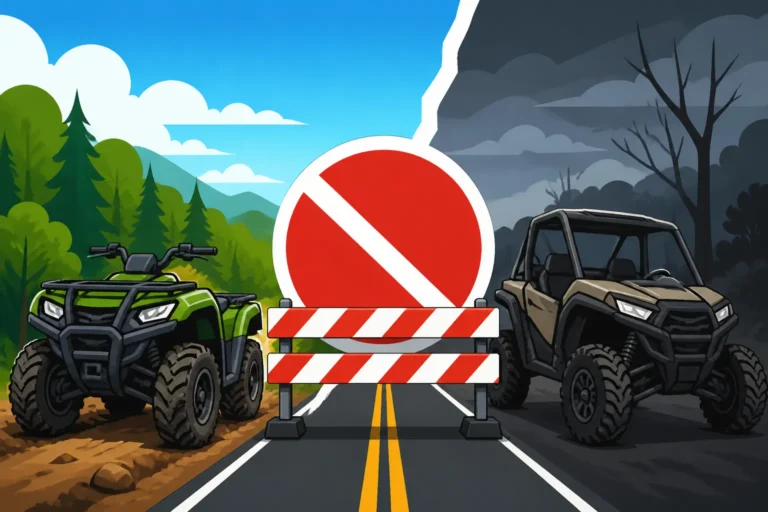
While the 45 mph rule creates some avenues for road use, it's equally important to know where your OHV is definitively not allowed. Interstates and multi-lane state highways are strictly off-limits, regardless of their posted speed limits. These high-speed, high-traffic thoroughfares are simply not designed to safely accommodate off-highway vehicles. Attempting to ride an ATV or UTV on an interstate would not only be illegal but incredibly dangerous, putting you and others at severe risk.
Furthermore, even within the 45 mph or under category, there might be specific roads or areas that local governments have explicitly restricted. For example, a city might pass an ordinance allowing OHV use on certain residential streets but explicitly prohibit it on their main downtown drag, even if that street is posted 35 mph. It's always best to check with the local county or city clerk's office for a current list of designated roads or any specific prohibitions. Ignoring these restrictions can lead to fines and other legal consequences, making it a frustrating end to what should be an enjoyable ride. For a broader understanding, consult [Tennessee Rules for Riding a State Highway] and [Riding a Road Posted 50 mph Is Off Limits].
The Special Case: Adventure Tourism Districts and Local Ordinances
While the general statewide rule provides a framework, Tennessee recognizes specific regions where off-road recreation is a significant part of the local economy and culture. These are known as "Adventure Tourism Districts," and within these designated areas, the rules for riding on roads 45 mph or under become a bit more expansive, offering riders greater flexibility.
What Defines an Adventure Tourism District?
[Tennessee's Adventure Tourism Districts] are areas specifically identified by state law, where the economic livelihood of the community is closely tied to outdoor recreation, particularly off-highway vehicle riding. These districts were created to support and facilitate the unique blend of tourism and local lifestyle found in places like Tennessee's rugged Cumberland Mountains. The intent is to allow riders to more easily access trailheads, local businesses, lodging, and services without having to trailer their machines constantly.
Within these districts, the statewide 45 mph or under rule takes on a more direct application. Here, county roads and certain city streets posted at or below 45 mph are generally open for OHV use, sometimes without requiring individual county ordinances for every single road. However, cities or counties within these districts can still restrict specific roads for safety or other local concerns, so it's not a blanket "anything goes" situation. This distinction is crucial: outside these districts, specific local designation is almost always required on a road-by-road basis; inside, the presumption leans more towards allowing it, unless restricted.
Key Counties with Broader Access
Several counties in Tennessee are explicitly named in the legislation as part of these Adventure Tourism Districts, and they have become hotspots for OHV enthusiasts. These include [Scott, Anderson and Campbell Counties], along with Morgan, Jackson, Johnson, Perry, Unicoi, Fentress, and Hickman Counties. In these areas, you'll often find a more robust network of county roads and town streets where OHV use is commonplace, allowing riders to connect directly from their lodging to nearby trail systems like Windrock Park, Brimstone Recreation, or Royal Blue Resort.
For example, a rider staying in Oliver Springs in Anderson County might be able to ride their UTV on local roads directly to the Windrock trail system entrance, avoiding the need to load onto a trailer. This ease of access significantly enhances the riding experience. However, even in these prime locations, vigilance is key. Always look for posted signs, check county websites for maps of designated roads, and be aware that even within these counties, some state routes or particular town streets might still be off-limits or have specific operating hours.
The Role of Local Ordinances
While Adventure Tourism Districts provide a broader allowance, local ordinances still play a vital role. For counties outside these districts, the ability to permit OHV use on roads 45 mph or under rests entirely with the local governing body. This means a county commission or city council must pass specific legislation to designate which roads are open and under what conditions. If your county hasn't passed such an ordinance, then riding your OHV on any public road, even a quiet 25 mph residential street, is likely illegal.
This is why you'll see a varying landscape of legality across Tennessee. One county might embrace OHV road use, opening up many miles of local roads, while an adjacent county might have no such provisions, effectively banning OHVs from all its public roads. Before planning any road-based riding, it's incumbent upon you to research the specific local laws. A quick call to the county clerk's office or a search on the county's official website can often provide the definitive answer. Remember, ignorance of the law is no excuse, and a ticket in one county where it's not permitted can quickly sour your trip. For details on how local governments make these decisions, look into [Tennessee Rules for Riding a County Road].
Equipping Your Machine and Yourself for Tennessee Road Use
Getting on a public road in Tennessee, even one posted 45 mph or under, means adhering to specific equipment and driver requirements designed to ensure safety and compliance with traffic laws. This isn't just about avoiding a ticket; it's about making your machine visible and controllable in a mixed-traffic environment.
Equipment You Must Have
When operating an OHV on a public road, it needs to be equipped much like a low-speed vehicle or even a car. The law requires several key pieces of equipment:
- Headlights: Must be fully functional and visible from a specified distance.
- Taillights and Brake Lights: Essential for being seen from behind and indicating when you're slowing down or stopping.
- Mirrors: At least one rearview mirror is typically required, allowing you to see traffic approaching from behind. Some riders opt for a full set of side mirrors for better visibility, and companies like SuperATV offer a wide range of durable, adjustable mirrors perfect for this.
- Turn Signals: Required for indicating your intentions when changing lanes or turning. While some older ATVs might lack these, UTVs often come with them, or you can add aftermarket kits.
- Horn: A working horn is necessary to alert other drivers or pedestrians to your presence.
- Seatbelts: If your UTV is equipped with seatbelts, they must be worn by all occupants. This is a critical safety feature often overlooked when transitioning from trail to road.
- DOT-Approved Tires: While not always explicitly stated for OHVs, it's best practice to ensure your tires are in good condition and suitable for paved surfaces. Aggressive knobby tires, while great for mud, can handle poorly and wear quickly on asphalt.
It's vital that all this equipment is in proper working order before you even pull out of your driveway onto a public road. A quick pre-ride check can save you from a roadside stop and a potential citation. For more information, check [Tennessee Equipment Rules for Road Use].
Who Can Drive and What They Need
Beyond the machine itself, the operator and any passengers also have specific requirements under Tennessee law:
- Minimum Age and Driver's License: To operate an OHV on a public road, the driver must be at least 16 years old and possess a valid driver's license. This means a learner's permit or a restricted license might not be sufficient. This rule is in place because road driving requires a different skill set and knowledge of traffic laws than off-road riding. For more on this, see [Tennessee Minimum Age to Ride a Road] and [Tennessee Driver's License Rules for UTVs].
- Insurance: Just like with any other motor vehicle, you must carry proof of financial responsibility, typically in the form of liability insurance. This ensures that if you are involved in an accident, there is coverage for damages or injuries you might cause. Always have your insurance card readily accessible, as a law enforcement officer will likely ask for it during a stop. [Tennessee UTV Insurance Requirement] provides further details.
- Helmet Rules: Tennessee has specific helmet laws that apply to OHV riders on public roads. Operators and passengers under 18 years of age are required to wear a DOT-approved helmet. While the law on public roads sometimes extends this requirement to all riders regardless of age, it is always the safest practice to wear a helmet. For a full breakdown, consult [Tennessee Helmet Law for ATV Riders].
Carrying all necessary documentation – your driver's license, insurance card, and any trail permits if you're connecting to a system – is crucial. A simple document check can turn into a frustrating delay if you can't produce the required paperwork.
Staying Visible and Safe
Once you're on the road, maintaining visibility and adhering to safe driving practices becomes your primary responsibility. This means riding defensively, anticipating the actions of other drivers, and being mindful that your OHV handles differently than a conventional car. Companies like SuperATV provide a host of accessories, from full windshields to wider fender flares, which can enhance your machine's road manners and overall visibility. Always use your turn signals well in advance, maintain a safe following distance, and be extra cautious at intersections and blind curves. Remember, while you might be accustomed to navigating rough terrain, road surfaces introduce new challenges like potholes, loose gravel, and high-speed traffic, demanding a heightened level of awareness.
Navigating Crossings, Exemptions, and Avoiding Penalties
Even with clear rules about which roads you can ride, there are nuances to how you interact with the broader road network, specific exemptions, and the serious consequences of non-compliance. Understanding these aspects is key to truly "street-legal" riding in Tennessee.
Crossing Higher Speed Roads
Sometimes, even when riding on designated roads under 45 mph, you might need to cross a higher-speed state highway to connect to another permissible road or a trail system. Tennessee law makes specific provisions for these crossings, but they come with strict requirements to ensure safety.
- Two-Lane Highways: If you need to cross a two-lane state highway that is 45 mph or less, you are generally permitted to do so at a right (90-degree) angle. This means approaching the road, stopping, checking for traffic in both directions, and then crossing directly across to the opposite side in a straight line, without traveling along the highway itself. The goal is to minimize your time spent in the flow of traffic. [Crossing a Two-Lane at a Right Angle] offers more guidance.
- Multi-Lane or Higher Speed Highways: For multi-lane highways or state routes with speed limits above 45 mph, crossings are far more restricted. These are generally only permitted at points specifically designated by the Tennessee Department of Transportation (TDOT). These designated crossing points are typically chosen for optimal visibility and safety, often at intersections with traffic signals or clear lines of sight. You cannot simply cross a busy four-lane highway wherever you deem fit. Always yield to existing traffic and make your crossing as quickly and safely as possible.
These crossing rules are not suggestions; they are legal mandates. Improper crossings are incredibly dangerous and can lead to severe accidents or citations. Plan your route carefully to identify official crossing points and avoid attempting to cross high-speed roads illegally.
Agricultural Exemptions
Tennessee law provides specific exemptions for ATVs and UTVs used for agricultural purposes. If your machine is primarily used for farming, ranching, or other agricultural operations, some of the road-use rules might not apply to you when you're operating within the scope of your farm work. For example, a farmer moving between fields on a county road might have different requirements than a recreational rider.
These exemptions typically cover activities like transporting equipment, checking fences, moving livestock, or performing tasks directly related to the farming operation. A key distinction is that this exemption generally only applies during the course of actual farm work and does not extend to recreational riding. Furthermore, even with an agricultural exemption, basic safety principles still apply, and you're expected to operate your machine in a safe and responsible manner. While helmets might be exempt for farm work, it's still prudent to use safety equipment. More details can be found in [Tennessee Rules for Agricultural Road Use].
Potential Penalties and Enforcement
Ignoring Tennessee's OHV road use laws carries real consequences. Violations are typically treated seriously, often resulting in fines and potentially other legal troubles.
- Fines: The most common penalty for illegal road use is a monetary fine. While specific amounts can vary, a [Tennessee Fines for Illegal UTV Road Use] can be around $50 or more for a first offense.
- Class C Misdemeanor: More severe violations, or repeat offenses, can escalate to a Class C Misdemeanor. This is a criminal charge that can carry higher fines, potential jail time (though rare for a first offense), and a mark on your criminal record. Being charged with a [A Class C Misdemeanor in Tennessee] is not something any rider wants.
- Impoundment: In some cases, law enforcement has the authority to impound your OHV if it's being operated illegally on public roads. This means not only a fine but also the added cost and hassle of recovering your machine from an impound lot.
Law enforcement officers, particularly in areas popular with OHV riders, are often well-versed in these regulations. They prioritize public safety, and if they observe an OHV being operated unsafely or illegally on a public road, they will likely intervene. The best way to avoid these unpleasant scenarios is to simply know and follow the rules. A little preparation goes a long way in ensuring your rides remain enjoyable and trouble-free.
Practical Tips for Road-Legal Riding in Tennessee
Navigating Tennessee's road rules for ATVs and UTVs doesn't have to be daunting. With a bit of preparation and common sense, you can confidently and legally connect trails, access services, or simply enjoy a scenic ride on designated roads.
Pre-Ride Checklist for Road Legality
Before you even think about putting a tire on a public road, a quick checklist can save you a lot of headache.
- Machine Readiness:
- Lights: Are your headlights, taillights, and brake lights all working? Test them.
- Signals & Horn: Do your turn signals flash correctly, and does your horn honk clearly?
- Mirrors: Are your mirrors securely mounted and adjusted to give you a clear view behind you?
- Tires: Check your tire pressure and ensure treads aren't excessively worn, especially if you'll be on pavement.
- Seatbelts: If your UTV has them, are they easily accessible and functional for all occupants?
- Fuel: Have enough fuel for your intended route, especially if you're planning a long connection between trails. Consider carrying a small, approved fuel can for emergencies.
- Personal Readiness:
- Driver's License: Do you have it on you, and is it valid?
- Insurance Card: Have proof of liability insurance.
- Helmet: If under 18, or if you simply prioritize safety (which you should!), is your DOT-approved helmet with you and properly fitted?
- Local Ordinances: Quickly review the specific county or city ordinances for the roads you plan to use, especially if you're in an unfamiliar area.
Planning Your Route
Effective route planning is crucial for maximizing your road-legal riding time and avoiding restricted areas.
- Consult Maps: Use physical or digital maps to identify roads clearly marked 45 mph or under. Pay close attention to distinguishing between county roads, state routes, and city streets. Google Maps, for example, often shows state routes with an "SR" or "TN" prefix, or a shield icon.
- Identify Connections: Plan how to connect different trail systems or points of interest using only the permissible roads. Look for routes that minimize your time on roads, especially if they are heavily trafficked.
- Avoid State Highways: Unless it's a designated crossing point or a specifically permitted section within an Adventure Tourism District, assume state highways are off-limits, even if they appear to be low-speed. It's better to detour a bit than risk a citation or, worse, an accident.
- Check for Restrictions: Some communities or counties within Adventure Tourism Districts might still have "restricted road lists" for safety or noise concerns. Always check local resources if possible.
Accessories from SuperATV, such as GPS mounts or durable storage solutions, can make carrying maps and essential gear much easier, enhancing your ability to plan and execute a safe, legal ride.
Riding Etiquette and Safety
Once you're on the road, your responsibilities shift to safe and courteous operation, just like any other vehicle driver.
- Ride Predictably: Signal your turns well in advance, maintain a consistent speed, and avoid sudden maneuvers. Other drivers might not be accustomed to seeing an OHV on the road, so make your intentions clear.
- Stay to the Right: Keep as far to the right side of the lane as safely possible, especially on two-lane roads, to allow faster traffic to pass you easily.
- Maintain Distance: Keep a safe following distance from the vehicle in front of you. OHVs can have different braking characteristics than cars, so give yourself plenty of room to stop.
- Be Visible: Even in daylight, brighter clothing can help you stand out. Ensure your lights are on, even during the day, for maximum visibility.
- Caution at Intersections: Be extra vigilant at intersections. Make eye contact with other drivers if possible, and double-check for traffic before proceeding.
- Respect Local Residents: Keep noise levels down, especially in residential areas. Your behavior reflects on the entire OHV community, and respectful riding helps maintain good relationships with locals who share these roads.
Riding your ATV or UTV on Tennessee roads posted 45 mph or under can be a fantastic way to extend your adventures, access more areas, and connect with local communities. By understanding and adhering to the specific rules, equipping your machine properly, and driving responsibly, you'll contribute to a positive image for OHV riders and ensure your experiences are safe, legal, and truly unforgettable.
Disclaimer
This article is for general informational purposes only and does not constitute professional advice. Laws, prices and regulations vary by location and change over time. Consult a qualified professional for guidance on your specific situation.