Creek Crossings in an East Tennessee Holler
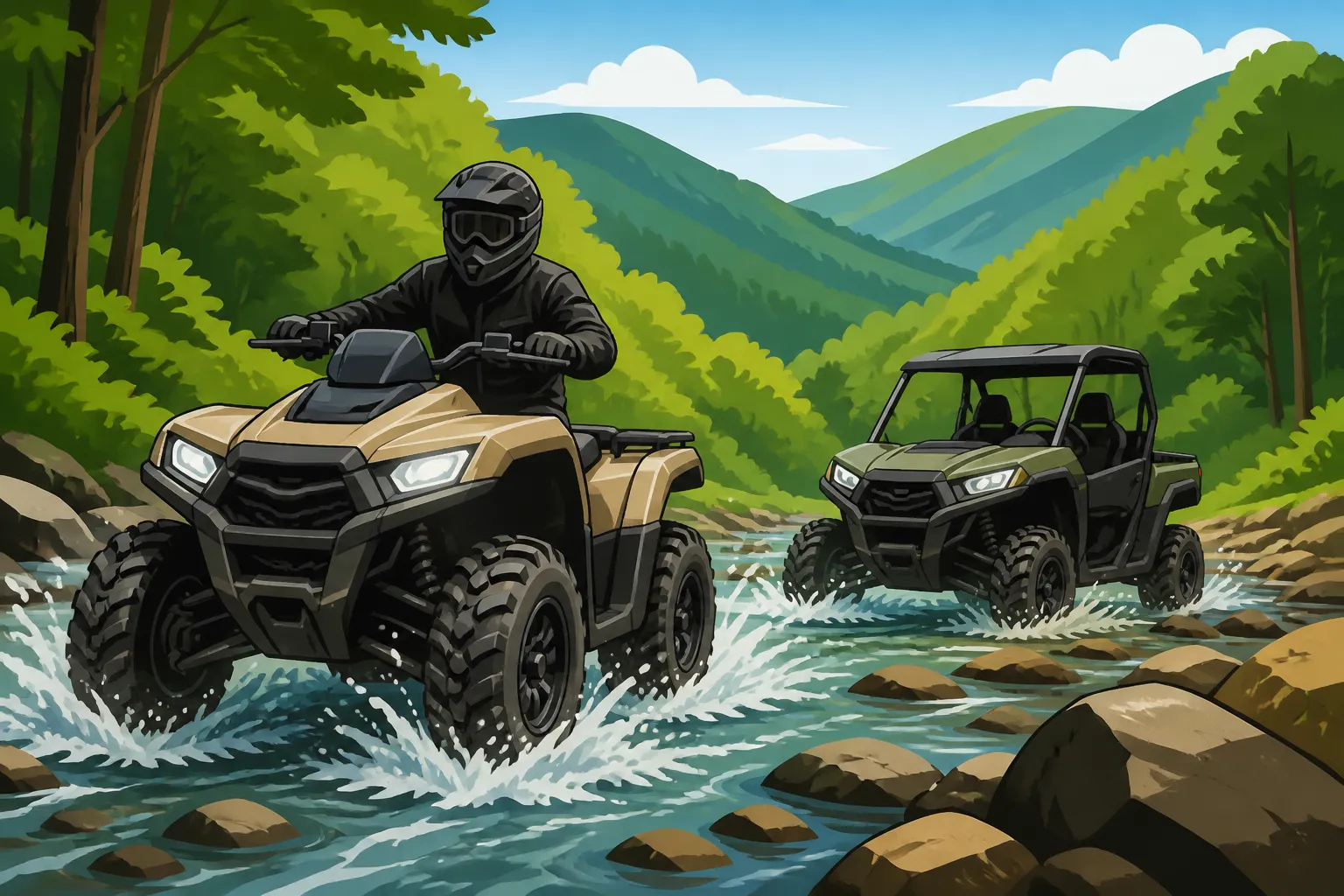
A creek that looks harmless from the seat of your ATV can hide a slick rock shelf, a sudden drop, or a deeper channel than it appears. In an East Tennessee holler, runoff can change a crossing quickly, and a mistake can leave you stranded or hurt. This guide explains how to assess the water, choose a safe line, and know when to turn around.
Read the creek before you ride into it
Stop and assess the whole crossing
Do not judge a crossing by the water closest to the bank. Stop well back from the edge, where you have room to turn around, and look at the entire approach, channel, and exit. Check for places where the water narrows, bends around a rock, or runs over a ledge. Those features can conceal deeper holes and stronger currents.
Look for a safe way out on the opposite bank before you enter. A crossing is not a good choice if the exit is steep, muddy, undercut, or blocked by rocks and brush. Even if your ATV or UTV can push through the water, it may not be able to climb the far bank without spinning, tipping, or getting stuck.
Pay attention to the water itself. Fast-moving water, rising water, floating debris, and a current that makes it hard to see the bottom are reasons to stop. If you cannot confidently identify a safe route across and a clear exit, do not try to find out by driving into the creek.
Consider what changed upstream
Creeks in steep hollers can respond quickly to rain, including rain that fell farther uphill and out of sight. A crossing that was manageable earlier in the day may be deeper or faster later. After heavy rain, water may also carry branches and loose gravel that can shift under your tires.
Before riding, check the forecast and current trail notices for the area you plan to visit. Conditions matter at places such as Windrock near Oliver Springs and Brimstone Recreation near Huntsville, but conditions can differ between trails and even between nearby crossings. [Tennessee Trail Conditions Before You Ride] is a useful place to start when planning around changing terrain, and [Tennessee Trails Closed After Rain] covers why a wet trail may not be suitable for riding.
If you are using a mapping app such as onX Offroad, use it to help orient yourself and plan your route, not to confirm that a creek is shallow or passable. A map cannot show you the current depth, speed, hidden rocks, or damage from recent runoff. Check the park or land manager’s notices as well, and treat any crossing restriction or closure as a firm boundary.
Choose a crossing strategy that matches the conditions
Walk the route only when it is safe to do so
If the water is slow and shallow enough to assess from the bank, inspect the intended line before riding across. Look for a firm bottom, an even entry, and a gradual exit. Avoid stepping into water that is swift, deep, cold, or cloudy enough to hide the bottom. If you cannot safely inspect it, that is a reason to turn around rather than guess.
When it is safe to check on foot, wear footwear with grip and be careful on wet rocks. Do not wade into moving water to test its strength or depth. A submerged branch or a loose rock can shift, and a current that seems manageable at the edge may be stronger in the channel.
If you are riding with a group, agree on the plan before the first machine enters the creek. Keep other riders back from the bank, leave space to maneuver, and avoid crowding the exit. One person should not enter simply because the rider ahead made it across; the water or bottom may behave differently along another line.
Keep the machine controlled and the route simple
Cross only where the route is clearly permitted and the conditions are suitable for your machine and skill level. Use a smooth, deliberate pace rather than rushing into the water. Sudden throttle, sharp steering, or an abrupt stop can make it harder to keep your line on a slick or uneven bottom. Follow your vehicle manufacturer’s guidance for water crossings, and never exceed its stated limits.
Do not ride into water that could reach the air intake, exhaust, electrical components, or other vulnerable parts of the machine. The safe depth varies by vehicle and situation, so there is no single depth that is safe for every ATV or UTV. Water can also be deeper than it looks, especially where the creek has cut a channel beneath the surface.
Keep passengers seated and following the vehicle’s safety instructions. If the machine begins to lose traction or the water is moving it off line, do not make a panicked correction. If you cannot maintain control, or the crossing is beyond the machine’s or rider’s capability, stop before entering and choose another route. [Tennessee Rules for Riding a WMA] and [Tennessee Rules for Riding Private Property] are helpful reminders that the land and the route matter as much as the riding technique.
Prepare your machine and your group
Check equipment before leaving the staging area
A creek crossing is not the place to discover a loose battery connection, a damaged belt cover, or a weak tire. Before the ride, check your tires, brakes, steering, lights, and any components your owner’s manual identifies as important for wet conditions. Make sure the machine is carrying only the gear you need and that cargo is secured.
A winch may help with recovery in some situations, but it is not permission to attempt a crossing that is unsafe. Recovery in a creek can put people at risk, damage the machine, and disturb the waterway. If you carry recovery equipment, know how it works and use it only from a stable position with a suitable anchor. Do not stand in the water or place yourself in the likely path of a moving machine or loaded recovery line.
Bring a way to contact your group and share your route, while remembering that cell service can be unreliable in mountain hollers. An offline map in onX Offroad or another navigation app can help you keep track of your planned route when service drops, but download the map ahead of time and carry a backup plan. [Cell Dead Zones Across the North Cumberland WMA] offers a useful reminder to prepare for areas where a phone may not connect.
Set group rules before anyone reaches the water
Groups often get into trouble when riders feel pressured to keep up. Make it clear that anyone can call for a stop and that turning around is an acceptable decision. Keep enough distance between machines to avoid a chain reaction if the first rider stops or changes direction. Do not enter a crossing until the exit is clear and the rider ahead has reached a stable place.
For families or less experienced riders, choose routes that match the least experienced person in the group. A confident driver on a larger UTV may be comfortable with a line that is unsuitable for a smaller ATV or a youth rider. Keep children away from the creek edge while adults assess the crossing, and do not use a child’s successful passage as proof that the water is safe for another machine.
A simple pre-ride check helps everyone stay on the same page:
| Before the crossing | What to check |
|---|---|
| Water conditions | Current, depth, clarity, debris, and signs of rising water |
| Entry and exit | Stable approach, visible bottom where possible, and a usable far bank |
| Route permissions | Whether the crossing is on an authorized, open route |
| Machine suitability | Manufacturer guidance, vehicle condition, tires, and load |
| Group readiness | Clear plan, safe spacing, and agreement that anyone may turn back |
Know when to turn around
Treat these warning signs as a stop
Turn around if the current is swift, the water is rising, or you cannot see enough of the bottom to judge the route. Do the same if the bank is collapsing, the exit is too steep, debris is moving downstream, or another rider reports that the crossing has changed. A familiar crossing is not automatically safe after rain or a trail closure.
Do not follow tire tracks as proof that a crossing is passable. Those tracks could be from a different machine, a different water level, or a rider who took a risk you should not repeat. If a park has closed a trail or posted a crossing as unsafe, do not bypass the closure by making a new route through the creek or along its bank. Check [Tennessee Rules for Riding Off the Trail] before considering any detour.
A turn-around can feel frustrating when you have driven a long way or are close to the next trail section. Still, the cost of abandoning one crossing is usually far less than a damaged machine, an injury, or a recovery that puts other people in danger. A safe ride is not measured by how many obstacles you force your way through.
Avoid common creek-crossing mistakes
One common mistake is entering at speed to “carry momentum.” That can hide the bottom, splash water into vulnerable components, and leave the rider with little control if the tires hit a rock. Another is stopping in the channel to take a photo or wait for a group. Plan the crossing so that riders can move through steadily and stop only where the machine and people are on stable ground.
Do not assume that a creek is safe because it is familiar, because another vehicle is nearby, or because it looks shallow from the trail. Water distorts depth, and a small change in flow can make a familiar route unpredictable. Never pressure someone into crossing. If a rider is uneasy, help them find a safe way back rather than making the decision feel like a test of courage.
Finally, stay on the established route and avoid driving up or down the creek to search for an easier line. That can damage the bank, disturb the waterway, and put the group somewhere it is not authorized to ride. Use [Tennessee Trail Maps Worth Carrying] to plan your route, and review [Tennessee Trails Open Year Round] only as a planning aid; open status does not guarantee that every crossing is safe on the day you arrive.
Disclaimer
This article is for general informational purposes only and does not constitute professional advice. Laws, prices and regulations vary by location and change over time. Consult a qualified professional for guidance on your specific situation.