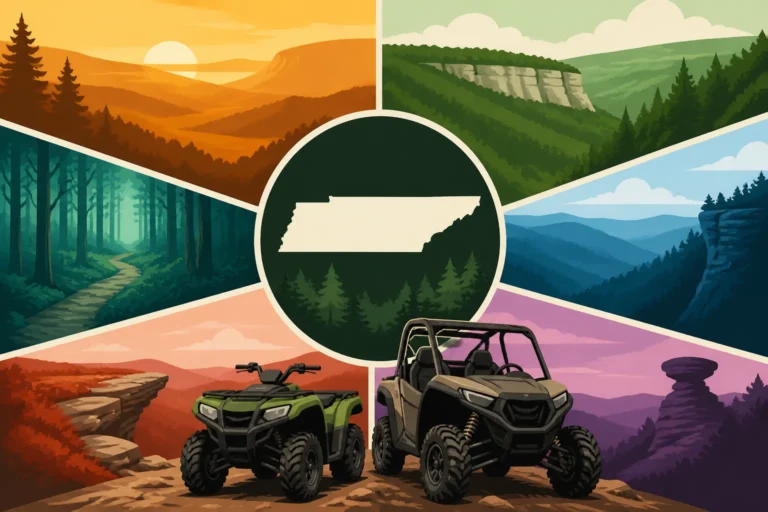
Tennessee Multi-Day Trail Rides
A Tennessee multi-day ATV or UTV trip can unravel when the trails you planned to connect turn out to be separate riding areas, require different permits, or have closures you didn’t know about. This guide helps you choose a practical base, plan ride days around distance and conditions, and sort out fuel, lodging, maps, and permits before you unload.
Choose a riding area that fits your trip
A multi-day ride is often easier when you pick one main riding area and explore it over several days, rather than trying to ride a different park every morning. Tennessee’s major off-road destinations are spread across the state, and trail access does not automatically connect from one private park or public riding area to another.
Before booking a cabin or campground, decide what kind of days you want. A group hoping to cover long distances will plan differently from a family with young riders, a first-time UTV driver, or a crew that wants to spend half the afternoon at overlooks. Allow time for slower trail sections, stops, and the occasional route change.
Compare the main destinations
Windrock Park near Oliver Springs, Brimstone Recreation near Huntsville, and Ride Royal Blue around Pioneer are familiar starting points for East Tennessee trips. Each has its own setting and access arrangements, so compare the riding experience and nearby lodging rather than choosing based only on a mileage claim or a trail photo.
| Riding area | A good fit for | What to plan around |
|---|---|---|
| Windrock Park near Oliver Springs | Riders looking for a large area with varied routes and a convenient East Tennessee base | Trail difficulty, changing conditions, fuel planning, and the right permit |
| Brimstone Recreation near Huntsville | Groups who want a dedicated riding destination and a place to build a multi-day itinerary | Park access, lodging or camping plans, and confirming current trail availability |
| Ride Royal Blue near Pioneer | Riders who want a base near the Royal Blue area and trails across a broad region | Route selection, fuel range, and which riding units or access points are open |
| North Cumberland units | Riders planning public-land riding with particular attention to unit boundaries and rules | Permit requirements, closures, seasonal restrictions, and trail-map details |
Use these comparisons as a starting point, not as a promise that every route or facility will suit your machine. The individual park’s rules and notices determine what is open and what you need to ride there.
If Windrock is your likely base, start with [Windrock Park at Oliver Springs, Tennessee]. For a trip built around Huntsville, review [Brimstone Recreation at Huntsville, Tennessee]. If Pioneer is more convenient for your group, [Ride Royal Blue Resort in Tennessee] gives you a focused place to begin your planning.
Avoid planning a park-to-park ride as if trails connect
A map can make two destinations look close together while the legal route between them is not rideable. A highway, private property, a closed section, or an unapproved road may separate trail systems. Don’t assume you can ride directly from one park to another just because both appear in the same regional map view.
This is especially important when you’re splitting a trip between areas. Treat each destination as a separate riding day, and plan to move the machines by trailer or street-legal vehicle where needed. Check the exact access rules for the land you’ll enter; road-use rules and trail access are not interchangeable.
It can also be useful to plan one primary riding area and one optional alternative. If rain, a closure, or a mechanical issue changes your schedule, you’ll have a fallback without needing to improvise a long transfer. [Why Tennessee's Big Parks Are Not Connected] is a helpful reminder to check the actual route rather than relying on geographic proximity.
Build a ride plan for each day
A multi-day itinerary should leave room for the ride to be slower than expected. On a trail, a short distance can take much longer than it would on a paved road, especially when the route includes rocks, mud, steep climbs, creek crossings, or frequent stops. It’s better to finish a sensible loop with daylight to spare than to chase a mileage goal and rush back in fading light.
For each day, choose a planned route, a shorter option, and a clear turnaround point. Share the plan with everyone in the group. If riders separate, a simple agreement about where to regroup can prevent a minor navigation mix-up from becoming a stressful search.
Match your routes to the group and the machines
Start by being honest about the least experienced rider and the least capable machine in your group. A stock ATV with limited ground clearance, a wide side-by-side, and an experienced rider on a modified machine may not be equally comfortable on the same route. A trail that feels manageable to one driver can be tiring or intimidating to someone else.
Build the first day as a shakedown. Use it to check how the machines handle the local terrain, how long the group takes to travel between trail features, and whether everyone is comfortable with the pace. A shorter first loop can reveal a tire issue, a loose accessory, or a communication problem before you commit to a longer ride the next day.
As the trip continues, vary the effort. After a demanding day, plan a shorter route or a relaxed morning instead of scheduling the hardest loop of the week. This matters for passengers, children, and anyone who is new to off-road riding: fatigue can make a familiar obstacle feel much more difficult.
Use maps and conditions together
Download or carry maps before you lose cell service. A route-planning app such as onX Offroad can help you review trails and keep your group oriented, but do not make a phone your only navigation tool. Bring a backup power source, save the relevant map area for offline use if available, and know how to identify your location if the screen or signal fails.
Compare the planned route with current park notices and trail conditions. A line on a map does not guarantee that the trail is open or passable on the day you arrive. Rain can change mud, water crossings, and steep sections; a closure can also make a loop unusable even if most of it remains accessible. Check [Tennessee Trail Conditions Before You Ride] and [Tennessee Trail Seasons and Closures] while you’re planning, then check again close to departure.
Keep the itinerary simple enough that the whole group can follow it. Mark the start point, planned stops, likely return time, and an alternate route. onX Offroad can be one part of that plan, but a paper or offline backup helps if a phone battery dies or the group gets separated. Carry a trail map appropriate to the area as well; [Tennessee Trail Maps Worth Carrying] is useful when deciding what navigation information to bring.
Sort out permits, lodging, fuel, and supplies
A comfortable multi-day ride depends on the off-trail details as much as the route itself. Confirm access before traveling, check where you’ll sleep, and decide how you’ll refuel machines and riders. Doing this early prevents the familiar arrival-day scramble: one person is trying to find a permit, another is searching for a campground, and the group is discovering that its fuel plan assumed a station would be open near the trail.
Confirm permits and access for every riding area
Tennessee does not have one trail permit that automatically grants access everywhere. Public riding areas and private parks can have separate requirements, and a permit or pass for one destination should not be assumed to work at another. Check the rules for each place on your itinerary, including who must hold a permit and whether it must be displayed or carried.
For a trip that includes more than one property, make a simple checklist of each area, its access requirements, and how you’ll obtain the necessary authorization. Keep proof accessible rather than buried in a packed trailer. [Tennessee Trail Permits Explained] provides useful background, but confirm the destination’s own rules before setting out.
Do not assume that a park permit gives permission to ride nearby roads or adjoining land. Road use, private-property access, and trail access are distinct questions. If your group is considering a route beyond a signed trail system, verify the rules with the relevant land manager or property owner first.
Choose a base and plan fuel deliberately
A place to sleep close to the trailhead can make a three-day trip feel much easier. Compare campgrounds, cabins, and other lodging based on how you’ll stage the machines, whether trailers can be parked, and how far you’ll need to travel each morning. A spot that looks close on a map may still require a slow drive or a detour with a trailer.
Browse [Camping Near Tennessee ATV Trails] for ideas, then confirm details directly with the campground or lodging provider. Ask about trailer parking, check-in arrangements, access roads, and whether the site is suitable for your group’s vehicle. If you’re camping, think through the practical basics too: dry clothing, food storage, charging batteries, and a place to clean muddy gear.
Fuel planning deserves its own attention. Do not assume you can refuel midway through a trail day, or that a nearby business will be open when you need it. Estimate fuel needs conservatively, consider the machine’s range under slow and demanding riding conditions, and identify reliable places to refuel between the lodging area and trailhead. [Fuel Between East Tennessee Towns] can help frame the planning, but verify the specific stops that make sense for your route. A spare fuel container may be useful where permitted, secured properly and carried according to park rules.
Prepare for changes, closures, and common problems
A strong itinerary is not a rigid one. Rain, a flat tire, an unexpected closure, or a tired rider can change the day. Plan with enough flexibility to adjust safely rather than treating every stop and loop as a deadline.
Pack for the ride you are actually taking
Bring the essentials for navigation, communication, weather, and basic repairs. What you need depends on the machine and route, but a practical checklist might include:
- Offline maps and a backup navigation option.
- A charged phone, charging cable, and portable battery.
- Water, snacks, and weather-appropriate layers.
- Basic tools and supplies that match your machine.
- First-aid supplies and a way to contact your group.
- Required permits, identification, and any park-specific documents.
- A plan for recovery if a machine becomes disabled.
Before the first ride, inspect tires, brakes, lights, fluids, and the equipment you rely on most. Confirm that the machine fits the intended route and that each rider understands the group’s signals and regrouping plan. If you’re bringing children or inexperienced passengers, explain where to sit, how to hold on, and what to do if the group stops.
Respect the trail and the conditions. Turn around if water, mud, visibility, or a damaged section makes the route unsafe for your group. Stay on authorized routes and follow posted closures. A rerouted day is frustrating, but damaging a machine or getting stranded far from the trailhead can turn a weekend into a much bigger problem.
Keep a flexible itinerary and a clear fallback
Build a shorter loop into each day’s plan so you can return early if weather or fatigue catches up with the group. Identify a nearby place to regroup and agree on what to do if riders lose contact. If you ride with several machines, make sure everyone knows who is leading and who is sweeping behind the group.
Check notices again before you ride, not only when you first book the trip. [Tennessee Trails Closed After Rain] is a useful topic to keep in mind when planning around wet weather. If the intended area is closed or conditions are poor, use your backup plan rather than trying to find an unverified route on the spot.
Finally, leave room for the parts of a trip that aren’t riding. Loading, unloading, meals, drying wet gear, and small repairs all take time. A realistic schedule gives your group space to enjoy the trip instead of racing the clock. With the right base, verified access, sensible daily routes, and a fallback for changing conditions, a multi-day Tennessee ride can feel adventurous without becoming unnecessarily stressful.
Disclaimer
This article is for general informational purposes only and does not constitute professional advice. Laws, prices and regulations vary by location and change over time. Consult a qualified professional for guidance on your specific situation.