Tennessee Rules for Riding a State Highway
It's a common dream for many ATV and UTV enthusiasts in Tennessee: the freedom to ride from the trails directly onto the open road, especially a state highway, for convenience or to connect to another riding area. However, the reality in the Volunteer State is far more complex than just heading out. This guide aims to unravel the intricacies of Tennessee's laws regarding ATV and UTV use on state highways, helping you understand where you can and cannot ride, and what strict conditions apply.
The Basics: Why State Highways Are Different
Navigating the rules for off-highway vehicles (OHVs) on public roads in Tennessee can feel like trying to solve a Rubik's Cube blindfolded. Many riders just want to get from Point A to Point B without trailering, but state highways, by their very nature, present a unique set of challenges and, consequently, stricter regulations.
Understanding Tennessee's Vehicle Categories
First, it’s crucial to understand how Tennessee classifies your machine. Generally, ATVs and UTVs fall into specific categories like [Tennessee's Class I OHV Definition] or [Tennessee's Class II OHV Definition]. These classifications are based on factors like width, weight, and seating capacity, and they dictate a lot about where your machine can legally operate.
The key takeaway here is that these classifications are primarily designed for off-road use. Unlike cars, trucks, or motorcycles, which are purpose-built for paved roads and highway speeds, ATVs and UTVs have different suspension, braking, and tire characteristics. This fundamental difference is the root of most road-use restrictions, especially on high-speed thoroughfares like state highways. They simply aren't engineered for sustained high-speed pavement travel, and the state's laws reflect this inherent safety concern.
The General Prohibition and Its Rationale
For the vast majority of Tennessee, the default rule is quite clear: ATVs and UTVs are not permitted to be ridden on state highways. This isn't just a bureaucratic whim; it's rooted deeply in safety considerations. State highways often carry higher speed limits, experience greater traffic volume, and are designed for vehicles capable of maintaining consistent speeds and handling pavement conditions robustly.
Imagine a situation where a side-by-side, designed for rugged trails and speeds up to 50-60 mph, is suddenly on a state highway where traffic is moving at 65-70 mph. The speed differential alone creates a massive hazard. OHVs typically have a narrower track width, higher center of gravity, and tires designed for traction in dirt, mud, or rock, not for smooth, high-speed asphalt. This makes them less stable, slower to react, and harder to control in highway traffic. This general prohibition aims to prevent serious accidents and protect both OHV riders and other motorists. It can be frustrating when you just need to connect two trails, but the state prioritizes public safety above all else.
Limited Exceptions: When You Might See an OHV on a State Highway
While the general rule is "no OHVs on state highways," Tennessee's laws, recognizing practical needs and specific scenarios, do carve out very narrow exceptions. It's vital to understand that these are exceptions and not broad permissions.
Crossing a State Highway
One of the most common exceptions to the general prohibition is the ability to cross a state highway. This is a crucial distinction: you can cross it, but you cannot ride on it for any significant distance. The goal is to allow riders to access trails or private property on the other side of a state highway.
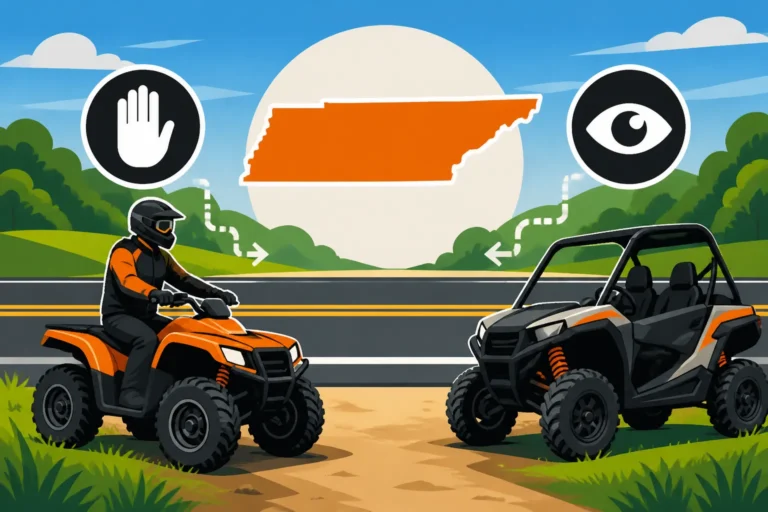
For two-lane state highways, the rule generally permits crossing at a ninety-degree angle. This means you approach the highway, stop, ensure it's safe to cross, and then proceed directly across to the other side, perpendicular to the flow of traffic. You're not supposed to drive down the shoulder or on the roadway to find a better crossing point; it's a direct, straight-line maneuver. For multi-lane highways, the process can be even more restrictive, often requiring specific intersections or designated crossing points as defined by the Tennessee Department of Transportation (TDOT). Always check for signage or local regulations before attempting to cross a multi-lane state route. Remember, crossing still demands extreme caution and adherence to all traffic laws, including yielding to highway traffic. [Crossing a Two-Lane at Ninety Degrees in Tennessee] and [Crossing a Multi-Lane Where TDOT Designates] are key references here.
Agricultural and Emergency Exemptions
Tennessee law also recognizes specific functional needs that might require an OHV to operate on a public road, including state highways, under very controlled circumstances.
For instance, [Tennessee's Agricultural Exception] allows OHVs to be used for farming operations. This means a farmer might be able to move their ATV or UTV a short distance on a state highway if it's directly related to agricultural work, such as moving between fields or to market. However, this is not a blanket permission for recreational riding or for driving long distances. The machine must be actively engaged in or directly supporting agricultural operations. Similarly, emergency and wildlife management vehicles are often exempt from these restrictions when they are performing their official duties. A park ranger or a wildlife officer using an ATV in an official capacity would fall under this exemption. It’s important to understand these are very specific, limited use cases and do not apply to the average recreational rider.
Designated Adventure Tourism Districts
This is where the rules become truly fascinating and, for some riders, a beacon of hope. Tennessee has established "Adventure Tourism Districts" in specific counties. These districts are designed to leverage the state's natural beauty and trail systems, allowing for limited, designated road use of OHVs to connect trails or access amenities within those specific zones.
The [Tennessee's Adventure Tourism Districts] law names [The Ten Counties Named in Tennessee Law] that have the potential to establish such districts. Within these counties, local authorities (like county commissions or town councils) can vote to designate certain county roads, and in very specific, limited instances, sections of state highways, for OHV use. This means that even within an Adventure Tourism District, you cannot assume all state highways are open. Often, these open sections are short connectors, clearly marked, and subject to strict rules. You'll typically find designated roads in places like Scott, Anderson, and Campbell counties. These areas often have robust trail systems, and the road access is intended to enhance the riding experience, allowing riders to move between trailheads, gas stations, or local businesses. For example, some sections of SR 63 in Huntsville might be open during specific weekends, or certain areas in LaFollette may have designated streets.
When riding in these districts, you'll need to be hyper-vigilant for signage and respect local ordinances. It's not a free-for-all; it's highly regulated access to boost local tourism.
Requirements for Permitted State Highway Use (Where Applicable)
Even in the rare instances where an OHV is legally allowed on a designated section of a state highway within an Adventure Tourism District, it's not simply a matter of rolling onto the pavement. There are stringent equipment, operator, and insurance requirements that must be met to ensure safety for everyone on the road.
Equipment Mandates for Road Use
If your OHV is permitted to be on a designated state highway section, it needs to be equipped like a proper road vehicle. This isn't just a suggestion; it's the law. [Tennessee Equipment Rules for Road Use] generally require:
- Headlights and Taillights: These must be functional and visible from appropriate distances, especially at dawn, dusk, or in inclement weather. For many stock machines, while they have lights, they might not meet the brightness or beam pattern requirements for highway use.
- Brake Lights: Essential for signaling stops and slowing down to traffic behind you.
- Turn Signals: Required for indicating your intent to turn or change lanes, a critical safety feature on any road.
- Rearview Mirrors: At least one, but often two, are mandated to give the operator a clear view of traffic approaching from behind.
- Horn: A functioning horn is necessary to alert other drivers or pedestrians to your presence.
- Windshield: While not always explicitly stated for OHVs in all road-use scenarios, a windshield offers crucial protection from debris, especially at higher speeds.
- Seatbelts/Restraints: For UTVs, these are typically factory-installed and must be worn.
Many stock ATVs and UTVs might not come with all these features, especially turn signals or a proper horn. This is where aftermarket solutions come into play. Companies like SuperATV offer a wide range of accessories, from turn signal kits to rearview mirrors and DOT-approved tires, that can help bring an OHV into compliance with road-use requirements. However, adding these parts doesn't automatically make your machine street legal everywhere; it only addresses the equipment aspect for areas where road use is already permitted. It's a critical distinction.
Operator and Passenger Rules
Beyond the machine itself, the person operating it, and any passengers, must also adhere to specific regulations when an OHV is on a state highway, even if it's a designated section.
- Minimum Age: Tennessee typically sets a [Tennessee Minimum Age to Ride a Road] of 16 years old for operating an OHV on public roads. This ensures that operators have some level of driving experience and maturity.
- Driver's License: An operator must possess a valid driver's license. This means a standard automobile license (Class D) is usually sufficient, as opposed to a specialized motorcycle endorsement.
- Helmet Law: [Tennessee Helmet Rules for Tennessee Riders] are quite strict. Generally, anyone under 18 operating or riding as a passenger on an OHV on a public road must wear an approved helmet. In some districts or on specific designated roads, helmets might be required for all riders regardless of age. Always check local ordinances, as these can vary slightly. The primary goal of these rules is to ensure that operators are competent and that all occupants are protected, especially given the increased risks of interacting with faster-moving traffic.
Insurance and Other Important Considerations
Finally, just like any other vehicle on a public road, OHVs used on designated state highway sections must typically carry liability insurance. [Insurance Tennessee Requires on a Road] protects you and others in case of an accident. It's not just a good idea; it's usually a legal requirement.
Beyond insurance, riders must always be aware of additional local rules. Even within Adventure Tourism Districts, specific roads might have different speed limits for OHVs, or restrictions on night riding (e.g., [Riding Only Between Sunrise and Sunset]). It's not enough to know you're in an "open" county; you need to know the specific rules for the exact section of road you're on. Always look for signage, check county websites, or inquire with local law enforcement or park officials. Ignoring these details can quickly turn a fun ride into a costly citation.
Consequences of Illegal State Highway Use
Riding an ATV or UTV illegally on a Tennessee state highway isn't just a slap on the wrist; it carries significant penalties and, more importantly, poses serious safety risks. Understanding these consequences is crucial for making informed decisions about where and how you ride.
Penalties and Fines
The financial and legal repercussions of illegally operating an OHV on a state highway can be substantial. You could be subject to fines that vary depending on the county and the specific infraction, but they are rarely minor. [Tennessee Fines for Illegal UTV Road Use] can quickly add up, especially if combined with other violations like lacking proper equipment or operating without a valid license.
Beyond just a fine, riding illegally can be classified as a misdemeanor. For instance, some violations might fall under [A Class C Misdemeanor in Tennessee], which can carry not only fines but also potential jail time, though this is often reserved for repeat offenders or more severe cases. The vehicle itself could also be impounded, leading to towing and storage fees on top of the legal penalties. Getting your machine back can be a lengthy and expensive process. It's a harsh reminder that while the trails offer a sense of freedom, public roads are a different domain governed by strict laws.
Safety Risks and Liabilities
The legal penalties, while impactful, often pale in comparison to the inherent safety risks and potential liabilities associated with operating an OHV on a state highway. As discussed, these machines are not designed for high-speed road use.
- Collision Risk: The biggest danger is the risk of collision with other vehicles. Differences in speed, braking distance, and handling characteristics make OHVs particularly vulnerable on highways. A side-by-side or ATV might not be able to accelerate or maneuver quickly enough to avoid a fast-approaching vehicle, or it might struggle to stop effectively at highway speeds.
- Stability Issues: High-speed turns or sudden evasive maneuvers that a car can handle might lead to a rollover or loss of control for an OHV.
- Exposure to Elements: Without enclosed cabs, riders are far more exposed to the elements and impact in a collision.
- Legal Liability: In the event of an accident, if you were operating your OHV illegally on a state highway, your liability could be significantly increased. Your insurance company might deny coverage, leaving you personally responsible for damages, medical bills, and potential lawsuits, which could amount to hundreds of thousands of dollars. Even if you carry insurance, operating outside the legal parameters can void your policy's protection.
It’s easy to think "just a short hop" won't hurt, but that short hop on a state highway can turn into a life-altering event. Always prioritize safety and adhere strictly to the law to protect yourself, your passengers, and your investment.
General OHV Road Use in Tennessee: Overview
Here's a quick overview of the general rules for OHV road use in Tennessee, keeping state highways in context:
| Aspect | General Rule | Exceptions (Highly Specific) |
|---|---|---|
| State Highways | Generally PROHIBITED for riding. | Crossing: Permitted at 90-degree angle (2-lane) or TDOT-designated (multi-lane). Adventure Tourism Districts: Specific sections within designated counties may allow use via local ordinance. (e.g., SR 63 on certain weekends). |
| County Roads | Generally PROHIBITED unless specifically designated by local county government via a two-thirds vote. | Adventure Tourism Districts: Many county roads within these districts are designated for OHV use. Agricultural Exception: Limited use for farm purposes. Emergency/Wildlife: Official duties. |
| Equipment | Not typically required for off-road use. | If on Designated Roads: Requires headlights, taillights, brake lights, turn signals, mirrors, horn, seatbelts (for UTVs). Aftermarket parts (e.g., from SuperATV) often needed. |
| Operator | No specific license for off-road. | If on Designated Roads: Valid driver's license, minimum age 16. |
| Helmets | Recommended off-road, often required for riders under 18 in parks. | If on Designated Roads: Required for all riders under 18; may be required for all ages by local ordinance. |
| Insurance | Recommended for private land/parks. | If on Designated Roads: Liability insurance is generally required. |
| Speed/Time | No statewide limit off-road; park rules apply. | If on Designated Roads: Speed limits apply (often 35 mph or 45 mph max); daylight hours only. |
| Interstates | Absolutely PROHIBITED. | No exceptions. |
Disclaimer
This article is for general informational purposes only and does not constitute professional advice. Laws, prices and regulations vary by location and change over time. Consult a qualified professional for guidance on your specific situation.