What a Tennessee Deputy Checks Roadside
It's no secret that riding your ATV or UTV in Tennessee offers some of the most incredible experiences, from the stunning trails of Windrock to the winding backroads of our beautiful state. But when you find yourself pulling off a county road onto a trail, or even just heading down the street for gas, there's always that little flicker of worry: what if a deputy pulls me over? The laws around off-highway vehicles on Tennessee roads can feel like a moving target, confusing even the most seasoned rider. This guide is here to untangle that knot, walking you through exactly what a Tennessee deputy is looking for during a roadside stop, so you can ride with confidence and keep those wheels turning.
Navigating Tennessee's Evolving OHV Road Laws
For years, the rules about riding ATVs and UTVs on Tennessee roads felt like a wild west scenario, with regulations changing not just from county to county, but sometimes even town to town. It was a dizzying patchwork that made it nearly impossible for riders to know if they were legal or not without a deep dive into local ordinances, which often felt like they were written in disappearing ink. That uncertainty was a real headache, leading to frustrated riders and sometimes, unexpected citations.
The Patchwork of Regulations and Recent Changes
Historically, Tennessee's approach to OHV road use was decentralized, meaning each county or municipality had the power to set its own rules. This created a complicated map where a UTV might be perfectly legal on a gravel road in Scott County, but crossing into Campbell County just a few miles down the road could land you a ticket for the exact same behavior. This wasn't just inconvenient; it actively discouraged riders from exploring new areas, fearing they might unknowingly break a local rule. The complexity often left riders feeling like they were playing a guessing game, rather than simply enjoying their machines.
However, the landscape began to shift with more statewide clarity emerging. Recent legislative changes have aimed to bring a degree of uniformity, especially regarding designated "adventure tourism districts." These new laws, like those outlined in [What House Bill 810 Changed in 2025], have started to establish a more consistent framework, moving away from the extreme local variability. While not a complete free-for-all, these changes provide a more predictable environment for riders, designating specific conditions and locations where OHV road use is permissible. It's a welcome development that reduces the guesswork, though local nuances still definitely exist and demand your attention.
Where OHVs Are Permitted and Prohibited on Public Roads
Even with statewide changes, understanding precisely where you can and cannot ride on Tennessee roads remains crucial. Generally speaking, the state has opened certain county roads to OHV use, particularly within the designated adventure tourism districts. These are often unpaved or low-speed roads where OHV traffic is expected and managed. The key here is "designated." You can't just assume any county road is fair game. Many counties have specific lists of open roads, and it’s your responsibility to know them. For detailed insights, you’ll want to review [Tennessee Rules for Riding a County Road].
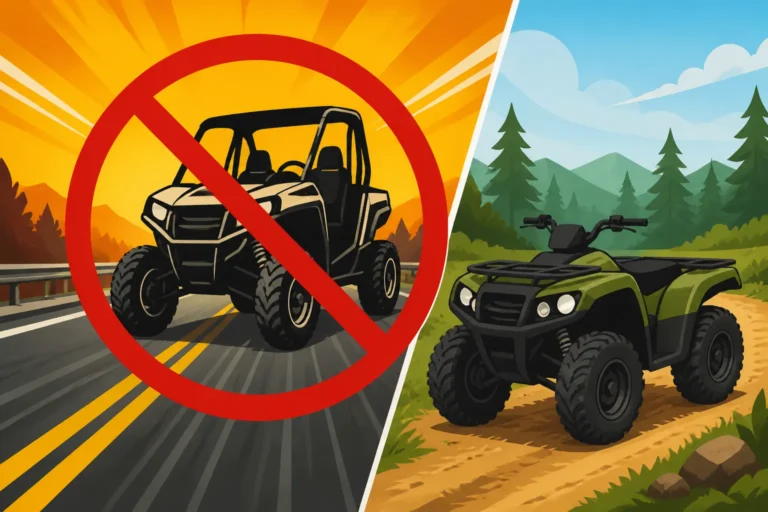
State highways, on the other hand, typically remain much more restricted. While there might be specific, limited exceptions for crossing, generally, major state routes are off-limits for ATVs and UTVs. The speed, volume of traffic, and design of these roads simply aren't compatible with OHV characteristics. This distinction is vital, as mixing an OHV with high-speed highway traffic poses significant safety risks and can lead to immediate citations. Always err on the side of caution when considering state routes. Your best bet is to understand [Tennessee Rules for Riding a State Highway] and stick to clearly marked or designated routes.
Essential Documentation for Every Rider
When a Tennessee deputy waves you over, the first things they're going to ask for are your papers. Think of it like a driver's license stop in your car – they need to verify who you are, who owns the machine, and if you're legally allowed to operate it. Having everything in order doesn't just prevent a ticket; it makes the whole interaction go a lot smoother and quicker, getting you back on the trail or road faster.
Title, TDR Sticker, and Proof of Ownership
In Tennessee, proving ownership and registration for your OHV is paramount. This starts with your vehicle's title, which is the official document identifying you as the legal owner. It’s similar to a car title but specifically for your ATV or UTV. While you don't necessarily need to carry the physical title with you on every ride (it's best kept in a safe place at home), you absolutely need proof of its existence and proper titling.
That proof comes in the form of the Tennessee Department of Revenue (TDR) sticker. This small but mighty sticker, often affixed directly to your title document or provided as a separate document to be kept with your machine, indicates that your OHV has been properly titled in Tennessee. It’s a critical piece of the puzzle, and a deputy will look for it. The nuances of this sticker are explained further in [Tennessee's TDR Sticker Explained]. Remember, this isn't a "registration" in the same way a car has a yearly registration; rather, it’s proof your machine has gone through the state's titling process. Understanding [A Sticker That Proves a Tennessee Title Exists] will clarify its significance during a roadside check.
Valid Driver's License and Insurance Requirements
Just like driving a car, operating an OHV on any public road in Tennessee means you need to be a licensed driver. This isn't just about knowing how to handle the machine; it's about demonstrating you meet the basic legal requirements for operating a motor vehicle. A standard Class D driver's license is generally sufficient. Deputies will ask for this to confirm you're of legal driving age and possess the necessary authorization. Operating an OHV on a public road without a valid license can lead to serious legal consequences, not just for the OHV violation but for driving without a license. Make sure you understand [Tennessee Driver's License Rules for UTVs] before you head out.
Furthermore, Tennessee mandates that any OHV operated on public roads must carry liability insurance. This is a critical safety net, protecting you and others in the event of an accident. Deputies will likely ask for proof of insurance, typically in the form of an insurance card or policy document. Many riders assume that because their OHV isn't a "car," it doesn't need insurance for road use, but that's a dangerous misconception. The moment you put wheels on a public road, those rules kick in. Failing to carry proof of insurance can result in fines and other penalties, so ensure your policy is up to date and accessible. For all the specifics, check out [Tennessee UTV Insurance Requirement].
Mandatory Equipment for Street Legality
Beyond paperwork, your ATV or UTV itself needs to meet certain equipment standards to be considered street-legal in Tennessee, even on designated roads. Think of it as outfitting your machine for mixed-use: it's still a trail beast, but it needs to play nice with road traffic. Deputies are trained to look for these modifications, as they directly impact safety for both the OHV operator and other motorists.
Lighting, Signaling, and Visibility Components
For an OHV to be legally operated on Tennessee roads, it needs to be visible and capable of signaling its intentions to others, much like any other vehicle. This means having fully functional headlights that illuminate the road ahead, taillights that are visible from the rear, and brake lights that clearly signal when you're slowing down or stopping. These aren't just for night riding; they're essential for visibility during the day, especially in changing light conditions or inclement weather. Ensure all these lights are clean, working, and easily seen.
But it doesn't stop there. Turn signals are also a requirement for road use. Your ATV or UTV needs to clearly indicate when you're turning, similar to a car. Many off-the-shelf machines don't come with turn signals, so this often requires an aftermarket kit. Brands like SuperATV offer comprehensive turn signal kits that are designed to integrate seamlessly into most popular OHV models, ensuring you meet this critical road-use requirement. Additionally, some regulations may require reflective tape or other visibility enhancements, particularly for larger machines or those used at dawn or dusk, even if full night riding isn't permitted. Familiarize yourself with all the requirements under [Tennessee Equipment Rules for Road Use].
Mirrors, Horns, Windshields, and Other Safety Gear
Visibility isn't just about being seen; it's about seeing what's around you. This is why mirrors are a mandatory component for road-legal OHVs. You'll typically need at least one rearview mirror, and often two side mirrors, to provide a clear field of vision behind and to the sides of your machine. Again, many stock ATVs and UTVs might not come equipped with these, so an aftermarket solution is often necessary. SuperATV provides a variety of robust and trail-ready mirrors that also meet the criteria for road use, ensuring you can safely monitor traffic around you.
Another crucial safety feature is a working horn. It might seem simple, but a horn is your primary tool for alerting other drivers or pedestrians to your presence in a potentially hazardous situation. Make sure your horn is easily accessible and produces an audible sound. While not always explicitly required for every OHV, a DOT-approved windshield is becoming increasingly common for UTVs on roads. This offers protection from road debris and weather, enhancing driver comfort and safety. If you're looking for a durable, compliant windshield, SuperATV is a great resource. Beyond these, general equipment like properly functioning seatbelts (for UTVs) and adequate mud flaps to prevent debris from being thrown are also factors a deputy might consider when assessing your machine's roadworthiness under [Tennessee UTV Road Requirements].
Operator and Passenger Safety Protocols
Beyond the machine itself, Tennessee law also has clear expectations for how operators and passengers conduct themselves on public roads. These rules are in place not to restrict your fun, but to maximize safety for everyone sharing the road. A deputy checking you roadside will be looking not just at your machine, but at how you and your passengers are equipped and behaving.
Helmet Laws and Age Restrictions on Public Roads
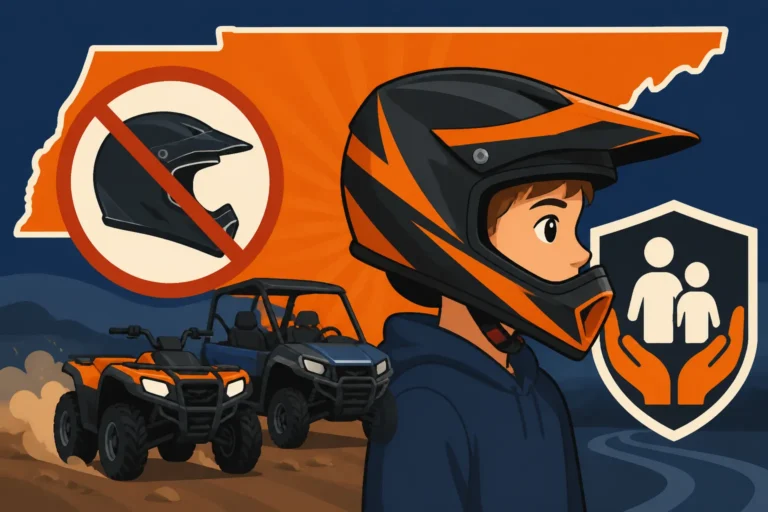
One of the most consistently enforced safety rules for OHV use on public roads in Tennessee revolves around helmets. For operators and passengers, specific age-related helmet requirements are in place. Generally, anyone under a certain age (often 18, but it's crucial to check current statutes as these can change) is legally mandated to wear an approved helmet when riding an ATV or UTV on a public road. This is a non-negotiable safety measure designed to protect younger riders who might be more vulnerable in a collision. Even if you're an adult and the law allows you to ride without a helmet in certain situations, wearing one is always the smartest choice for your own protection.
The laws can sometimes be nuanced, distinguishing between off-road and on-road use, or even varying based on the type of machine. So, while you might be accustomed to riding helmet-free on private land, those rules absolutely shift the moment your tires hit a public thoroughfare. Deputies are well aware of these distinctions and will specifically check for compliance, especially if there are minors on board. Neglecting this could result in a citation. For a comprehensive understanding, consult [Tennessee Helmet Law for ATV Riders] and [Tennessee Helmet Law for Passengers].
Passenger Rules and Safe Operating Practices
The number of passengers your ATV or UTV can legally carry on a public road is another crucial point a deputy will scrutinize. Generally, the rule of thumb is that passengers must be seated in manufacturer-designed seating positions and secured by seatbelts (in UTVs). You cannot have more passengers than the vehicle was designed for, nor can passengers ride in unconventional or unsafe positions, such as in the bed of a UTV or standing. This is a safety issue first and foremost, as improperly seated passengers are at a much higher risk of injury during sudden stops or turns.
Beyond just the numbers, safe operating practices are also under review. This means no reckless driving, no excessive speeds for the conditions, and certainly no driving under the influence. A deputy observes the overall conduct of the operator. Are you maintaining control? Are you signaling turns? Are you respecting other traffic? These observations contribute to a deputy's decision on whether to just check your documents or issue a citation. Safe and responsible riding, including adhering to proper passenger limits, demonstrates that you are a conscientious operator. To learn more about specific guidelines, refer to [Tennessee Rules for a Passenger on a Road].
Avoiding Citations: Common Roadside Scenarios and Best Practices
Nobody wants to cut short a great day of riding with a roadside stop that ends in a citation. While a deputy might pull you over just for a routine check, knowing the common pitfalls and how to avoid them can save you a lot of hassle, time, and money. It's about being prepared and understanding the specific limitations Tennessee places on OHV road use.
Speed Limits, Daylight Use, and Restricted Zones
One of the quickest ways to draw a deputy's attention is by exceeding the posted speed limits. In Tennessee, even on designated OHV roads, there are typically speed restrictions, often capped around [Tennessee's 45 mph Road Rule], or even lower depending on the specific road and local ordinances. Your OHV might be capable of much higher speeds, but on public roads, you must adhere to the limits designed for mixed traffic. Speeding is a universal traffic violation, and OHVs are no exception.
Furthermore, most Tennessee laws restrict OHV road use to daylight hours. This means riding only between sunrise and sunset. While your machine may have powerful aftermarket lights, the intent of the law is to minimize the challenges of low-light visibility for both the OHV and other vehicles. Riding after dark or before dawn, even if the road technically allows OHVs, can lead to a citation. Deputies will be particularly vigilant about this. Always confirm the exact "daylight hours" stipulation for the area you're riding, as described in [Riding Only Between Sunrise and Sunset]. It's a fundamental rule that helps ensure everyone's safety. Beyond speed and time, deputies will also be checking if you're actually on a designated road. Many areas publish restricted road lists, and it's your responsibility to review [Checking a Restricted Road List] before you ride.
Crossings, Interstates, and Designated Adventure Districts
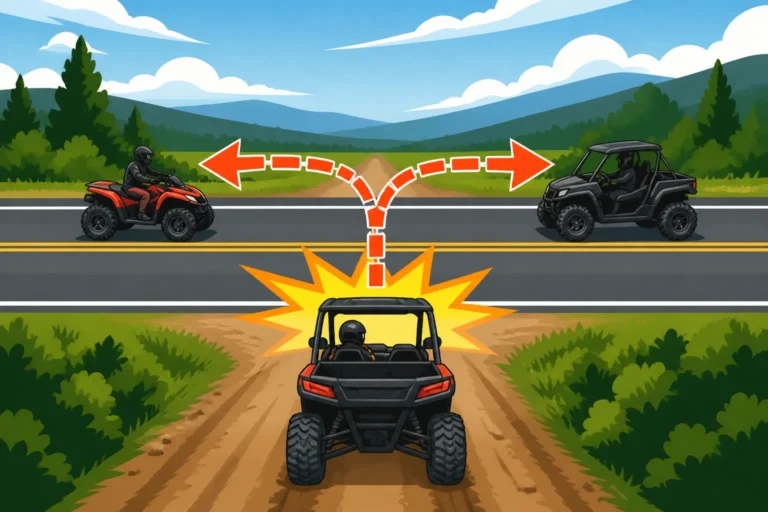
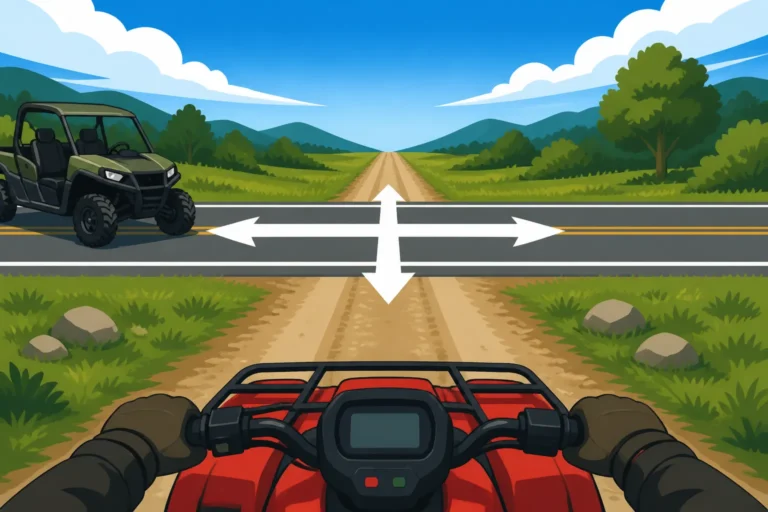
Tennessee law often makes specific provisions for crossing roads. For instance, you might be allowed to cross a two-lane highway at a ninety-degree angle to get from one trail segment to another, provided it's done safely and quickly, as detailed in [Crossing a Two-Lane at Ninety Degrees in Tennessee]. However, this is vastly different from riding along a state highway. Deputies will be watching how you execute these crossings and if you're attempting them in legal, designated areas. Trying to ride down a busy state highway, even for a short distance, is almost certainly a violation.
It's also absolutely crucial to remember that interstates are uniformly off-limits for ATVs and UTVs in Tennessee. There are simply no exceptions to this rule. Trying to access or ride on an interstate with your OHV will result in immediate and serious legal consequences. For more detail, you can check [Why Tennessee Bars Interstates]. Conversely, understanding the benefits of [Tennessee's Adventure Tourism Districts] can be immensely helpful. These are areas where local governments have specifically designated roads for OHV use, often with clear signage and infrastructure to support riders. Operating within these districts, while still adhering to all other rules, provides a more permissive environment for OHV road travel, and deputies in these areas are accustomed to seeing OHVs, though they will still enforce all applicable laws.
Disclaimer
This article is for general informational purposes only and does not constitute professional advice. Laws, prices and regulations vary by location and change over time. Consult a qualified professional for guidance on your specific situation.