Tennessee Equipment Rules for Road Use
There's nothing quite like the freedom of hopping on your ATV or UTV and hitting the trails, feeling the wind and the grit of the dirt beneath you. But what happens when you need to cross a paved road, or you want to ride directly from your cabin to a nearby trailhead? Many riders in Tennessee find themselves scratching their heads, wondering exactly what their off-road machine needs to be street legal, or at least road-compliant, for those short stretches. The confusion around specific equipment requirements can be a real headache, leading to worry about fines or even accidents. This comprehensive guide is here to cut through the noise, detailing all the essential equipment your ATV or UTV needs to legally navigate Tennessee's roads where permitted, helping you ride with confidence and peace of mind.
Understanding the "Why" Behind Road Equipment Rules
It’s easy to feel like these road rules are just arbitrary hoops to jump through, especially when your machine feels perfectly capable off-road. But when you move from a dedicated trail to a public road, the entire environment changes drastically. Suddenly, you're sharing space with cars, trucks, and even large commercial vehicles, all operating at different speeds and with different expectations. The equipment rules aren't designed to make your life harder; they're in place to help bridge that gap between the two worlds, ensuring everyone's safety.
Bridging the Gap: From Trail Machine to Road-Legal Vehicle
Think about it: your ATV or UTV was likely designed primarily for navigating rough terrain, climbing hills, and tackling mud pits. Its tires are aggressive, its suspension might be geared for articulation, and its lighting might be focused more on illuminating a dark trail than being seen clearly by oncoming traffic. When you transition to asphalt, these characteristics can actually become liabilities if not properly addressed. A knobby tire that excels in dirt might wear rapidly on pavement, reduce traction in wet conditions, or even cause unstable handling at road speeds.
Tennessee, like other states, recognizes the growing popularity of these machines and the desire of riders to connect trails or access amenities. However, this convenience must be balanced with the existing infrastructure and traffic laws. The modifications or additions required are essentially about giving your off-road vehicle the basic features that standard passenger vehicles have, so it can operate predictably and visibly in a mixed-traffic environment. It's about adapting your trail beast to politely coexist with daily commuters for those permitted stretches.
Prioritizing Safety for Both Rider and Public
At its heart, every equipment rule for road use boils down to safety. When you’re out on a county road, you need to be seen, you need to be able to signal your intentions, and you need to be able to stop effectively. Other drivers aren't expecting the unique profile or handling characteristics of an ATV or UTV, so your machine needs to compensate by being undeniably visible and communicating clearly. This means having proper lights, reflective surfaces, and functioning turn signals.
Beyond visibility, having adequate brakes, a stable steering system, and appropriate tires are critical for maintaining control, especially when encountering unexpected obstacles or sudden stops. It's not just about protecting yourself from a collision with a 3,000-pound sedan; it's also about preventing you from becoming an unpredictable hazard to others. These rules are a collective agreement to ensure that everyone who shares the road, regardless of their vehicle, has a reasonable expectation of safety and predictability. It’s an empathetic approach, understanding that you want to enjoy your ride but also recognizing the responsibilities that come with sharing public thoroughfares.
Mandatory Lighting and Signaling for Visibility
When you're out on a road, especially one with a speed limit that approaches 35 or 45 mph, visibility is paramount. Unlike a secluded trail where you might only need enough light to see directly in front of you, on the road, you need to be seen by others from all directions, both day and night. Tennessee's rules reflect this need, mandating specific lighting and signaling equipment to prevent accidents and ensure your presence is unmistakable.
Illuminating Your Path: Headlights, Taillights, and Reflectors
First and foremost, your machine needs proper illumination. This isn't just about your ability to see the road; it's about other drivers being able to see you. Tennessee typically requires working headlights that are capable of both high and low beams, providing adequate forward visibility. These lights need to be properly aimed so they don't blind oncoming traffic, just like a car's headlights. Imagine trying to navigate a winding rural road at dusk without proper headlights – it’s not just dangerous for you, but for anyone else on that road.
Equally important are red taillights mounted on the rear of your machine. These must be clearly visible from a certain distance, ensuring that anyone following you knows you're there. Many off-road machines come with basic LED taillights, but it’s crucial to ensure they’re functioning correctly and aren't obscured by mud, equipment, or modifications. For added measure, many states also require rear reflectors, which offer a passive but effective way to be seen, even if your lights fail or aren't on. Think of them as a backup beacon, catching light from other vehicles. These [Tennessee Lighting Requirements for UTVs] are in place to drastically reduce the risk of a rear-end collision, a common type of accident for slower-moving vehicles on public roads.
Communicating Your Intent: Turn Signals and Brake Lights
One of the biggest differences between trail riding and road riding is the need to communicate your intentions to other drivers. On a trail, you might simply slow down or shout to a friend. On the road, a sudden, unannounced turn can cause a serious accident. This is where turn signals become absolutely critical. Your ATV or UTV needs functional turn signals, both front and rear, that flash clearly and consistently. They must be amber in color and visible from a reasonable distance, giving other drivers ample time to react to your upcoming maneuver.
Just as vital are brake lights. Your machine must have a red brake light (or lights) on the rear that illuminates automatically and immediately when you apply the brakes. This instantaneous communication tells drivers behind you that you are slowing down or stopping, allowing them to adjust their speed and maintain a safe following distance. Many off-road machines don't come standard with comprehensive turn signal and brake light setups, making this one of the most common modifications for road use. Companies like SuperATV offer excellent aftermarket kits that provide these essential safety features, often designed specifically for the rugged demands of ATV and UTV use while meeting road-legal specifications. It's an investment in your safety and the safety of everyone around you.
Control and Stability: Wheels, Brakes, and Steering
Beyond just being seen, your ATV or UTV needs to handle predictably and safely when on paved surfaces. The unique dynamics of these machines, coupled with the demands of road driving, mean that components like your tires, brakes, and steering system must meet a different standard than what might suffice for solely off-road adventures. Ensuring these elements are in top shape is about maintaining control, especially when situations change rapidly.
Tires and Wheels: The Foundation of Road Grip
This is where many riders encounter a significant hurdle. Those aggressive, deep-lugged tires that grip dirt, mud, and rocks so brilliantly can be a real detriment on pavement. Their large voids and soft compounds can lead to poor traction on smooth, wet asphalt, accelerate wear dramatically, and even cause unstable handling at speed. Tennessee, like most states, expects tires designed for road use, or at least ones that won't compromise safety. This often means tires with a more street-oriented tread pattern, offering more contact patch with the road.
Beyond tread, consider the wear. Aggressive off-road tires can wear down incredibly fast on pavement, becoming a costly replacement cycle. You’ll also want to ensure your tire pressure is set appropriately for road use, which is typically higher than for trails, to improve stability and fuel efficiency. While a dedicated set of street tires might seem like an extra expense, it’s a crucial safety component. Some riders opt for a less aggressive all-terrain tire that can offer a compromise, but it’s important to research what’s best for your machine and riding habits. Choosing the right tires is literally the foundation of your machine's ability to maintain grip and control on a public road, impacting everything from braking distance to cornering stability.
Braking Power: Stopping Safely on Asphalt
On the trail, you might rely on engine braking or simply slide to a stop in the dirt. On a paved road, in traffic, reliable and effective braking is non-negotiable. Your ATV or UTV must have a fully functional braking system on all wheels. This means calipers, rotors (or drums), and brake pads that are in good condition and provide strong, consistent stopping power without pulling to one side. A functional parking brake is also typically a requirement, ensuring your machine stays put when parked on an incline or waiting in traffic.
Regularly inspecting your brake lines for leaks or damage and checking your brake fluid levels is vital. The demands of road use, especially if you’re traveling at higher speeds, put more stress on your braking system than typical trail riding. Imagine needing to make an emergency stop to avoid a deer or an unexpected traffic jam – a compromised braking system could lead to disastrous consequences. It’s not enough for your brakes to "work"; they need to work well and reliably every single time you need them.
Steering and Suspension: Maintaining Control
The steering system on your ATV or UTV needs to be tight and responsive, without excessive play or looseness. This ensures predictable handling, which is crucial when navigating road curves, staying in your lane, or reacting to hazards. Worn tie rod ends, ball joints, or loose steering components can make a machine feel "wandering" or unstable on pavement, a sensation you absolutely want to avoid at higher speeds.
Similarly, your suspension system plays a key role in road stability. While a flexible suspension is great for absorbing bumps on the trail, for road use, you need a setup that minimizes body roll and maintains tire contact with the pavement. If you've modified your suspension with lift kits or custom shocks, ensure these modifications don't compromise your machine's road manners. A reputable aftermarket manufacturer like SuperATV offers suspension components designed to improve both off-road performance and on-road handling, but always verify that any modifications adhere to Tennessee's specific guidelines for road-legal vehicles. Ensuring your steering and suspension are robust and properly maintained provides the confidence and control you need to safely share the road with other vehicles.
Essential Accessories for Awareness and Protection
While lights and brakes cover basic visibility and stopping, a few other accessories are universally accepted as crucial for road safety. These components help you stay aware of your surroundings, communicate effectively, and offer basic protection, completing the picture of a road-ready ATV or UTV. Without them, you're operating with blind spots or lacking the ability to alert others.
Mirrors and Horn: Seeing and Being Heard
Just like any car or truck, your ATV or UTV needs to give you a clear view of what’s happening behind you. Tennessee typically requires at least one, and often two, functional rear-view mirrors. These mirrors must be properly positioned to provide an unobstructed view to the rear and side. A single handlebar-mounted mirror might suffice for some, but having two mirrors – one on each side, usually attached to the roll cage or handlebars – provides a much more comprehensive field of vision, which is incredibly important for lane changes or simply monitoring traffic. Imagine pulling onto a highway without knowing if a truck is right on your tail; it's a terrifying thought.
Alongside mirrors, a working horn is an absolute must. This isn’t just for sounding off at friends on the trail. On the road, a horn is a vital safety device, allowing you to alert other drivers, pedestrians, or even animals to your presence. Whether it’s to prevent a potential collision or simply get someone’s attention, your horn needs to be loud enough to be heard over road noise and other vehicles. Make sure it's easily accessible and functional before heading out on any public thoroughfare.
Windshields, Seatbelts, and Occupant Safety
While not always a universal requirement for all road-legal OHV categories in every state, a windshield is often a highly recommended, if not mandated, accessory for UTVs intended for road use. A proper windshield, typically made of laminated safety glass, protects occupants from wind, bugs, and road debris, greatly enhancing comfort and safety at speed. Without one, you’re exposed to elements that can quickly become hazardous, especially for your eyes. Always check the exact [Tennessee UTV Road Requirements] for your specific class of vehicle.
Beyond the windshield, seatbelts are non-negotiable for any occupant in a UTV. If your machine has multiple seats, each seating position must be equipped with a functional seatbelt, and they must be worn by all occupants. This goes hand-in-hand with [Tennessee Helmet Law for Operator and Passengers], which generally dictates helmet use on public roads, especially for younger riders. Some states also specify requirements for doors or safety nets, particularly for side-by-sides, to ensure occupants remain securely within the vehicle's cage in the event of an impact or rollover. It’s all about protecting the precious cargo you carry, whether that’s yourself or your family.
Documentation, Identification, and Road-Specific Details
Even if your ATV or UTV is perfectly equipped for the road, it’s not truly legal without the right paperwork and proper identification. Think of it like dressing up for a formal event – you can have the perfect outfit, but if you forget your invitation, you’re still not getting in. Tennessee has specific requirements for titling, identification, and sometimes even a special sticker that proves your machine is recognized by the state for road use.
Displaying Your Title Sticker and Proof of Compliance
In Tennessee, your off-road machine, if it meets certain criteria, will have a title, and for road use, you might need to display proof of that. While Tennessee does not register off-road machines in the traditional sense like cars, it does require titling for many ATVs and UTVs. The key here is often the [Tennessee's TDR Sticker Explained]. This sticker, which you apply to your machine, is visual proof that your vehicle has gone through the titling process with the Tennessee Department of Revenue. It's a quick way for law enforcement to see that your machine is recognized by the state.
Beyond the sticker, you absolutely must carry your driver's license – a valid one, suitable for operating a motor vehicle. [Tennessee Driver's License Rules for UTVs] are clear on this. You'll also need proof of insurance. While not all OHV categories require insurance for off-road use, it is almost always mandatory for any machine operating on public roads. This [Tennessee UTV Insurance Requirement] protects you and others in case of an accident. Furthermore, always keep a copy of your machine's title or registration handy, usually in a waterproof bag on the machine itself or with you. While [Does a Tennessee UTV Need a Plate for Roads?] is a common question, the TDR sticker serves a similar identification purpose in lieu of traditional license plates for these specific machines.
Weight and Width: Meeting Vehicle Category Standards
Tennessee has established different vehicle categories for OHVs, and these classifications directly impact what roads you can legally ride on and under what conditions. Your machine's physical dimensions, particularly its weight and width, play a critical role here. For instance, [Tennessee's Class I OHV Definition] generally applies to machines that are 2,500 pounds or less and 50 inches or less in width. Many traditional ATVs fall into this category.
However, many popular side-by-sides exceed these dimensions, often falling into [Tennessee's Class II OHV Definition]. These are typically wider than 50 inches but not more than 80 inches, and heavier than 2,500 pounds but not more than 8,000 pounds. This is where phrases like [2,500 Pounds and 80 Inches] come into play, referring to the upper limits for certain road use cases. Understanding which class your machine falls into is paramount because it dictates whether you can even consider road use, and if so, under which specific provisions. Exceeding width limits, such as those covered in [Tennessee Rules for a Machine Over 80 Inches], can mean your machine is simply too wide for certain roads or may require special permits, fundamentally altering its road legality. This distinction is also vital when considering categories like [Tennessee's Low Speed Vehicle Category] or [Tennessee's Medium Speed Vehicle Category], which have their own sets of speed, weight, and dimension restrictions for road use.
Beyond the Basics: Important Considerations and Compliance
Once you've got the core equipment dialed in and your paperwork in order, there are still a few nuanced aspects of road compliance that dedicated riders need to be aware of. These go beyond the immediate safety features and delve into how your machine interacts with the environment and the law, especially when you're looking to push performance or simply avoid unexpected trouble.
Modifying for the Road: Aftermarket Parts and Legality
Many riders love to customize their machines, and the aftermarket is brimming with options for ATVs and UTVs. However, when you're aiming for road legality, every modification needs careful consideration. While companies like SuperATV provide a fantastic array of performance and utility parts, it's crucial to ensure that any aftermarket component you add doesn't inadvertently violate Tennessee's road-use rules. For instance, a lift kit that's perfect for clearing obstacles on the trail might raise your center of gravity too much for stable road handling, or exceed height restrictions.
Similarly, adding custom lighting needs to be done with care. While extra LED light bars are great for night riding off-road, they are often illegal for use on public roads and can blind oncoming traffic. Headlights and taillights, even if aftermarket, must meet brightness, color, and placement specifications. Always read the fine print or consult with a reputable dealer or the county clerk's office when making significant modifications that could impact your machine's road-worthiness. The goal is to enhance your machine within the boundaries of the law, not to create a compliance headache.
Emissions, Sound, and Environmental Compliance
While ATVs and UTVs typically aren't subjected to the same stringent emissions testing as passenger cars, there are still some general expectations regarding environmental compliance. Most notably, your machine should have a functioning spark arrester in its exhaust system. This is a safety device designed to prevent hot carbon particles from exiting the exhaust and potentially igniting dry vegetation, a very real concern when riding in wooded areas or along dry roadsides.
Sound levels are another area to be mindful of. While an aggressively loud exhaust might sound powerful, excessive noise can be a nuisance to residents and other road users, potentially drawing unwanted attention from law enforcement. Although specific decibel limits for OHVs on Tennessee roads may not be as clearly defined as for off-road trails (where noise rules are more common), operating an excessively loud vehicle can still lead to citations under general nuisance laws. It's best practice to keep your exhaust system in good repair and avoid modifications that significantly increase noise output beyond reasonable levels.
Consequences of Non-Compliance on Tennessee Roads
Ignorance of the law is rarely an excuse, and riding a non-compliant ATV or UTV on Tennessee roads can lead to a host of unpleasant consequences. The most immediate is a traffic citation, which can include fines and potentially points on your driver's license. Depending on the severity of the violation, your machine could even be impounded, leading to significant costs for recovery and storage. Imagine getting a ticket for not having turn signals, or worse, having your pride and joy towed away because it lacked proper lighting.
Furthermore, if you're involved in an accident while operating a non-compliant machine, you could face severe legal and financial repercussions. Your insurance company might deny a claim if your vehicle was not legally equipped for road use, leaving you personally liable for damages and injuries. This is why understanding [Tennessee Road Use Rules for ATVs] and the specific changes brought by legislation like [What House Bill 810 Changed in 2025] is so vital. Staying informed and ensuring your machine meets all necessary equipment standards is the smartest way to enjoy your ride and avoid unnecessary trouble.
Essential Equipment Checklist for Tennessee Road Use
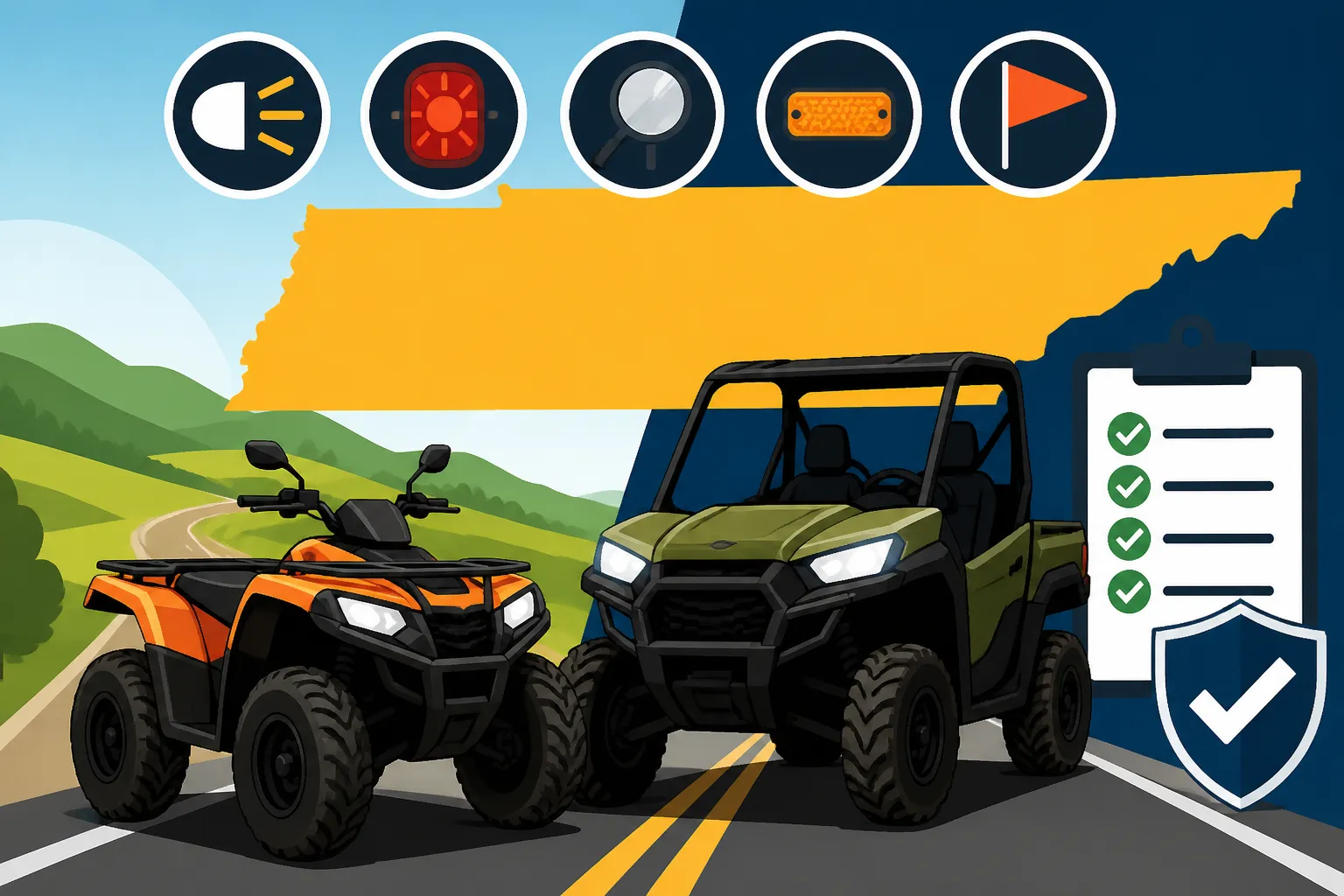
To help you get a quick overview, here's a checklist of common equipment items and their typical status for road use in Tennessee. Remember, specific requirements can vary based on your machine's classification (Class I, Class II, Low-Speed Vehicle, Medium-Speed Vehicle) and the specific roads you intend to ride on, so always verify with your local county clerk or the Tennessee Department of Revenue.
| Equipment Item | Typically Required for Road Use in TN? | Notes |
|---|---|---|
| Headlights (High/Low Beam) | Yes | Must be fully functional, properly aimed, and visible. |
| Taillights (Red) | Yes | Must illuminate consistently and be visible from the rear. |
| Brake Lights (Red) | Yes | Must activate immediately upon brake application. |
| Turn Signals (Amber, F&R) | Yes | Must be visible from front and rear, indicating direction. |
| Rear-View Mirrors | Yes (At least one, two recommended) | Must provide clear view to the rear. |
| Horn | Yes | Must be audible from a specified distance. |
| Windshield | Often for UTVs; varies by class/speed | Protects from wind and debris; typically laminated safety glass for road speeds. |
| Seatbelts | Yes (for all occupants in UTVs) | Must be worn by all occupants. |
| Tires | Yes | Must be safe for pavement; aggressive off-road tires may be unsuitable or wear quickly. |
| Brakes (All Wheels) | Yes | Must be fully functional and provide reliable stopping power. Parking brake often required. |
| Spark Arrester | Yes | Prevents ignition of dry materials. |
| Reflectors | Often, especially rear red reflectors | Provides passive visibility, especially if lights are off or fail. |
| TDR Sticker Displayed | Yes | Proof of titling in Tennessee. |
| VIN Clearly Visible | Yes | Vehicle Identification Number must be legible and match documentation. |
| Muffler / Exhaust System | Yes | Must be in good working order to prevent excessive noise. |
| Fenders / Mudguards | Sometimes; varies | To prevent throwing road debris onto other vehicles. |
Remember, this table is a general guide. For the most accurate and up-to-date information regarding your specific machine and intended use, consult official Tennessee state resources or your local county clerk.
Disclaimer
This article is for general informational purposes only and does not constitute professional advice. Laws, prices and regulations vary by location and change over time. Consult a qualified professional for guidance on your specific situation.