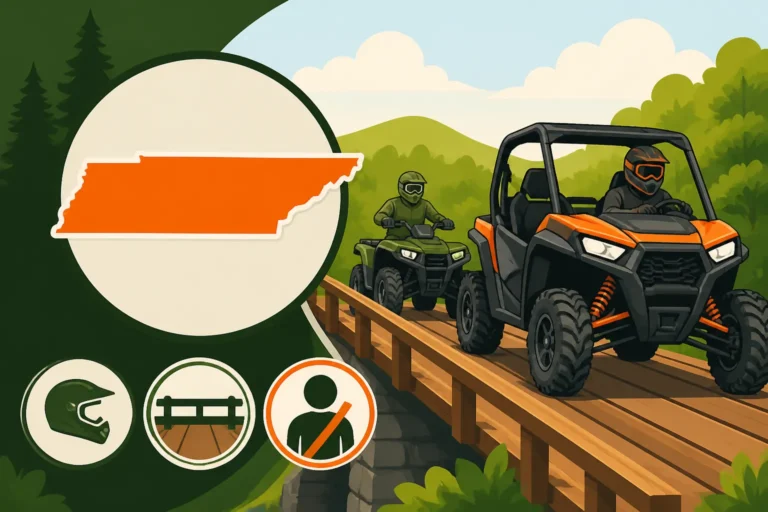
Fog on a Cumberland Ridge at Dawn
The crisp mountain air, a sense of adventure, and the rumble of your ATV or UTV – there’s nothing quite like exploring the incredible landscapes of Tennessee. But that feeling of freedom can quickly turn into frustration when you try to figure out where you can legally ride your machine on paved or unpaved public roads. The laws around street-legal ATVs and UTVs in the Volunteer State are notoriously complex, a patchwork of statewide rules and specific local ordinances that can leave even seasoned riders scratching their heads. This comprehensive guide will cut through the confusion, explaining Tennessee's regulations so you can ride confidently and lawfully.
The Core of Tennessee's OHV Road Laws: When "No" Isn't Always "No"
For many riders, the dream of cruising their ATV or UTV down a scenic Tennessee county road is immediately met with a firm "no." And while that's largely true as a general rule, Tennessee's laws have some critical nuances and, more recently, significant changes that create exceptions. It's not a blanket prohibition, but it's certainly not a free-for-all either. Understanding this foundational "no" and its specific carve-outs is the first step toward responsible road use.
The General "No" and What It Means for Most Riders
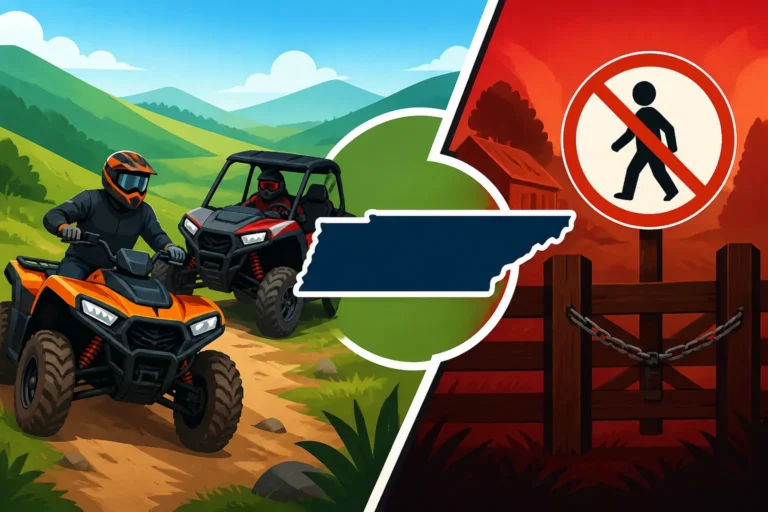
Here's the stark reality for most of Tennessee: Off-highway vehicles (OHVs), which include ATVs, side-by-sides, and quads, are generally not permitted on public highways or roads. This isn't just a suggestion; it's enshrined in state law. The legislature's intent was to keep these machines, designed primarily for off-road terrain, off the pavement where they can pose different safety risks than traditional vehicles. This means that if you're pulling out of your driveway onto a state highway or a common county road in most parts of Tennessee, you're likely breaking the law.
This prohibition often catches new residents or visitors off guard, especially if they come from states with more liberal road use policies for OHVs. You might see locals seemingly flouting the rules, but they are either operating under one of the specific exceptions we'll discuss, or they are, in fact, riding illegally. The consequences for violating this general rule can range from a citation and fines to having your machine impounded. It's a Class C misdemeanor, which means it’s not something to take lightly. Law enforcement, particularly in rural areas, is often quite familiar with these regulations and won't hesitate to enforce them.
Critical Exceptions: Agricultural, Emergency, and Crossings
While the general rule is restrictive, Tennessee law does recognize practical situations where OHV road use is necessary. These exceptions are very specific and cannot be broadly interpreted as permission to joyride on public roads.
First and foremost, there's a significant agricultural exception. If you're using your ATV or UTV for farm-related purposes, such as moving equipment, checking fences, or transporting feed on private farmland that happens to involve crossing or briefly traveling on a public road, the law makes an allowance for this. However, this isn't a license to take your machine to town for groceries just because you live on a farm. The use must be directly related to legitimate agricultural operations. This means you might see a farmer driving their side-by-side down a gravel county road at dawn, but they're doing so under a specific exemption, not a general right. [Tennessee Rules for Agricultural Road Use] offers more insight here.
Emergency personnel, such as law enforcement, fire, and emergency medical services, are also exempt when operating OHVs in the line of duty. This allows them to use these versatile machines to navigate difficult terrain or access areas not reachable by traditional vehicles during critical incidents. Lastly, and perhaps most commonly, OHVs are permitted to cross a public road or highway at an angle of approximately 90 degrees to get from one off-road trail segment or private property to another. This crossing must be done safely, promptly, and with full regard for other traffic. You cannot drive down the road to find a better crossing point; it must be a direct, perpendicular traverse. So, if your favorite trail continues on the other side of a two-lane road, you can cross, but you can't cruise. [Crossing a Two-Lane at Ninety Degrees in Tennessee] details this further.
Navigating Tennessee's New Road Use Provisions: Adventure Tourism Districts
The landscape for ATV and UTV road use in Tennessee underwent a significant transformation with new legislation designed to support adventure tourism. This has created a bifurcated system where some parts of the state have much greater flexibility for OHV road access than others. This new framework acknowledges the economic impact of off-road recreation but delegates the ultimate decision-making power to specific local authorities.
What Is an Adventure Tourism District?
In a groundbreaking move, Tennessee lawmakers created the concept of "Adventure Tourism Districts." These districts are specifically defined geographic areas, currently encompassing ten counties, where local governing bodies (like county commissions or city councils) have the authority to designate public roads for OHV use. The named counties are Scott, Anderson, Campbell, Morgan, Jackson, Johnson, Perry, Unicoi, Fentress, and Hickman. This was a direct response to the popularity of riding destinations like Windrock Park and Brimstone Recreation, which draw thousands of riders and their dollars to these rural communities. [Tennessee's Adventure Tourism Districts] explains more about the reasoning behind this legislative change.
The crucial part here is that simply being in one of these ten counties doesn't automatically mean all roads are open. The local county or municipal government still has to take action, specifically passing an ordinance by a two-thirds vote to open up unpaved roads, or creating a detailed list of designated paved roads. This allows for a tailored approach, where local officials can consider traffic volume, safety concerns, and the character of specific roads before allowing OHV access. It’s a move towards local control, which means what’s legal in one county, or even one town within a county, might be strictly forbidden in another.
Local Rules and Restricted Road Lists
Because the authority rests with local governments within Adventure Tourism Districts, riders must be acutely aware that rules will vary from one jurisdiction to another. Even within a single county that has adopted OHV road use, not all roads are open. Local officials are required to create and publish "restricted road lists" or, more accurately, designated road lists that explicitly state which roads are open and under what conditions. These lists are dynamic and can change as local councils re-evaluate their policies or respond to community feedback. [Restricted Road Lists Published in October 2025] gives a hint as to the specificity of these lists.
For example, in a county like Scott County, which is home to parts of Brimstone Recreation, specific roads or even entire unincorporated areas might be designated for OHV use. However, busy state highways or certain residential streets might remain strictly off-limits. This means riders need to do their homework before they load up and head out. Checking the local county clerk's office, the county mayor's website, or even contacting local law enforcement can provide the most up-to-date information on which roads are open. It’s not enough to simply know you’re in an Adventure Tourism District; you need to know the specific roads your local government has designated. Many riders find that installing GPS units with updated trail and road maps, sometimes provided by aftermarket companies or park operators, is essential for staying on the right side of the law.
Essential Equipment and Rider Requirements for Road Use in Tennessee
Even in the designated areas of Tennessee where OHVs are permitted on public roads, you can't just roll your trail-ready machine onto the asphalt without some modifications and careful adherence to rider requirements. The state wants to ensure that any OHV operating on a public road meets basic safety standards to protect both the operator and other motorists. Ignoring these requirements isn't just risky; it's illegal.
Mandatory Gear and Machine Specs for Road Use
For an OHV to be legally operated on a designated public road in Tennessee, it must meet specific equipment standards that bring it closer to a conventional motor vehicle. This isn't about making your machine street legal everywhere, but rather equipping it for the limited road use allowed in Adventure Tourism Districts. Key requirements generally include:
- Headlights and Taillights: These must be operational and on when riding on roads, especially during dawn, dusk, or in low visibility, which is common if you find yourself in [Fog on a Cumberland Ridge at Dawn].
- Brake Lights: Clearly visible and functional brake lights are non-negotiable for safety.
- Turn Signals: While some trail machines come with basic signals, many do not. You'll likely need to add a turn signal kit. Companies like SuperATV offer a range of aftermarket turn signal kits designed specifically for UTVs and ATVs, making it easier to comply with these requirements.
- Mirrors: At least one rearview mirror, typically on the driver's side, is usually required. Many riders opt for a full set of side mirrors and a wide rearview mirror for better visibility. SuperATV, for instance, has numerous mirror options that can be easily mounted to most side-by-sides.
- Horn: A working horn is necessary to alert other drivers or pedestrians.
- Windshield: While not always explicitly mandated for all OHV types in all road use scenarios, a windshield can significantly improve safety and comfort on public roads, especially if you're traveling at higher speeds.
- Insurance: This is critical. You must carry liability insurance on your OHV if you plan to operate it on any public road. This protects you and others in case of an accident. Always carry proof of insurance with you. [Insurance Tennessee Requires on a Road] is a vital read for this.
- Speed Restrictions: Even on open roads, OHVs are generally restricted to roads posted 45 mph or less and often have their own maximum speed limits (e.g., 35 mph). You're not meant to keep pace with highway traffic.
- Width Restrictions: There may be specific rules regarding the width of your machine. Tennessee has categories like [2,500 Pounds and 80 Inches] that can apply to vehicle classifications. Ensure your machine fits within any width limits for road use.
Always check the local ordinance for the specific county or city you plan to ride in, as requirements can vary slightly. What might be sufficient in one town could be incomplete in another. Many riders proactively upgrade their machines with these components from trusted aftermarket providers like SuperATV, ensuring they are well-prepared for any legal road-riding opportunities.
Rider Age, License, and Helmet Rules
Beyond the machine itself, Tennessee also has strict rules about who can operate an OHV on a public road and what safety gear they must wear. These are in place to protect riders and are often a point of confusion.
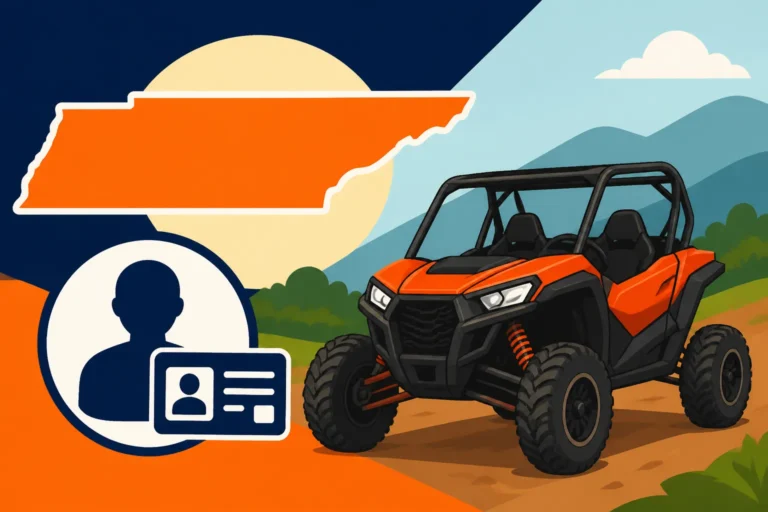
First, to operate an OHV on a public road in Tennessee, you must possess a valid driver's license. This means no learners permits or provisional licenses. The minimum age to legally drive on public roads is 16, which means anyone younger, even if they're experienced off-road, cannot operate an OHV on a designated road. [Tennessee Minimum Age to Ride a Road] covers this directly. This is a significant distinction from trail riding, where younger riders might be allowed with supervision.
Second, helmets are generally required for all operators and passengers on OHVs used on public roads in Tennessee. This is a critical safety measure. While the helmet law off-road can have different nuances (especially for adults on private land), when you move onto a public road, the rules tend to tighten up significantly. For any rider or passenger under 18 years of age, a helmet is absolutely mandatory, both on and off-road. However, when on a public road, the requirement extends to all ages unless a very specific and rare exemption applies (like farm work, as discussed earlier). Always err on the side of caution and wear a DOT-approved helmet. [Tennessee Helmet Law for ATV Riders] outlines these requirements.
It’s easy to get caught up in the excitement of riding, but overlooking these basic equipment and rider requirements can lead to serious legal trouble and, more importantly, put your safety and the safety of others at risk. Always prioritize preparation and compliance before you hit those designated roads.
Here's a quick comparison of general statewide OHV rules versus those potentially found in Adventure Tourism Districts:
| Feature | General Statewide Rules | Adventure Tourism District Rules (if adopted) |
|---|---|---|
| Road Use | Generally Prohibited | Permitted on Designated Roads by Local Ordinance |
| Primary Purpose | Off-road recreation, agricultural work | Off-road recreation, connecting trails, tourism |
| Agricultural Exception | Yes, for farm-related activities | Yes, for farm-related activities |
| Road Crossing | Yes, at 90-degree angle, safely | Yes, at 90-degree angle, safely, plus designated road use |
| Equipment Requirements | Basic off-road safety (spark arrestor, etc.) | Specific street-legal upgrades (signals, mirrors, horn, etc.) |
| Insurance Required | Not for off-road only | Yes, for any public road use |
| Driver's License | Not required for off-road only | Yes, valid driver's license required for road use |
| Helmet Requirement | Under 18 always; adults vary off-road | Generally all ages on public roads |
| Local Control | Minimal regarding road access | Significant, local government designates roads |
Disclaimer
This article is for general informational purposes only and does not constitute professional advice. Laws, prices and regulations vary by location and change over time. Consult a qualified professional for guidance on your specific situation.