Guided ATV Tours in Tennessee
A guided ATV tour can make Tennessee’s rugged trail country easier to enjoy, especially if you’re new to off-road riding or visiting without your own machine. The challenge is choosing a tour that fits your group, ability, and plans: “guided” can mean anything from a leader riding nearby to a fully supported outing. Here’s how to compare options and book with fewer surprises.
What a Guided ATV Tour Includes
A guided ATV tour is a ride led by an outfitter or guide along trails the operator is authorized to use. Depending on the outing, the guide may ride ahead, stay with the group, explain trail conditions, and help riders navigate. Some tours include a machine and required safety equipment; others have separate costs or requirements for permits, gear, passengers, and add-ons.
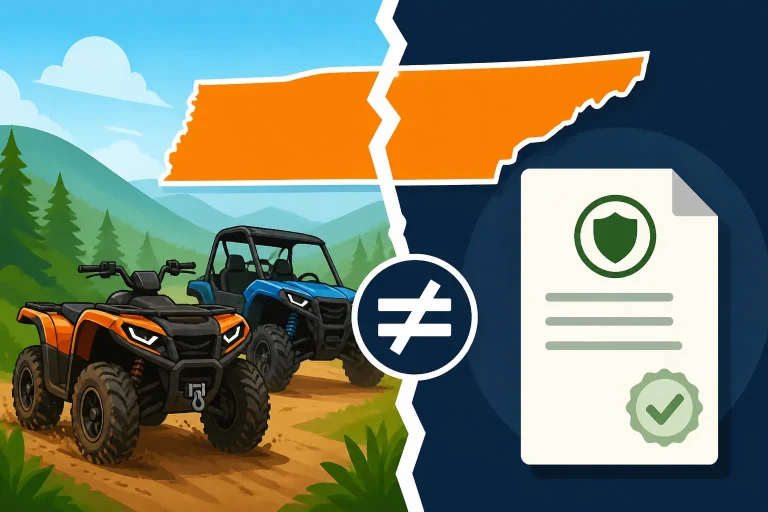
The word “ATV” is sometimes used broadly in advertising, even when the vehicle offered is a side-by-side UTV. An ATV is generally a straddle-seat machine controlled with handlebars. A UTV has a steering wheel, seats alongside one another, and often room for a passenger. That difference affects who can ride, how the tour feels, and what the booking includes. Before you pay, ask for the exact vehicle type and seating arrangement.
Tours are also different from simply renting a machine. With a guided tour, the route, schedule, and pace are generally planned by the operator. A rental may let you ride independently, subject to the rental agreement and park rules. Some businesses offer both formats, while others focus on guided trips. If you are deciding between them, Tennessee Rentals Versus Buying a Machine can help frame the broader choice.
A useful tour description should tell you:
- Whether the outing uses ATVs, UTVs, or both.
- Whether the listed price is per rider, per vehicle, or per passenger.
- How long you’ll be riding, and whether the stated duration includes check-in and training.
- What the guide provides, and whether the group stays together.
- Which trail system or property the tour uses.
- What’s included in the booking and what you must arrange separately.
- What happens if weather, trail conditions, or a closure changes the route.
A guided ride is not automatically a beginner lesson, a private tour, or an all-inclusive package. Those are separate details to confirm. For a closer look at the differences between formats, see Tennessee Guided UTV Tours and Tennessee’s Guided Permit. The permit topic is especially relevant if the operator’s activity involves guiding for compensation on public land; do not assume that a tour booking alone answers every permit question.
Where Guided Tours Run in Tennessee
Tennessee’s best-known off-road areas include private recreation properties and public land units. They differ in trail networks, access rules, scenery, operating practices, and the kind of ride a visitor can expect. A tour company’s location near a park does not necessarily mean it rides every trail there, so confirm the actual meeting point and route.
Windrock and the Oliver Springs area
Windrock Park near Oliver Springs is a major off-road destination with an extensive trail network and a variety of terrain. A guided ride can be useful here if you are unfamiliar with the area or would rather follow someone who knows the route. The terrain and trail options can vary, so ask how the operator selects a route for your group and what difficulty to expect. Read more about the area in Windrock Park at Oliver Springs, Tennessee.
Windrock’s size is not a reason to assume that every tour covers a particular distance or reaches a specific feature. Route length, pace, and stops depend on the tour and conditions. Confirm how much time you’ll spend moving, whether there are scenic stops, and whether the guide can adjust the plan for the group’s experience.
Brimstone and Huntsville
Brimstone Recreation near Huntsville offers a different setting and its own access procedures. If your tour is based there, verify whether the operator provides the required park access or expects you to handle it. Ask where to check in, whether the tour meets at the outfitter’s office or another location, and if passengers need their own permit or booking. See Brimstone Recreation at Huntsville, Tennessee for more on the area.
A tour’s advertised start time may not be the same as the time the group enters the trails. Check-in, waivers, orientation, and fitting gear can take time, so plan around the arrival instructions rather than assuming you can show up at the last minute.
Royal Blue and North Cumberland
Ride Royal Blue is associated with the North Cumberland area. That region includes multiple units, and access rules can differ between public land and private recreation property. Do not treat a nearby tour, resort, or trail system as interchangeable with another. Ask the operator which land the tour uses and whether the route stays on the property named in your booking. Ride Royal Blue Resort in Tennessee provides context on the area.
Public-land riding may have its own permit and operating rules. A private outfitter’s tour may handle some logistics, but you should still ask what access the booking covers. For an overview of the differences between permits and trail access, see Tennessee Trail Permits Explained.
| Tour setting | What to confirm | Why it matters |
|---|---|---|
| Windrock area | Meeting location, route difficulty, and park access | A large trail network can offer very different rides |
| Brimstone area | Check-in location, passenger requirements, and included access | The operator’s booking may not include every park requirement |
| Royal Blue or North Cumberland | Exact land unit, permit coverage, and route boundaries | Nearby public and private riding areas may have different rules |
| Other Tennessee location | Property owner, route, and who controls access | A business name or nearby town alone does not establish where you’ll ride |
When comparing destinations, think beyond scenery. Consider how far you are willing to travel, where you’ll stay, how much riding time your group wants, and whether the route suits the least experienced rider. A destination that sounds exciting may still be a poor fit if its trail conditions or schedule do not work for your group.
How to Choose a Tour and Book It
Start with the people in your group, not with the most dramatic trail photo. A suitable tour should match the participants’ ages, comfort with off-road driving, physical needs, and tolerance for a long ride. It should also be clear about what happens if someone is nervous, a machine has a problem, or weather changes the plan.
Ask about the guide and group format
“Guided” can describe different levels of support. The guide might lead a group on a fixed route, ride at the back, or accompany a small private group. Ask how many vehicles are expected, whether the guide can see and communicate with everyone, and whether there is a separate support vehicle or recovery plan. Do not assume that a guide will be beside each rider.
Find out whether the tour is shared with other bookings or reserved for your party. A shared outing can be a good way to meet other visitors, but the group pace and stops may be set around the whole group. A private tour may offer more flexibility, though availability and cost depend on the operator. If privacy matters, read Tennessee Private UTV Tours and confirm what “private” means for the specific booking.
Ask how the guide handles different experience levels. A good answer should explain how the route is selected, whether riders can pause or turn back, and what happens if the group has a large gap in ability. “Beginner-friendly” should prompt follow-up questions rather than settle them. See [Tennessee Tours for Beginners] for more considerations.
Confirm the vehicle and driver rules
Before booking, identify who will drive and who will ride as a passenger. Ask the operator for its minimum driver age, license requirements, passenger age or size limits, and any restrictions for children. These rules may vary by vehicle and business, and the rental agreement can be stricter than general law. Check Tennessee Rental Age and License Rules and [Tennessee Rules for Riders Under 16], then confirm directly with the tour provider.
For a UTV, verify the number of seats and whether every passenger has an assigned seat and belt. Do not plan on a passenger sitting on someone’s lap or riding in a cargo area. For an ATV, ask if each person needs to operate their own machine, whether passengers are allowed on the model used, and whether a child may ride with an adult. The answer depends on the vehicle and operator’s requirements.
If anyone in your group has limited mobility, a medical concern, or difficulty gripping controls or sitting for a long time, ask the operator before booking. Describe the practical need and request a clear answer about vehicle access, stops, and the route. Do not rely on a general promise that the ride is suitable for everyone.
Read the booking terms before paying
Check the tour’s cancellation and rescheduling terms, including what happens when the park closes or weather makes the route unsafe. A rainy forecast does not always mean a tour is canceled, and an operator may decide conditions are unsuitable even without heavy rain. Ask who makes the decision, when you will be notified, and whether you can reschedule or receive a refund under the stated terms.
Also verify the meeting address, check-in deadline, estimated return time, and contact method for the day of the tour. Confirm what identification or payment card the driver must bring. If you booked through a marketplace such as Viator, compare the listing’s terms with the operator’s instructions and make sure you know which business will actually run the ride. A listing platform can help with discovery and booking, but it does not replace checking the operator’s own requirements.
Polaris Adventures may also be a route to find certain guided or rental experiences, depending on location and availability. Treat the listing as a starting point: verify the outfitter, vehicle, trail access, schedule, inclusions, and cancellation terms for the exact outing you are considering. Availability and offerings can change, so check directly before making travel plans.
Use a short checklist when comparing tours:
- Identify the exact vehicle and who drives it.
- Confirm the route or trail property and meeting location.
- Ask what the price includes and what is charged separately.
- Check age, license, passenger, and equipment rules for every participant.
- Read the cancellation and weather policy.
- Save the operator’s day-of contact details and arrival instructions.
What to Expect on Tour Day
A guided ride usually begins with check-in rather than an immediate departure. Allow time for confirming the booking, signing documents, fitting equipment, receiving instructions, and learning how the machine works. The operator may require every participant to attend the briefing, even if only one person is driving.
Before you reach the trail
Follow the operator’s arrival instructions closely. A meeting point may be an office, staging area, campground, or trail entrance. Nearby landmarks are not a substitute for the exact address, particularly in rural areas where phone service can be unreliable. If you are unsure where to go, contact the business before leaving town instead of trying to sort it out when you are close to check-in time.
Wear clothing suited to dust, mud, changing weather, and contact with brush. Closed-toe footwear with a secure fit is a sensible baseline; ask whether the operator requires a specific type of footwear. Long sleeves and pants can help protect against sun, dust, and scratches. Bring layers if conditions may change, but avoid loose items that could catch on the vehicle. The operator should explain what safety gear is included and what you may bring yourself. For a fuller packing discussion, see Tennessee Tours and What to Wear.
At the briefing
Listen carefully to the machine controls, hand signals, spacing instructions, stopping procedures, and rules for passing. Ask questions before the group leaves. If the controls feel unfamiliar, say so and request additional instruction or practice time. A guided tour is not the place to hide uncertainty because the group is already moving.
The guide may explain how to follow on climbs and descents, how to approach turns, and what to do if a vehicle stops. Stay within the guide’s instructions, keep a safe following distance, and do not ride beyond your ability to keep up. If you can’t see the rider ahead clearly because of dust or terrain, create more space rather than closing the gap.
Do not assume that a guide’s presence means you can ignore posted signs or ride off the marked route. Operators must follow property rules, and riders are generally expected to stay on authorized trails. For more on access boundaries, see Tennessee Rentals and Where You Cannot Go.
During the ride
Expect the guide to set the pace according to the group and conditions. A route may include stops to regroup, take a break, or assess a difficult section. If you need to stop, follow the guide’s instructions so you do not block the trail or separate from the group.
Tennessee trail conditions can change with rain, traffic, maintenance, and closures. Mud, loose rock, ruts, steep grades, dust, and narrow sections may all affect the ride. Do not judge a trail by the tour’s marketing photos or assume that a route will be identical from one visit to the next. Check Tennessee Trail Conditions Before You Ride and ask the operator what conditions they expect for your booking.
Be honest about how you are feeling. Fatigue, discomfort, anxiety, or a machine that does not feel right are reasons to tell the guide promptly. Continuing silently can turn a manageable issue into a safety problem. Ask beforehand how to signal the guide and what to do if your vehicle has a mechanical issue.
Safety, Permits, and Access Questions
A guide can help with route-finding and group management, but the rider still has to follow instructions, use the machine responsibly, and understand the limits of the booking. Safety practices and legal access are related, but they are not the same thing: a well-run tour does not make every nearby road or trail open to off-road vehicles.
Make sure the tour has the access it describes
Ask which property or trail system the route uses and who is responsible for access arrangements. If a public-land permit applies, clarify whether the operator obtains it, whether it is included in the booking, and whether each rider needs separate documentation. If the ride is on private property, ask whether the tour stays on that property and follows its rules.
Do not infer that a Tennessee park permit works everywhere in the state. Separate landowners and parks may have separate access systems. Likewise, a permit for riding trails does not automatically authorize use of public roads. For a broader explanation of public-road limits, see Tennessee Road Use Rules for ATVs.
Understand the waiver and insurance
Operators commonly ask participants to sign a waiver or acknowledge risks before riding. Read it carefully and ask about any wording you do not understand. A waiver is not a substitute for safety instruction, and it does not tell you by itself what insurance, damage coverage, or recovery assistance is included.
Ask the business what happens if the machine is damaged, breaks down, or needs recovery from the trail. Confirm whether any optional damage protection is available, what it covers, and what exclusions or responsibilities apply. Do not assume that a tour ticket includes insurance for every type of loss or injury. Tennessee Rental Insurance Options offers related questions to ask when a machine is supplied as part of an outing.
If a tour includes a rental vehicle, the operator may use rental terms in addition to the tour conditions. Ask whether a deposit or card hold applies, when it may be released, and whether damage, cleaning, fuel, or late-return costs can be charged separately. For details specific to rentals, see Tennessee Rental Deposits and Damage Holds.
Keep the group’s limits in view
A trail that feels manageable to an experienced rider can be intimidating to a first-timer. Tell the operator about your group’s experience when booking, and ask for a candid description of the route rather than relying on a broad difficulty label. If the tour includes children or mixed ages, verify the operator’s rules for each person and vehicle. Tennessee Tours for Families can help you think through family-specific questions.
Weather and visibility also matter. Ask what conditions lead the operator to change or cancel a ride. If the group encounters a closure or unsafe section, follow the guide’s decision without taking an unapproved detour. The shortest route is not necessarily the safest or permitted route.
Tour Costs and How to Compare Value
Tour prices vary by operator, vehicle, duration, group format, location, and what is included. A quoted amount may apply per person or per vehicle. That distinction can change the total substantially for a couple or family sharing a side-by-side, so identify the pricing unit before comparing listings. For a focused overview, see Tennessee Tour Prices per Person.
Instead of comparing only the headline price, write down the full expected cost for your group. Look for separate charges or requirements such as:
- A passenger or additional rider charge.
- Trail or land-use access that is not included.
- Required safety gear, if not supplied.
- Taxes or booking charges shown at checkout.
- A deposit, card hold, or possible damage responsibility.
- Fuel, cleaning, late-return, or recovery charges when applicable.
- Optional guide upgrades, private-group arrangements, or added ride time.
Not every operator uses every charge, and terms vary. Ask which costs are mandatory and which are optional. The provider’s current booking information and written terms are the best place to confirm amounts and conditions.
A higher-priced tour may include a smaller group, more guide attention, a different machine, or more time on the trails. A lower-priced tour may be a better fit if it covers what your group needs without extras. Compare like with like: the same vehicle type, number of riders, duration, access, and support level.
| Comparison point | Questions to ask |
|---|---|
| Price basis | Is the amount per person, driver, vehicle, or group? |
| Ride time | How much time is actually spent riding? |
| Vehicle | Is it an ATV or UTV, and how many people can ride? |
| Access | Are permits or park charges included? |
| Group size | Is the tour shared or private, and how many vehicles join? |
| Equipment | What helmets or other gear are supplied? |
| Support | What help is available for breakdowns or recovery? |
| Changes | What happens if weather or trail closures affect the outing? |
Value also depends on how well the tour fits your trip. If you have limited off-road experience, instruction and a manageable route may matter more than a longer ride. If you are traveling with a group, a clear passenger arrangement and reliable schedule may be more valuable than an optional upgrade. If you already know the area and want to choose your own route, a self-guided rental may suit you better, provided you understand its rules and access limits.
Frequently Asked Questions
Are guided ATV tours in Tennessee suitable for beginners?
Some tours are designed to welcome beginners, but the label is not enough to judge fit. Ask about instruction, route difficulty, group pace, and whether the guide can adjust the ride. Tell the operator honestly how much experience each participant has.
Is a guided tour the same as an ATV rental?
No. A guided tour generally follows an operator-led route and schedule. A rental may allow independent riding under the rental agreement. Some businesses offer both, so confirm which format you are booking and what support is included.
Can children join a Tennessee ATV or UTV tour?
Possibly, but minimum ages, passenger rules, driver requirements, and vehicle capacity depend on the operator and machine. Confirm the policy for each child before booking. Do not assume that a child can ride simply because a UTV has an open seat.
Does the tour price include a trail permit?
It may, but not always. Ask which land the tour uses and whether the booking covers access for every participant. A permit or access arrangement for one location should not be assumed to apply at another.
What happens if rain affects the tour?
The operator decides whether conditions are safe and whether the route can be used. Review the written weather and cancellation terms before paying. Ask how and when the business will contact you and what options are available if the tour changes.
Disclaimer
This article is for general informational purposes only and does not constitute professional advice. Laws, prices and regulations vary by location and change over time. Consult a qualified professional for guidance on your specific situation.