Campgrounds Beside a Tennessee Trailhead
A Tennessee riding weekend can unravel before the first trail if your campsite is miles from the staging area, your trailer will not fit, or the campground and riding area have different access rules. This guide explains how to choose camping near Tennessee ATV and UTV trailheads, compare the main riding regions, and confirm the practical details that make arrival and departure easier.
How to choose a campground near a Tennessee trailhead
“Near the trail” can mean several different things. A campground may sit beside a park entrance, within a short drive of a trailhead, or on a resort property that offers both camping and riding access. Those options are not interchangeable, especially when you are towing a trailer or hoping to ride directly from your campsite.
Check what trail access actually means
Before booking, ask the campground or riding-area operator exactly how you get from your site to the trails. Is there a signed route within the property, or do you need to load your machine and drive to a separate staging lot? If riding access involves a public road, ask whether your machine can legally use that road. A trail permit or campground reservation does not automatically make a machine street-legal.
Also ask whether the access route is open to every guest or only to riders with a particular park permit. Tennessee has several private riding areas and public-land riding opportunities, and each can have its own access rules. A campground’s proximity to a trail system does not mean it provides permission to ride there. For a useful overview, see [Tennessee Trail Permits Explained] and [Why Tennessee Has No Statewide Trail Sticker].
Make the question specific when you call: “Can I ride from my campsite to the trail system without using a public road, and what permit do I need?” That wording is more useful than simply asking whether the campground is “close to the trails.” If the answer is unclear, request the name of the entrance or staging area you should use.
Match the site to your equipment
A tent site, an RV site, and a place to park a truck with a long trailer are different needs. Ask about the length and layout of the space, whether the access road has a tight turn, and whether you can leave your trailer at the site while riding. A listing that says “RV friendly” may not tell you whether a full-size truck and trailer can fit together.
Think through arrival as well as sleeping arrangements. If you expect to reach camp after dark, check how easy it is to find the entrance and whether check-in has a cutoff. If you are bringing children, several machines, or a group, ask whether vehicles can be parked together and whether the campground has room for unloading without blocking a lane.
Before paying, confirm the details that are easy to overlook: water and electrical hookups, restrooms, showers, quiet-hour expectations, fire rules, and whether pets are allowed. Facilities and access arrangements can change, so check directly with the campground rather than relying on an old listing or a rider’s memory.
| What to compare | Why it matters | What to ask |
|---|---|---|
| Distance to the staging area | A short drive may still require loading your machine | Which trail entrance or staging lot should guests use? |
| Direct riding access | “Near trails” does not necessarily mean ride-out access | Can I ride from the property without using a public road? |
| Trailer space | Tight sites and turning areas can complicate arrival | Can my truck and trailer fit at the site together? |
| Permit requirements | Campground access and trail access may be separate | Which permit does each rider need, and where is it purchased? |
| Facilities | Comfort needs vary by season and group | Are water, power, restrooms, showers, and waste facilities available? |
| Current closures | Weather, maintenance, or park rules can affect plans | Are the entrance and intended trails expected to be open? |
Camping near East Tennessee riding areas
East Tennessee is a natural starting point for riders looking for a full weekend of trails and camping. The best base depends on which riding area you plan to visit, what kind of site you need, and whether you want to drive to the trailhead or stay near the riding destination.
Windrock and Oliver Springs
Windrock Park is associated with the Oliver Springs area, and nearby camping can make it easier to plan a ride without a long daily drive to the mountain. Riders comparing places to stay often look at options connected with Windrock, including [Windrock Park at Oliver Springs, Tennessee] and [Coal Creek Campground Near Windrock, Tennessee]. Treat names and proximity as a starting point for your search, not a guarantee that a particular campsite has direct trail access.
When you contact a campground, ask where you will stage your machine and whether the campground has a designated route to the park entrance. Confirm whether your reservation includes any trail access or whether you need to arrange a separate park permit. You can also ask about the surface and grade of the road into the property. That matters if you are towing a heavy trailer or arriving after rain.
Windrock’s terrain and trail network make trip planning worthwhile even if you have ridden there before. Check current trail information before setting out, carry an appropriate map, and plan a route that suits your group’s experience and fuel range. A digital navigation tool such as onX Offroad can help you review routes and understand the surrounding trail area, but it should supplement—not replace—official park notices, posted signs, and any required permit information. For practical trip planning, see [Where to Camp Near Windrock] and [Parking a Trailer at a Tennessee Trailhead].
Brimstone and Huntsville
Brimstone Recreation is centered around Huntsville in Scott County. If you are considering camping nearby, clarify whether the site is within the riding property, near an entrance, or simply a convenient drive away. That distinction affects how you transport your machine, where you park your trailer, and how early you need to leave camp to reach the staging area.
Ask the operator about the route from the campground to the trail entrance and whether riding between the two is allowed. Do not assume that a machine can travel on a nearby road simply because the campground and trail system are close together. If you have not visited before, confirm the correct entrance and permit arrangements before you tow into the area. [Brimstone Recreation at Huntsville, Tennessee] is a useful starting point for learning about the riding destination, while [Brimstone's Land Use Permits] covers a separate part of trip preparation.
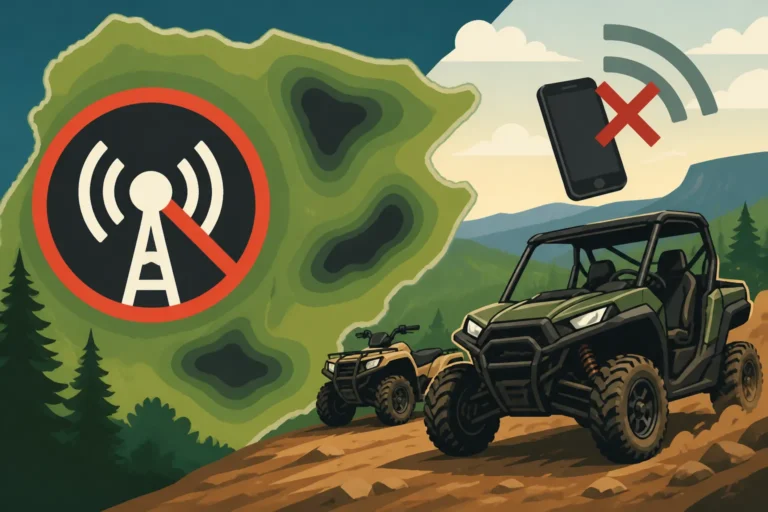
A map app can help you orient yourself around Huntsville, but the final route should be checked against information from the campground and park. onX Offroad may be useful for reviewing the riding area and planning a route, especially if you want to avoid improvising at a trail junction. Check your downloaded maps before leaving home if you expect weak or unreliable cell service. Keep a written note of the campground address, the entrance you are meant to use, and the park’s contact details.
Camping near Royal Blue and other destinations
Not every Tennessee riding weekend has the same setup. A campground that works well for a family staying several nights may not suit a group arriving late with multiple trailers. Think about the full trip—parking, permits, meals, fuel, and the ride back to camp—rather than choosing a site based only on a map pin.
Royal Blue and Pioneer
Ride Royal Blue is associated with Pioneer and the broader North Cumberland riding region. When looking at camping nearby, ask whether the property is affiliated with the riding area and what access that affiliation provides. A campground close to a trail system may still require you to trailer to a designated entrance, and a lodging reservation does not necessarily include every permit or fee needed to ride.
Before you book, confirm where to buy or pick up any required permits and whether every rider needs one. Ask if riders must check in at a particular office, whether there are restrictions on bringing machines back to camp after hours, and where trailers can be stored. Those details can shape the whole weekend, especially if your group plans to arrive on different schedules. See [Ride Royal Blue Resort in Tennessee] and [Tennessee's North Cumberland WMA] for related destination information.
Bring a route plan that accounts for the abilities of the least experienced rider and the condition of your machine. onX Offroad can be one tool for understanding the surrounding riding area, but do not rely on a phone screen alone where coverage may be limited. Download what you need in advance, keep your device charged, and follow official closures and on-site signs even when a mapped route appears open.
Decide whether a trail resort or a separate campground fits better
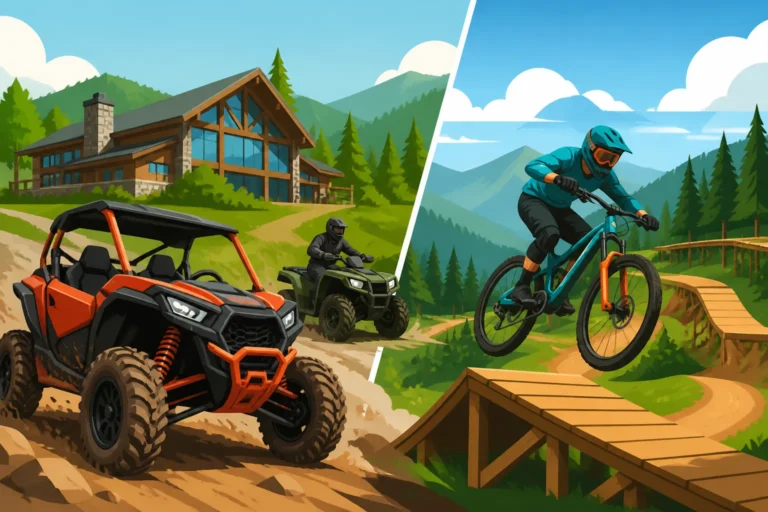
A trail resort or campground connected with a riding destination can simplify logistics: you may have less distance between where you sleep and where you ride, and you may find other riders nearby who understand the local setup. The tradeoff is that you still need to check the site’s facilities, availability, noise expectations, and exact access rules. “On-site” does not necessarily mean you can ride wherever you like from your campsite.
A separate campground may offer the type of site, hookups, or quiet setting your group wants, even if it means trailering each day. That can be a better fit for a family that wants a more traditional campground experience or a group carrying several machines. The extra loading and unloading is worth factoring in, particularly if the trailhead is not close or the access road is difficult for a trailer.
Use a map to compare the campground entrance, riding-area entrance, fuel stops, and any grocery or repair options you may need. onX Offroad can support route planning, while the campground and riding-area operators can answer the questions that matter most: where to check in, which entrance to use, and what is open. For a wider comparison of trip options, explore [Tennessee Pay-to-Ride Parks Compared].
A practical booking and arrival checklist
A little preparation prevents the most common campground headaches: turning up at the wrong entrance, discovering the trailer will not fit, or learning that your permit must be handled somewhere else. Once you have picked a region, verify the details with the people who manage the site and the riding area.
Confirm these details before you reserve
Use this checklist when calling or messaging a campground:
- Ask for the exact location. Get the street address or directions to the entrance, not just the name of the campground.
- Confirm trailer dimensions and parking. Explain what you are towing and ask whether you can park the truck and trailer together.
- Clarify trail access. Find out whether access is direct, by a designated route, or by driving to a separate staging area.
- Check permits separately. Ask whether the campground reservation includes anything related to riding, and verify permit requirements with the riding-area operator.
- Ask about facilities. Confirm water, power, restrooms, showers, waste disposal, and any restrictions on generators or fires.
- Check arrival procedures. Ask about late check-in, gate access, where to unload, and whom to contact if you arrive after the office closes.
- Ask about closures and weather. Find out how the campground or riding area shares updates when conditions affect access.
Save the answers in a message or booking confirmation. If one person is handling reservations and another is towing the trailer, share the entrance directions and check-in details before the group leaves. This avoids the familiar trailhead problem where one vehicle arrives at the wrong gate while everyone else waits.
Plan for the ride back to camp
Before leaving the campground each morning, make sure everyone knows where the group will meet if riders become separated. Agree on a turnaround time that leaves enough daylight for the return trip, and plan fuel around the route rather than assuming a station will be close to the trail. Pack water, basic tools, and any medication or supplies your group may need.
At the end of the day, follow the campground’s rules for parking and cleaning machines. Muddy tires and equipment can affect shared spaces, and noise carries at a quiet campground after other guests have settled in. If a machine needs attention, ask where maintenance work is permitted rather than making repairs in a spot that blocks access or creates a safety issue.
Finally, check that the route you intend to ride is still open before you head out. Trail conditions, gates, and local instructions can change. A map is helpful for orientation, but posted signs and current information from the riding-area operator take priority. A good campsite makes the trip more comfortable; confirming access, permits, and trail conditions is what makes the weekend work.
Disclaimer
This article is for general informational purposes only and does not constitute professional advice. Laws, prices and regulations vary by location and change over time. Consult a qualified professional for guidance on your specific situation.