Tennessee Rules for Riding Big South Fork
Big South Fork can be confusing for ATV and UTV riders because it spans Tennessee and Kentucky, and a machine that is legal on one trail system may not be allowed on a nearby route. The key is to confirm the route, land manager and current access rules before unloading. A Tennessee trail permit, title sticker or out-of-state registration should not be treated as blanket permission to ride here.
Big South Fork Is Not One General ATV Trail System
Big South Fork National River and Recreation Area is managed by the National Park Service, not as an extension of the North Cumberland Wildlife Management Area. That distinction matters: a permit or access rule for one riding area does not automatically apply to the other.
Within Big South Fork, motorized use is limited to routes where it is specifically allowed. A road shown on a map is not necessarily open to ATVs or UTVs, and a route that appears rideable may be closed or restricted. Do not assume that a trail, service road, railroad grade or route used by another kind of vehicle is open to your machine.
The O&W Road is a well-known route associated with Big South Fork and off-highway riding. Its access has been affected by closures and changes, so its name alone does not establish that it is open on the date of your trip. Check the park’s current notices and route information before heading out. For background on its status, see The O and W Road Reopening in Tennessee and Why the O and W Closed in 2024.
This is especially important because “Big South Fork” can refer casually to a broad region, while the rules depend on the precise road or trail and the agency responsible for it. A route can lie near the recreation area without being managed under the same rules. Likewise, a trail in a nearby wildlife management area or private riding park does not become part of Big South Fork just because it is close by.
Before riding, identify the route you intend to use and confirm all three points:
- Who manages it? The route may be on National Park Service land, another public property or private land.
- Is your type of machine allowed? Permission for a street-legal vehicle does not necessarily include an ATV or UTV.
- Is it open now? Closures, repairs, weather and seasonal conditions can change access.
If you cannot confirm that the exact route is open to your vehicle, do not ride it. The rules for Tennessee Rules for Riding a Closed Trail apply as a practical reminder: a route’s appearance or past use does not override a current closure.
| Question | What to confirm before you ride |
|---|---|
| Is the route in Big South Fork? | Check the park’s current map and identify the land manager |
| Are ATVs or UTVs allowed? | Confirm that the exact route is designated for your type of machine |
| Is the route open today? | Check current closure notices, including notices for the O&W Road |
| Does my permit cover it? | Verify whether a separate park authorization or fee applies |
| Does my paperwork make the machine trail-legal? | Check vehicle requirements separately from route access |
Permits and Reciprocity: Which Pass Applies?
Tennessee does not have one statewide off-highway vehicle sticker that grants access to every trail. A permit issued for one riding area is not a universal trail pass. That basic distinction is covered in Tennessee Trail Permits Explained and Why Tennessee Has No Statewide Trail Sticker.
In particular, do not assume that a North Cumberland WMA permit gives you permission to ride a Big South Fork route. Those are separate recreation areas with separate land managers and access rules. The same caution applies to permits from private parks: a Windrock, Brimstone or other park permit is not automatically valid elsewhere. See Why One Park’s Permit Is Worthless at the Next for the broader permit issue.
Big South Fork access is controlled by the park’s requirements for the specific route and vehicle. Before traveling, check directly with the National Park Service for any current OHV authorization, fee, vehicle documentation or operating restrictions that apply. Requirements can vary by route and may change, so confirm rather than relying on a past visit, an old map, a social media post or another rider’s permit.
Keep these different forms of authorization separate in your mind:
- A land-access permit is permission to use a particular riding area or route, subject to its rules.
- A title or title sticker documents the machine’s title status. It does not, by itself, authorize riding on a particular trail.
- Registration or proof of ownership may be relevant to the vehicle requirements, but it does not open a closed route.
- A park entrance or parking pass is not necessarily an OHV riding permit.
Rules on reciprocity are easy to misunderstand. An out-of-state registration or permit should not be assumed to satisfy Tennessee or Big South Fork requirements. Confirm the distinction in Does Tennessee Honor Out-of-State Registration? and Why Tennessee Reciprocates Nothing. If your machine needs Tennessee title paperwork, that is a separate task from checking route access; Titling Before a Trip to a Tennessee Park can help you prepare.
A simple pre-trip call or check with the park can prevent a wasted drive. Ask direct questions: Is the route open to ATVs or UTVs? Does the park require a particular permit or vehicle document? Are there restrictions on width, passengers, equipment or hours? Is there a current closure or detour? If the answer is unclear, ask for the official map or notice that identifies the route.
Vehicle, Route and Safety Checks Before Unloading
Even when a route is open, riders need to follow the requirements that apply to the machine and its use. A vehicle’s title status does not necessarily make it legal on every public road or park route. Similarly, being able to physically drive a route is not proof that your vehicle is authorized there.
Check the park’s current requirements for your ATV or UTV before the trip. Depending on the route and applicable rules, relevant details may include vehicle type, safety equipment, passenger limits, operator qualifications, speed, hours of operation and required documents. Do not rely on another rider’s setup as proof that yours meets the rules.
Use the official route map, not just a navigation app. A mapping app may show a road but not whether it is open to OHVs, whether a gate is in place or whether a route has a temporary restriction. Save or carry current park information in case cell service is limited. If you are using a paper map, make sure it is current enough to reflect route changes and closures.
Before starting, make sure everyone in the group understands:
- Which route is permitted for the machine
- Where the route begins and ends
- Which junctions or gates mark a boundary
- What to do if the route is closed or blocked
- How the group will communicate if riders become separated
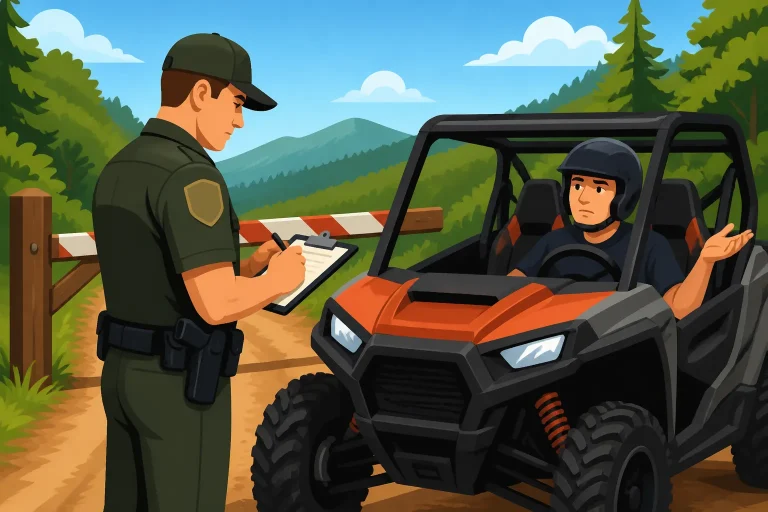
Stay on the route designated for motorized use. Do not create a shortcut around a gate, ride around a closure sign or turn onto an unmarked track because it looks like a continuation. A detour can take you onto land with different rules or into an area where motorized use is not allowed.
Weather and surface conditions also matter. Heavy rain can make a route unsafe or contribute to closures; loose rock, steep grades and narrow sections can be difficult for a machine that is wider or less capable than the route allows. Recheck conditions before leaving, especially if you are planning around the O&W Road or another route with changing access. A closure notice takes priority over a previously saved map.
For riders combining Big South Fork with other nearby areas, plan each stop separately. Confirm each land manager’s rules, permits and trail status rather than assuming one pass or one day’s authorization carries over. Tennessee Rules for Riding a WMA explains why WMA access is a separate question from riding within a national recreation area.
A Reliable Pre-Trip Plan
The safest way to plan a Big South Fork ride is to treat route access, permits and vehicle paperwork as three separate checks. That approach works whether you are visiting from another state or riding locally.
- Choose a specific route. Identify the route by its official name and location, not just by saying you plan to ride “Big South Fork.”
- Confirm the land manager. Make sure the route is within the area you think it is and identify which agency or owner controls it.
- Check current access. Verify that the route is open to your type of ATV or UTV on your planned riding day.
- Confirm required permits and documents. Ask the park which authorization and vehicle paperwork apply. Do not substitute a North Cumberland permit or another park’s pass unless the responsible authority confirms it is accepted.
- Review restrictions. Check for rules about vehicle type, hours, passengers, equipment, speed and route direction.
- Carry the information you may need. Keep your permit or proof of authorization, vehicle documents and current route information accessible during the trip.
- Recheck before unloading. Look for new notices, gates or closure signs at the entrance. If what you see conflicts with an older map, follow the current notice and contact the park.
For visitors bringing a machine from outside Tennessee, paperwork can be particularly easy to confuse. A registration from home may not answer whether the machine can ride a Big South Fork route, and a park pass does not replace vehicle documentation. Confirm both questions independently. If you are unsure what your Tennessee title sticker represents, What the TDR Sticker on Your Title Means explains the difference between title documentation and trail access.
The practical rule is straightforward: ride only a route that the responsible land manager currently identifies as open to your vehicle, and use only the permit or authorization that applies to that route. Big South Fork’s name, a past visit, a neighbor’s pass or a machine’s registration is not a substitute for checking.
Disclaimer
This article is for general informational purposes only and does not constitute professional advice. Laws, prices and regulations vary by location and change over time. Consult a qualified professional for guidance on your specific situation.