Why Tennessee Reciprocates Nothing
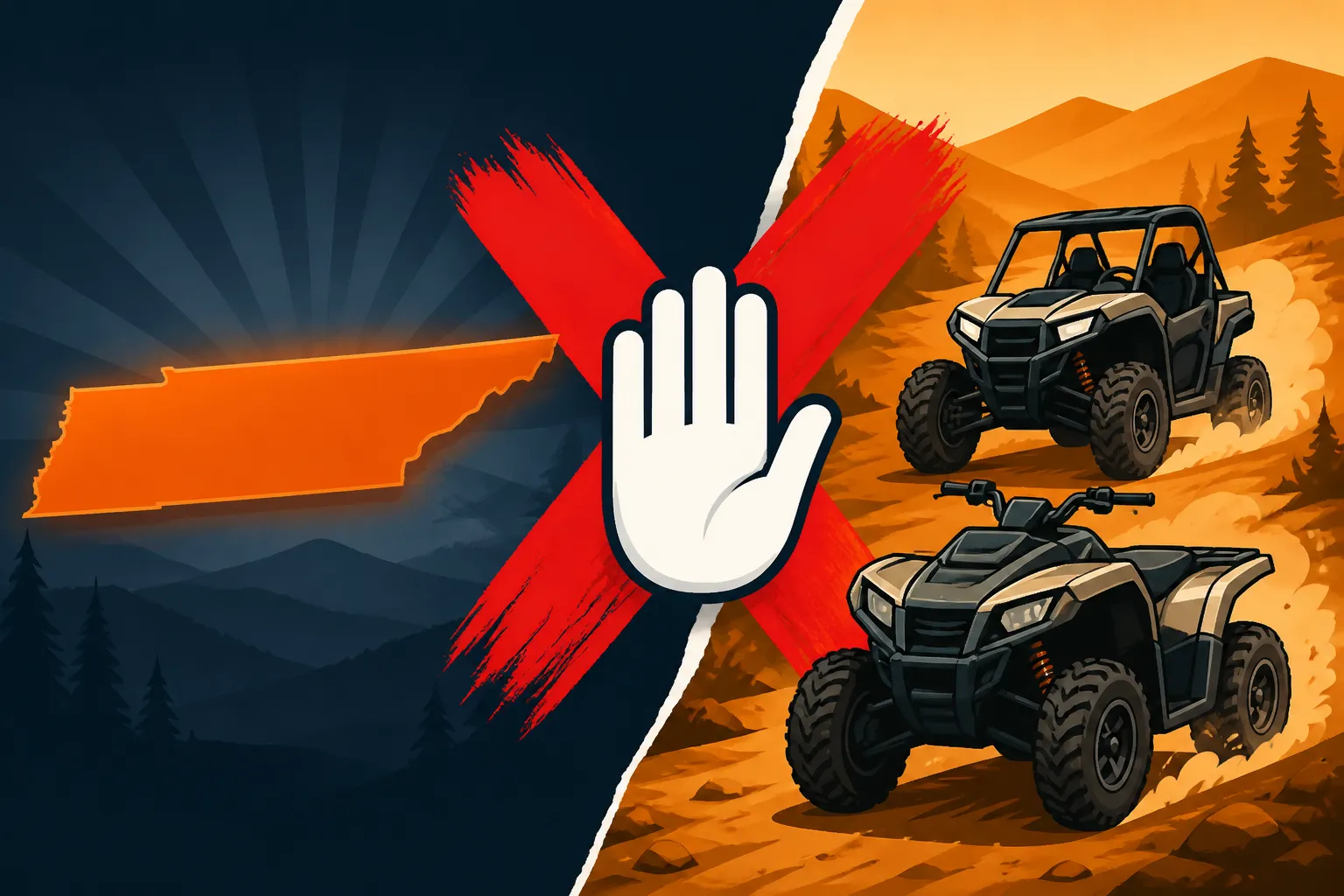
Tennessee riders coming from another state often assume an ATV registration, trail pass, or permit will carry over. It usually will not. Tennessee’s ATV and UTV access is managed by the agency or property that controls the riding area, so the practical question is not just what paperwork you have, but where you plan to ride.
What “no reciprocity” means for Tennessee riders
Reciprocity usually means one jurisdiction accepts a credential issued by another. For off-highway riding, that might be a registration, an off-road vehicle sticker, or a trail permit. Tennessee does not offer a general arrangement that makes an out-of-state OHV credential a substitute for the permit required at a Tennessee riding area.
That is a narrower point than saying Tennessee recognizes nothing from another state. A visitor’s driver’s license, proof of ownership, insurance, or other documents may matter for separate purposes. The issue here is trail access: an out-of-state registration or permit does not, by itself, authorize you to ride on Tennessee-managed or privately managed trails.
The reverse is also true. A Tennessee trail permit generally does not grant riding access in another state. The land manager there decides which credentials it accepts. Treat each state and each riding property as having its own rules unless the responsible agency expressly says otherwise.
This distinction matters because Tennessee does not rely on a single statewide registration sticker that automatically opens every trail. Some credentials are tied to a particular public riding area; others are issued by individual private parks. The permit system follows the land, not the machine as it travels from state to state. For more background, see Why Tennessee Has No Statewide Trail Sticker and Tennessee Trail Permits Explained.
| Credential you bring | What it may establish | What it does not automatically establish in Tennessee |
|---|---|---|
| Another state’s ATV or UTV registration | That the machine is recorded or authorized under that state’s rules | Permission to ride a Tennessee trail |
| Another state’s park or trail pass | Access under the issuing land manager’s rules | Access to a Tennessee WMA or private park |
| A Tennessee WMA permit | Permission for the covered WMA area, subject to its conditions | Access to a separate private park or another state |
| A private park permit | Access to the property and trails covered by that permit | Access to another park or public riding area |
| A Tennessee title or title sticker | A document associated with the machine’s ownership and title status | A trail permit or general road-use authorization |
A permit can also have limits within the same state. A pass for one park does not become a statewide pass simply because both areas are in Tennessee. The name of the issuer, the property covered, the dates, and any rider or vehicle conditions all matter.
Why Tennessee does not make one permit travel everywhere
A trail permit is usually permission to use a particular property under specific conditions. It is not a universal credential that follows an ATV or UTV from one land manager to another. That is why different agencies and parks can set separate access rules, collect their own fees, and require their own permits.
Public land and private riding areas have different operators and purposes. A state agency managing a wildlife area may set conditions to protect habitat, manage hunting seasons, or control traffic on designated routes. A private park may issue permits under its own land-use and safety rules. Neither system is automatically bound to accept the other’s pass.
The same principle applies to permits from other states. An out-of-state pass proves that a rider has met the requirements of the issuing program, not that the Tennessee land manager has approved that rider for its property. A state-to-state agreement would need to define what credentials are accepted, which properties are covered, and how the rules are enforced. Riders should not assume such an agreement exists just because two states both have ATV trails.
Public WMA permits are tied to the area
Tennessee’s North Cumberland Wildlife Management Area has a permit system for OHV use. A permit for that area is not a general Tennessee trail pass. The WMA has its own boundaries and rules, and permission to ride applies only where the relevant permit and current land-use rules allow it.
If your trip includes more than one public unit or riding area, check whether the permit covers each planned section. A single permit may cover multiple units within a particular system, but that does not make it valid on unrelated public land or private property. Confirm the current coverage, dates, vehicle conditions, and rider requirements before leaving home. Does One Permit Cover Every North Cumberland Unit? explains why checking coverage is better than assuming that every unit has a separate pass or that one pass covers all Tennessee trails.
A permit also does not override closures. A marked route may be closed, seasonal restrictions may apply, and land managers can post updates that affect where riding is allowed. The permit is permission to use eligible routes under the applicable rules, not permission to ride anywhere inside a boundary. Review [Tennessee Rules for Riding a WMA] and current notices before heading out.
Private parks issue separate access permission
Private parks set their own access arrangements. A permit or pass for Windrock does not automatically work at Brimstone or Ride Royal Blue. Each operation controls its own land and may have its own permit process, rider conditions, permitted routes, and closure notices.
That separation is not a penalty aimed at visiting riders. It reflects who manages the property and who is responsible for its trails. The permit from one park pays for or authorizes access under that park’s terms; another park has no reason to treat it as its own pass.
Before booking a trip, check the exact park and the exact permit you need. Windrock’s Trail Permits, Brimstone’s Land Use Permits, and Ride Royal Blue Permit Requirements cover separate systems, not interchangeable versions of one Tennessee pass. If a trip combines public and private riding, plan for the credentials each area requires.
What an out-of-state rider should check before unloading
The most useful way to avoid a permit problem is to work backward from the planned route. Identify the property, find out who manages it, and confirm the permit and vehicle rules directly with that manager. Do not start with the assumption that your home-state registration or trail pass will be accepted.
Use this checklist before you travel:
- Name the riding area. “Riding in Tennessee” is not specific enough. Identify the WMA, private park, or other property you plan to use.
- Identify the land manager. Determine whether the area is state-managed, privately operated, or controlled by another entity. The manager’s rules determine what access permission is required.
- Check the permit type. Confirm whether you need a day permit, annual permit, special-use credential, or park-specific pass. A permit for a different area is not a substitute.
- Confirm who must hold a permit. Rules can depend on whether someone is operating, riding as a passenger, or accompanying a minor. Check the current requirements for every person in the group.
- Check machine conditions. Width, vehicle type, noise, equipment, and other conditions may affect whether a machine can use a particular trail. Do not assume that a permit makes every vehicle eligible.
- Review dates and closures. Confirm that your permit is valid for the intended dates and that the trails are open. Weather, maintenance, hunting seasons, or other restrictions can affect access.
- Carry proof as instructed. Find out whether the permit must be displayed, carried digitally, or shown at a gate or office. Keep confirmation details accessible.
- Check the rules again close to the ride. A pass can be valid while a trail is closed. Check current information before loading the machine and again if conditions change.
The distinction between a machine’s paperwork and its riding permission is especially important for visitors. A title, registration card, or license plate from home may help identify the machine or satisfy a separate legal requirement. It does not answer whether the machine may enter a particular Tennessee trail system. For the registration question specifically, see Does Tennessee Honor Out-of-State Registration?. For the permit question, see [Tennessee Rules for a Visiting Rider] and Do You Need a Permit for Tennessee Trails?.
Do not assume a dealer document, insurance card, or proof of purchase is a trail pass either. These documents may serve different purposes, but none should be treated as permission to ride unless the land manager says it is accepted for that area.
Check road use separately from trail access
Trail permits and road-use rules are separate questions. A permit to ride on a designated trail does not automatically make a public road legal for an ATV or UTV. Likewise, an out-of-state plate or registration does not establish that a machine can use a Tennessee road.
Road access depends on applicable state and local rules, the type of road, the vehicle, and any local restrictions. A route that connects two trail sections may include a public road where different requirements apply. Before riding a connector or crossing, verify the rules for that specific road rather than relying on the trail permit.
This is also why “reciprocity” should not be used as shorthand for every legal issue a visitor might face. A state may have separate arrangements or rules for driver credentials, insurance, or road operation, while still declining to accept another state’s trail permit. The safe approach is to check each issue on its own: trail access with the land manager, and road use under the rules that apply to the road.
Common mistakes and how to avoid them
Assuming registration equals permission to ride
Registration often leads riders to believe the machine is cleared for off-road use wherever they travel. But registration and land access answer different questions. Registration concerns the machine under a jurisdiction’s system; a trail permit concerns permission to enter a specific property or riding area.
A visitor should keep both questions in view. If a manager requires a local permit, an out-of-state registration does not replace it. If a machine’s status is relevant to a separate rule, the registration may still be useful, but that does not create access permission. Does Tennessee Honor Out-of-State Registration? provides a closer look at this distinction.
Buying one Tennessee permit and planning to use it everywhere
A Tennessee-issued credential is not automatically statewide. A WMA permit, a private park pass, and a title-related sticker are not interchangeable. Check the document’s issuer and stated coverage instead of relying on the fact that it was purchased in Tennessee.
This is particularly important for riders putting together a multi-park weekend. Each property may require its own pass, even if the areas are close together or offer similar trails. Ask each park what its permit covers and whether any additional access or passenger requirements apply. Why a Tennessee Park Permit Does Not Travel explains this park-to-park distinction.
Treating a previous visit as proof that the rules are unchanged
A rider may have visited a property before and still need to check the current terms. Permit procedures, open routes, access conditions, and closures can change. A pass from a prior trip may not be valid for a new visit, and a familiar trail may not be open on the day you arrive.
Confirm current information from the land manager, especially before a long drive. If you are unsure whether a credential covers your vehicle or group, ask directly and keep the answer with your trip paperwork. That is more reliable than interpreting a sticker or an old receipt as a broad authorization.
Assuming adjacent properties share access rules
Trail systems can meet near a boundary without sharing ownership or permit arrangements. A route that appears connected on a map may lead onto land with a separate manager. Crossing a boundary without the right permission can turn a valid ride into an unauthorized one.
Use the property map and posted signs, not just a phone map or a remembered route. When riding a larger area, mark boundaries and planned exits in advance. If a trail or gate is unclear, stop and verify before proceeding. A permit for the land on one side of a boundary does not grant access on the other.
Relying on an informal answer
A friend, online post, or old trip report may describe a permit rule that applied to another property or another season. It may also leave out details about the type of rider or vehicle covered. For questions about acceptance, validity, or trail access, the issuing agency or park is the best place to confirm.
Be precise when asking. Provide the permit name, the issuing state or park, the vehicle type, the date of your trip, and the specific area you want to ride. “Will my pass work in Tennessee?” is too broad to get a reliable answer. “Will this named pass meet the permit requirement for this named area on these dates?” is much easier for a manager to answer.
A simple way to plan a Tennessee riding trip
The rule is easier to follow when every credential is matched to the property it covers. Make a short permit plan for the trip instead of relying on one document to do everything.
| Trip plan | What to verify |
|---|---|
| Riding only at a Tennessee private park | The park’s own permit, operating dates, vehicle eligibility, passenger conditions, and any required check-in |
| Riding a designated WMA | The correct WMA permit, covered units, valid dates, eligible routes, and any closures |
| Riding both public and private property | Separate access requirements for each property and any legal connector between them |
| Bringing an ATV or UTV from another state | Whether the machine’s documents satisfy relevant vehicle rules, and separately, which Tennessee trail permit is required |
| Using public roads during the ride | Road-specific access rules, required equipment or documents, and any posted restrictions |
Keep the relevant confirmation and permit instructions where the group can find them. If the permit must be displayed, do so as directed. If it is electronic, make sure the rider can access it when mobile coverage is weak. The detail that matters is not whether the pass looks official; it is whether the right authority issued it for the place and date you are riding.
The practical takeaway is straightforward: Tennessee does not have a general ATV or UTV permit that accepts every other state’s trail credentials, and Tennessee passes do not automatically travel to other states or parks. Start with the riding area, then obtain the permission that area requires. Keep title, registration, road-use, and trail-access questions separate, and confirm any uncertain rule with the property manager before the trip.
Frequently Asked Questions
Can I use my home-state ATV registration as a Tennessee trail permit?
No. Registration and trail access are separate. An out-of-state registration does not, by itself, meet a Tennessee riding area’s permit requirements. Check with the specific land manager.
Does one Tennessee permit cover every Tennessee ATV park?
No general permit should be assumed to cover every park. Public areas and private parks may issue separate permits. Confirm exactly which property and routes your credential covers.
Does a Tennessee trail permit work in another state?
Not automatically. The other state or property manager decides whether it accepts that permit. Check the destination’s rules before traveling.
Can I ride a Tennessee trail with no permit if my machine is titled?
A title is not a trail permit. If the area requires an access permit, a title does not replace it. Check the permit rules for the place you plan to ride.
Does a trail permit let me ride Tennessee roads?
Not by itself. Road use is a separate legal question, and the rules may depend on the road, vehicle, and location. Verify road access separately from trail access.
Disclaimer
This article is for general informational purposes only and does not constitute professional advice. Laws, prices and regulations vary by location and change over time. Consult a qualified professional for guidance on your specific situation.