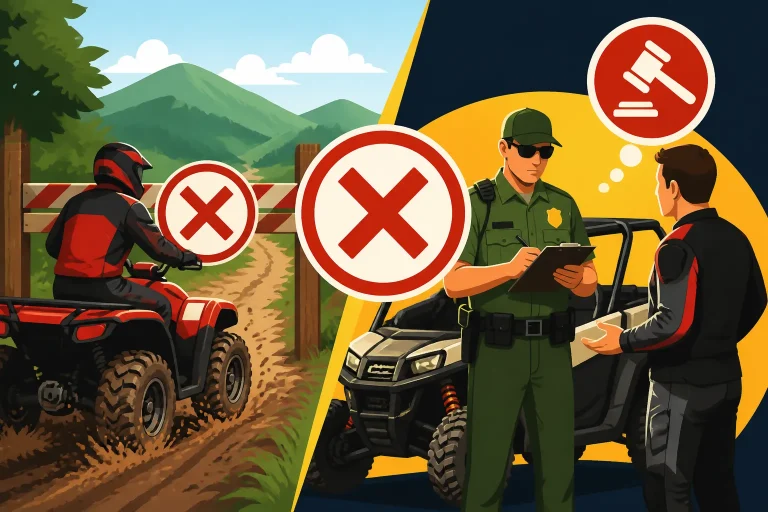
Where Tennessee Permit Money Goes
Tennessee riders often pay a permit fee without seeing what it funds, which can make trail closures or worn routes especially frustrating. The answer depends on who manages the land: state permit revenue is tied to the state program, while private parks collect their own fees. Here’s what permit money can support, what a receipt can’t tell you, and how to check spending claims.
The short answer: permit money supports the program that issues the permit
There isn’t one Tennessee permit that covers every ATV or UTV trail. The permit system for riding on state-managed land is separate from the permits sold by private riding areas. So, before asking where the money goes, identify which permit you bought and which land manager collected the fee.
For riding in the North Cumberland Wildlife Management Area, the state permit is part of the system for managing permitted off-highway vehicle use there. Permit revenue helps support that program and the work involved in managing recreation on the area. That can include administration as well as on-the-ground operations. It does not mean each purchase is assigned to one particular trail, bridge, or maintenance job.
Private parks work differently. A permit or land-use pass at Windrock, Brimstone, or another privately managed riding area is collected by that operation under its own arrangements. It is not the same pot of money as a North Cumberland permit. The distinction matters when comparing prices, asking about maintenance, or expecting one pass to work at another property. For the broader permit landscape, see Tennessee Trail Permits Explained and Why Tennessee Has No Statewide Trail Sticker.
| Permit type | Who collects it | What the fee is connected to | What it does not mean |
|---|---|---|---|
| State permit for North Cumberland WMA riding | The state permit system | Administration and management of permitted riding on the managed area | A guarantee that each purchase funds one named trail project |
| Private riding-area permit | The private park or operator | That property’s access and operating program | A state permit or access to another park |
| A separate permit, pass, or authorization | The manager named in its terms | The activity or property specified by that manager | Universal access across Tennessee |
A permit pays for authorization to ride under the rules attached to that permit. It is not a promise that every trail will be open, that all maintenance will happen immediately, or that all revenue is spent in the same way. Conditions, staffing, budgets, weather, environmental concerns, and management priorities affect what work gets done and when.
The details also depend on the permit’s scope. State permits are associated with riding on designated portions of a managed area under applicable rules. Private parks set their own access arrangements. Check the permit terms and land manager before assuming that a fee—or a pass bought for one park—covers another place. Does One Permit Cover Every North Cumberland Unit? explains why the permit’s coverage is worth confirming before a trip.
What state permit revenue may help pay for
Managing off-highway riding involves more than smoothing a trail. The visible route is only one part of the work. A managed area may also need access controls, signs, monitoring, visitor information, and responses to problems that affect both riders and other land uses.
Permit revenue is part of the funding picture for the state program. Without a current, itemized accounting, it’s better to describe the possible work broadly than to claim a particular share goes to a particular task. Common operational needs can include:
- Trail upkeep: Addressing erosion, drainage, surface damage, and obstacles where work is appropriate and authorized.
- Signs and route information: Marking routes, communicating closures or restrictions, and helping riders understand where they may travel.
- Access management: Maintaining or monitoring gates, trail entrances, and other controls that help keep riding within permitted areas.
- Visitor and permit administration: Handling permit sales, customer questions, program records, and information about rules.
- Enforcement and compliance: Monitoring use and responding to riding outside allowed routes or other rule violations.
- Land and wildlife management: Coordinating recreation with the broader management of a wildlife management area, including concerns that are not limited to OHV use.
These are practical examples of the kinds of needs a managed riding program can involve. They are not a claim that Tennessee publishes a fixed percentage for each category, or that every category is paid solely from permit revenue. A public land manager may rely on multiple funding sources, and work may be planned and budgeted across broader programs.
Trail work itself can be expensive and technically involved. Water that runs down a route can cause more damage than ordinary tire traffic, so drainage and runoff control may matter as much as grading. A damaged crossing may need evaluation before repair. A route can also be closed while land managers address safety, environmental, or operational concerns. A closure, by itself, doesn’t establish that permit revenue has been spent badly or not spent at all.
Likewise, a well-maintained route doesn’t show exactly which source paid for the work. Public projects can draw on more than one budget or staff resource. That’s why a useful answer to “where did the money go?” needs to distinguish between a program’s general purpose and the accounting for a specific period or project.
If you want to understand which state permit applies to your ride, start with Where to Buy a North Cumberland Permit and confirm the conditions directly with the state program. The permitted area and its rules are not interchangeable with a private park’s boundaries or terms. Tennessee Rules for Riding a WMA is also useful for understanding that a permit is only one part of riding lawfully.
Why a permit receipt does not show a trail-by-trail breakdown
A checkout receipt generally shows that a payment was made and identifies the product or permit purchased. It is not necessarily a spending report. It usually won’t say how much was used for trail work, how much supported administration, whether staff time was charged to the program, or which route received maintenance.
That is normal for many public programs. Revenue collection and spending are tracked through accounting and budget systems, not by attaching each person’s payment to a project. The permit fee may enter a broader account or support a program whose expenses are recorded in budget documents. Even if revenue is associated with a particular management purpose, that does not necessarily mean each dollar is separately traceable from buyer to work crew.
It also helps to separate several questions that can sound like one:
- Who received the fee? The permit seller or state system named in the transaction.
- What was the permit for? The access or activity described in its terms.
- What program does the revenue support? The purpose established for the program and its funds.
- What was spent during a period? The actual recorded expenditures.
- What work happened on a particular route? Project or maintenance records, if available.
A receipt can answer the first question and help answer the second. It rarely answers all five.
The total amount a rider pays also may not be the same as the amount ultimately available for field work. Depending on how a system is structured, collection, payment processing, administration, and other program costs may be accounted for separately. Don’t assume that the entire checkout total is transferred directly to a trail crew, and don’t assume deductions exist in a particular amount unless the manager’s accounting confirms them.
The same caution applies to comparisons between state and private permits. A private park’s fee may support that operator’s costs and services, but the park’s arrangement is separate from a state permit. A pass from one does not substitute for the other. Why a Tennessee Park Permit Does Not Travel explains why separate land managers set separate access terms.
A receipt also doesn’t guarantee that a particular trail will be open on the day you arrive. Routes can close for weather, maintenance, safety, land-management needs, or other operational reasons. Check current notices before loading up, and avoid treating a permit as permission to ride outside the routes or dates allowed by the manager.
How to check where the money goes
If you want more than a general explanation, ask for the information that can actually answer your question. A broad complaint such as “the trails are rough, so where is the money?” may get a broad response. A focused request about a program, time period, expenditure category, or named project is easier to investigate.
Start with the right land manager
First, identify whether the fee was paid to the state or to a private operator. Check the name on the confirmation, receipt, permit, or transaction record. If you rode at a private park, ask that park about its own fees and maintenance. A state agency cannot account for a private park’s operating revenue.
For North Cumberland, direct questions about state permits and area management to the responsible state program. If your question concerns a specific trail or closure, include the route name or location and the date you noticed the issue. A manager may be able to explain the closure or planned work even if the permit accounting is not broken down by individual rider.
Ask for the right kind of record
A practical request might ask for:
- The program’s budget or spending information for a specified period.
- The amount of permit revenue received during that period, if reported.
- The categories in which program expenses were recorded.
- Maintenance or improvement projects completed or planned for a named area.
- Information about a specific closure, repair, or route condition.
- The office or staff contact responsible for permit administration.
Ask whether figures are reported as gross collections, deposited revenue, or net program funds. Those terms can describe different things. If you are looking for project-level detail, ask whether work is tracked by route, by management unit, or under a broader maintenance category. The agency may not maintain the exact breakdown you have in mind, but that is more informative than guessing from the permit price.
Keep the request neutral and specific. For example: “Which office can explain how North Cumberland OHV permit revenue and program expenses are reported, and where can I find the applicable budget information?” If you’re asking about a trail, include its name and the issue you observed. This helps route the question to someone familiar with that work.
Read spending information with context
If you receive budget or expenditure records, look at the period covered, the categories used, and whether the information describes planned or actual spending. A budget is not the same as a completed project list. A line item for maintenance may include work in several places, while a project report may list a repair without identifying every funding source.
It can also take time for collected revenue and work to show up in the field. Planning, approvals, staffing, contractor availability, weather, and environmental constraints can affect schedules. A lack of visible work on one trail does not automatically mean no program spending occurred, just as a general maintenance line does not prove a particular route was repaired.
For questions about rules and permit eligibility, use the permit’s official terms rather than relying on an old receipt or an informal online discussion. The Law That Created Tennessee’s Trail Permits offers context about the permit system, while North Cumberland OHV Permit Cost is relevant if your question is about the fee itself. Permit amounts and administrative details can change, so verify current information with the responsible source.
What riders can reasonably expect from a permit
A permit gives access only under the conditions set by the manager. It does not make every route available, remove safety restrictions, or grant rights on private land. Riders should know where the permitted area begins and ends, which routes are open, and what rules apply to their machine and ride.
That distinction matters because a permit purchase can feel like a general admission ticket, especially when the trail network is large. In practice, access is conditional. A manager may close a route for a repair, land-management activity, unsafe conditions, or another legitimate operational reason. Riders still need to follow posted instructions and current notices.
It is reasonable to expect the permit program to be administered, and to ask how the revenue and expenses are reported. It is also reasonable to ask about a specific maintenance concern or a persistent closure. But a permit alone does not create an entitlement to a particular trail condition or a guaranteed schedule of improvements.
For a useful assessment, separate three issues:
- Access: Does the permit authorize riding in this area, on these routes, under these terms?
- Condition: Is the route currently safe and open, and are there known hazards or closures?
- Funding: How are permit revenue and related expenses recorded and reported?
Each may have a different answer and a different contact. The first is answered by the permit conditions. The second is answered by current trail notices and the land manager. The third requires budget or accounting information. Keeping the questions separate helps avoid mistaking a poor trail condition for proof about how money was handled.
It’s also worth checking whether the permit you bought is the right one for your trip. Tennessee does not have a single permit that grants access to all riding areas. A state permit and a private park permit are separate, and rules can vary even among units within a managed area. Why Tennessee Has No Statewide Trail Sticker and Does One Permit Cover Every North Cumberland Unit? help explain why riders should confirm coverage rather than infer it from the word “Tennessee” or from a previous visit.
The most useful takeaway is straightforward: a state permit supports the state-managed riding program associated with that permit, while private park fees belong to separate operations. To find out more than that general purpose, ask the land manager for the relevant accounting or project records. A receipt confirms a purchase; it is not an itemized map of where the money was spent.
Frequently Asked Questions
Does every dollar from a Tennessee ATV permit go to trail maintenance?
Don’t assume that it does. Permit revenue supports the relevant program, which can involve administration and other management needs as well as trail work. Ask the responsible manager for current accounting details.
Does a North Cumberland permit pay for Windrock or Brimstone maintenance?
No. Those are separate private riding operations with their own access arrangements. A state permit and a private park permit are not the same fee or authorization.
Can I find out whether permit money repaired a specific trail?
Ask the land manager whether maintenance or project records are available for that route and period. Accounting may be reported by broader category rather than by individual trail.
Does buying a permit guarantee that a trail will be open?
No. Access remains subject to the permit terms and current closures or restrictions. Check the manager’s notices before riding.
Disclaimer
This article is for general informational purposes only and does not constitute professional advice. Laws, prices and regulations vary by location and change over time. Consult a qualified professional for guidance on your specific situation.