Tire Choice for Tennessee Rock and Mud
Tennessee’s trails can change from hard, sharp rock to slick red clay in a short stretch, and the wrong tires make both feel harder than they need to. This guide explains how to choose ATV and UTV tires for the state’s mixed terrain, what trade-offs to expect, and how to match tread, construction, and pressure to the ride you actually plan to take.
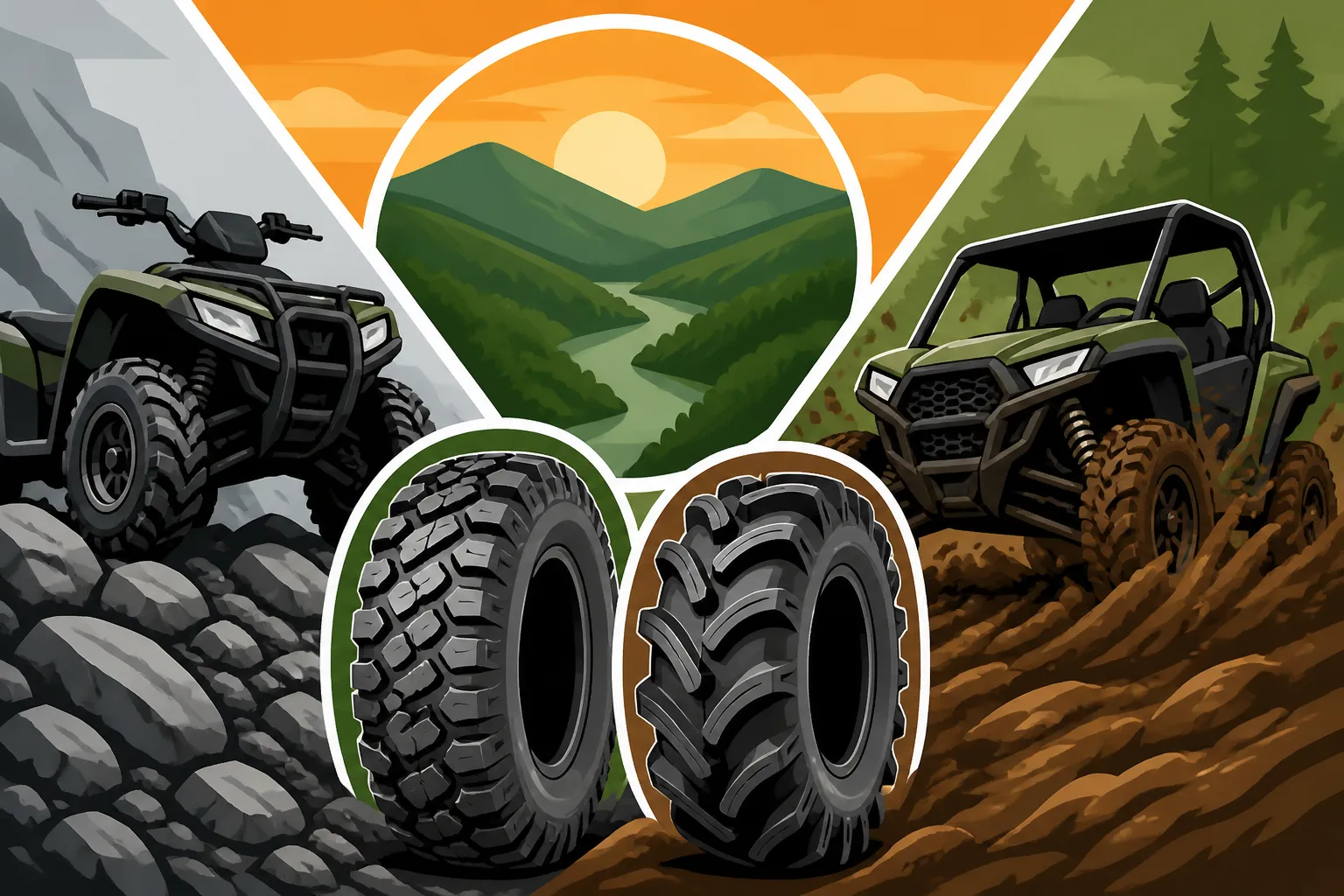
Match the Tire to Tennessee’s Trail Surface
A tire that hooks up well on one part of a ride may feel frustrating on the next. Around Windrock, Brimstone, and Royal Blue, riders can encounter rocky climbs, loose shale, mud holes, roots, and packed bench roads in the same outing. Before choosing a tire, think about the surface you ride most often, not just the toughest obstacle you hope to tackle.
For rock, ledges, and rough trails
On rocky trails, look for durable construction, dependable grip, and a tread pattern that can conform to uneven ground without feeling vague. A tire with sturdy sidewalls can help resist cuts and punctures from sharp edges. That added protection may matter on rough sections where a tire’s sidewall brushes against rocks or the machine drops into a rut.
Rock grip is not simply about having the most aggressive tread. A tire with widely spaced lugs may bite into loose dirt, but on hard rock it can sometimes feel less predictable than a pattern with more rubber contacting the surface. The right balance depends on the compound and tread design, as well as tire pressure, vehicle weight, and riding style.
If your regular rides include exposed rock and ledges, compare the tire’s construction details carefully. Look at the manufacturer’s information for carcass strength, sidewall design, and intended use. Do not assume that a visually chunky tread automatically means a tire is puncture-resistant. Some tires look aggressive but are designed primarily for soft terrain rather than repeated contact with sharp rock.
Trail character matters, too. A rocky route with gradual grades asks different things of a tire than a steep climb with loose stone. Before heading out, check current trail conditions and maps; Tennessee Trails With Rock and Tennessee Trail Conditions Before You Ride are useful starting points for thinking through that terrain. Tools such as onX Offroad can help you review mapped routes and terrain context before choosing which trails to ride, but conditions can change after rain, maintenance, or heavy traffic.
For mud, clay, and wet ground
Mud tires usually have taller, more widely spaced lugs than all-around trail tires. The gaps let mud clear as the tire rotates, helping the tread find firmer ground. In sticky clay, a shallow tread can pack up and lose bite. A more open pattern may keep working longer, especially at low speed where the tire is not spinning fast enough to shed mud easily.
There is a trade-off: a very open, tall-lug tire can ride roughly on hard-packed surfaces. It may feel less settled on gravel or rock, and it can create more vibration and noise. For a rider who encounters occasional mud but spends most of the day on mixed trails, an extreme mud tire may solve one problem while making the rest of the ride less comfortable.
Mud depth also changes the decision. A light layer of wet clay on a trail does not necessarily call for a dedicated mud tire. Deep ruts, standing water, and soft ground are a different matter, but aggressive tires are not a substitute for judgment. Spinning hard in a rut can dig the machine deeper, damage the trail, or leave you needing a recovery. If the route is soaked, consider turning around rather than trying to prove what the tires can do.
A trail map can help you plan a route around the conditions you want to avoid, but it cannot tell you exactly how much water is in a mud hole today. Check local trail updates and use onX Offroad or another mapping tool as part of the planning process, not as a guarantee that every segment is passable. For more on the terrain mix, compare Tennessee Trails With Mud with Tennessee Trails With Rock.
For mixed terrain and everyday riding
Many Tennessee riders do not want separate tire sets for every season or park. An all-around trail tire can be a sensible choice when most rides include a mix of hardpack, loose dirt, rocks, and occasional mud. It may not excel in deep clay or on the sharpest rock, but it can offer a more balanced feel across a varied day.
The best compromise depends on where the machine spends its time. A rider who mostly takes family-friendly routes and sees a muddy patch now and then may prefer a predictable all-terrain tread. Someone who regularly rides steep, rough trails may reasonably accept a firmer ride in exchange for stronger sidewalls and more traction-oriented tread.
| Tire style | Often suited to | Main advantage | Common trade-off |
|---|---|---|---|
| All-around trail | Mixed dirt, gravel, modest rock, occasional mud | Balanced handling across varied surfaces | Less bite in deep mud and less specialized rock performance |
| Rock-oriented | Ledges, rocky climbs, sharp and uneven ground | Durable construction and dependable contact on rough terrain | May not clear sticky mud as effectively |
| Mud-oriented | Deep, soft, or sticky mud | Open tread can help shed mud and find traction | Rougher feel and less predictable handling on hard surfaces |
| Sand-oriented | Loose, sandy terrain | Designed to float and move through softer ground | Usually a poor match for rocky Tennessee trails |
The labels are only a starting point. Two tires described as “all terrain” can behave differently, and an ATV tire may not be appropriate for a heavier side-by-side. Check load and speed ratings, rim compatibility, overall diameter, and the machine manufacturer’s recommendations before buying. Tennessee Trails for a Wide Machine is also worth considering if you ride a wider UTV and need to think about trail fit as well as tire fit.
Choose the Right Construction, Size, and Pressure
A tire can have the right tread pattern and still disappoint if it is the wrong size, too lightly built for the vehicle, or run at an unsuitable pressure. These details affect grip, comfort, steering, puncture risk, and whether the tires clear the machine properly.
Check size and load requirements first
Start with the size listed in your owner’s manual or on the tire currently fitted to the vehicle. A larger tire can increase ground clearance, but it can also alter gearing, steering effort, braking feel, and the machine’s effective power. It may rub against suspension or bodywork when the wheels turn or the suspension compresses.
Do not choose a tire based only on the idea that bigger is better. A heavy, oversized tire can make a machine feel sluggish and may place additional strain on components. If you want to change diameter, compare the proposed size with the vehicle maker’s guidance and ask a qualified tire or powersports professional whether the fit is appropriate for your specific model.
Load capacity matters particularly on UTVs, which may carry passengers, tools, recovery gear, or camping supplies. Check the tire’s load rating against the vehicle and the way it will be used. A tire that seems adequate for a lightly loaded solo ride may be a poor choice for a full machine on rough terrain.
When comparing options, write down the tire size, construction, load rating, and intended surface. It is easy to focus on tread appearance and overlook a compatibility detail that matters more once the machine is loaded and moving over uneven ground.
Understand sidewalls and puncture protection
Rocky Tennessee trails can punish a tire’s sidewall, not just its tread. A strong sidewall can reduce the chance of damage from sharp rocks and can help the tire hold its shape under load. However, construction descriptions differ among manufacturers, so compare the actual specifications rather than relying on a vague “heavy-duty” label.
More robust construction often comes with extra weight. That can affect acceleration, steering, and suspension response. The change may be subtle on a large UTV but more noticeable on a smaller ATV. If you ride mostly smooth trails, a heavy rock-focused tire may offer protection you rarely need while making the machine feel less nimble.
Think about the full setup, too. A spare tire, plug kit, inflator, and basic recovery gear are useful companions on remote rides. They do not make a weak tire suitable for punishing terrain, but they can help you respond to a repairable problem. Learn how to use your repair equipment at home rather than trying to figure it out for the first time beside a trail.
Set pressure for the machine and conditions
There is no single pressure that works for every ATV or UTV, tire, load, and trail. Begin with the vehicle and tire manufacturers’ recommendations. Then account for the machine’s weight, passengers, cargo, and the terrain you expect to encounter. Avoid copying a pressure figure from another rider without knowing whether their vehicle and tires match yours.
Lower pressure can increase the tire’s contact area and may improve grip on some surfaces, but going too low can create new risks. The tire may flex excessively, come off the bead, or become more vulnerable to sidewall damage. Higher pressure can make a tire feel harsh and reduce its ability to conform to irregular ground. Make adjustments cautiously, stay within manufacturer guidance, and use a reliable gauge.
Check pressure before the ride, when the tires are cool, and inspect for damage after a rocky or muddy outing. A slow leak can be hard to notice while riding, especially if the trail is rough. On a multi-day trip, bring a gauge and a portable inflator so you can check and correct pressure rather than guessing by eye.
Plan Your Tires Around the Ride
The best tire choice is not made in isolation. It depends on where you ride, how far you travel, who is riding with you, and whether you can get help if a tire fails. A little planning can prevent the familiar disappointment of reaching a trailhead and realizing the machine is not set up for the day’s conditions.
Start with the park and route
Look at the trail system before deciding that you need a specialized tire. Windrock Park at Oliver Springs, Tennessee, Brimstone Recreation at Huntsville, Tennessee, and Royal Blue and Sundquist each represent different riding opportunities and route choices. The exact conditions on a particular trail can vary, so use park information and recent local updates alongside maps.
If you are new to an area, choose routes that match both your experience and your machine’s setup. A highly aggressive tire will not make an unfamiliar steep route automatically safe. Likewise, a conservative all-around tire may be entirely adequate for a moderate route even if the park contains more demanding trails elsewhere.
Mapping tools such as onX Offroad can help you study trail layout, locate route options, and plan a ride around your group’s comfort level. Confirm access and current closures through the park or land manager before setting out. Digital maps are helpful for orientation, but they do not replace posted signs, local rules, or on-the-ground decisions.
For trail-specific preparation, Reading a Tennessee Park Trail Map can help you think through route choice before loading up. A careful route plan also makes tire selection more practical: you can choose for the terrain you expect rather than buying the most extreme tire available just in case.
Match the setup to your machine and riding group
An ATV ridden solo on moderate trails has different needs from a loaded four-seat UTV carrying passengers and supplies. Extra weight can affect how the tires behave, especially on climbs, in soft ground, and during braking. If you routinely ride with passengers or cargo, include that load when checking the tire’s capacity and setting pressure.
Consider the least experienced rider in the group when planning a route. A tire that grips well does not eliminate the need for smooth throttle control, appropriate speed, and safe spacing. If one machine has different tires from the rest, it may handle mud or rock differently; leave more room between vehicles and avoid assuming everyone can follow the same line.
Before a longer outing, inspect tread depth, sidewalls, valve stems, and wheels. Look for embedded rocks, cuts, bulges, or signs of a bead leak. Replace a tire that has damage affecting its structure rather than relying on a quick patch for a problem that could worsen far from the trailhead.
Use a simple pre-ride decision process
When you are deciding between two tire types, work through these questions:
- What surface will take up most of the ride? Choose for the terrain you will encounter most often, not a rare obstacle.
- How sharp or rough is the terrain? Give sidewall protection and construction more weight when the route includes frequent rocks and ledges.
- How deep and sticky is the mud likely to be? Occasional wet patches may not justify an extreme mud tire; persistent deep mud may call for more open tread.
- What does the machine carry? Check load rating and pressure with passengers, cargo, and accessories in mind.
- What compromises can you tolerate? More mud traction can mean a rougher ride on hard ground; heavy construction can add weight.
- Can you repair or manage a problem on the route? Bring suitable tools and know how to use them before leaving cell coverage.
If you ride different parks and seasons, an all-around tire may be the more practical choice. If your regular routes consistently involve deep mud or sharp rock, a specialized tire may be worth considering. Either way, make the decision based on the machine, the terrain, and your actual riding habits—not just the most aggressive tread in the shop.
Disclaimer
This article is for general informational purposes only and does not constitute professional advice. Laws, prices and regulations vary by location and change over time. Consult a qualified professional for guidance on your specific situation.