The Ten Counties Named in Tennessee Law
Trying to figure out where you can actually ride your ATV or UTV on the road in Tennessee can feel like navigating a maze blindfolded. One moment you hear about new laws, the next you're getting conflicting information from different sources. This guide is here to clear up the confusion, specifically by diving deep into the ten Tennessee counties that are explicitly named in the state's adventure tourism legislation, giving them unique powers to open up roads for your off-highway vehicle.
Understanding Tennessee's OHV Road Laws: A Patchwork of Regulations
For years, the idea of legally riding an ATV or UTV on public roads in Tennessee was a bit of a pipe dream for most. The general rule across the state was a resounding "no." Your machine belonged on trails, private property, or dedicated riding parks, and bringing it onto paved or even unpaved county roads was a surefire way to invite a citation. This created a lot of frustration for riders who wanted to connect trails, access fuel, or simply enjoy their machines beyond the confines of a park.
The Evolution of Tennessee's Street Legal Efforts
The landscape, however, has been slowly but surely changing. Recognizing the immense economic and recreational potential of off-highway vehicle tourism, especially in the rugged, scenic areas of East Tennessee, lawmakers began to explore ways to integrate OHVs into local transportation. These efforts weren't about throwing open every road in the state, but rather about creating targeted, localized solutions. The goal was to support the growing "adventure tourism" industry, which brings visitors and their dollars to rural communities, all while trying to maintain public safety and minimize disruption to non-riding residents. It's a tricky balance, and it’s why the laws have evolved into a rather specific, somewhat complex system that often requires local engagement.
One of the most significant shifts came with legislation that didn't just tweak existing rules but introduced entirely new categories and permissions. For example, understanding [What House Bill 810 Changed in 2025] is crucial, as it really reshaped how certain counties could approach road access. This bill didn't make every UTV street legal overnight, but it laid the groundwork for specific areas to adapt their regulations. It acknowledged that a one-size-fits-all approach wouldn't work for a state as geographically and culturally diverse as Tennessee.
Why County-Specific Rules Exist
The reason we have this patchwork of regulations, rather than a single statewide decree, boils down to local control and the unique needs of different communities. What makes sense for a heavily forested, trail-rich county in East Tennessee might be entirely impractical or undesirable for a bustling suburban county near Nashville or a farming community in West Tennessee. The state legislation, therefore, often acts as an enabling framework, giving counties the option to enact their own ordinances within defined parameters, rather than mandating uniform rules.
This means that while the state sets the overarching boundaries—like defining [Tennessee's Class I OHV Definition] or [Tennessee's Class II OHV Definition]—the decision to open specific roads, and the specific rules for doing so, often rests with county commissions and local authorities. They are the ones who understand the local traffic patterns, the needs of their residents, and the potential impact of increased OHV traffic. This decentralized approach requires riders to be extra vigilant. You can't assume that just because you rode legally on a county road in Scott County, the same rules apply if you cross into Morgan County, even if they're both named in the same statewide legislation. Always, always check the local ordinances for the specific county you plan to ride in.
The Concept of Adventure Tourism Districts
The heart of Tennessee's approach to opening roads for OHVs lies in the concept of "Adventure Tourism Districts." This isn't just a catchy phrase; it's a legal designation that grants specific powers and responsibilities to counties identified as having significant potential for outdoor recreation, particularly involving off-highway vehicles. These districts are designed to foster economic growth by attracting riders, encouraging local businesses, and integrating trail systems with community amenities.
How Districts Empower Localities
Once a county is designated (or falls within the named counties, as we'll discuss), it gains the authority to create specific ordinances that allow OHVs on certain county roads. This is a huge deal because, without this designation, counties would typically be bound by the stricter statewide prohibitions. The power includes defining which roads are permissible, setting specific hours of operation, establishing speed limits, and even requiring certain safety equipment beyond state minimums.
For instance, within these districts, a county commission might decide to open certain unpaved roads to connect residents to [Windrock Park at Oliver Springs, Tennessee] or allow riders to access gas stations and restaurants. This power isn't limitless; state law provides guidelines, such as the stipulation that state highways generally remain off-limits, with very few exceptions for specific crossings or short segments. But within county-controlled roads, these districts empower local leaders to craft solutions that fit their unique geography and economic goals. It moves the decision-making much closer to the people directly affected by the changes, allowing for more responsive and tailored solutions.
The Impact on OHV Riders and Tourism
For riders, the creation of Adventure Tourism Districts means more opportunities to legally explore. It transforms disconnected trail systems into broader networks, allowing for longer rides, more scenic routes, and better access to amenities. Imagine being able to ride directly from your cabin to a trailhead, or from a trail system into town for lunch without having to load your machine onto a trailer. This convenience significantly enhances the riding experience.
Economically, the impact on these counties can be substantial. OHV tourism brings in significant revenue through lodging, food, fuel, parts, and repairs. Local businesses, from small diners to hardware stores, see an uptick in customers. This creates jobs and strengthens local economies, particularly in rural areas that might otherwise struggle. SuperATV, for example, produces many aftermarket parts and accessories that riders purchase to enhance their machines, whether for trail riding or making them more road-friendly with items like turn signal kits or windshields. The ability to ride on roads connects riders to these types of businesses more easily. Ultimately, these districts aim to create a symbiotic relationship where riders get more access, and communities reap the economic benefits of being a prime destination for OHV enthusiasts.
Diving Deep into the Ten Named Counties
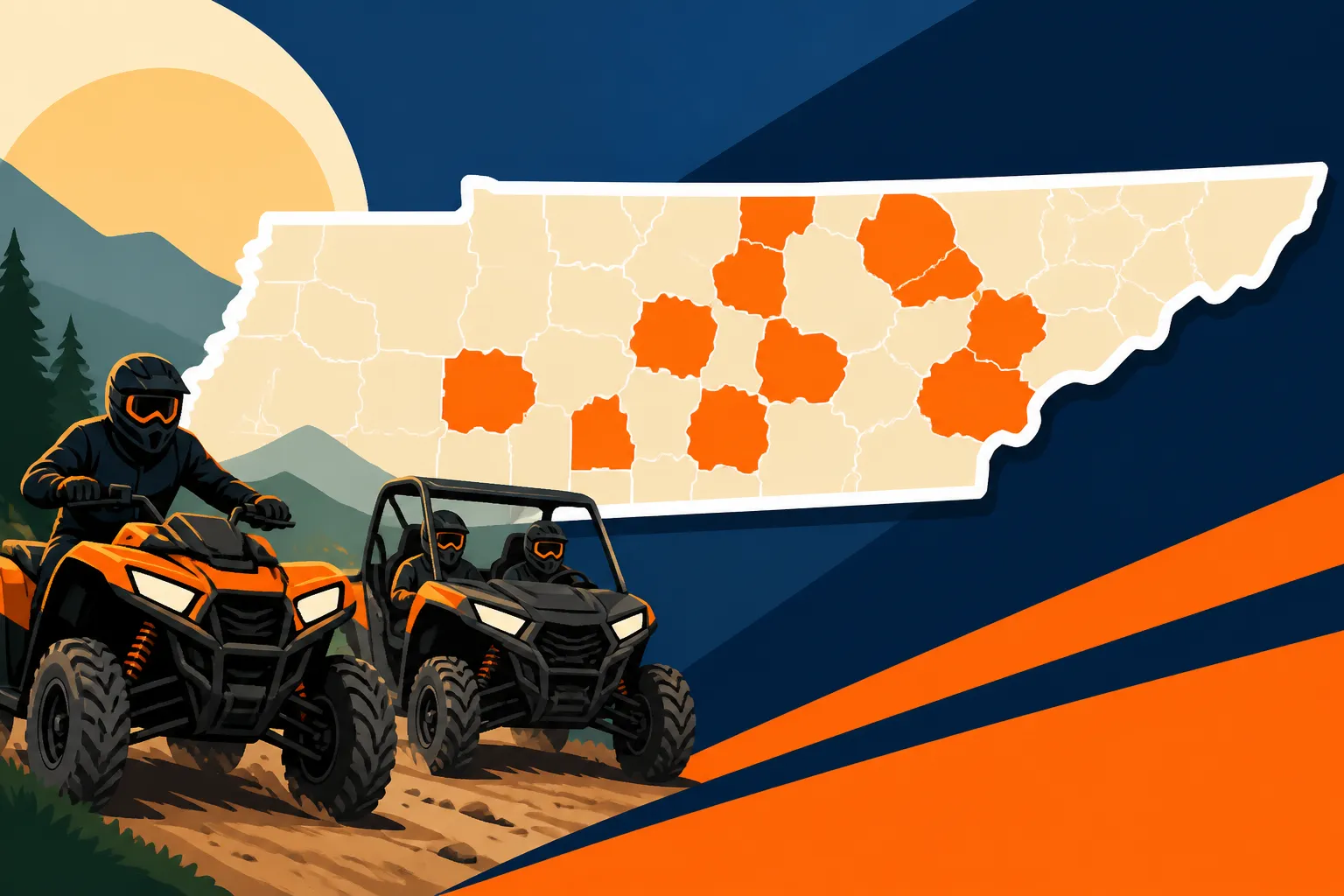
The Tennessee state law specifically names ten counties that are either established as or have the authority to create Adventure Tourism Districts, granting them special powers regarding OHV road use. These are Scott, Anderson, Campbell, Morgan, Jackson, Johnson, Perry, Unicoi, Fentress, and Hickman counties. Each of these areas offers unique riding opportunities and has taken different approaches to implementing the new laws.
Scott County: A Trailblazer in OHV Access
Scott County is often considered a pioneer in embracing OHV tourism in Tennessee. It's home to major riding destinations like Brimstone Recreation, and the community has long recognized the economic engine that off-road vehicles represent. In Scott County, you'll find some of the most progressive road-use policies, allowing riders to connect trails and access towns. For example, specific streets within the town of Huntsville have been designated for OHV use during certain hours, allowing riders to travel between [Brimstone Recreation at Huntsville, Tennessee] and local businesses.
However, even in Scott County, there are strict rules. For example, major state routes like SR 63 and US 27 typically remain off-limits, with very few exceptions. Riders need to be acutely aware of [Checking a Restricted Road List] that the county publishes to understand exactly which roads are open. The famous O and W Road, for example, is a historic logging and railroad bed that has been opened for OHV use, but its specific access points and conditions can change. Always verify current rules, especially when planning to ride areas like [Between Brimstone Road and Norma Road] or where [The O and W Road Leaves Oneida].
Anderson and Campbell Counties: The Heart of Coal Country Riding
Anderson and Campbell counties are equally legendary in the Tennessee riding scene, primarily thanks to massive parks like Windrock and Ride Royal Blue. These counties are synonymous with rugged mountain terrain, former coal mining lands, and hundreds of miles of trails. The state's designation means these counties have the authority to make local roads accessible to OHVs, often with the goal of connecting these vast trail systems or allowing riders to reach nearby towns for supplies, food, and lodging.
In Anderson County, for instance, you'll find [Windrock Park at Oliver Springs, Tennessee], a massive 73,000-acre park. While most of your riding will be on the park's private trails, the local county government has worked to designate certain roads that allow riders to travel between staging areas, campgrounds, and the town of Oliver Springs itself. Similarly, Campbell County, home to [Ride Royal Blue Resort in Tennessee] and parts of the [Tennessee's North Cumberland WMA], has embraced OHV tourism. These counties often face unique challenges, such as sharing roads with active logging or mining operations, which can influence which roads are opened and under what conditions. Riders here must be especially mindful of heavy machinery and industrial traffic, particularly on roads that might also serve as haul roads for the coal industry.
Morgan, Jackson, and Johnson Counties: Eastern Tennessee's Diverse Landscapes
Moving further into East Tennessee, Morgan, Jackson, and Johnson counties also hold the special designation for adventure tourism. While perhaps not as widely known for OHV parks as the "coal country" trio, these counties offer diverse terrain, from the Cumberland Plateau in Morgan to the Appalachian Mountains in Johnson County. This designation allows these counties to develop their own OHV road-use strategies, potentially opening up access to scenic overlooks, fishing spots, or connecting smaller, lesser-known trail networks.
For example, a county like Morgan, with its mix of forests and rural roads, might open routes that provide access to hunting areas or connect to privately owned trail systems. Johnson County, in the extreme northeast, with its stunning mountain vistas, could designate roads that lead to trailheads or allow for scenic drives. The key takeaway for riders is that the potential for OHV road use exists in these counties, but you absolutely must consult their specific local ordinances. The rules for [Riding Unicoi County Roads] might be quite different from [Riding Fentress County Roads], even though both are named in the same state law. The beauty is in the local flexibility, but the responsibility to know the rules falls squarely on the rider.
Perry, Unicoi, Fentress, and Hickman Counties: Western and Central Tennessee's Opportunities
The list of ten counties extends beyond just the eastern mountains, reaching into central and even parts of western Tennessee with Perry, Unicoi, Fentress, and Hickman counties. This demonstrates the state's broader vision for adventure tourism, recognizing that off-highway vehicle recreation isn't just confined to one region. These counties each have distinct geographic features and types of riding experiences.
Perry and Hickman counties, for instance, are located in the scenic Western Highland Rim region, characterized by rolling hills, rivers, and dense forests. While perhaps not known for massive OHV parks, their designation allows them to explore connecting rural roads to smaller, localized trails, or using OHVs for accessing remote recreational areas like fishing spots along the Buffalo or Duck Rivers. Unicoi County, nestled in the Appalachian Mountains near the North Carolina border, offers mountainous terrain and dense forests, with potential for connecting to the Appalachian Trail region (though OHVs are strictly prohibited on the AT itself). Fentress County, on the Cumberland Plateau, has diverse landscapes including parts of the Big South Fork National River and Recreation Area, and its designation could lead to improved access around the perimeter of these federal lands, or to other local trail systems. As with the other named counties, any road use in these areas would be strictly governed by local ordinances, and riders must always verify specific permissions before heading out. For riders wanting to explore these varied landscapes, aftermarket accessories from companies like SuperATV can be invaluable for customizing their machines for the specific demands of rocky trails or extended road connections.
Navigating County Roads: Rules and Restrictions
Just because a county allows OHVs on certain roads doesn't mean it's a free-for-all. Far from it. These permissions come with a specific set of rules and restrictions designed to ensure rider safety, protect infrastructure, and minimize inconvenience to other road users. Ignoring these rules can lead to hefty fines and jeopardize the future of OHV access in these areas.
Speed Limits and Daylight Hours
One of the most common restrictions you'll encounter on designated OHV roads is specific speed limits. You won't be able to fly down these roads at highway speeds. Typically, designated OHV roads, especially those in rural or residential areas, will have reduced speed limits, often much lower than the posted limit for cars. Many jurisdictions specify that OHVs cannot exceed 25 mph or 35 mph, even if the road is posted for 45 mph. For example, [Riding a Road Posted 45 mph or Under] might sound like it’s open season, but often the OHV-specific limit is lower. It’s critical to remember that [Riding Only Between Sunrise and Sunset] is also a common requirement, unless otherwise specified, largely due to safety concerns and the limitations of ATV/UTV lighting systems compared to street-legal vehicles. Night riding on public roads usually requires specific local permission and advanced lighting, which is rare.
These speed restrictions are in place for several reasons: OHVs typically have a higher center of gravity, less stable handling at speed, and are not designed with the same crash protection as cars. Reduced speeds help mitigate these risks. Adhering to these limits is not just about avoiding a ticket; it's about staying safe and showing respect for the community.
Helmet Requirements and Age Restrictions
Safety gear is paramount, and helmet laws are often stricter for OHV road use than for off-road trail riding. While [Tennessee Helmet Law Off-Road] might have certain exemptions for older riders on private land, when you hit a public road in Tennessee, even a designated county road, the rules tighten significantly. Expect helmet mandates for all operators and passengers, regardless of age. This often aligns with the state's broader motorcycle helmet laws, which are quite comprehensive. For example, [Tennessee Helmets for Operator and Passengers] is a critical rule to follow.
Age restrictions also play a significant role. Generally, you need to be a licensed driver, usually 16 or older, to operate an OHV on a public road. This means that a younger rider, even if they're experienced on trails, might not be legally allowed to operate an OHV on a public road, even if a parent is supervising. [Tennessee Minimum Age to Ride a Road] is a non-negotiable requirement. These rules are in place to ensure that operators have the necessary maturity, experience, and understanding of traffic laws to safely navigate public roads alongside other vehicles.
Insurance and Driver's License Mandates
Just like with any other motor vehicle on a public road, you will almost certainly be required to carry valid liability insurance for your OHV. This protects you and others in case of an accident. [Tennessee UTV Insurance Requirement] is not just a suggestion; it’s a legal necessity. You should always carry proof of insurance with you while riding, as a deputy at a roadside stop will undoubtedly ask for it.
Furthermore, the operator of the OHV must possess a valid driver's license. This isn't a special "OHV license"; it's your standard Class D or equivalent driver's license. [Tennessee Driver's License Rules for UTVs] mean that if you can't legally drive a car on the road, you can't legally drive an OHV on a designated county road either. This ensures that the operator has passed the state's driving examination, understands traffic laws, and is legally permitted to operate a motor vehicle on public thoroughfares. Without a valid license and insurance, you're not just risking a ticket; you're risking a misdemeanor charge and severe financial consequences if an accident occurs.
How Counties Designate OHV-Friendly Roads
The process by which these ten counties actually open their roads for OHV use isn't arbitrary; it follows specific legal mechanisms outlined by the state. Understanding this process is key for riders, as it highlights why some roads are open and others aren't, and how you can stay informed.
The Two-Thirds Vote for Unpaved Roads
One of the specific provisions in Tennessee law related to Adventure Tourism Districts is the ability for a county's legislative body (the county commission) to open unpaved roads through a supermajority vote. Specifically, a two-thirds vote of the county commission is often required to designate certain unpaved county roads for OHV use. This provision is significant because unpaved roads often form the backbone of rural trail systems and are less trafficked than paved roads. It allows counties to connect existing trail networks or provide access to remote areas without the same traffic concerns as main thoroughfares.
This [How a Two-Thirds Council Vote Opens Unpaved Roads] requirement ensures that there's broad local consensus before roads are opened. It's not a decision made lightly, and it typically involves public hearings, input from residents, and careful consideration of safety and environmental impacts. So, if you're riding on an unpaved road in one of these counties, it's highly likely that this specific legislative process has occurred to deem it permissible for OHV use.
Checking Restricted Road Lists
This cannot be stressed enough: always, always check the current local ordinances and designated road lists for the specific county you plan to ride in. The state law grants counties the authority, but it's up to each county to exercise that authority and publish their specific rules. These rules are not static; they can change based on local conditions, public input, or new safety concerns.
Counties are typically required to make these lists public. This could be on their county clerk's website, at the county courthouse, or even posted at common entry points to riding areas. The best practice is to consult the county's official website or call the county clerk's office before your trip. Just because [Scott, Anderson and Campbell Counties] are named in the law doesn't mean all their roads are open. In fact, specific routes, especially state highways or roads through densely populated areas, will almost certainly remain restricted. For instance, you might find designated streets in LaFollette, but these are often limited. [Finding the Restricted Road List Your County Published] is your ultimate responsibility as a rider to avoid citations and ensure safe, legal riding. A good example is the specific limitations you might find on [SR 63's Two Open Weekends a Year] in certain areas, highlighting that even within open counties, restrictions can be very granular.
Beyond the Ten: What About Other Tennessee Counties?
While the focus of this guide is on the ten named counties that have special provisions for OHV road use, it's natural to wonder about the rest of Tennessee. What if you live in a county not on this list, or want to ride in an area known for its beauty but without the "Adventure Tourism District" designation?
The Default "No Road Use" Rule
For any county not explicitly named in the state's adventure tourism legislation, the default rule regarding OHV use on public roads remains the strict prohibition. This is the [Why Tennessee Bars Interstates] and most other public roads for OHVs. Unless a specific county has successfully lobbied for its own special legislation (which is rare and usually has to fit a very specific set of criteria), you should assume that operating your ATV or UTV on any public road—paved or unpaved—in an unnamed county is illegal. This includes crossing roads, riding on shoulders, or even short jaunts to a neighbor's house.
This default rule is in place for several reasons, including vehicle design, safety concerns, and the need to protect public infrastructure. OHVs are simply not built to the same safety standards as street-legal vehicles, nor are they typically equipped with all the required street-legal features like proper lighting, mirrors, or turn signals (though many riders add these with aftermarket kits, often from brands like SuperATV, for trail safety or for states that do allow road use). Without specific local or state authorization, you risk a [Tennessee's $50 Fine] or even a [A Class C Misdemeanor in Tennessee] for illegal road use.
Advocacy and Future Changes
The landscape of OHV laws is always evolving, and what is true today might not be true tomorrow. The success of adventure tourism in the ten named counties could very well inspire other counties to seek similar designations or advocate for changes to statewide legislation. Local communities, businesses, and rider groups often play a crucial role in advocating for such changes.
If you are passionate about expanding OHV access in your county, getting involved with local government, attending county commission meetings, and joining local riding clubs can be effective ways to voice your opinions. Gathering data on the economic benefits of OHV tourism and presenting well-reasoned arguments for safe, responsible road use can help sway public opinion and legislative bodies. However, it's a slow process that requires patience, persistent advocacy, and a commitment to demonstrating responsible riding practices. Until then, always abide by the current laws and stick to designated areas, especially when [Bringing a Machine From Kentucky to Tennessee] or other neighboring states, as their rules might differ significantly.
Essential Gear and Preparation for Tennessee Road Riding
Riding on designated county roads, even with limited traffic, requires a different mindset and different equipment considerations than pure trail riding. You're sharing the road with cars, trucks, and potentially even tractors, so your machine needs to be as visible and safe as possible.
Lighting, Mirrors, and Safety Equipment
For any road use, your OHV must be equipped with adequate lighting. This typically includes working headlights, taillights, and brake lights. While most modern ATVs and UTVs come with these, you might need to ensure they are bright enough and functioning perfectly. Many aftermarket kits, including those from SuperATV, offer enhanced LED lighting options that improve visibility dramatically, which is crucial for safety on public roads. Beyond basic lights, some counties might require turn signals and even a horn, similar to standard vehicles. These are vital for communicating your intentions to other drivers.
Mirrors are another non-negotiable item. You'll need at least one, if not two, rearview mirrors to see traffic approaching from behind. Again, many OHVs don't come standard with robust mirrors for road use, so investing in quality aftermarket mirrors is a smart move. And, of course, your personal safety equipment includes an approved helmet, appropriate eye protection (goggles or a visor), and durable riding gear to protect you in case of a fall or collision. Remember, [Tennessee Equipment Rules for Road Use] can be quite specific, and a deputy [What a Tennessee Deputy Checks Roadside] will be looking for these items.
Tire Considerations for Mixed Terrain
Most ATVs and UTVs are equipped with aggressive off-road tires designed for maximum traction in mud, dirt, and rocks. While these are fantastic on the trails, they can wear down quickly and perform poorly on paved roads, leading to reduced handling and increased tire noise. If you plan on doing a significant amount of road riding, even on unpaved county roads, you might consider tires that offer a better compromise.
Some riders opt for "all-terrain" tires that have a less aggressive tread pattern, offering a smoother ride and better longevity on hard surfaces while still providing decent traction off-road. Companies like SuperATV offer a wide range of tire options, including those designed for mixed-use, which could be a great investment if you're regularly connecting trails via public roads. The right tire choice can make a huge difference in comfort, safety, and the lifespan of your tires when you're traversing different types of terrain during a single ride.
Permits and Paperwork
Beyond your driver's license, insurance card, and any required permits for accessing private riding parks, what else should you carry? Depending on the county, there might be a specific sticker or permit required to designate your OHV for road use, or simply proof that your machine is titled. While Tennessee does not register OHVs in the same way it does cars, it does require them to be titled, and you might receive a [Tennessee's TDR Sticker Explained] to affix to your machine, indicating that it has been legally titled. This sticker is often part of [A Sticker That Proves a Tennessee Title Exists], which county clerks issue.
You should also carry any documentation specific to the local ordinance that permits road use, if available. This proves you are on a designated road and abiding by the rules. Keeping all this paperwork (or clear, legible photos of it on your phone) in a waterproof bag on your machine is highly recommended. Being prepared with your [Tennessee OHV Title Paperwork] can save you a lot of hassle and potential fines if you're stopped.
Common Misconceptions and Rider Responsibilities
Riding on public roads, even in designated areas, comes with a unique set of responsibilities and potential pitfalls. It's important to dispel common myths and reinforce the critical role of rider behavior in maintaining access.
"Street Legal" Does Not Mean "Any Road"
This is perhaps the biggest misconception. Just because your UTV has turn signals, a horn, and mirrors (perhaps from a SuperATV kit) and you're in one of the ten named counties, it does not automatically mean you can ride on any public road. The state law is quite clear: it grants counties the ability to designate roads, but it does not open all roads by default. [Tennessee UTV Road Requirements] are specific and vary by locale.
State highways (often identified by "SR" or "US" route numbers) are almost universally off-limits, with very few, strictly defined exceptions for crossing. For example, [Why SR 63 and US 27 Stay Closed in Huntsville] is a perfect illustration. Most designated OHV roads are county-maintained roads, often rural or unpaved. Always remember that [Why Your Class Decides Your Road Rights] is a real factor; a Class I OHV might have different permissions than a modified dune buggy under Class II, depending on the local ordinance. You, the rider, are responsible for knowing which specific roads are open and which are closed in the exact area you're riding. Ignorance of the law is not an excuse.
Respecting Local Laws and Private Property
The future of OHV road access in Tennessee hinges on responsible rider behavior. When you're riding on public roads, you are an ambassador for the entire riding community. Excessive noise, reckless driving, littering, or disrespecting private property rights can quickly lead to public backlash and potentially cause counties to revoke or restrict OHV access.
This means adhering strictly to speed limits, yielding to other traffic (especially farm equipment or school buses), avoiding excessive noise (especially in residential areas), and never, ever trespassing on private land. Just because a county road runs through a rural area doesn't mean the surrounding land is fair game for riding. [Tennessee Trespass Rules for Riders] are serious, and landowners are often very protective of their property. Be courteous to residents, clean up after yourself, and be mindful of your impact on the environment. Riding legally and responsibly ensures that the hard-won privileges of road access can continue for years to come. Ultimately, showing that OHV riders are responsible members of the community is the best way to secure and expand access in the long run.
Here's a quick overview of the ten counties:
| County Name | General Region (Tennessee) | Primary Geographic Feature | Potential OHV Access Focus | Key Riding Areas (Examples) |
|---|---|---|---|---|
| Scott | East (Northeast) | Cumberland Plateau, Mountains | Connecting trails, town access | Brimstone, O&W Road, Huntsville area |
| Anderson | East (Northeast) | Cumberland Plateau, Mountains | Connecting trails, town access | Windrock, Oliver Springs area |
| Campbell | East (Northeast) | Cumberland Plateau, Mountains | Connecting trails, town access | Ride Royal Blue, North Cumberland WMA |
| Morgan | East (Central) | Cumberland Plateau | Scenic roads, forest access | Rural roads, connecting to private trails |
| Jackson | East (Central) | Eastern Highland Rim, Cumberland Plateau | Rural connectors, river access | Obey River area, local unpaved roads |
| Johnson | East (Northeast) | Appalachian Mountains | Mountain roads, scenic routes | Doe Mountain Recreation Area (nearby) |
| Perry | West (Central) | Western Highland Rim | Rural access, river access | Buffalo River area, connecting small trails |
| Unicoi | East (Southeast) | Appalachian Mountains | Mountain roads, forest access | Cherokee National Forest (perimeter) |
| Fentress | East (Central) | Cumberland Plateau | Rural connectors, access to Big South Fork | Big South Fork (perimeter), local roads |
| Hickman | West (Central) | Western Highland Rim | Rural access, river access | Duck River area, connecting small trails |
Disclaimer
This article is for general informational purposes only and does not constitute professional advice. Laws, prices and regulations vary by location and change over time. Consult a qualified professional for guidance on your specific situation.