Tennessee Rules for a Rented Machine
Renting an ATV or UTV in Tennessee can simplify a trip, but it does not automatically cover trail permits, park access or road-use rules. The key is to match the rental agreement to the place you plan to ride. This guide explains what to check before booking, at pickup and on the trail, including what changes for visitors and passengers.
The rental does not replace the riding permit
A rental agreement gives you permission to use a machine under the rental company’s terms. A trail permit or land-use permit gives you permission to ride in a specific area. Those are separate permissions, and having one does not necessarily provide the other.
That distinction matters because Tennessee does not have one statewide trail permit that grants access to every ATV or UTV riding area. Requirements depend on the land manager. A state-managed riding area, a private off-road park and a national recreation area can each have different rules. A machine rented near one park is not automatically cleared to ride somewhere else.
Before you book, identify the exact riding area and ask three questions:
- Does the rental include the required permit for this specific area?
- If it does, whose name is the permit issued in, and which riders or vehicles does it cover?
- If it does not, where must each rider obtain the permit?
Get clear answers before paying or signing. A general statement like “trail access included” may describe access to the outfitter’s property or one designated trail system, not all nearby public or private trails.
For a broader explanation of how Tennessee’s trail access permits differ, see Tennessee Trail Permits Explained. If you are still deciding whether your destination requires one, Do You Need a Permit for Tennessee Trails? is a useful starting point.
A quick comparison by riding area
| Where you plan to ride | What to verify before pickup | Why a rental does not settle the question |
|---|---|---|
| North Cumberland Wildlife Management Area | Current permit requirements, rider eligibility, vehicle rules and any unit-specific notices | A rental company may not be the permit issuer, and a private park permit does not cover the WMA |
| Windrock or Brimstone | The park’s current permit or land-use permit rules, including how passengers are handled | Each private park sets its own access terms; a permit from another park may not work |
| Big South Fork or another public recreation area | The managing agency’s current OHV rules, approved routes and required authorization | A state or private-park permit does not necessarily authorize use there |
| Private land or a leased coal property | The landowner’s or leaseholder’s permission and any separate site rules | Renting a machine is not permission to enter someone else’s land |
| A public road | Whether that particular road is open to the type of vehicle and what road-use requirements apply | A trail permit is not a street registration, road permit or exemption from traffic laws |
This table is a planning aid, not a substitute for the current rules of the specific area. Closures, approved routes and permit procedures can change. Confirm them with the land manager before you ride.
Permit and rental are two different agreements
The rental contract is between you and the outfitter. It may set limits on who can drive, where the machine can go, when it must be returned and who pays for damage or recovery. The land-use permit is issued under a separate set of rules. It may be tied to a rider, vehicle, date range or riding area.
Sometimes an outfitter handles the permit as part of the rental process. Even then, ask what “included” means. It could mean the outfitter buys or arranges a permit, or it could mean the rental price includes access to a particular private trail system. Those are not always the same thing.
A permit can also be required for a rider even when the rider is not operating the machine. Passenger rules vary by area and program, so do not assume that the driver’s permit covers every person in a side-by-side. Ask whether passengers need their own authorization, whether there is a separate passenger charge and whether children are treated differently.
If you are comparing package details, Tennessee Rentals That Include the Permit can help you identify the specific questions to ask. Read the park’s rules as well as the rental company’s description.
Identify the rules for your exact destination
The fastest way to avoid a permit surprise is to plan around the land manager, not just the town where you are picking up the machine. Several riding areas can be close together in Tennessee, but their rules are not interchangeable.
State-managed riding areas
The North Cumberland Wildlife Management Area has its own OHV permit program and riding conditions. If your rental itinerary includes a WMA unit, check the current requirements directly with the program or managing agency. Confirm which permit applies to your dates, which machines and riders are covered, and whether any unit or trail has a special closure or restriction.
Do not assume a rental shop can answer every WMA question simply because it operates nearby. A shop can explain its rental process, but the land manager controls access to the public riding area. For the separate obligations that apply on a WMA, read [Tennessee Rules for Riding a WMA].
Tennessee’s state permit program is not a pass for every off-road destination. It does not automatically give permission to ride a private park, a private coal tract, a closed trail or a road that is not open to your machine. Likewise, a private park permit does not replace a WMA permit when you cross into the WMA.
Private parks and outfitters
Private parks set their own access and permit conditions. A rental company may be located at or affiliated with a particular park, but that does not establish that its rental includes every permit or covers every person in the group.
Ask whether the machine may ride only on the park’s trail network or whether it can be transported to another destination. Ask how the park handles the permit: does the renter collect it, does the outfitter issue it, or does the rider need to buy it separately? If you are renting a multi-seat UTV, find out whether the permit conditions are based on the vehicle, the driver, the passenger or some combination.
A pass for one private park should not be treated as a regional pass. The same is true in reverse: a state-issued OHV permit may satisfy one public-area requirement but does not grant access to a separate private park. Why a Tennessee Park Permit Does Not Travel explains why checking each destination matters.
Big South Fork and other public lands
A trip itinerary may include more than one kind of public land. Check each area’s managing agency and current OHV guidance separately. For example, do not assume that rules for the North Cumberland WMA apply at Big South Fork. The authorized roads, vehicle requirements and permits can differ. See [Tennessee Rules for Riding Big South Fork] if that area is part of your plan.
The same care applies to connecting roads between trail systems. A route shown on a mapping app may cross public roads, private property or a closed segment. A rental outfit’s suggestion of a scenic loop is not a substitute for confirming that the entire route is open to the type of machine you have rented.
Private land, coal property and informal routes
A visible trail is not proof that it is open to the public. A rental permit does not give you landowner permission, and an old map or social media post may not reflect current access. If a route crosses private property or a leased tract, verify that access is authorized and that the rental company allows its machines there.
Do not rely on an informal assurance such as “people ride there all the time.” Ask who controls the land, whether written permission is needed and whether your rental agreement permits the route. If the answer is unclear, choose a designated riding area instead.
Confirm what the rental package actually includes
Rental descriptions often group together the machine, basic safety gear and some form of trail access. That can be convenient, but each part has different terms. A written confirmation makes it easier to see what you still need to arrange.
Ask specific questions before booking
Before you reserve, contact the outfitter and describe your plan plainly: the date, the park or public riding area, the number of machines, the number of drivers and passengers, and whether you want to ride beyond the outfitter’s immediate trail network.
Ask questions such as:
- Is the required permit included in the rental, or is it a separate purchase?
- Which exact park, WMA unit or trail system does it cover?
- Is the permit attached to the machine, the renter, the driver or the date?
- Does it cover every adult in the group, or only the person named on the rental?
- Do passengers need separate permits or park authorization?
- Does the permit cover the full rental period, including a second riding day?
- What proof must be carried while riding?
- Can the machine leave the designated park or trail system?
- Are there route closures, operating-hour restrictions or seasonal rules to know about?
- If the destination closes or a trail becomes unavailable, what happens to the reservation and permit?
A helpful answer names the destination and the coverage. “Yes, it’s included” is not enough if the company cannot say what is included.
Make the permit arrangement visible in your booking records
Ask for the permit terms in writing, whether by email, booking confirmation or rental paperwork. Save the confirmation on your phone and keep any required printed document or permit receipt as instructed. If the permit is issued electronically, check whether you need to display it, show an order number or keep it available for inspection.
If the outfitter says you will buy the permit at pickup, ask whether the purchase point is open when you arrive and whether the permit is available for your intended dates. Do not assume you can buy it at a gate, trailhead or after the ride begins. A phone signal may be poor, and a website or office may not be available at the time you reach the area.
A quick call to the park or land manager can resolve a mismatch between the rental company’s information and the current official rules. For guidance on choosing the source of a permit, see Where to Buy a North Cumberland Permit when North Cumberland is your destination.
Check how a rented machine is identified
The permit program may ask for information about the vehicle, while the rental company may use its own unit number or fleet records. If a permit needs a vehicle description, identification number or other detail, confirm who supplies it. Do not guess or enter a number from the wrong machine.
At pickup, make sure you receive the machine that matches the paperwork. If the outfitter substitutes another unit, ask whether the permit or recorded vehicle details need to be updated. The rental company should explain how it handles a substitution before you ride.
Do not confuse a trail permit with a title, registration or road authorization
A trail permit is not proof of ownership and does not make an ATV or UTV street legal. It also does not authorize riding on a public road that is closed to that type of vehicle. A rental machine may be properly maintained and authorized for use on an approved trail while still being prohibited from ordinary road travel.
If your plan includes a public road, verify the specific road-use rules separately. Check the vehicle category, road designation, equipment, operator eligibility and any local restrictions. Do not take a machine onto a road simply because it has a windshield, lights, a plate-like sticker or a trail permit.
For the separate issue of out-of-state paperwork, Does Tennessee Honor Out-of-State Registration? can help clarify why a registration from home does not answer every Tennessee trail-access question.
Nonresidents, identification and multiple riders
Visitors can often rent in Tennessee, but being allowed to rent does not automatically mean you qualify for every permit under the same conditions as a resident. Permit programs may distinguish between residents and nonresidents, and the relevant proof can depend on the program. Check the land manager’s current definitions and requirements rather than relying on a rental clerk’s informal description.
Tell the outfitter who will actually drive
A booking may be made by one person while another person operates the machine. Do not assume the booking name can be used as the permit holder or authorized driver for the whole group. Tell the company who will drive and ask whether each person must be listed, checked in or approved.
The rental company may require identification, a signed agreement or proof that the driver meets its own rules. Those are contract conditions, separate from the state or park’s permit eligibility. A person who meets a park’s rules may still be ineligible under the outfitter’s rental policy, and the reverse can also be true.
For driver-specific questions, see Tennessee Rental Age and License Rules. Requirements can depend on the provider and the riding location, so confirm them with both the outfitter and the land manager.
Keep the group list accurate
If your group changes after booking, contact the outfitter before pickup. A new driver may need to be approved, and an additional passenger may change the permit or seating arrangement. Do not assume someone can take over the controls simply because the machine has room for another adult.
For a group using more than one machine, make a list of the driver and passengers assigned to each vehicle. This makes it easier to confirm that everyone is covered, that every machine has the required permit and that the rental company has recorded the correct operators.
If one person plans to ride in one machine in the morning and another in the afternoon, ask how the permit applies to that change. The answer may depend on whether authorization follows the person, vehicle or time period. Avoid passing a permit or permit receipt between riders unless the program expressly allows it.
Carry proof in the way the program requires
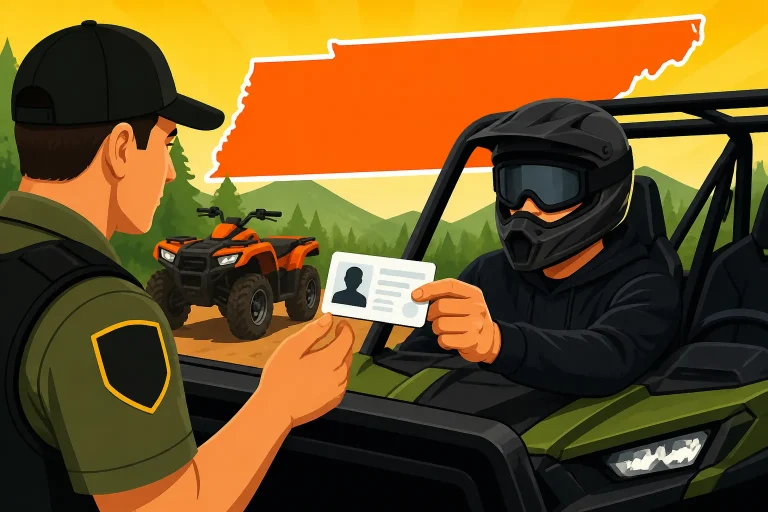
Some programs may use a physical sticker, permit document, online record or another method of verification. Follow the current instructions for the specific area. If you are told to keep proof on your person, do not leave it in a vehicle parked at the staging area. If a permit must be displayed on the machine, ask the outfitter where and how it should be attached.
Keep identification and the rental agreement accessible, but protected from water and mud. A phone screenshot can be a useful backup, but do not assume it replaces a required original, display or official record. Ask the permit issuer what forms of proof are acceptable.
Passengers are not automatically covered
A passenger may not be a driver, but that does not settle whether the passenger needs a permit or must meet other rules. Check the area’s requirements and the rental company’s contract. Pay attention to seat limits and age restrictions: the number of seats on a UTV does not mean every passenger is authorized to ride.
The same caution applies when children are in the group. Confirm that the machine is appropriate for the passenger, that the child is permitted under the park and rental rules, and that a properly sized helmet and other required equipment are available. Do not rely on a general statement that “families are welcome” as confirmation of the conditions for a particular child or machine.
Rules that still apply to a rented ATV or UTV
A rented machine is still subject to the rules of the place where it is being operated. Rental paperwork does not waive trail restrictions, equipment requirements, age rules or instructions from the land manager. Follow posted signs and current notices even if the machine was rented nearby.
Stay on the authorized trail
Ride only on routes open to your machine and permit. A trail may be closed because of maintenance, weather, a land-use restriction or a seasonal rule. A GPS line, old map or route shared by another rider does not override a gate sign or current closure notice.
Do not cut around a closed gate or ride beside a trail to get around mud, a fallen tree or a queue. Going off-route can create erosion, damage property and violate the access conditions. If you meet a closure during the ride, stop and use the approved return route or contact the outfitter for directions.
Respect operating limits and local conditions
The area may have speed limits, width limits, sound restrictions, hours of operation or other machine requirements. Check that your rental fits the destination before you leave the shop. A wide side-by-side that is suitable for one trail system may be restricted on a narrower route elsewhere.
Follow any rule about lights, helmets, passengers or protective equipment. The outfitter should explain the controls and basic operating practices, but it is your responsibility to know and follow the area’s rules. If a machine has a feature you do not understand, ask for a demonstration before departing.
Use particular care on roads and crossings
A trail permit does not create road access. Some riding areas may have designated crossings or limited routes that interact with public roads, but those are not blanket permission to ride anywhere that looks like a quiet county road. Check road-specific rules and follow signs, traffic controls and instructions from officials.
If an approved route includes a road crossing, use only the authorized crossing point and follow the required procedure. Never ride along a prohibited road simply to connect two trail areas unless the governing rules expressly allow it.
Weather and trail conditions can change your plan
Tennessee’s terrain can be steep, rocky and muddy. Heavy rain can change trail conditions quickly, and a route that was manageable earlier may become unsafe or closed. Check conditions before setting out and stay within the ability of the least experienced driver in your group.
Ask the outfitter what to do if the machine becomes stuck, damaged or disabled. Know the permitted recovery process and emergency contact method. A recovery call may involve separate charges under the rental agreement, and a trail permit does not guarantee that park staff will retrieve the machine.
If you are renting protective gear or bringing your own, check fit before the ride. A helmet that moves around, goggles that fog immediately or gloves that compromise grip are poor substitutes for equipment that works. If you buy personal riding gear through Amazon or another retailer, check its sizing and safety markings rather than assuming a product description guarantees suitability.
At pickup, inspect the machine and paperwork
A careful pickup takes a few minutes and can prevent confusion later. Do not let a busy counter or a group waiting behind you rush the basic checks.
Before leaving the rental site
- Match the machine to your booking. Confirm the vehicle type, passenger capacity and assigned unit number.
- Confirm who may operate it. Make sure every intended driver has been approved and is listed where required.
- Review permit coverage. Check the destination, dates, riders and vehicle covered, and ask where the proof must be kept or displayed.
- Read the route and boundary rules. Find out which trails are allowed and whether the machine may leave the designated area.
- Inspect the machine. Look for existing damage, tire condition, lights, mirrors, seat belts and other equipment relevant to your trip.
- Document existing damage. Take clear photos or video of visible marks and follow the company’s process for recording them.
- Ask how to report a problem. Get the contact method for breakdowns, trail emergencies and late returns.
- Check safety gear. Make sure helmets fit and that any additional equipment you need is included or allowed.
- Confirm return instructions. Ask where and when to return the machine and what to do if you are delayed.
A short walkthrough is especially important if you have never driven that model. Learn how to start and stop it, select the correct drive mode, use the parking brake, operate the lights and contact the rental company. A machine that feels unfamiliar on a rocky trail can be a safety problem even if you have experience with a different model.
Keep the information accessible during the ride
Carry the required permit proof, rental contact information and any route information the outfitter gave you. Put paper documents in a waterproof pouch. Keep a phone in a secure location, but do not count on continuous cell coverage in remote terrain.
A power bank can help keep a phone available for navigation or emergency calls. If you order one through Amazon, test it before the trip and carry the right cable; a new accessory that has not been charged is not a useful backup. Download or save the information you may need before entering a dead zone, while remembering that a saved map does not grant access to a closed trail.
Know what the rental company expects if plans change
If the park closes, the weather turns, someone in your party is injured or the machine develops a problem, contact the outfitter and follow its instructions. Do not take a substitute route across unapproved land just to finish the planned loop. Ask about approved return routes and the company’s process for a late return or roadside assistance.
Before paying, understand how the company handles cancellations, weather interruptions, damage, cleaning, fuel and recovery. These are rental-contract questions, not permit rules, and they differ between providers. For more on the contract side, read Tennessee Rental Insurance and Waivers. A waiver or insurance option does not replace a trail permit, and a permit does not cover damage to the rental machine.
A practical checklist before you book and ride
Use this checklist when comparing rental options:
- Name the exact park, WMA unit or riding area you plan to use.
- Check the current permit rules with the land manager.
- Ask the outfitter whether the permit is included and define precisely what it covers.
- Confirm whether drivers and passengers need separate authorization.
- Check how resident or nonresident status affects the permit, if applicable.
- Verify that each intended driver meets the land manager’s and rental company’s requirements.
- Confirm that the machine is allowed on the routes you plan to ride.
- Ask whether the rental may leave the outfitter’s trail system.
- Find out what permit proof you must carry or display.
- Check current closures, hours, weather conditions and route notices.
- Review the rental agreement for damage, recovery, fuel, return and cancellation terms.
- Save the permit confirmation and rental contact details before entering an area with weak reception.
A rented ATV or UTV can make a Tennessee ride much easier, especially if you do not want to haul your own machine. The reliable approach is to treat the rental, the permit and the riding area as three separate checks. Confirm each one, keep the proof accessible and stay within the authorized routes.
For additional planning, [Renting an ATV in Tennessee] covers the broader rental process, while Tennessee Rules for a Rented Machine is the specific checklist for understanding how rental conditions and riding rules fit together.
Disclaimer
This article is for general informational purposes only and does not constitute professional advice. Laws, prices and regulations vary by location and change over time. Consult a qualified professional for guidance on your specific situation.