Tennessee OHV Title After Moving to the State
Moving to a new state is exciting, but it often brings a whole new set of rules for your cherished possessions – and your off-highway vehicle (OHV) is no exception. If you've just unpacked your bags in the Volunteer State, you're probably wondering what you need to do to make your ATV, UTV, or dirt bike legally recognized here, especially since Tennessee has its own unique way of handling OHV ownership. This guide is designed to walk you through the process of getting your out-of-state OHV titled in Tennessee, making sure you hit all the right notes with the local authorities.
Welcome to Tennessee: Why Your Out-of-State OHV Needs a New Title
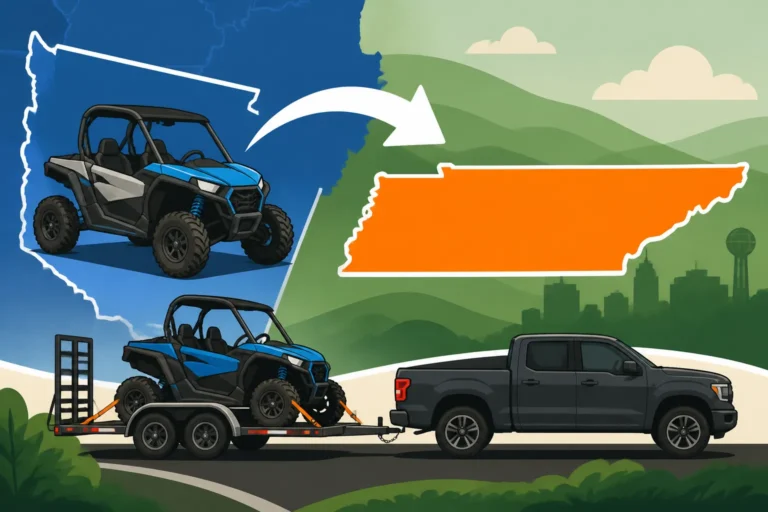
When you bring your off-highway vehicle into Tennessee from another state, it's not simply a matter of continuing to use your old registration or title. Tennessee has specific laws that require OHVs, like ATVs, UTVs, and dirt bikes, to be titled within the state if they are going to be operated here. This might feel like an extra hoop to jump through, especially if your previous state had different rules or no titling requirements at all for your type of machine. However, understanding this foundational requirement is the first and most crucial step. It ensures you're on the right side of the law, avoiding potential fines or complications down the line, particularly if you plan on riding at popular destinations like Windrock or Brimstone.
Understanding Tennessee's Titling Requirements for New Residents
Tennessee’s approach to OHV ownership centers around the concept of a "title." Unlike some states that might only require registration or a simple permit, Tennessee uses a titling system through the Tennessee Department of Revenue (TDR) to establish legal ownership. When you move here, your out-of-state title or proof of ownership needs to be converted into a Tennessee OHV Title. This process isn't just about paperwork; it's about officially documenting your machine within the state's system. Think of it as giving your OHV a new identity that Tennessee recognizes. Without a proper Tennessee title, you can't legally prove ownership within the state, which can impact everything from selling your machine later to dealing with insurance claims or even recovering it if it's stolen.
Many newcomers express frustration that their previously valid title from, say, Georgia or Kentucky, isn't immediately recognized as "good enough." It's a common feeling, but Tennessee's system is designed to create a uniform record for all OHVs operating within its borders. The state wants to ensure that all machines have a clear chain of ownership, which helps in preventing theft and ensuring appropriate taxes are collected. This is also how Tennessee tracks [Tennessee's TDR Sticker Explained], which is tied directly to your title.
The Role of the County Clerk in Your Titling Journey
While the Tennessee Department of Revenue ultimately issues and oversees OHV titles, your direct point of contact for this process will be your local county clerk's office. This is a common point of confusion for new residents, who might expect to deal directly with a state agency. Instead, the county clerk acts as the frontline agent for the TDR, handling the application, collecting fees, and forwarding the necessary paperwork. This means that if you've moved to, say, Anderson County, you'll visit the Anderson County Clerk's office. If you're in Scott County, it's the Scott County Clerk's office.
Each county clerk's office will have specific hours and might have slightly different procedures for handling walk-ins or appointments, so it’s always a good idea to call ahead. They are the ones who will review your documents, verify your identity, collect any applicable sales tax and fees, and submit your application for a new Tennessee title. They essentially serve as the gatekeepers, ensuring all the requirements are met before your OHV can officially join the ranks of Tennessee-titled machines. Their role is absolutely critical in getting your [Titling at a Tennessee County Clerk] completed smoothly, so treat them as your primary resource for questions about local procedures.
The Paper Trail: What You Need to Title a Previously Registered OHV
The success of titling your out-of-state OHV in Tennessee hinges largely on having the correct documentation. This can be the most daunting part of the process, especially if your original paperwork is scattered or incomplete. The key is to be prepared. Gathering everything beforehand will save you multiple trips to the county clerk's office and a lot of frustration. It’s not just about having a document; it's about having the right document, filled out correctly and legally, to prove your ownership history to the satisfaction of the state.
Gathering Your Documentation: Previous Title, Bill of Sale, and More
Here’s a breakdown of the essential documents you’ll need to bring to your county clerk:
- Your Previous Out-of-State Title: This is the most important document. It serves as proof of your legal ownership in your previous state. Make sure it's the original title, not a copy. If there are multiple owners listed, all must be present or have properly assigned their interest. If your OHV came from a state that issues titles, this will be the cornerstone of your Tennessee application. The clerk will verify the VIN against this title to ensure accuracy.
- Bill of Sale: Even if you have a title, a bill of sale can be crucial, especially if you bought the OHV from a private seller or if the title transfer wasn't fully documented when you originally purchased it. A solid bill of sale proves the transaction details, including the purchase price (which impacts sales tax) and the date of sale. If you find yourself needing to create a new, legally sound bill of sale, or you want to ensure the one you have is comprehensive, online services like LawDepot can provide templates that cover all the necessary details, offering peace of mind that you're not missing any crucial information. This document helps in establishing the fair market value for sales tax calculations in Tennessee.
- Proof of Tennessee Residency: You'll need to demonstrate that you are a resident of Tennessee. This typically includes a Tennessee driver's license or state ID. Utility bills, rental agreements, or property tax statements showing your Tennessee address might also be accepted if your driver's license hasn't been updated yet.
- Proof of Identity: Your current valid driver's license or state-issued ID is usually sufficient for this.
- Verification of Vehicle Identification Number (VIN): In some cases, especially if your previous state's title or registration isn't robust, the county clerk may require a physical VIN inspection. This is to ensure the VIN on your machine matches the paperwork. A law enforcement officer or an authorized dealer can often perform this verification. It’s a safeguard against stolen vehicles and ensures that the machine being titled is indeed the one described in the documents. [Checking a VIN Before a Tennessee Purchase] is always a good practice, even after you own it.
- Lien Release (if applicable): If you had a loan on your OHV and it's now paid off, you'll need a lien release from the lender. This document proves that there are no longer any outstanding financial claims against your machine, allowing you to obtain a clear title in your name.
- Odometer Disclosure Statement (if applicable): For some vehicles, an odometer disclosure might be required, though this is less common for many smaller OHVs. Always check with your local county clerk.
Having all these [Tennessee OHV Title Paperwork] documents organized and ready will streamline your visit to the county clerk significantly.
The Application Process at the County Clerk
Once you have all your documents in order, your next step is to visit your local county clerk’s office. This is where the rubber meets the road. You’ll present your paperwork, fill out a Tennessee title application form, and pay the necessary fees and taxes.
- Filling out the Application: The county clerk will provide you with the necessary forms, typically a Tennessee Application for Certificate of Title. You'll need to accurately fill in details about yourself and your OHV, including the VIN, make, model, year, and any other pertinent information. Don't be afraid to ask for clarification if any section is unclear; it's better to get it right the first time.
- Review and Verification: A clerk will review all your submitted documents, cross-referencing information like your name, address, and the OHV's VIN. They will verify that the assignment of the previous title is correct and that any necessary lien releases are present. This is also when they'll confirm your Tennessee residency.
- Paying Fees and Taxes: This is where you'll settle up. Tennessee requires sales tax to be paid on the purchase price of your OHV, even if you bought it in another state, unless you can prove you already paid an equivalent sales tax in that state. If the sales tax you paid in your previous state was less than Tennessee's rate, you'll owe the difference. The clerk will also collect the state title fee, a county clerk fee, and potentially an [Tennessee OHV Lien Fee] if you're taking out a new loan or transferring an existing one. Remember, these fees are distinct from the cost of the OHV itself and contribute to the overall [Tennessee OHV Title Cost].
It's common for people to be surprised by the sales tax aspect, especially if they’ve owned the OHV for a while. Tennessee's law dictates that the sales tax is due when the vehicle is first brought into the state for titling, based on the original purchase price or a fair market value if the purchase price isn't readily available or seems unusually low.
What to Expect Regarding Fees and Taxes
Navigating the financial aspect of titling can be a bit opaque without clear guidance. Here's what you should generally anticipate:
- Tennessee Sales Tax: This is often the largest financial component. If you purchased your OHV in another state and are now titling it in Tennessee, you'll likely be required to pay Tennessee sales tax on its purchase price. There might be an exception or credit if you paid sales tax in your previous state at a rate equal to or higher than Tennessee's. If the other state's rate was lower, you'd pay the difference. The clerk will need proof of the original purchase price, often from your bill of sale or the previous title's recorded value. Keep in mind that for private sales without a clear bill of sale, the county clerk may use a valuation guide to determine a fair market value for sales tax purposes.
- State Title Fee: This is a standard fee collected by the state for issuing the new Certificate of Title.
- County Clerk Fee: Your local county clerk's office charges a separate fee for their services in processing your application. This fee helps cover the administrative costs incurred by the county office.
- Lien Recording Fee: If you have a lender on your OHV, or if you're taking out a new loan against it, there will be a fee to record that lien on the Tennessee title. This ensures the lender's interest is legally protected.
It's difficult to give exact figures here as they can change, but it's always prudent to call your specific county clerk's office ahead of time to inquire about the current rates for these fees and taxes. They can often give you a good estimate of what you'll owe, especially if you have your bill of sale and previous title information handy. Having a checkbook or sufficient cash/card funds ready will prevent delays.
Navigating the Nuances: Special Situations and Common Hurdles
Even with the best preparation, unique circumstances can arise when titling an out-of-state OHV in Tennessee. From lost paperwork to machines that never had a title in their original state, these situations require specific attention and often a bit more legwork. Understanding how Tennessee addresses these nuances can save you a lot of headache and ensure your machine gets titled correctly.
Lost Titles or Missing Paperwork
One of the most common frustrations for new residents is realizing their original out-of-state title is missing or that a crucial bill of sale can't be found. Don't panic, but do understand that this adds a layer of complexity.
- If your out-of-state title is lost: Your first step should be to contact the Department of Motor Vehicles (or equivalent titling agency) in the state where the OHV was last titled. You'll need to apply for a duplicate title from that state. This process can take time, sometimes several weeks, so it's wise to start it as soon as you realize the original is missing. Tennessee cannot issue a new title based solely on a registration card; they need that official proof of ownership from the previous state.
- If you're missing a bill of sale: A clear [A Tennessee Bill of Sale for an OHV] is essential, especially for determining sales tax. If you bought your OHV privately and never got a formal bill of sale, or if you've lost it, you might need to try and contact the previous seller to create one retroactively. Services like LawDepot can provide standardized bill of sale templates that you and the previous owner can complete. These templates ensure all the necessary information, such as VIN, make, model, sale price, and signatures, is included, making it more likely to be accepted by the county clerk. If the original seller is unreachable, the county clerk might have specific forms or procedures, possibly involving a signed affidavit of ownership or using a fair market value for tax purposes. Be prepared to explain the situation clearly.
The county clerk's office needs to establish an unbroken chain of ownership. Any gaps in this chain, whether a missing title or a lacking bill of sale, will raise red flags and require additional steps to satisfy Tennessee's requirements.
Machines Without Previous Titles: Coming from Non-Titling States
Not all states title ATVs and UTVs. This can be a huge point of confusion for someone moving to Tennessee from, for example, a state like Georgia, where many OHVs are not titled at the state level but rather might only have a certificate of origin or a registration sticker. If your OHV comes from a state that does not issue titles for that type of machine, you'll need to provide alternative proof of ownership.
Here's what Tennessee typically requires in such a scenario:
- Manufacturer's Certificate of Origin (MCO) or Manufacturer's Statement of Origin (MSO): If your OHV is relatively new and has never been titled anywhere, the MCO/MSO is the primary document proving its initial ownership. This document essentially acts as the "birth certificate" for the vehicle.
- Original Bill of Sale: This becomes even more critical if there's no title. A comprehensive bill of sale from the dealership or previous owner, detailing the OHV's VIN, sale price, and parties involved, is essential. Again, if you're working with an informal or lost bill of sale, a well-structured template from a service like LawDepot can be invaluable to formally document your ownership.
- Previous State's Registration Card: While not a title, a registration card from your former state shows that you were recognized as the operator of the vehicle.
- Affidavit of Ownership: In some cases, especially if other documentation is sparse, the county clerk may require you to sign an affidavit swearing that you are the rightful owner of the OHV and explaining its ownership history.
It's a common scenario in areas near Tennessee's borders. Someone from Alabama might bring an ATV that was only registered there, or a North Carolina resident might have only had an MSO. The county clerk will examine these documents closely to ensure they meet Tennessee's standards for proving ownership. They want to be certain that the machine isn't stolen and that you are the legal and rightful owner before issuing a Tennessee title.
Understanding Tennessee's OHV Categories: Class I and Class II
Tennessee doesn't just title "an OHV"; it classifies them. Understanding [Tennessee's Four Vehicle Categories] for OHVs, specifically Class I and Class II, is important because these classifications are noted on your title and can have implications for how your machine is identified and, in some rare cases, what paperwork is needed.
- Class I OHV: This category generally includes machines like traditional ATVs (quads) and side-by-sides (UTVs) that are 80 inches or less in width and weigh 2,500 pounds or less. Most recreational ATVs and many smaller UTVs fall into this category. If you have a two-seat side-by-side or a typical four-wheeler, it's almost certainly a Class I. For new residents, your machine will be automatically assigned to this class if it meets the criteria during the titling process. You can learn more about [Tennessee's Class I OHV Definition].
- Class II OHV: This category is for machines that exceed the Class I width or weight limits, such as wider, heavier, or more specialized UTVs, or custom-built machines like sand rails. If your large, multi-passenger UTV, or a unique vehicle you've brought from another state, is over 80 inches wide or weighs more than 2,500 pounds, it will be classified as Class II. This distinction is made during the titling process based on the vehicle's specifications. For more details, see [Tennessee's Class II OHV Definition].
The main impact of these classifications for titling purposes is accurate documentation on your new Tennessee title. While the titling process itself is largely the same for both classes, the correct classification ensures your title accurately reflects your machine's characteristics according to Tennessee law. The county clerk will assess your OHV's specifications based on manufacturer's data or a physical inspection if necessary to assign the correct class.
Beyond the Title: Understanding Tennessee's OHV Landscape
Once you've successfully navigated the titling process and received your new Tennessee OHV title, you might think you're done. However, there are a few more critical pieces of information you'll want to understand, especially concerning the unique Tennessee Department of Revenue (TDR) sticker and what your new title means for future ownership. This isn't just bureaucratic detail; it's about being a fully informed and responsible OHV owner in Tennessee.
Receiving Your Tennessee TDR Sticker and What It Means
One of the unique aspects of OHV ownership in Tennessee is the [Tennessee's TDR Sticker Explained]. Unlike traditional vehicle registration stickers that you renew annually, the TDR sticker for OHVs is a one-time sticker issued by the Tennessee Department of Revenue with your title. It's not a registration that expires or needs renewal in the typical sense.
Here's what you need to know:
- Proof of Title, Not Registration: The TDR sticker serves as physical proof that your OHV has a valid Tennessee title on file with the state. It does not act as a registration that permits road use or access to public trails (those require separate permits). It simply signifies that your machine's ownership is properly documented in Tennessee.
- Where it Goes: The sticker is typically a small decal that should be affixed to your OHV in a visible location, often on the frame or a fender, as specified by the instructions that come with it. It should be easily seen for verification by authorities. [Where the Tennessee TDR Sticker Goes] often causes confusion, so follow the guidelines provided with your sticker.
- One-Time Issue: This is crucial: the TDR sticker is generally issued only once when the OHV is first titled in Tennessee. It doesn't get renewed annually like car tags.
- Tied to the OHV, Not the Owner: The sticker is issued for the specific OHV with its unique VIN. However, it is not transferable between owners. [Why the Tennessee Sticker Cannot Be Transferred] is a key point for future sales.
So, when you get your Tennessee title after moving to the state, you'll also receive this TDR sticker. It's an important piece of the puzzle, signaling to law enforcement and others that your OHV has gone through the official titling process in Tennessee.
What to Do If You Sell Your OHV Later in Tennessee
The process of titling your out-of-state OHV in Tennessee directly impacts how you'll handle selling it in the future. Once you have a Tennessee title, the sale process becomes much more straightforward, following standard Tennessee procedures for vehicle transfers.
- Proper Assignment of Title: When you sell your OHV, you will sign over the Tennessee title to the new owner in the designated section. This is called "assigning" the title. It's critical that this is done correctly, with accurate information for both seller and buyer, and that the odometer reading (if applicable) is recorded.
- Bill of Sale: Even with a signed-over title, it’s always a good practice to provide the buyer with a separate [A Tennessee Bill of Sale for an OHV]. This document serves as a clear record of the transaction, including the sale price, date, and condition of the OHV. For both your protection and the buyer's, using a reliable template from a service like LawDepot can ensure all legal bases are covered, including warranties (or lack thereof) and buyer/seller contact information. This helps prevent disputes down the line.
- The TDR Sticker Becomes Void: This is a critical point. When you sell your OHV, your Tennessee TDR sticker becomes void. The new owner will need to apply for a new title in their name, and with that new title, they will receive a new TDR sticker. You cannot simply hand over your old sticker to the new owner. [Why a Tennessee Sticker Dies With the Sale] is important for buyers to understand.
- Removing Your Plates/Stickers: While OHVs don't have traditional license plates, ensure any personalized decals or park permits (which are separate from the TDR sticker) that are tied to you are removed.
Being meticulous about the title transfer and providing a clear bill of sale protects both you as the seller and the new buyer, making the transition smooth and legal for everyone involved.
Disclaimer
This article is for general informational purposes only and does not constitute professional advice. Laws, prices and regulations vary by location and change over time. Consult a qualified professional for guidance on your specific situation.