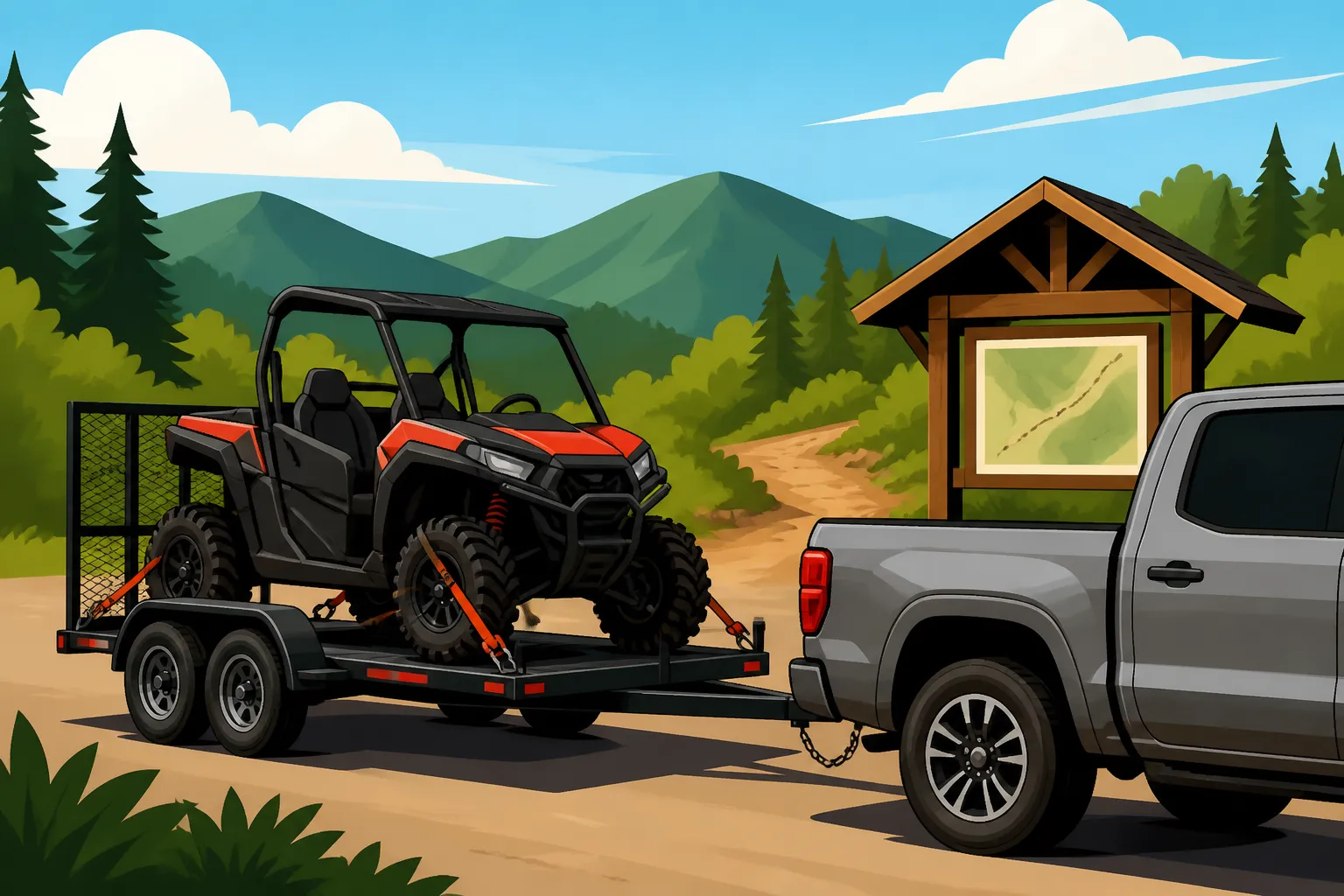
Parking a Trailer at a Tennessee Trailhead
A trailer can turn a simple Tennessee trail ride into a frustrating start if the staging area is full, the access road is too tight, or the spot you chose is not meant for overnight parking. This guide explains how to plan trailer parking near popular riding areas, check site-specific rules, protect your tow vehicle, and avoid blocking other riders or emergency access.
Before you tow to a Tennessee trailhead
Confirm the trailhead and parking rules
“Trailhead” can mean a signed public access point, a private off-road park’s staging area, or simply the place where riders unload before continuing on a trail. Those locations can have very different rules. A trailer spot that works at a managed resort may not be permitted beside a public road, on a wildlife management area, or near a gate.
Start with the land manager or park operator, not just a map pin. Ask whether trailers are allowed, where the designated unloading area is, whether parking is day-use only, and whether you may leave a trailer while riding elsewhere. If you are heading toward Windrock near Oliver Springs, Brimstone near Huntsville, or Royal Blue near Pioneer, confirm the current directions and parking instructions with the specific operator or access point you plan to use. Nearby roads and entrances can lead to different properties or facilities.
This is especially important in the North Cumberland area, where a trail system can include different units and access points. A permit or permission to ride does not automatically answer where you may park a truck and trailer. Check [Tennessee Rules for Riding a WMA] and Does One Permit Cover Every North Cumberland Unit? for related planning questions, then verify the parking details with the land manager.
Choose a route your whole rig can handle
A route that is easy in a pickup alone may feel very different with a long trailer behind it. Mountain approaches, narrow lanes, steep driveways, sharp turns, loose gravel, and limited sightlines can make turning around difficult. Before leaving home, identify the correct entrance and look for a suitable place to pull over if you need to check directions. Avoid relying on a last-minute phone search while you are driving a trailer through an unfamiliar holler.
Use a mapping tool to review the approach, but treat mapped roads and parking symbols as planning clues rather than proof that a trailer may park there. onX Offroad can help you orient yourself around trail areas and nearby roads; confirm the actual entrance, surface conditions, and trailer rules with the park or land manager. Check your route at home while you have a larger screen and enough time to compare directions, rather than trying to sort out a confusing map at a narrow junction.
If you are unsure whether your rig can turn around, contact the destination and describe the tow vehicle and trailer length. A useful question is not just “Can I get there?” but “Is there room to turn around or unload without backing into traffic?” That distinction matters on steep or constricted approaches. For general destination planning, Parking a Trailer at a Tennessee Trailhead can be paired with Tennessee Trail Maps Worth Carrying and Tennessee Trail Conditions Before You Ride.
Where trailer parking usually makes sense
Managed parks and private riding areas
At a managed riding park, look for the designated staging or parking area and follow staff directions, posted signs, and any check-in instructions. Some facilities may have separate spaces for trucks, trailers, unloading, and overnight stays. Do not assume that an open patch of gravel is available for parking simply because another vehicle is already there. It may be a turnaround, a staff access lane, or a space reserved for a different use.
When you arrive, take a moment to assess the layout before you commit to a tight maneuver. If staff are available, ask where to unload and whether your trailer should remain connected to the tow vehicle. Keep the unloading process efficient: secure your vehicle, unload machines in the designated area, and move out of a shared lane as soon as you can. This is courteous to riders waiting behind you and reduces the chance of blocking someone who needs to leave.
If your destination is a large property, verify that the parking location matches the area you intend to ride. A staging area at one entrance may not provide convenient access to every riding unit. Use onX Offroad or another map to keep your bearings, but follow the operator’s directions over a route that merely looks shorter on a screen. A little time spent checking the entrance can prevent an avoidable drive with a trailer between the wrong gate and the right one.
Public land, roadside access, and informal pull-offs
Public-land access does not mean every nearby shoulder or clearing is an approved place to leave a trailer. A roadside pull-off might be too narrow, block visibility, interfere with a gate, or leave too little room for work vehicles and emergency responders. Never park in a way that restricts access to a trail entrance, utility feature, private driveway, or road. If signs or a land manager prohibit parking, choose another location rather than trying to fit in.
Be cautious with informal spots you find through social media or an old map pin. Conditions and access arrangements can change, and a place that once served as a staging area may no longer be available. If there is no clear sign or reliable direction, contact the managing agency before unloading. For land where permission is required, get it directly from the responsible owner or manager; a trail map does not grant permission to park on private property.
For North Cumberland and other public riding areas, check the specific unit and access point rather than assuming rules are identical throughout the region. Tennessee’s North Cumberland WMA provides context about the broader riding area, while Tennessee Trail Closures to Check First is a useful reminder to verify access before making the drive. If your plan includes a public-land trailhead, ask directly whether trailer parking is allowed and whether the vehicle must be moved at a particular time.
| Parking situation | What to confirm before unloading | Common risk to avoid |
|---|---|---|
| Managed off-road park | Designated trailer area, check-in process, and overnight rules | Blocking a shared lane or using a staff-only space |
| Public-land access point | Permission, posted restrictions, and whether trailers are accommodated | Assuming an open shoulder is approved parking |
| Roadside pull-off | Safe width, visibility, and whether parking is allowed | Obstructing traffic, a gate, or emergency access |
| Campground near a trail | Whether a trailer may remain at the campsite and how to reach the ride area | Treating campground parking as trailhead parking |
| Unfamiliar private property | Owner or manager permission and the correct entrance | Relying on a map pin or another rider’s old directions |
Parking and unloading without creating a problem
Set up the truck and trailer carefully
Before backing into a spot, pause and look for the full path of the trailer, not just the place where you want the truck to end up. Check for ditches, soft shoulders, steep grades, low branches, rocks, drainage channels, and other trailers. A spot that appears level from the driver’s seat may slope enough to make unloading awkward or allow a trailer to shift if it is not properly secured.
Use a spotter when available, and agree on clear hand signals before moving. If the approach is tight or visibility is poor, stop and reassess rather than rushing because other riders are waiting. Leave adequate room for neighboring vehicles to open doors and unload machines. Once parked, secure the trailer as appropriate for its design and the ground beneath it, and make sure the tow vehicle can leave without another driver having to move.
Keep ramps, tie-downs, tools, fuel containers, and gear organized so they do not spill into traffic or shared access lanes. A family arriving with children may need more time to unload, while a group of several machines may need a more deliberate sequence. If the staging area is busy, unload one machine at a time, keep bystanders clear of moving vehicles, and shift equipment out of the way promptly.
Protect your vehicle and valuables
Do not leave important items visible in the cab or truck bed while you are riding. Secure documents, keys, wallets, and electronics, and avoid leaving a spare key in an obvious place. If you have a locking storage box or a secure way to cover equipment, use it. A trailer parked for several hours can be exposed to weather, dust, and curious passersby, so bring only what you need and secure the rest.
Take a quick walk around your rig before leaving. Check that the trailer is stable, the hitch and safety connections are in the expected position, and nothing is hanging into the travel lane. Photographing your setup can help you remember where you left it and document its condition, especially if you are parked in a crowded lot. Keep the photo private if it shows identifying details or valuables.
Cell service can be inconsistent in mountain terrain. Save the destination’s contact information and directions before leaving a town with reliable coverage. onX Offroad can be useful for keeping track of your general location, but do not count on a phone app as your only way to find the trailer at day’s end. Note the entrance, lot name or sign, and any recognizable landmark while you still have signal. For further trip logistics, see Cell Dead Zones Across the North Cumberland WMA.
A practical arrival and departure plan
Use this pre-trip checklist
A short checklist helps avoid the familiar scramble when you reach the trailhead and realize the map pin is not the entrance or the trailer cannot fit where you expected. Before departure, confirm the address or gate, parking permission, operating instructions, and whether your group needs to check in before unloading. If you are traveling to a popular area on a weekend or during a busy season, ask whether the staging lot fills and whether there is an alternate approved location.
- Confirm the exact trail access point with the park or land manager.
- Ask whether trailers are allowed and whether parking is day-use or overnight.
- Check the approach for tight turns, steep grades, and safe places to turn around.
- Save directions and the destination contact information offline.
- Prepare tie-downs, ramps, wheel chocks, and gear before reaching the staging area.
- On arrival, follow signs and staff instructions, then park only in the designated area.
- Before riding away, secure the truck and trailer and note the entrance or lot landmark.
If you are bringing a group, share the same entrance details with every driver. A convoy can become separated when one vehicle follows an outdated map pin or turns into the wrong access road. Send a written location and any instructions from the operator, and agree on a meeting point that does not block the entrance. For broader preparation, Parking a Trailer at a Tennessee Trailhead fits naturally alongside Tennessee Trail Permits Explained and Camping Near Tennessee ATV Trails.
Leave the site as you found it
When you return from riding, check the area around your truck and trailer before loading. Mud, loose gravel, and tired riders can make a rushed departure more likely, so take a moment to clear the loading area and keep ramps away from traffic. Load machines in a controlled order, secure them properly, and make sure straps or equipment are not left behind. If the lot has a posted closing time or staff procedure, follow it rather than assuming you can remain after others have left.
Before pulling out, look for pedestrians, riders entering the lot, and vehicles backing from nearby spaces. A trailer can hide a person or machine from view, particularly in a busy staging area. If you have a spotter, use them when visibility is limited. Once on the access road, take extra care on steep grades and narrow routes where a sudden stop or sharp turn could create trouble for the whole rig.
If the parking area is crowded, muddy, or unexpectedly closed, do not improvise by leaving the trailer on a shoulder or blocking an entrance. Call the operator or land manager and ask where they want you to go. That small pause is far less frustrating than returning from a ride to find your rig obstructing access or parked somewhere it should not be.
Disclaimer
This article is for general informational purposes only and does not constitute professional advice. Laws, prices and regulations vary by location and change over time. Consult a qualified professional for guidance on your specific situation.