One Statewide Standard Replacing County-by-County Rules
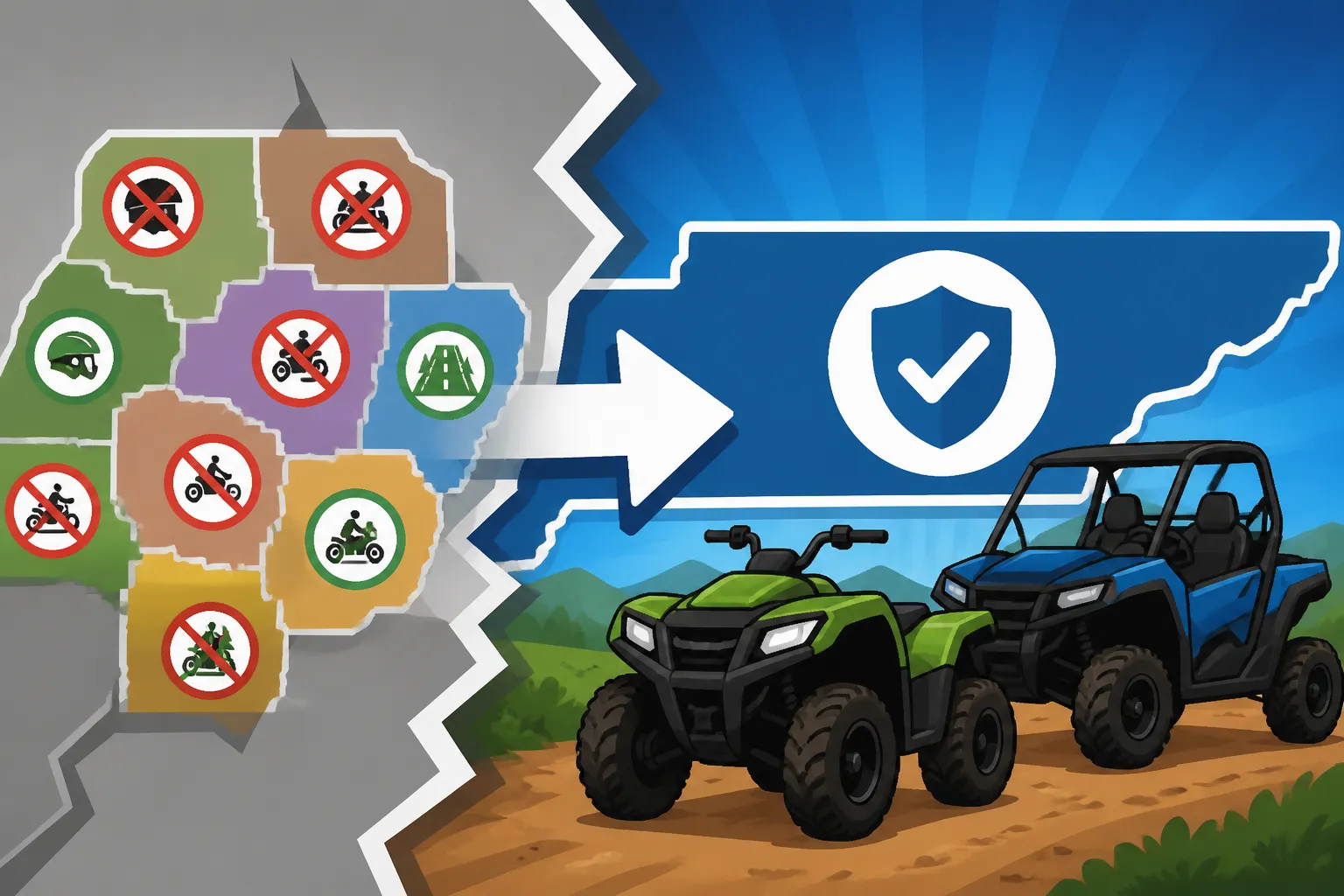
For years, navigating the rules for riding ATVs and UTVs on Tennessee’s public roads has felt like a wild goose chase. One county would say yes, the next would say no, and the county after that would have its own unique set of stipulations, leaving riders confused, frustrated, and sometimes, facing unexpected fines. This guide is here to cut through that chaos, explaining Tennessee’s new statewide standard that aims to bring much-needed clarity and consistency to OHV road use.
The Frustration of County-by-County Rules and Why It's Changing
If you've spent any time riding an ATV or UTV in Tennessee, you know the absolute headache that was the old system of county-by-county road rules. It wasn't just inconvenient; it was genuinely maddening for anyone trying to enjoy our beautiful trails and connect them with the towns and services that support our passion. Riders were constantly on edge, wondering if they were legal or about to get a ticket just for going down the road to grab a snack or get some fuel.
The Old Patchwork System: A Nightmare for Riders
Imagine this scenario: You're planning a weekend trip to ride some fantastic trails in East Tennessee. You've researched the local ordinances for the county where your campsite is, confirming that, yes, you can ride your side-by-side on certain paved county roads to get to the trailhead. You arrive, set up camp, and head out. But then, as you cross into the next county over, perhaps just to explore or to reach another section of the trail system, you suddenly find yourself on roads where OHVs are strictly prohibited. There were no clear signs, no uniform state law to guide you, just an invisible line that could lead to a fine or worse.
This wasn't an isolated incident; it was the norm. Each of Tennessee's 95 counties had the authority to create its own rules regarding OHV use on public roads. Some counties embraced OHV tourism, designating miles of roads for riders, while others were completely closed off. Even within a single region, like the Coal Country Trail Triangle, you could encounter vastly different rules. This meant you couldn't rely on what you knew from your home county or even the adjacent one. It was a constant game of checking local government websites, making phone calls, and hoping the information was current and accurate. This kind of uncertainty really took the fun out of planning rides and exploring new areas.
Why Riders Needed a Simpler Solution
The demand for a simpler, more unified approach to OHV road use was deafening. Riders, tourism businesses, and even local law enforcement were all feeling the strain of the confusing patchwork. For riders, it was about access and enjoyment. We wanted to be able to connect trails, visit small towns, and feel confident that we weren't breaking the law. It was also a safety issue; constantly having to guess which roads were legal, or being forced onto busy highways because county roads were closed, wasn't safe for anyone.
Local businesses, especially in rural areas that thrive on outdoor recreation, saw the potential for growth if riders felt more welcome and less burdened by legal complexities. Imagine trying to run a gas station, a restaurant, or a cabin rental business in an area popular with OHV enthusiasts, but every time a rider comes through, they have to navigate a maze of conflicting local laws. It hurt tourism and prevented our state from truly capitalizing on its incredible natural resources for riding. So, the push for a statewide standard wasn't just about convenience; it was about supporting our riding community, our local economies, and creating a safer, more enjoyable environment for everyone.
Understanding Tennessee's New Statewide Standard for OHV Road Use
The good news is that Tennessee has listened to the calls for clarity. A new statewide standard has emerged, designed to simplify the rules and give riders a more consistent framework for using their ATVs and UTVs on public roads. This change is a game-changer for anyone who has struggled with the former county-by-county confusion. It means that while local nuances will always exist, there's now a foundational set of rules that applies across the state where road use is permitted.
The Core Changes: What You Need to Know
The new standard brings several key provisions that riders need to understand. First and foremost, it establishes a framework for what kinds of roads OHVs can operate on and when. Generally, the law focuses on roads that are not part of the interstate highway system and are typically posted at 45 mph or less. This isn't a free pass for every road, but it provides a clear guideline. For instance, you can expect to find more opportunities to ride your machine on local [Tennessee Rules for Riding a County Road] or state highways within these speed limits, especially in designated areas.
Crucially, the new law emphasizes daylight-only operation. This means no cruising down that county road after sunset, even if you have great headlights. Speaking of lights, your machine needs to be properly equipped. This includes headlights, taillights, brake lights, and turn signals – just like a regular vehicle. If your machine is stock, you might need some upgrades. Many riders turn to aftermarket suppliers like SuperATV to get their machines outfitted with proper lighting kits and mirrors to meet these new requirements.
In terms of who can ride, the new rules are clear: operators must hold a valid driver's license, and there's generally a [Tennessee Minimum Age to Ride a Road] of 16 years old. Passengers are also covered under [Tennessee Helmet Law for Passengers], with specific rules for helmets, especially for those under 18. And yes, you'll need liability insurance. Think of it this way: if you're going to share the road, you need to follow many of the same rules as cars and trucks to ensure safety for everyone. You can learn more about specific requirements under [What House Bill 810 Changed in 2025].
Designated Roadways and Restricted Areas
While the statewide standard provides overarching rules, it's vital to understand that not every road is suddenly open. The law works in conjunction with decisions made by the Tennessee Department of Transportation (TDOT) and individual counties and municipalities. TDOT is responsible for designating state highways where OHV use is permitted, often in consultation with local authorities. This usually involves identifying specific segments of state routes that connect trail systems or provide access to amenities without compromising traffic flow or safety.
Counties still play a significant role. They can, through a formal process, open certain county roads for OHV use, often involving a [How a Tennessee Town Opens Its Roads] by their local governing body. This is where "Adventure Tourism Districts" come into play. These districts, often found in counties like Scott, Anderson, and Campbell, have been instrumental in encouraging OHV recreation and have a more robust framework for opening roads. However, even in these areas, there will be [Finding the Restricted Road List Your County Published] that explicitly prohibit OHVs. These lists are non-negotiable, and it's your responsibility as a rider to check them before you venture out. It's not enough to assume; you must verify. Understanding [Why an Adventure Tourism District Matters] is key to recognizing where you might find more open roads.
Equipment Requirements for Road-Legal OHVs
Making your off-road machine street-legal in Tennessee involves more than just having a driver's license and insurance. Your ATV or UTV needs to meet specific equipment standards to be considered safe for road use under the new statewide rules. This is where many riders find themselves needing to make some upgrades, and it's critical for both safety and avoiding citations.
First off, proper lighting is non-negotiable. You'll need working headlights, taillights, and brake lights. These aren't just for seeing; they're for being seen by other drivers. Turn signals are also a must. If your machine didn't come with them, you'll need to install an aftermarket kit. Mirrors are another crucial piece of equipment, typically requiring at least one rearview mirror, similar to what you'd find on a car. Again, companies like SuperATV offer a range of universal and model-specific mirrors that can easily be added to your rig.
Beyond lighting and mirrors, your OHV must have a functional horn, and a windshield is often a good idea for safety, though not always explicitly required by law for all OHV types. Your tires need to be DOT-approved if they are going to touch pavement, and your exhaust system must comply with noise regulations – no excessively loud aftermarket pipes on public roads. Even something as simple as a seatbelt for all occupants can be a requirement. Essentially, the goal is to bring your off-road machine's safety features up to a standard that makes it predictable and visible to other vehicles on the road. Many riders choose high-quality accessories from trusted brands to ensure their machines meet all [Tennessee Equipment Rules for Road Use] without compromising their off-road performance.
Navigating the New Rules: Practical Advice for Tennessee Riders
With Tennessee's new statewide standard, riders have a much clearer path to enjoying their ATVs and UTVs on designated public roads. But even with a simplified system, there are still crucial steps you need to take to ensure you're riding legally and safely. It's about being prepared, staying informed, and understanding the nuances that still exist.
Essential Paperwork and Preparations
Before you even think about putting a tire on a paved county road, make sure your personal documentation and your machine's status are in order. First, you absolutely need a valid driver's license. No temporary permits or learning permits; it needs to be a full, unrestricted license. This applies to everyone operating the OHV on a public road. Also, ensure you have proof of liability insurance. Just like a car, if you're going to share the road, you need to be covered. Keep your insurance card or digital proof readily accessible.
Next, know your machine. Understand its classification, especially if you're trying to figure out where it fits within [Tennessee's Class I OHV Definition] or [Tennessee's Class II OHV Definition]. While the new road rules apply broadly to OHVs, understanding your specific machine helps with any questions from law enforcement. Make sure your OHV has all the required safety equipment we discussed – headlights, taillights, brake lights, turn signals, mirrors, and a horn. Double-check everything before each ride, especially if you've recently been on trails where some of these components might have gotten knocked around. Many riders keep a small toolkit and spares, just in case a crucial light bulb goes out while they're away from home.
Staying Informed: Checking Road Lists and Local Ordinances
Even with a statewide standard, local decisions still matter. This is perhaps the most critical piece of advice: always check the current restricted road lists and local ordinances for the specific areas you plan to ride. While the state provides a framework, counties and TDOT are the ones who ultimately designate which roads are open and which are closed. These lists can change, and what was open last year might be closed this year.
How do you find these lists? Start with the county clerk's office or the county's official website for the area you'll be riding in. Many counties that embrace OHV tourism will have dedicated sections on their websites with maps and lists of approved roads. For state highways, TDOT may publish maps or lists. Organizations like SuperATV, who are deeply involved in the OHV community, often share information and resources about these types of regulations, but always verify with official government sources. Don't rely solely on word-of-mouth or outdated forum posts. A quick call to the local sheriff's department or county clerk can save you a lot of grief. Remember, ignorance of the law is not an excuse, and a simple search for [Checking a Restricted Road List] could prevent a fine.
Common Pitfalls and How to Avoid Them
Even with the new clarity, riders can still run into trouble if they're not careful. One of the biggest pitfalls is assuming that "statewide standard" means all roads are open. They're not. Only designated roads are fair game. Riding a road posted at 50 mph or more is generally [Why a Road Posted 50 mph Is Off Limits], and venturing onto the interstate is absolutely forbidden. Stick to roads posted [Riding a Road Posted 45 mph or Under] and confirmed as open for OHV use.
Another common mistake is riding outside of daylight hours. The [Riding Only Between Sunrise and Sunset] rule is firm. Even if you have fantastic LED light bars (perhaps from SuperATV!), you cannot legally operate your OHV on public roads after dark. Carrying a firearm on your ATV or UTV also has specific [Tennessee Rules for Carrying a Firearm on an ATV] that you need to be aware of, especially if you're heading to or from hunting land.
Finally, be mindful of your speed and driving behavior. Even on designated roads, you're sharing the space with cars, trucks, and sometimes even tractors. Drive defensively, obey all traffic laws, and maintain a reasonable speed. Getting ticketed for improper operation or for riding on a restricted road can lead to [Tennessee Fines for Illegal UTV Road Use] or even a [A Class C Misdemeanor in Tennessee] in some cases, which is something no one wants. Stay informed, stay prepared, and ride responsibly to ensure you, and future generations, can continue to enjoy Tennessee's incredible landscapes.
Here's a quick comparison of the general shift in Tennessee's OHV road rules:
| Aspect | Before Statewide Standard (General) | After Statewide Standard (General) |
|---|---|---|
| Road Eligibility | Highly variable; depended entirely on county-by-county ordinances. | Restricted to roads with speed limits 45 mph or less, and specifically designated. |
| Operator Age | Inconsistent; some counties had age limits, others didn't specify for roads. | Minimum 16 years old with a valid driver's license. |
| Helmet Rules | Varied by county, sometimes only for minors. | Helmets generally required for operators and passengers under 18 on public roads. |
| Insurance | Not universally mandated for road use. | Liability insurance required for OHVs on public roads. |
| Equipment | Minimal or no specific requirements for road use in many counties. | Must have headlights, taillights, brake lights, turn signals, mirrors, horn. |
| Time of Day | Not always specified, leading to nighttime use on some open roads. | Restricted to [Riding Only Between Sunrise and Sunset]. |
| Information Source | Local county clerk, sheriff, or specific town ordinances; often hard to find. | TDOT for state routes, county/city websites for local roads; published lists. |
Disclaimer
This article is for general informational purposes only and does not constitute professional advice. Laws, prices and regulations vary by location and change over time. Consult a qualified professional for guidance on your specific situation.