Sharing a WMA With Deer Hunters
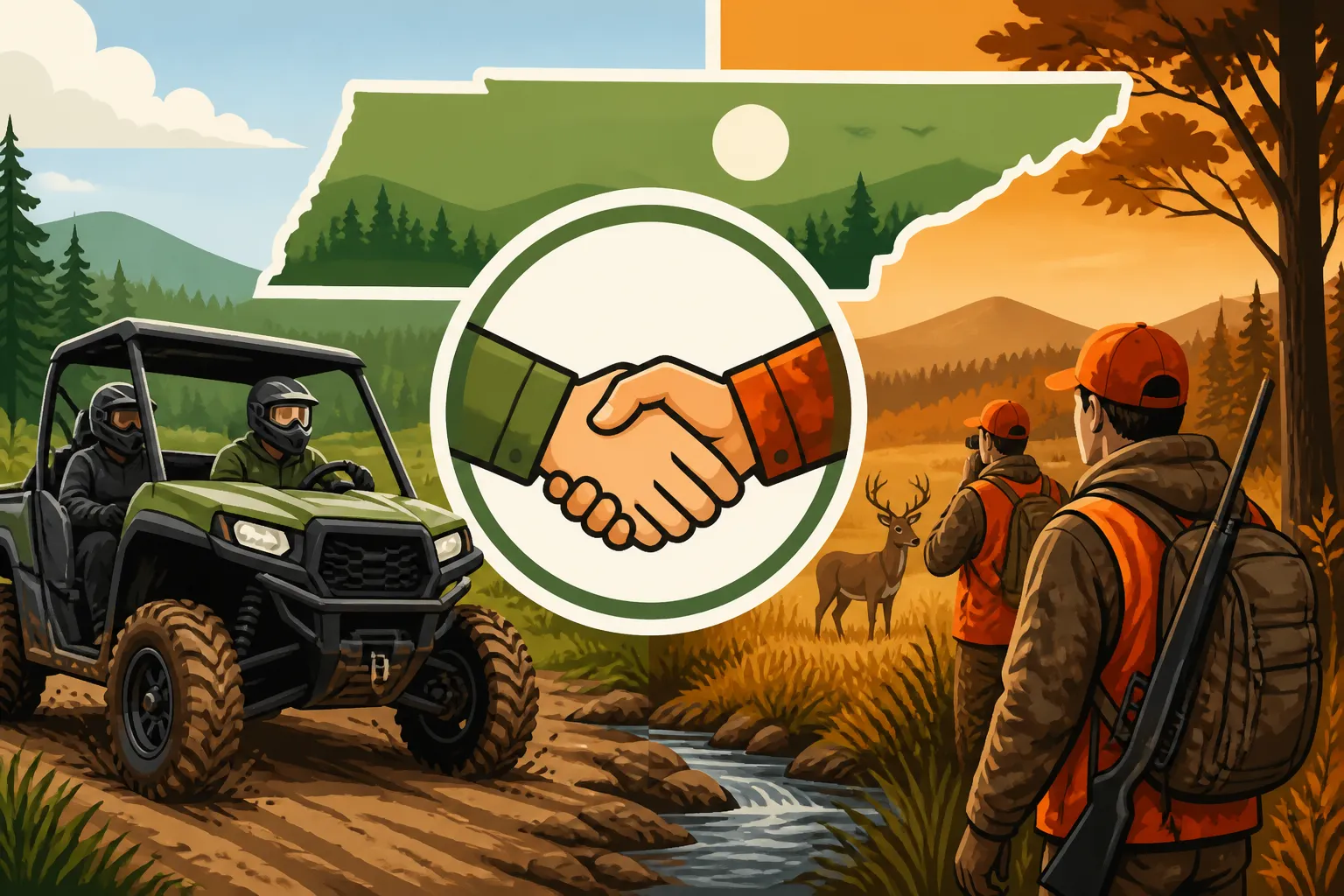
A fall ride through a Tennessee wildlife management area can put you on the same roads and trails as deer hunters heading into the woods before daylight. That overlap calls for more than a bright helmet or a quick glance at a map. This guide explains how to prepare, ride visibly, respect closures, and respond calmly when hunters and off-road vehicles share the same WMA.
Understand the shared-use setting before you ride
A WMA is not automatically open to every activity
Wildlife management areas are managed for wildlife and public recreation, but that does not mean every road, trail, or activity is open at all times. Access can depend on the specific area, the route, the season, and the activity. OHV use is generally limited to designated routes where it is allowed, and hunting activity may bring additional restrictions or temporary closures.
That distinction can be easy to miss when a trail looks well used. A visible tire track does not prove the route is open today, and an open gate does not necessarily mean every nearby route is available to OHVs. Before loading up, review the applicable area rules and check current notices. [Tennessee Rules for Riding a WMA] explains why it is important to treat each WMA’s rules as specific to that area rather than assuming one set of access rules covers every public property.
Plan around the possibility that hunting activity will affect your ride. A route you used in summer may be closed, restricted, or busier during a hunting season. If a sign, gate, or official notice conflicts with an older map or a route someone recommended, follow the current on-site direction and do not ride past a closure.
Know when hunting and riding may overlap
Deer hunting seasons do not all involve the same dates, methods, or access conditions. The timing can vary by season and area, so do not rely on a general fall calendar or a friend’s memory when planning a specific ride. Check current Tennessee wildlife regulations and the rules for the WMA you intend to visit.
Even when OHV riding remains permitted, hunters may be walking away from a parking area, crossing a road, or quietly approaching a hunting spot. They may be in camouflage and difficult to see against autumn leaves, shadowed slopes, and brush. A machine’s engine can also make it harder for a rider to hear someone nearby.
This is why the goal is not simply to determine whether riding is technically allowed. It is to understand where people may be, which routes remain open, and how to make your presence easy to recognize. For broader planning, Tennessee Trail Closures to Check First and Checking a Tennessee Trail Notice First are useful reminders to look for current information before leaving home and again when you arrive.
Get ready to be seen and ride predictably
Wear visible orange when the rules call for it
During relevant hunting periods, Tennessee rules may require fluorescent orange for people using certain public lands, and WMA-specific requirements can apply to riders. Check the current rule for your destination and dates instead of assuming your helmet, machine plastics, or a small patch on a backpack meets the requirement. Tennessee Orange Requirements for Riders covers the issue in more detail.
When orange is required, wear it where it can be seen clearly. A bright vest or outer layer is easier to notice than a small accessory partly covered by a pack or muddy jacket. Check that straps, a windshield, a passenger, or a cargo bag are not hiding the visible area. If you ride with children or passengers, make sure each person understands what they need to wear rather than treating the driver’s gear as sufficient for everyone.
Visibility is helpful even when a particular rule does not require orange on your ride. Choose clothing that stands out from the woods, especially if you will be walking near a parking area or helping someone with a disabled machine. Keep headlights in good working order, but do not treat lights as a substitute for any required clothing or equipment.
| Before or during the ride | What to do | Why it matters |
|---|---|---|
| Before leaving home | Check the WMA’s current rules, route access, and hunting notices | A familiar route may have seasonal restrictions |
| At the entrance | Read posted signs and inspect the gate area | On-site notices can clarify closures or conditions |
| Before starting | Confirm required orange clothing and carry it where it is visible | Hunters may have difficulty seeing riders in woodland colors |
| On shared routes | Slow down near trail junctions, parking areas, and blind bends | People may be on foot or approaching from cover |
| If you encounter a hunter | Stop at a safe distance, make your presence known, and follow directions | A calm pause prevents a close pass or misunderstanding |
Keep speed and noise under control near people
A blind corner on a narrow forest road is not the place to assume you have the route to yourself. Reduce speed before bends, intersections, trail crossings, and areas near parking lots or access points. If you hear a voice or see movement ahead, stop somewhere safe and wait until you can identify the situation.
Do not ride aggressively past someone on foot. Give hunters and other visitors room, avoid revving the engine beside them, and do not use a horn or loud call to startle people. If a group is spread across a road, wait until the route is clear rather than squeezing between them.
Predictable riding helps everyone. Stay on the authorized route, avoid sudden turns into brush, and keep your group together enough that the riders behind you know when the lead rider has stopped. If your group is large, agree in advance on a simple hand signal for slowing or stopping. That small bit of planning can prevent a rider at the back from coming around a bend too quickly.
Plan your route around signs, closures, and changing conditions
Check maps, notices, and the actual trail entrance
A map is useful for planning, but it is not a substitute for posted signs or current access information. Use a map to understand your intended route and identify likely junctions, then check the WMA’s current rules and notices before riding. Tennessee Trail Maps Worth Carrying offers a useful starting point for thinking about what to bring, while Tennessee Trail Conditions Before You Ride highlights the value of checking conditions before committing to a route.
Digital mapping tools such as onX Offroad can help riders review routes and orient themselves, but a route shown in an app should not be treated as proof that OHV access is authorized. Download or save the information you need before entering areas where cell service may be weak, and keep an offline backup such as a paper map or written route notes. Most importantly, follow current official signs and closures, even if a digital map still shows a line through the area.
When you reach a trailhead, stop long enough to read the signs rather than rolling past them with the group. Check for seasonal restrictions, vehicle limits, permit requirements, closed routes, and any hunting-related notices. A Gate Board With Today’s Rules in Tennessee is a helpful reminder that the information posted at the entrance can matter more than what you remember from a previous trip.
Turn around when a route is closed or unclear
A closure is a boundary, not a suggestion to see whether the trail becomes passable farther ahead. Do not move a barrier, ride around a closed gate, or take a narrow bypass through vegetation. A closure may protect wildlife, public safety, property, or a route that is not authorized for OHV use. [Tennessee Rules for Riding a Closed Trail] and [Tennessee Rules for Riding Off the Trail] explain why staying on permitted routes matters.
If a sign is damaged, missing, or difficult to interpret, do not guess in favor of riding. Pause, check an official source or contact the relevant land manager, and choose a route whose status is clear. If you are already on a trail when you encounter a closure, turn around safely and retrace your route rather than looking for an informal way around it.
Build flexibility into your day. If a hunting closure or crowded access point changes your plan, a shorter ride or an alternate approved route is better than pressuring the group to continue. Before leaving, tell someone your general destination and expected return time, especially if you are riding in a remote area where cell coverage may be unreliable.
Share the area respectfully and handle encounters calmly
Give hunters space without assuming where they are
Hunters may be parked at a trailhead, walking on a road, or positioned out of sight from the route. Avoid stopping close to a person’s equipment or approaching a hunting location out of curiosity. If you see a vehicle or gear near an access point, keep your machine on the authorized route and give the area room.
A brief, respectful exchange is usually enough if you meet someone. Slow down, stop at a safe distance, and let the person know you are there before moving closer. If the hunter is preparing to cross the route or asks for a moment, wait. Do not insist on passing through a narrow area while someone is handling equipment or moving between locations.
The same courtesy applies to other riders and visitors. Keep noise and speed considerate near parking areas, avoid blocking gates or access roads, and pack out anything your group brings in. Sharing a WMA works best when riders behave in ways that do not make hunters, hikers, or land managers worry about what will happen around the next bend.
Make a simple plan for the group
Before starting, tell everyone where the group intends to ride, what to do if someone encounters a hunter, and where to stop if the group becomes separated. Agree that the lead rider will slow down at intersections and that the group will not continue past a closure while waiting for a late rider. For children or inexperienced passengers, explain that they should stay with the group and follow the lead adult’s directions.
If you encounter an unexpected situation, stop in a safe place, shut down if appropriate, and avoid escalating the interaction. Give people room, listen to reasonable directions, and leave the area if the route or setting feels unsafe. If there is an immediate threat or emergency, use the appropriate emergency services rather than trying to resolve it by riding deeper into the woods.
A good pre-ride routine can be simple: confirm that the route is open, check the hunting-season rules, make sure required orange is visible, and identify a backup plan. For additional context on riding in these shared areas, see Sharing a WMA With Deer Hunters and [Tennessee Rules for Riding a WMA]. The practical takeaway is straightforward: ride only where permitted, make yourself visible, and be ready to change plans when conditions call for it.
Disclaimer
This article is for general informational purposes only and does not constitute professional advice. Laws, prices and regulations vary by location and change over time. Consult a qualified professional for guidance on your specific situation.