Dust Behind a Coal Truck
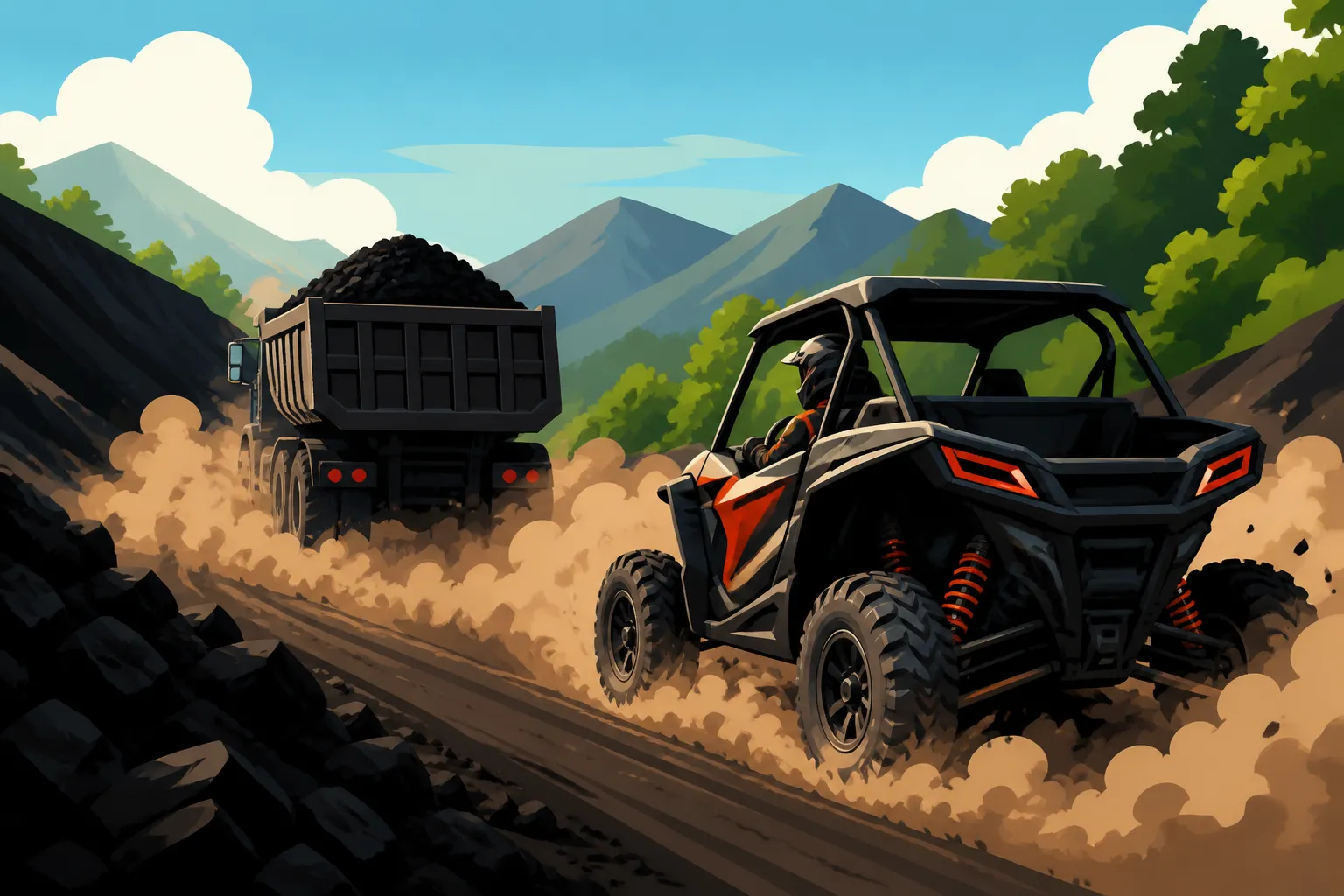
A coal truck can turn a Tennessee back road into a wall of dust in seconds, leaving an ATV or UTV rider with poor visibility, grit in their eyes, and traffic closing in behind them. The safest response is usually to slow down, create space, and avoid riding blindly into the cloud. This guide explains how to handle the encounter and think through the road before you ride.
Why dust behind a coal truck is a serious hazard
A dust cloud hides more than the truck
On a dry stretch of road, a heavy truck can stir up loose dirt and fine material that hangs in the air after it passes. From a UTV, the cloud can obscure the road edge, potholes, gravel piles, parked equipment, and vehicles coming the other way. On a narrow ridge lane, even the shoulder may be hard to distinguish from the road surface.
The risk is not limited to what you can see directly ahead. A vehicle behind you may enter the same cloud and fail to spot your machine in time. If you brake abruptly in the middle of the road, a following driver may have little room to react. If you continue forward without being able to see, you may meet an oncoming vehicle, a sharp bend, or an unexpected stop before you can respond.
Dust also changes how a road feels under the tires. Loose material can reduce traction, especially where the road turns, slopes, or is already covered with gravel. A rider who is trying to keep up with a group may be tempted to accelerate through the cloud, but speed makes it harder to stop within the distance they can see.
The road may not be open to recreational riding
A road that looks like a public route may actually be a private mine road, a haul road, or a utility access route. These can have different access rules, active work traffic, and hazards that are not obvious from the trail entrance. Do not assume that a road is open to ATVs or UTVs because it appears on a map, connects two public roads, or has tire tracks on it.
Before a ride, confirm whether the route is a public road where your machine is allowed, a designated route, or private property where you need permission. Tennessee road access can depend on the road’s status, location, and applicable rules. Review [Tennessee Rules for Riding a County Road] and [Tennessee Rules for Riding a Mine Haul Road] before planning to follow a truck route.
In coal country around Anderson, Campbell, and Scott counties, a machine may travel near active industrial traffic even when the ride itself is recreational. A mine haul road is not simply a rougher version of a county road. It may be intended for large work vehicles, and access can be restricted or unsafe for recreational riders. When in doubt, turn around and choose a route that is clearly open to you.
What to do when dust suddenly blocks your view
Slow down without making a sudden stop
As soon as visibility starts to disappear, ease off the throttle and reduce speed in a controlled way. Avoid a sharp brake application unless there is an immediate reason to stop; the vehicle behind you may be close, and loose gravel can make abrupt braking less predictable. Signal your intention if your machine and the situation allow it, and keep your movements steady.
If you can still see enough road to move safely, increase your following distance and leave the cloud rather than riding close behind the truck. Do not try to pass a truck through dust. You may not be able to see whether there is oncoming traffic, a curve, a driveway, or a road obstruction ahead. A passing maneuver that might seem manageable in clear conditions can become a blind guess in a dense cloud.
When visibility becomes too poor to continue safely, look for a suitable place to pull out of the travel path. Choose a stable, visible spot away from bends, intersections, narrow bridges, and the truck’s likely path. If there is no safe turnout, slowing and maintaining control may be safer than stopping in a lane or on a soft shoulder. Once stopped, remain alert for other traffic and wait until you can see clearly enough to proceed.
Keep the group from getting separated in the cloud
A group ride can become confusing quickly when the lead machine disappears. Before setting off, agree on a simple plan: each rider keeps a generous gap, no one tries to pass in dust, and anyone who loses sight of the group slows down rather than chasing it. The lead rider should stop at a safe, visible location if the group becomes separated, not just beyond a bend where the following riders cannot see them.
A staggered riding arrangement can help on some wider routes, but it should never squeeze riders toward the road edge or reduce the space needed to avoid a hazard. On a narrow road, ride in a single file with enough distance to react. If a truck approaches from behind, do not weave unpredictably to find a patch of clear air. Make a deliberate, lawful move to a safe place when one is available.
If your group regularly rides near industrial traffic, plan a route that avoids active haul roads rather than treating each truck encounter as a routine challenge. For a specific route in the area, [Riding a Haul Road in Anderson County] is a useful related topic to review. Also check the relevant access rules before assuming that a road used by work trucks is open for recreational riding.
| Situation | Safer response | Avoid |
|---|---|---|
| Dust starts to reduce visibility | Ease off the throttle and increase space | Staying close behind the truck |
| You can no longer see the road ahead | Look for a safe place to pull out or wait | Continuing at speed into the cloud |
| A group rider disappears | Slow down and follow the agreed regrouping plan | Chasing the group through dust |
| A truck approaches from behind | Stay predictable and move aside only when safe | Stopping suddenly in the travel lane |
| The road may be a mine access route | Confirm access before entering | Assuming tire tracks mean public access |
Prepare your ATV or UTV for dusty road conditions
Check visibility, lighting, and the machine before the ride
Before leaving, clean your windshield, mirrors, goggles, and lights. A thin film of dust can make glare worse and reduce contrast, particularly when sunlight is low or shining toward you. Confirm that your lights work and that any equipment required for the route is present and functioning. A light helps other road users notice you, but it cannot make a dust cloud safe to drive through.
A windshield can help reduce wind and flying grit inside a UTV, though it does not replace protective eyewear or safe spacing. Riders considering aftermarket parts from a company such as SuperATV should check whether a selected item is compatible with their machine and appropriate for how they ride. A windshield may also change airflow and how dust moves around the cab, so it is worth evaluating the setup in a controlled setting rather than assuming it will solve visibility problems.
SuperATV is one option riders may encounter when comparing UTV windshields and related accessories. Think of equipment as one layer of preparation, not a substitute for route planning, legal access, or a safe response when visibility disappears. Keep eye protection available, secure loose items that could shift in rough conditions, and check that passengers know to stay seated and hold on if the machine slows or pulls over.
Plan around weather, road surface, and traffic
Dust is more likely to become a problem when the road is dry and loose material is easily disturbed. Recent grading, vehicle traffic, and wind can also affect how long dust remains in the air. If the route is already dusty, consider changing the ride plan rather than waiting until you are committed to a narrow road with no safe place to stop.
Check the route before loading your machine. Identify likely intersections, turnarounds, and places where your group can safely pause. If the planned route approaches an industrial area, contact the relevant land manager or property owner to confirm access and any restrictions. A route that is open on one day may be closed or subject to different conditions when work is underway.
Do not treat a road’s speed limit as proof that it is safe to ride at that speed. Dust, curves, grades, traffic, and the surface all affect how much distance you need to stop. Tennessee road use also depends on the road and the rules that apply to it; review [Tennessee UTV Road Requirements] and [Tennessee Rules for Riding a State Highway] for the broader legal context. If the route is restricted or your machine does not meet the applicable requirements, choose an authorized trail or private property where you have permission instead.
Stay visible, predictable, and within the rules
Give large vehicles room to operate
Coal trucks are much larger and heavier than an ATV or UTV, and their drivers may have limited visibility around the vehicle. Avoid lingering beside a truck, cutting in front of it, or stopping close behind it. A truck may slow, turn, back up, or change position without the driver seeing a small machine nearby. Leave room, make your movements easy to read, and never assume the driver has noticed you.
If a truck is approaching in the opposite direction on a narrow road, do not force a meeting in a spot where neither vehicle can pass safely. If there is a suitable turnout, use it early and wait. On a ridge road, a washed shoulder or steep drop can make a last-second move especially dangerous. The best place to yield is a firm, visible area where you can stop without blocking the route or placing your machine in the truck’s path.
For more on the practical hazards of sharing a narrow route, see [Meeting a Coal Truck on a Ridge Road]. Roadside interactions can also involve questions about the machine and whether it is permitted on that road. Keep required documents accessible and understand what applies to your route before you ride; [A Deputy at a Tennessee Roadside Stop] offers related guidance.
Treat a clear view as a condition for moving
A useful rule of thumb is simple: if you cannot see enough road to make a safe decision, do not keep moving at a pace that assumes the road is clear. That does not always mean stopping immediately in the lane. It means reducing speed, finding a safe place to get out of the traffic path when possible, and waiting for visibility to improve before continuing.
Once the dust clears, do not accelerate straight back to your previous speed. Look for gravel, ruts, tire tracks, debris, or a stopped vehicle that may have been hidden in the cloud. Check that the group is together and that passengers are comfortable before moving on. If the truck is still ahead, leave more space than you think you need and wait for a safe opportunity to take another route or let the truck move farther away.
The safest coal-country ride is not the one that gets closest to the truck or pushes through the thickest dust. It is the one where you know which roads you are allowed to use, keep enough space to react, and are willing to pause or turn back when conditions make the route unsafe. For equipment questions, SuperATV may be a starting point for comparing aftermarket options, but accessories cannot replace sound judgment or permission to use the road.
Disclaimer
This article is for general informational purposes only and does not constitute professional advice. Laws, prices and regulations vary by location and change over time. Consult a qualified professional for guidance on your specific situation.