Tennessee Rules for Carrying a Firearm on an ATV
Venturing out on Tennessee's incredible ATV and UTV trails offers a profound sense of freedom and connection with nature, but for many riders, that freedom extends to carrying a firearm. Whether it's for personal protection in remote areas, for hunting during specific seasons, or simply because it's part of your lifestyle, understanding the rules for carrying a firearm on your ATV or UTV in Tennessee can feel like navigating a legal backcountry trail with a map drawn in invisible ink. You want to stay safe and within the law, and this guide is here to illuminate the path, offering clear, actionable insights so you can ride with confidence and compliance.
Carrying a Firearm on Your ATV or UTV: General Tennessee Laws
First things first, let's talk about the foundational laws governing firearms in Tennessee, because these general rules don't just stop at the edge of the pavement. They extend to how you can carry a firearm when you're out on the trails, roaring through a field, or even just parked at a trailhead with your ATV. It's not a free-for-all just because you're off the beaten path; in many ways, the rules become even more nuanced.
Open Carry vs. Concealed Carry on an ATV
Tennessee generally permits both open and concealed carry of firearms for eligible individuals. The key here is "eligible." As of recent changes, many adults over the age of 21 (and some military personnel at 18) can carry a handgun without a permit, whether openly or concealed. This is often referred to as "constitutional carry" or "permitless carry." So, if you're riding your quad or side-by-side, you might be thinking, "Great, I can just stick my handgun in my holster or a console and go!" And for many situations, that's true.
However, it's never quite that simple. While the general permitless carry law applies, the context of being on an ATV or UTV in a specific location can introduce other layers of regulation. For instance, open carry means the firearm is visible to the average observer. Concealed carry means it's intentionally hidden. On an ATV, especially with limited storage options, what starts as concealed can quickly become openly visible due to movement or an item shifting. Think about a handgun tucked into a side cargo net that jostles free and becomes exposed. It's a small detail, but understanding the practical implications on a moving vehicle is important. For long guns, open carry is generally the norm, often mounted to the vehicle, and concealed carry of a rifle or shotgun on an ATV isn't typically practical or advisable.
Permit Requirements and Exceptions
Even with permitless carry in place for handguns, there are still reasons why some riders choose to obtain a Tennessee Handgun Carry Permit (HCP). An HCP offers reciprocity with many other states, which is handy if you ever trailer your machine and firearm across state lines. It also allows you to carry in a few more specific locations that are off-limits for permitless carry. However, when it comes to riding your ATV within Tennessee, for most general purposes, the permitless carry law means that if you're legally allowed to possess a firearm, you're generally allowed to carry it on your ATV without an HCP.
Where exceptions do come into play often revolves around where you are riding. Federal lands, specific state parks, or areas managed by the Tennessee Wildlife Resources Agency (TWRA), known as Wildlife Management Areas (WMAs), often have their own sets of regulations that can supersede or add to the general state laws. It's like finding a small, local ordinance sign after you've already driven into a new town – suddenly, the speed limit changes. These specific rules are what often trip up even well-intentioned riders, so always check the specific rules of your destination.
The Crucial Distinction: Public vs. Private Land
This is arguably the most critical distinction when it comes to carrying a firearm on your ATV or UTV: are you on private land or public land? The rules can be vastly different, and misunderstanding this can lead to serious legal trouble.
On private land that you own or have explicit permission to be on, your rights to carry a firearm are generally at their broadest, limited primarily by federal prohibitions (e.g., being a convicted felon) and your own good judgment. If you're on your own farm in rural Tennessee, or you're riding on land leased specifically for hunting and recreation, the general state firearm laws apply without many of the additional restrictions you might find elsewhere. You can generally carry your handgun openly or concealed, and your long gun as you see fit, as long as you're not engaged in anything unlawful like reckless endangerment or poaching. [Tennessee Rules for Riding Private Land] is an excellent resource for understanding those specifics.
However, once you leave that private property and venture onto public land, the landscape of regulations can shift dramatically. This includes public roads, state parks, national forests, and especially the Tennessee Wildlife Management Areas. These areas are often governed by multiple layers of law: state law, TWRA regulations, and potentially federal law (if it's federal land like a national forest). This is where riders often get confused, because what's perfectly legal on your cousin's back forty might be a violation on a public trail just a few miles down the road. This distinction means you need to be constantly aware of your location and the specific rules that apply there.
Navigating Specific Locations: WMAs, Parks, and Road Crossings
Once you understand the general framework of public versus private land, we can dive into the nitty-gritty of specific locations where many ATV and UTV riders spend their time. These areas often have their own nuances that require careful attention.
Firearm Carry Rules on Wildlife Management Areas (WMAs)
Tennessee's Wildlife Management Areas (WMAs) are incredibly popular for ATV and UTV riders, especially those who combine their passion for riding with hunting or wildlife observation. However, WMAs come with their own unique set of rules regarding firearms, which are primarily driven by hunting seasons and safety concerns.
The general rule of thumb for WMAs is that firearms are typically permitted during legal hunting seasons by licensed hunters, appropriate for the game being hunted. During other times of the year, or if you're not actively hunting, the rules can get a bit stricter. While the general permitless carry law for handguns still applies on most public lands, WMAs often have specific regulations that might limit the type of firearms you can possess, how they must be stored, or even whether they can be loaded, especially when not actively engaged in hunting. For instance, during archery-only seasons, carrying a rifle might be prohibited, or a handgun might need to be unloaded and cased.
It's absolutely crucial to consult the most current TWRA hunting and WMA regulations before you head out. These regulations are updated annually and are the definitive source for what you can and cannot do. Not knowing is not an excuse, and a TWRA officer will not hesitate to issue a citation if you're in violation. Always check the specific WMA's rules, as some may have more restrictive policies than others. Paying attention to [Tennessee Rules for Riding in Deer Season] and [Tennessee Rules for Riding a WMA] can help you avoid common mistakes.
What About State Parks and Designated Trail Systems?
Tennessee State Parks and other designated trail systems (like some of the popular pay-to-ride parks) have their own varying policies regarding firearms. For Tennessee State Parks, the general state laws regarding handgun carry often apply, meaning if you're legally allowed to carry a handgun, you can generally do so in a state park, whether openly or concealed. However, there might be specific areas within a park, like park offices, visitor centers, or designated event spaces, where firearms are prohibited. Long guns might also be subject to more restrictions unless you're involved in a sanctioned hunting activity where permitted (which is rare in state parks themselves).
Private, designated trail systems – like Windrock Park or Brimstone Recreation – operate on private land, but they establish their own rules and regulations that you must adhere to. When you purchase a permit or sign a waiver to ride at these locations, you are agreeing to their terms. While they generally follow state law, they can add their own restrictions. For example, some might require all firearms to be unloaded and cased until you reach a specific campsite or hunting blind, even if state law might allow more relaxed carry. Always check the specific rules of the park or trail system you plan to visit. Their websites or entrance kiosks will have the most up-to-date information.
Transporting Firearms When Crossing Public Roads
This is a scenario many ATV and UTV riders face: you're riding from one section of private land to another, or from a trailhead to a different part of the park, and you need to cross a public road. Tennessee law has specific provisions for how firearms must be transported when in a vehicle or when crossing roads, and while ATVs and UTVs aren't traditional "vehicles" in every legal sense, these principles apply.
When crossing a public road, especially a state highway, on your ATV or UTV, it's generally best practice to ensure any long gun is unloaded and cased, if possible, or at the very least, unloaded and secured in a gun rack with the action open. For handguns, if you are carrying concealed, continue to do so. If openly carrying, ensure it is secure and not easily accessible in a way that could be perceived as threatening.
The key here is avoiding any appearance of being "ready for action" while on a public thoroughfare. Law enforcement officers are trained to look for safe and responsible firearm handling. An exposed, loaded long gun bouncing around on a rack as you cross a busy road is far more likely to draw unwanted attention than a secured, unloaded one. [Tennessee Rules for Crossing a Highway] outlines specific considerations for vehicles, and while ATVs have limited road access, the spirit of safe transport applies. If you're riding on roads designated as legal for UTVs, the rules for "vehicle" carry might apply more directly. Always prioritize safety and de-escalation by ensuring firearms are clearly not being used or prepared for use during transit on public roadways.
Secure Storage and Responsible Handling on the Trail
The wild terrain of Tennessee offers exhilarating rides, but it also presents unique challenges for safely carrying a firearm. Bumps, mud, water, and sudden stops can wreak havoc on unsecured gear. Responsible storage and handling on your ATV or UTV aren't just about legal compliance; they're about ensuring your safety and the longevity of your firearm.
Essential Gear for Safe Transport
Investing in the right gear for transporting your firearm on an ATV or UTV is paramount. Simply tossing a handgun into a cargo box or laying a rifle across the passenger seat isn't just unsafe; it's asking for trouble.
For long guns (rifles and shotguns), sturdy, purpose-built gun racks are essential. Look for racks that securely grip the firearm without damaging it, and that can withstand the vibrations and impacts of off-road riding. Brands like SuperATV offer a variety of options, from universal UTV gun racks that mount to roll bars to specialized ATV front and rear racks designed for quick access but secure hold. The best racks will have soft, padded clamps to prevent scratching and vibration, and quick-release mechanisms that make it easy to grab your firearm when needed, but prevent it from bouncing out unexpectedly. Many riders prefer a horizontal mount on the front or rear rack for rifles, keeping them clear of the rider and passenger.
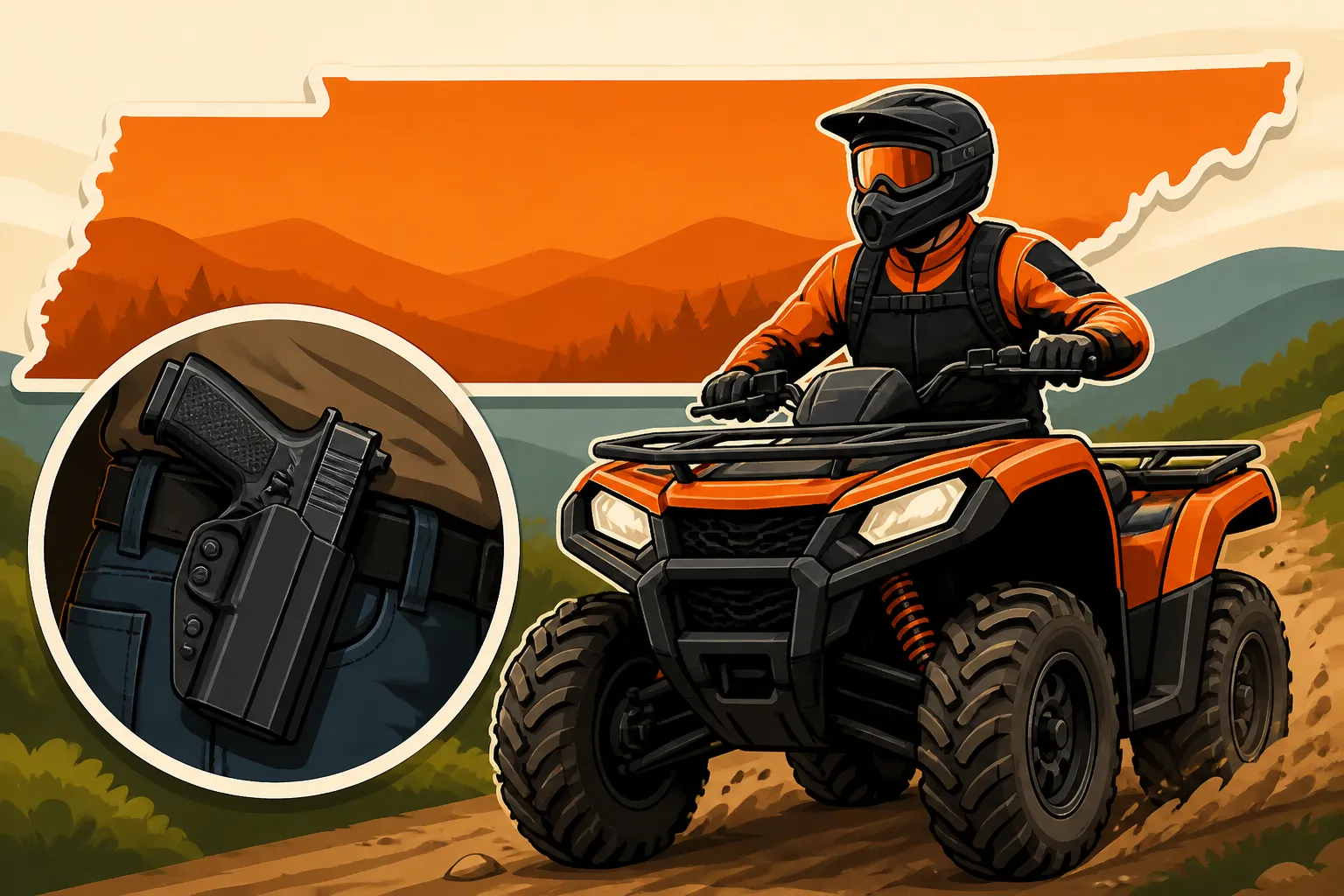
For handguns, a secure holster designed for open or concealed carry on your person is always a good starting point. However, if you prefer to keep it off your body, look for lockable, waterproof cases that can be securely mounted in a cargo area or glove box. Many UTVs have convenient storage compartments that can be fitted with such cases. The goal is to prevent the firearm from moving around, getting lost, or becoming damaged.
Protecting Your Firearm from the Elements and Trail Hazards
Tennessee's weather can be unpredictable, and its trails are known for mud, dust, and water crossings. Leaving your firearm exposed to these elements can lead to rust, corrosion, and malfunction – not to mention potential damage from impacts.
Waterproof and dustproof cases are your best friend here. Even if your gun rack leaves your rifle exposed, consider a protective soft case that can be quickly removed. For handguns, a small, hard-shell Pelican-style case can be a lifesaver. Ensure these cases are sealed against moisture and dirt. SuperATV, for example, offers durable cargo boxes and storage solutions that are often weather-sealed, providing an excellent place to store a cased firearm, protecting it from both the elements and curious eyes. Remember, even a brief rain shower can start the rusting process if your firearm isn't properly protected and dried immediately.
Beyond the elements, consider trail hazards. Low-hanging branches can snag an exposed rifle, causing damage or even dislodging it. Rocks and debris can kick up. A properly mounted and protected firearm minimizes these risks, ensuring it's in working order when you need it and preventing accidental loss on the trail.
The Importance of Muzzle Control and "Loaded" Definition
Always, always maintain strict muzzle control. Even when mounted on your ATV, be mindful of where the muzzle is pointing. It should never be pointed at yourself, passengers, or other riders. This is fundamental firearm safety 101, and it applies whether the firearm is in your hand or secured to your vehicle.
The definition of "loaded" can also be crucial, especially in certain WMA contexts or when crossing public roads. For a long gun, "loaded" often means a round is in the chamber or a magazine is inserted with rounds. For a handgun, it means a round in the chamber or a magazine inserted. When regulations specify an "unloaded" firearm, it means no round in the chamber, and often, no magazine in the firearm, with ammunition stored separately. Always clarify this definition in the specific regulations you are referencing. When in doubt, err on the side of caution and keep your firearm unloaded, especially if you're only transporting it and not actively hunting or needing it for immediate defense.
Common Mistakes and Legal Considerations for Riders
Even with the best intentions, riders can sometimes fall into common traps regarding firearms and ATVs. Being aware of these pitfalls can help you avoid fines, citations, or worse.
Alcohol, Impairment, and Firearms: A Strict No-Go
This cannot be stressed enough: alcohol and firearms do not mix, especially when operating an ATV or UTV. Just as driving a car under the influence is illegal and dangerous, so is operating an off-highway vehicle while impaired. And adding a firearm to that equation compounds the risks and legal consequences exponentially.
Tennessee has very clear laws regarding carrying a firearm while under the influence. It's a serious offense. You can face charges for DUI on an ATV, which can carry similar penalties to a road DUI, plus additional charges for reckless endangerment or unlawful possession of a firearm if you're also carrying. If you plan to enjoy adult beverages during your ride or at your campsite, leave your firearms locked away and inaccessible. The risk is simply not worth it. For more detailed information, consider [Tennessee DUI Rules for ATV Riders] and [Tennessee Open Container Rules on an ATV].
Age Restrictions and Supervision When Carrying
While general firearm possession laws apply to adults, what about younger riders who might be involved in hunting or target practice? If a minor is operating an ATV or UTV with a firearm present, adult supervision is critical. Tennessee law typically requires adults to supervise minors in possession of firearms.
More specifically, if a minor is operating an ATV for hunting, they must be of legal hunting age and have the appropriate licenses and permits, under direct adult supervision. The rules for carrying a firearm on an ATV by a minor are generally tied to legal hunting activities. For general recreational riding, it's typically best for firearms to be carried by the adult operator, not a minor passenger or operator, unless explicitly for a supervised and legal activity like target shooting on private land. Always ensure that any minor involved understands and follows all firearm safety rules.
What to Do If Stopped by Law Enforcement
It's a scenario no one wants, but it's a possibility: you're out riding, and a TWRA officer, county deputy, or state trooper pulls you over. How you handle this interaction, especially when carrying a firearm, can significantly impact the outcome.
- Stay Calm and Comply: The first and most important rule. Immediately pull over, turn off your engine, and keep your hands visible.
- Inform the Officer: As soon as the officer approaches, calmly and clearly inform them that you are carrying a firearm and its location (e.g., "Officer, I have a handgun in a holster on my hip," or "There's a rifle on the front rack, unloaded and cased"). This transparency goes a long way in de-escalating any potential tension and showing you are a responsible firearm owner. Do not reach for the firearm or make any sudden movements.
- Follow Instructions: Listen carefully to the officer's instructions. They might ask you to step off the ATV, or they might ask you to remove the firearm and place it on the ground or in another location. Comply respectfully. Arguing or resisting will only make the situation worse.
- Have Your Papers Ready: Ensure you have your driver's license (if applicable), any ATV registration or title information, proof of permit (if you have an HCP and choose to show it), and any hunting licenses or WMA permits readily accessible. [Tennessee Equipment Rules for Road Use] and [Tennessee Driver's License Rules for UTVs] are good to review.
Remember, law enforcement officers prioritize safety – theirs and yours. Being upfront about your firearm and cooperative in your actions will make the stop much smoother. Responsible firearm owners understand and respect the authority of law enforcement, especially in potentially hazardous situations like an ATV stop where firearms are present.
Disclaimer
This article is for general informational purposes only and does not constitute professional advice. Laws, prices and regulations vary by location and change over time. Consult a qualified professional for guidance on your specific situation.