Emergency and Wildlife Vehicles in Tennessee
It's quite common to see ATVs or UTVs zipping around on Tennessee roads and trails, but what really gets folks scratching their heads is when they see an official-looking machine – maybe a game warden's side-by-side or a fire department's ATV – operating in ways that seem to bend the usual rules. This can feel confusing and even a little unfair if you're a recreational rider trying to follow all the strict guidelines. This comprehensive guide aims to clear up that confusion by explaining the specific legal exemptions and practical reasons why emergency and wildlife vehicles operate differently on Tennessee's roads and public lands.
Defining Emergency and Wildlife Vehicles in the Context of Tennessee OHV Laws
When we talk about ATVs and UTVs in Tennessee, there's usually a clear distinction between recreational use and official duties. For most of us, getting a machine street-legal in Tennessee can be a complex endeavor, involving specific equipment, licensing, and strict road use rules. But for emergency responders and wildlife officers, the very nature of their work demands a different set of allowances, often allowing them to bypass the standard restrictions that apply to the rest of us. It's not about special privilege, but about operational necessity and public safety.
What Constitutes an "Emergency Vehicle"?
In the eyes of Tennessee law, an "emergency vehicle" typically refers to those operated by fire departments, law enforcement agencies, and emergency medical services (EMS). For these entities, ATVs and UTVs often serve as crucial tools for reaching places traditional patrol cars or ambulances simply cannot. Imagine a hiker lost deep in the woods of the Great Smoky Mountains National Park, a wildfire spreading through dense underbrush in a state forest, or a multi-vehicle accident far down a remote gravel road where larger vehicles struggle to maneuver. In such scenarios, a nimble UTV equipped for emergency response becomes invaluable. These aren't just joyrides; they are vital pieces of equipment used by trained professionals to save lives and protect property. They might be designated as [Tennessee's Class I OHV Definition] or [Tennessee's Class II OHV Definition] vehicles, but their operational parameters are often set by the emergency statutes, not just the general OHV laws.
What Constitutes a "Wildlife Vehicle"?
Similarly, "wildlife vehicles" in Tennessee generally refer to those operated by the Tennessee Wildlife Resources Agency (TWRA), state park rangers, and sometimes federal agencies like the U.S. Forest Service or National Park Service. These officers have the immense responsibility of enforcing hunting and fishing regulations, managing wildlife populations, conducting search and rescue operations, and maintaining vast tracts of public land. To effectively patrol remote wildlife management areas (WMAs), access difficult conservation sites, or investigate poaching incidents, a truck or standard patrol car simply won't cut it. An ATV or UTV allows them to traverse rugged terrain, deep mud, and narrow trails that are inaccessible to other vehicles. Their work often involves protecting natural resources and ensuring public safety in wilderness settings, tasks that are impossible without the specialized capabilities of an off-highway vehicle.
Distinct from Recreational Use
It's absolutely essential to understand that these official vehicles, while they may look similar to your personal side-by-side or quad, operate under a completely different legal umbrella. When you, as a private citizen, take your OHV out, you are bound by all the standard [Tennessee Road Use Rules for ATVs], permit requirements, and equipment regulations. Emergency and wildlife vehicles, however, are specifically exempted from many of these rules when they are actively engaged in their duties. This means they might be seen on roads where recreational OHVs are forbidden, or operating at times and in conditions that would lead to a citation for a private individual. This distinction is not arbitrary; it's a reflection of the critical public services these agencies provide.
Exemptions for Emergency Responders
When an emergency strikes, time is of the essence. Whether it's a medical emergency on a remote trail, a search for a missing person, or battling a brush fire, traditional vehicles often face insurmountable obstacles. This is where the specialized capabilities of OHVs, combined with specific legal exemptions, become absolutely critical for emergency responders. They are designed to cut through red tape, not just mud.
Road Use Exemptions for Emergency Operations
One of the most significant exemptions for emergency vehicles is their ability to use public roads in ways that are typically off-limits to recreational OHVs. For instance, while you might be limited by [Tennessee's 45 mph Road Rule] or [Daylight Hours Only Under Tennessee Law] on designated county roads, an emergency UTV responding to a critical incident might operate at higher speeds, travel on state highways for short distances, or even use roads usually closed to OHVs, regardless of the time of day. This is because their mission takes precedence over standard traffic laws, much like an ambulance or fire truck with lights and sirens activated. The law recognizes that in an emergency, the safety and well-being of the public depend on responders reaching the scene as quickly and efficiently as possible, even if it means temporarily sidestepping typical vehicle restrictions. Their focus isn't on a leisurely ride, but on rapid deployment to save lives.
Equipment Exemptions and Specialized Gear
While private OHVs must adhere to [Tennessee Equipment Rules for Road Use] like mirrors, turn signals, and brake lights to be considered for road-legal use, emergency OHVs often have a different set of requirements, or at least a different interpretation of them. Their vehicles are typically outfitted with specialized equipment that directly supports their mission: winches, advanced communication systems, searchlights, medical equipment, or firefighting apparatus. Many of these machines are built for rugged environments, and even aftermarket companies like SuperATV provide heavy-duty components like lifted suspension, upgraded axles, and robust skid plates that are often integrated into these official vehicles to ensure reliability in extreme conditions. These modifications aren't about luxury; they're about survivability and functionality in demanding situations where standard equipment would fail. The focus is on capability for the mission, not just compliance with general road-use accessories.
Search and Rescue Scenarios
Consider a scenario in the vast, rugged terrain of the North Cumberland WMA. A family hiking has become disoriented, and daylight is fading fast. Deploying a traditional search party on foot could take hours to cover challenging ground. This is where an emergency services UTV, perhaps from a local volunteer fire department or search and rescue team, becomes indispensable. These machines can quickly navigate dense forests, rocky trails, and steep inclines, covering vast distances in a fraction of the time it would take on foot. They can carry specialized gear like thermal imaging cameras, medical supplies, and even stretchers. The frustration for a search and rescue team trying to get to a remote location without such a vehicle would be immense, often costing critical time. The exemptions they enjoy are not merely conveniences; they are essential tools that enable them to save lives in Tennessee's toughest environments.
Exemptions for Wildlife and Conservation Officers
Just like emergency responders, Tennessee's wildlife and conservation officers have unique operational needs that necessitate specific exemptions from standard OHV rules. Their mandate extends beyond simply enforcing laws; it encompasses managing natural resources, protecting wildlife, and ensuring the safety of visitors across millions of acres of diverse landscapes. These duties often require access to areas where conventional vehicles cannot travel, making ATVs and UTVs indispensable tools.
Patrol and Enforcement Needs on WMAs
Think about the immense challenge of patrolling vast areas like the North Cumberland Wildlife Management Area or checking remote fishing spots along the Tennessee River. A TWRA officer can't effectively monitor illegal hunting or fishing activities, respond to wildlife complaints, or ensure compliance with [Tennessee Rules for Riding a WMA] from a paved road. Their duties frequently take them deep into the backcountry, onto trails, and across terrain that is inaccessible to trucks. An ATV or UTV allows them to reach these remote locations quickly and quietly, often surprising poachers or individuals violating regulations. Without the ability to operate these specialized vehicles, large swaths of Tennessee's natural resources would be left unmonitored and vulnerable, and enforcing laws like [Tennessee Rules for Carrying a Firearm on an ATV] in remote areas would become nearly impossible.
Resource Management and Habitat Work
Beyond enforcement, wildlife officers and conservationists use OHVs extensively for resource management. This includes tasks like transporting equipment for habitat improvement projects, monitoring wildlife populations, maintaining boundary markers, and collecting data in ecologically sensitive areas. Imagine needing to haul fencing materials into a remote field for a deer enclosure, or transport specialized surveying equipment to a rarely visited wetland. These tasks are often physically demanding and involve traversing areas with no formal roads. The rugged capabilities of a UTV, often enhanced with heavy-duty cargo systems or even tracks over wheels from a company like SuperATV for ultimate flotation, make these operations feasible. The alternative—carrying everything on foot—would be incredibly inefficient, if not impossible, for many large-scale conservation efforts.
Specific Legal Basis for TWRA Operations
The exemptions for TWRA and similar agencies are not simply common practice; they are explicitly backed by Tennessee law. These statutes recognize the unique role these officers play in protecting the state's natural heritage and public safety within these areas. While a recreational rider might be ticketed for operating an OHV on a particular unpaved road, a TWRA officer has the legal authority to do so as part of their official duties. This might include using [Tennessee Rules for Riding a Logging Road] that are generally restricted or even traversing sensitive natural areas for scientific or enforcement purposes, provided it is done responsibly and with minimal impact. These legal provisions are crucial because they empower officers to perform their jobs effectively, which in turn benefits all Tennesseans who value the state's outdoor spaces and wildlife.
Practical Considerations for Emergency and Wildlife OHV Use
Operating an OHV for emergency or wildlife management purposes is a demanding job that goes far beyond recreational riding. It requires specialized equipment, rigorous training, and a keen understanding of public safety. These aren't just off-the-shelf machines; they are purpose-built and highly adapted tools designed for critical missions.
Specialized Equipment and Modifications
The ATVs and UTVs utilized by emergency responders and wildlife officers are typically far more robust and specifically outfitted than most recreational models. They often feature heavy-duty suspension systems to handle heavy loads and rough terrain, enhanced lighting for night operations, and robust protection like brush guards and skid plates. Many agencies turn to aftermarket solutions for these needs, and companies like SuperATV are often key providers for these types of upgrades. For instance, a search and rescue UTV might be fitted with a powerful winch, capable of pulling another vehicle or even moving obstacles, along with specialized baskets for transporting injured individuals. A TWRA side-by-side might have additional cargo racks to carry traps, enforcement equipment, or even samples for environmental analysis. These aren't cosmetic additions; they are functional necessities that enable these vehicles to perform their critical roles effectively and reliably in the most challenging conditions Tennessee can offer.
Training and Certification for Operators
It's one thing to ride your own ATV for fun; it's another entirely to operate an emergency UTV under pressure, potentially with a patient on board, across treacherous terrain in adverse weather. Operators of emergency and wildlife OHVs undergo extensive training that far exceeds any recreational safety course. This training covers advanced driving techniques for various terrains, emergency maneuvers, GPS navigation, communication protocols, and often, specialized skills related to their specific duties, such as patient handling or wildlife capture. They learn how to assess risks, operate safely under stress, and maintain their vehicles in the field. This high level of training is crucial, not only for the safety of the operator and their passengers but also for the effectiveness of their mission. It ensures that when these vehicles are seen operating under their legal exemptions, they are being handled by highly competent and responsible professionals.
Public Perception and Safety
While these exemptions are legally justified, it's also true that seeing an official ATV or UTV operating on roads or in areas where private machines are restricted can sometimes cause confusion or even resentment among recreational riders. This is a natural frustration when you're trying to follow all the rules yourself. Therefore, emergency and wildlife agencies place a strong emphasis on maintaining clear identification on their vehicles – visible markings, agency logos, and usually flashing lights – and on ensuring their operators are clearly identifiable in uniform. This transparency helps clarify their role and purpose. Furthermore, operators are trained to prioritize safety, even when operating under exemptions, to minimize risks to themselves, the public, and the environment. They understand that public trust is paramount, and every interaction, whether on a [Tennessee Rules for Riding a Bridge] or a remote trail, reinforces that trust.
Understanding Road Use Rules for Exempt Vehicles
The ability for emergency and wildlife vehicles to operate on Tennessee roads differently from recreational OHVs is a key distinction that often leads to questions. It’s not a blanket permission to ignore all rules; rather, it’s a targeted set of allowances that are directly tied to their official duties and the critical services they provide.
When and Where They Can Be Operated
The fundamental principle governing these exemptions is that the operation of the OHV must be directly related to the officer's or responder's official duties. This means a TWRA officer can't just take their state-issued side-by-side for a joyride on a paved county road. However, they can use it to patrol a remote section of a WMA, transport equipment to a conservation site, or respond to an emergency call. Similarly, an emergency services UTV can utilize county roads to quickly access a remote accident scene or move between staging areas during a large-scale incident. The specific road use rules for emergency and wildlife vehicles are often defined within the larger framework of state statutes concerning emergency operations or the specific agency’s operational mandates. This might include [Crossing a Two-Lane at Ninety Degrees in Tennessee] if necessary for their mission, or using roads that are otherwise marked as off-limits for general OHV traffic. The key is necessity and official duty.
Emergency vs. Non-Emergency Travel
It's important to distinguish between emergency and non-emergency travel for these vehicles. When an emergency vehicle is responding to an urgent call, such as a medical emergency or a wildfire, they typically have the authority to activate lights and sirens and bypass certain traffic laws to ensure rapid response. This is similar to how a police car or ambulance operates. However, when an officer is simply transporting equipment for routine maintenance, patrolling an area without an active emergency, or performing administrative tasks, they are generally expected to adhere more closely to standard traffic laws, even with their specialized vehicle. While they still retain certain operational advantages due to their official status and vehicle type, the urgency of the situation dictates the level of exemption applied. This nuanced approach ensures that the broader public safety is maintained while allowing these critical functions to be performed.
Coordination with Local Authorities
Operating these specialized vehicles, especially on public roads or through populated areas, often involves a level of coordination with local law enforcement and highway authorities. For instance, if a search and rescue team needs to move a convoy of UTVs along a state route to reach a remote trailhead, they might coordinate with the Tennessee Department of Transportation (TDOT) or the local sheriff's office to ensure safe passage, perhaps with escort vehicles. While TWRA officers have broad authority on state lands, they may also coordinate with county officials when their duties take them onto [Tennessee Rules for Riding a County Road] or through specific municipal boundaries. This cooperation helps prevent misunderstandings, ensures smooth operations, and maintains public safety. It’s a testament to the complex network of regulations and operational protocols that enable these vital services to function effectively across the varied landscapes of Tennessee.
The Importance of Official Identification and Training
For the average citizen, understanding the legal nuances of OHV operation can be tricky enough without wondering who's who on the trails and roads. That's why official identification, both for the vehicle and the operator, along with specialized training, isn't just a formality for emergency and wildlife personnel in Tennessee – it's absolutely crucial for safety, trust, and effective service.
Vehicle Markings and Lights
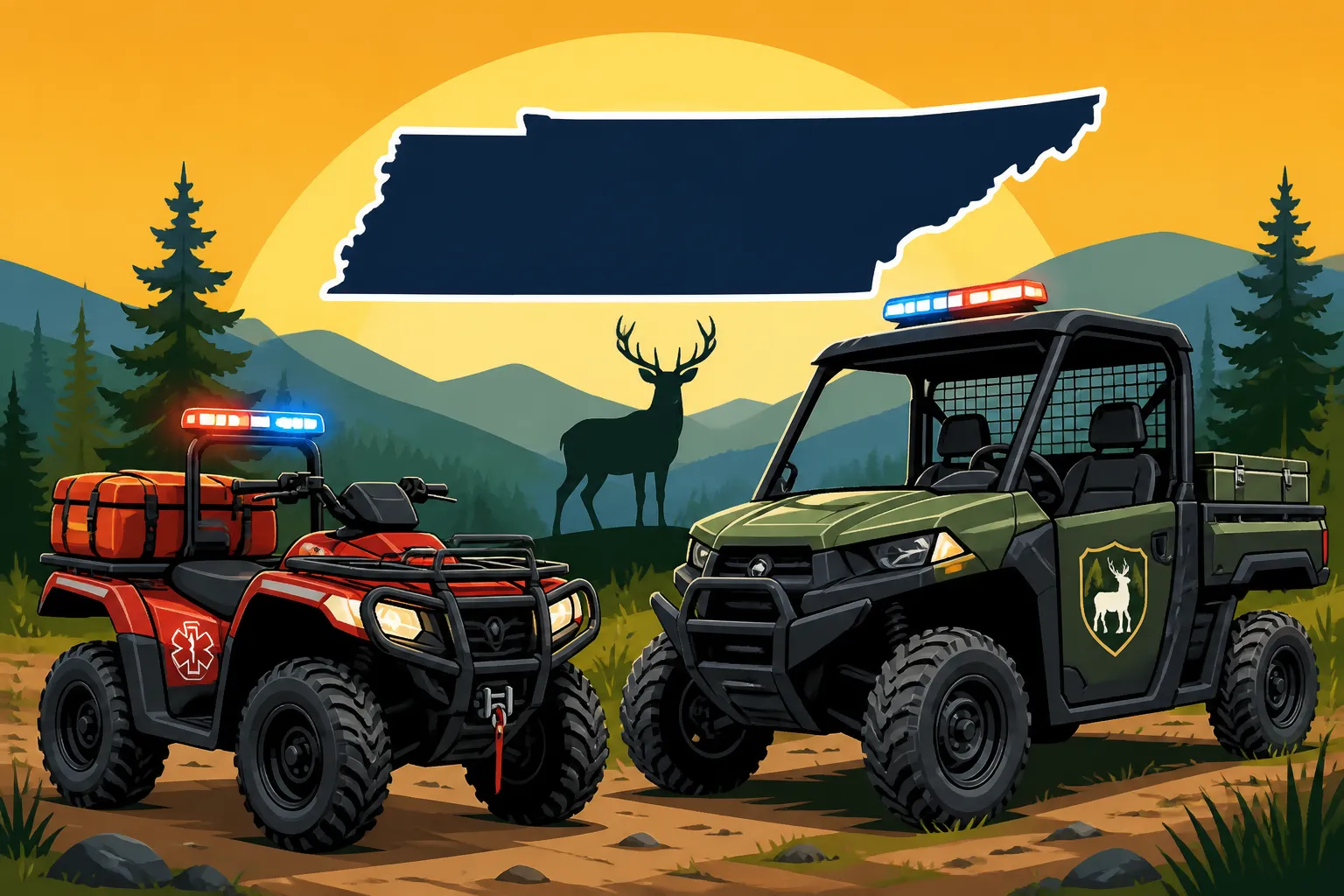
When you see an ATV or UTV being operated by an emergency responder or wildlife officer, you'll notice it stands apart from a recreational machine. These vehicles are typically clearly marked with agency logos, reflective decals, and often carry emergency lighting packages – flashing blue, red, or amber lights. These aren't for show; they serve vital functions. Clear markings help other road and trail users immediately identify the vehicle as official, reducing confusion and increasing safety, especially in high-stress situations. The emergency lights are critical for visibility, alerting motorists or other trail users to their presence, particularly when responding to an incident or operating in low-light conditions. Imagine a deputy on a quad, lights flashing, leading a search party down a [Tennessee Rules for Riding a National River Road] at dusk; those visual cues are indispensable. They also help differentiate official vehicles from private ones, reinforcing the legal distinctions in operation.
Operator Identification
Beyond the vehicle itself, the person operating it is also clearly identified. Emergency responders and wildlife officers are typically in uniform, often displaying badges or other official identification. This is paramount for several reasons. First, it immediately establishes their authority and purpose, helping to prevent misunderstandings with the public. If you encounter an individual operating an OHV in a manner that seems to disregard typical rules, their uniform and ID instantly clarify that they are performing official duties, not breaking laws. Second, it's a measure of accountability. Knowing who is operating the vehicle ensures that there is a responsible, trained professional at the controls. Finally, it builds trust within the community. When people see clearly identifiable officers or responders, they know that the operations are legitimate and for the public good.
Legal Protections and Responsibilities
The specialized training and clear identification of these operators and their vehicles are backed by specific legal protections. When acting within the scope of their official duties, these individuals are often afforded certain immunities from liability for actions taken in good faith, which is essential for them to perform high-risk tasks without undue personal exposure. However, this protection is not a license for reckless behavior. Operators of emergency and wildlife OHVs are still held to high standards of professionalism and safety. Their extensive training covers not just how to operate the vehicle, but also the legal framework within which they must operate. This ensures that while they can bend certain rules out of necessity, they do so responsibly, always with public safety and their mission as the guiding principles. It's a balance of empowerment and accountability, all designed to ensure these critical services are delivered effectively and safely across Tennessee.
| Aspect | Recreational OHV Rules (General) | Emergency & Wildlife OHV Rules (Official Duty) |
|---|---|---|
| Road Use | Restricted to designated county roads (45 mph max), specific areas. | Can operate on various public roads/highways for official duties. |
| Speed Limits | Must adhere to posted limits (often 45 mph max for OHVs). | May exceed limits for emergency response (lights/sirens activated). |
| Time of Day | Generally daylight hours only. | Can operate 24/7 as required by mission. |
| Equipment | Specific requirements (mirrors, signals, horn, etc.) for road use. | Specialized equipment for mission (winches, comms, medical, etc.). |
| Permits/Registration | May require trail permits, TDR sticker for titling. | Exempt from general trail permits/TDR sticker for official use. |
| Identification | None required beyond personal ID/title. | Clear agency markings, emergency lights, uniformed operator. |
| Operator Training | Safety courses recommended, not always mandatory. | Extensive, specialized training beyond basic safety. |
| Purpose of Use | Recreation, personal transportation, farm work. | Search & rescue, law enforcement, resource management, emergency. |
Disclaimer
This article is for general informational purposes only and does not constitute professional advice. Laws, prices and regulations vary by location and change over time. Consult a qualified professional for guidance on your specific situation.