Why North Cumberland Bars Competitive Events
A race, poker run or timed challenge can look like an ordinary group ride until it is planned as an event on public land. North Cumberland WMA has a specific restriction on competitive events, and a riding permit does not automatically make an event permissible. Here’s how to recognize the difference, plan a lawful recreational outing and check the rules before your group arrives.
What the competitive-event ban means
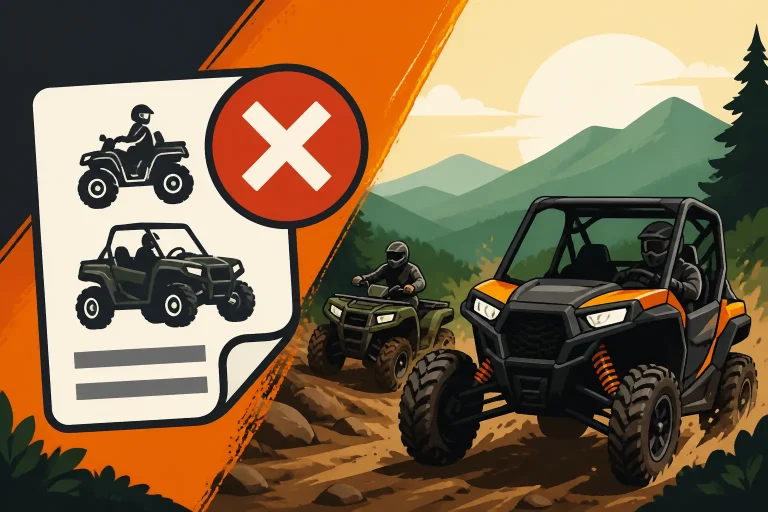
North Cumberland Wildlife Management Area is a place to ride designated routes under applicable permit and land-use rules. It is not a venue for competitive events. In practical terms, do not plan a race, timed course, contest or similar activity on the assumption that a regular riding permit covers it.
The important distinction is between riding as a recreation and organizing an event where participants compete. A group of friends traveling together at a safe pace is not automatically a competition. But adding a clock, rankings, prizes, a marked course or a winner can change the character of the activity. If your plan has any of those features, treat it as a potential competitive event and ask the land manager before making arrangements. Do not promote it or collect entry fees while assuming permission will be granted.
A permit allows the permitted riding it covers; it is not a blanket authorization for every activity on the WMA. It does not cancel restrictions on events, trails, group conduct or other land use. Likewise, having a permit for a trail system does not establish that an organized competition is allowed there.
The safest approach is to separate ordinary recreation from event planning. If you are arranging a gathering with a set route or schedule, even without a winner or entry fee, check the current rules. If participants will be timed, scored, ranked or rewarded, do not treat the outing as a casual ride. The distinction may depend on the details, so ask the managing agency rather than trying to find a loophole in the wording.
That caution applies whether you are bringing ATVs, UTVs or another permitted machine. A different vehicle, a small number of riders, or a privately organized event does not by itself remove the restriction. Nor does the fact that a route is open to ordinary riders mean it is available for a race.
This does not mean that individual riders cannot use North Cumberland WMA for lawful recreation. It means that a public riding permit and permission to stage a competitive event are not the same thing. For a broader overview of the land-use rules, see Tennessee Rules for Riding a WMA. Before you ride, also check Does One Permit Cover Every North Cumberland Unit? rather than assuming one permit or one unit’s rules apply everywhere.
Where a group ride ends and a competition begins
Some plans are easy to classify. A race with a start signal and a finish line is plainly competitive. Other activities are less obvious: a group may call something a “challenge” or “fun run” even though riders are being timed, scored or compared. The label is less useful than the way the activity is structured.
Use the following comparison as a planning tool, not as a formal legal test:
| Activity feature | More consistent with ordinary recreation | Signals a possible competitive event |
|---|---|---|
| Purpose | Riders travel together for enjoyment | Participants try to beat one another |
| Timing | No start or finish time is recorded | Elapsed times are recorded or compared |
| Results | No rankings or declared winner | Riders are ranked, scored or awarded places |
| Course | Riders follow open routes as permitted | A route is marked or arranged for a contest |
| Incentive | No prize or competitive recognition | Prizes, trophies or recognition depend on performance |
| Promotion | Friends coordinate a recreational outing | The event is advertised as a race, rally or challenge |
| Participation | Riders make their own choices and keep a safe pace | Participants are directed to compete or meet a target |
One feature alone may not answer every question. For example, setting a meeting time and suggesting a route can be ordinary coordination. A map, a shared start time and a planned break do not automatically turn a ride into a race. But when riders are expected to complete a course faster than others, or when performance is measured and rewarded, the activity is no longer just a group outing in the everyday sense.
Likewise, a charitable purpose does not automatically make a competition permissible. Raising money for a good cause, limiting the field to invited riders or keeping the event small does not change whether participants are competing. If you intend to conduct a race or contest, do not rely on a charitable label, a waiver or a standard riding permit to overcome the restriction.
Common examples to think through
- A family ride with a planned lunch stop: Usually a recreational outing in character if people simply ride together and no one is scored or timed. Follow group and trail rules.
- A club ride on open routes: The fact that a club is involved does not automatically make a ride competitive. Still, organized activities may have separate requirements, so review Tennessee Rules for an Organized Ride.
- A timed loop with a leaderboard: This is a clear warning sign for a competitive event. Do not stage it on the WMA without explicit direction from the managing agency.
- A poker run: The name does not settle the question. The route, activities, scoring, prizes and structure matter. Ask before advertising or collecting registrations.
- A skills contest or hill-climb challenge: If riders are judged, timed or ranked, do not assume it is permitted just because it takes place off the main trail.
- A large gathering with no scoring: It may not be a competition, but size, organization and land-use impacts can raise other questions. Confirm any applicable requirements before treating it as an ordinary ride.
If you are unsure, describe the plan plainly when you ask for guidance. Explain how many riders you expect, what machines they will use, where they plan to ride, whether the route is fixed, whether anyone will keep time or record results, and whether there will be fees, prizes or public promotion. A clear description is more useful than asking only, “Can we hold a group ride?”
Planning a lawful outing instead
If the aim is to enjoy North Cumberland together rather than compete, make the recreational character clear in both the plan and the way you communicate it. Do not keep a leaderboard, publish fastest times or offer rewards for completing a route first. Avoid directing riders to race one another, even informally. Keep the outing focused on riding open routes at a responsible pace.
A useful planning process is:
- Define the purpose. Decide whether participants are simply meeting to ride or are expected to compete. If speed, completion time, scoring or a winner matters to the plan, stop and ask the agency before proceeding.
- Describe the activity honestly. Use an accurate description in invitations and messages. Calling a timed race a “casual ride” does not change what participants are being asked to do.
- Check current access and permit rules. Confirm that the unit and routes you intend to use are open and that each rider has the required permit. The details can vary by permit type and location; review Why North Cumberland Charges Visitors More per Day for the residency distinction and confirm current requirements through the official permit channel.
- Check land-use restrictions. A route being open to individual riding does not mean it can be reserved or modified for a group activity. Do not mark, block, redirect or occupy routes unless the managing agency has clearly authorized that use.
- Keep the group responsible. Set expectations about pace, spacing, noise, passing, stopping and staying on authorized routes. A recreational outing should not pressure riders to take risks to keep up or finish first.
- Recheck before departure. Trail access and notices can change. Review Checking a Tennessee Trail Notice First close to the ride, and contact the agency if anything about your plan is uncertain.
An ordinary group ride still needs good coordination. Share the meeting location and route plan with participants, make sure everyone understands the permit requirements, and identify a realistic turnaround time. Group members should be able to ride at a comfortable pace or leave the group without being treated as having failed a challenge.
Also avoid making a group outing look like an event if it is not one. Public advertising, registration forms, entry fees, sponsor displays, prizes and a tightly scheduled course can all create a different impression than a few people arranging to ride together. None of these details alone necessarily answers the legal question, but together they can make it especially important to get advance guidance.
If your purpose really is a competition, the practical alternative is to look for a venue that expressly allows the activity and to confirm its event rules directly. A private park or other facility may have its own approvals, insurance requirements, land-use conditions and participant rules. Do not assume that permission at another riding area transfers to North Cumberland or that a permit from one property covers another. See Tennessee Rules for an Organized Ride for the wider distinction between group outings and organized activities.
Permits, guides and other rules still matter
The event restriction is only one part of riding responsibly on the WMA. A legal recreational ride can still violate a different rule if a participant lacks the required permit, rides on a closed route or enters an area with a separate restriction.
A riding permit is not event approval
Treat the ordinary trail permit as permission for the riding activity and area it covers, not as permission to stage a race or reserve public land. A permit purchase does not establish that an event has been reviewed, that an event application has been accepted or that the intended course is available for exclusive use.
When planning a group outing, check who needs a permit and which permit applies to the intended unit. Rules may depend on factors such as residency, duration, age or the specific place where the group will ride. Do not assume a participant’s permit from another park is valid at North Cumberland. Tennessee Permits for a Race or Event can help frame the separate event-permission question, while Why One Park’s Permit Is Worthless at the Next explains why park permits should not be treated as interchangeable.
A guide or club does not create an exception
A commercial guide, riding club or experienced organizer still has to follow the applicable rules. Organizing a paid tour is not the same as staging a competition, but guiding and commercial activity may be subject to separate requirements. A guide permit, if required for the activity, should not be interpreted as approval to run a race.
If you are taking payment, advertising a guided outing or arranging trips for clients, check Tennessee Rules for a Commercial Guide before offering the service. If you are a participant, ask the organizer whether permits and any required approvals are handled separately. Do not rely on a guide’s general experience or on a participant waiver as proof that the route or activity is authorized.
The same principle applies to clubs and volunteer groups. A club can help riders coordinate, but club membership does not change public-land restrictions. If the planned outing includes competition, recording results or a formal program, ask the managing agency how it classifies the activity before proceeding.
Open routes and closed routes are different questions
An event restriction does not make every trail unavailable, and an open trail does not make every use permissible. Riders should stay on routes authorized for their machines and check for temporary closures or other notices. Never create a shortcut, move a barrier or use an off-route area as a staging or spectator zone because it seems convenient.
A closed trail remains closed even if a group has traveled a long way or paid for permits. For more on that separate issue, see Tennessee Fines for Riding a Closed Trail. For current access information, consult Tennessee Trail Closures to Check First and the relevant official notices before loading your machines.
What to do if your plan is unclear
If your proposed activity is not an obvious casual ride or an obvious race, do not rely on guesswork. Contact the agency responsible for the land and explain the details before you announce the event, take registrations, sell merchandise or set a date. Ask directly whether the plan is considered a competitive event and whether any other approval is needed.
Be specific. “We are bringing a group” does not tell the agency whether participants will be timed, scored, directed to complete a course, offered prizes or charged an entry fee. A useful inquiry describes:
- The number and type of machines expected
- The planned date, duration and WMA unit
- Whether riders will follow a set route
- Whether there will be a start time, finish point or checkpoints
- Whether anyone will record times, scores or rankings
- Whether there are prizes, fees, sponsors or public registration
- Whether the outing is guided, commercial or limited to a club
Ask for the answer in a form you can keep, and follow any instructions the agency gives. If the answer is that the proposed competition is not allowed, do not reinterpret it as permission to hold the same event under another name. Change the activity so it is genuinely recreational, or move it to a venue that permits competitions.
For an outing that is clearly recreational, still verify the practical details close to the date. Confirm permit rules, unit access, route status and any temporary restrictions. Make sure every participant knows where the group can ride and understands that the group must not turn the ride into a race once it is on the trail.
The simplest rule is also the most useful: if the activity is designed to identify a winner or compare performance, do not stage it on North Cumberland WMA. If you are organizing a noncompetitive group ride, keep it noncompetitive in practice and check the separate rules that apply to groups, permits, guides and trail access.
Frequently Asked Questions
Can a group of friends ride together on North Cumberland WMA?
A group ride is not automatically a competition. Riders should follow the applicable permit and route rules, avoid racing or scoring one another, and check whether the size or organization of the outing triggers additional requirements.
Does a regular riding permit allow a race?
No. Do not treat an ordinary riding permit as authorization to conduct a competitive event. Ask the managing agency about the activity before planning or promoting it.
Is a poker run allowed if there is no race?
The name alone does not determine whether it is allowed. Route design, scoring, prizes, timing and other details can matter. Describe the full plan to the managing agency and get guidance before proceeding.
Can a guide run a competition if participants sign waivers?
A waiver does not override land-use rules. Guides and commercial operators must follow the restrictions and requirements that apply to their activity, and a guide permit should not be assumed to authorize a competition.
Disclaimer
This article is for general informational purposes only and does not constitute professional advice. Laws, prices and regulations vary by location and change over time. Consult a qualified professional for guidance on your specific situation.