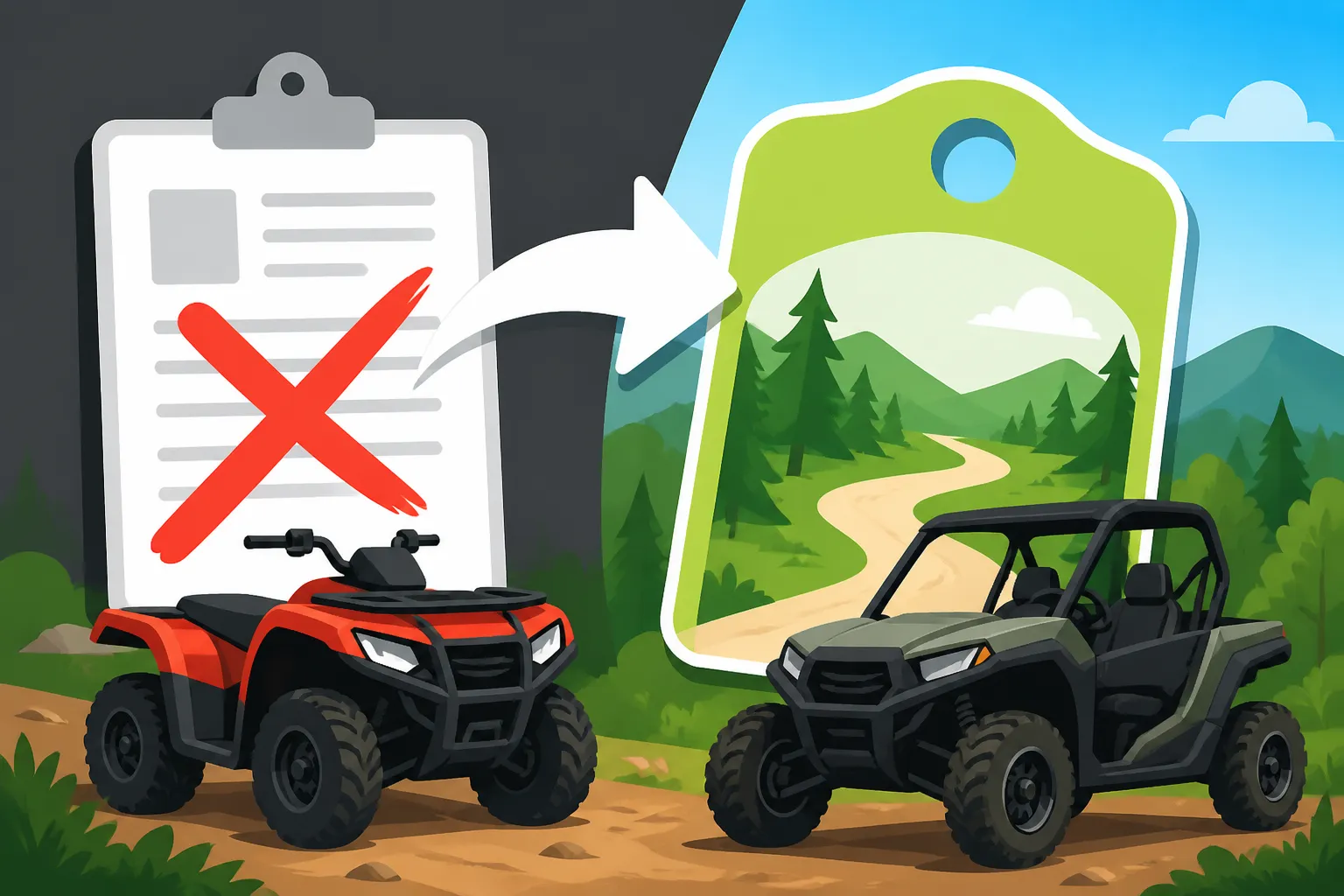
Why a Park Permit Replaces Registration in Tennessee
One of the biggest head-scratchers for new ATV and UTV owners, especially those moving to or visiting Tennessee, is figuring out the whole "registration" thing. You've heard whispers that Tennessee doesn't really register off-road machines in the traditional sense, and you're left wondering how you're supposed to legally hit the trails without the usual paperwork and license plates. It can feel like you're trying to solve a riddle without all the clues. This guide is here to clear up that confusion, explaining why a specific park permit, not a standard vehicle registration, is your golden ticket to riding legally in the Volunteer State.
The Tennessee Anomaly: No Statewide OHV Registration
It’s true, and it can be incredibly confusing if you’re used to the way other states handle their off-highway vehicles (OHVs). Most places have a system where you register your ATV or UTV with the Department of Motor Vehicles, get a little sticker or plate, and that signifies your machine is good to go for designated riding areas. Tennessee, however, marches to the beat of a different drum, and understanding this unique approach is the first step in navigating the state’s OHV landscape.
Understanding Tennessee's Approach to Off-Highway Vehicles
Unlike the cars and trucks you drive on public roads, which absolutely need to be registered and titled, Tennessee has opted for a different path when it comes to ATVs, UTVs, and other off-road machines. The state doesn't maintain a central registry for these vehicles in the way it does for street-legal vehicles. This isn't an oversight or a loophole; it's a deliberate choice rooted in how Tennessee generally views the primary use of these machines. For the most part, the state considers ATVs and UTVs to be recreational or utility vehicles primarily used on private property or within designated, managed trail systems.
This approach means that if you're pulling up stakes from, say, Ohio or Michigan, where you routinely renewed your ATV registration every year, Tennessee’s lack of such a system can feel like stepping into the wild west. You might even find yourself second-guessing whether you heard correctly. But rest assured, there’s a method to the madness, even if it’s a bit unconventional. The state basically says, "If you're going to ride on our managed lands, we'll manage access through permits. Otherwise, on private land, it's between you and the landowner." This hands-off approach for private land use, combined with the permit system for public access, forms the backbone of Tennessee's OHV policy.
Titling Versus Registration: A Critical Distinction
Here’s where a lot of the misunderstanding comes into play. While Tennessee doesn't have statewide registration for OHVs, it absolutely requires titling. These are two distinct concepts, and mixing them up can lead to a lot of frustration. Think of it this way: a title proves ownership, much like the deed to your house or the title to your car. It's a document issued by the state that legally establishes who the owner of the machine is. Without a title, proving you legally own your ATV or UTV becomes incredibly difficult, especially if you ever need to sell it, insure it, or recover it if it's stolen. You can learn more about [Titling an OHV in Tennessee] at your local county clerk's office.
Registration, on the other hand, is typically about granting permission to operate a vehicle on public roads or designated public lands, often tied to annual fees and a physical display (like a license plate or sticker) that proves you've paid those fees and met certain requirements. Since Tennessee's default position is that OHVs generally aren't for public road use (with specific exceptions we'll touch on later), the need for a statewide registration system for off-road purposes simply isn't there. Instead, the state issues a [Tennessee's TDR Sticker Explained] which, while a sticker, is merely visual proof that your OHV has a title – it's not a registration sticker in the traditional sense. It's crucial to understand this difference: you must title your OHV, but you won't register it like a car. This fundamental difference is key to understanding [Why Tennessee Does Not Register Off-Road Machines].
The Role of Park Permits: Your Ticket to Ride
So, if there's no statewide registration, how does the state manage access to its incredible network of trails and riding areas? The answer lies in the park permit system. These permits are the actual "gate passes" you need to legally ride on many of Tennessee's most popular OHV destinations. It’s a direct response to the lack of a centralized registration, allowing individual land management agencies to control and fund their specific operations.
Why Designated Parks and WMAs Require Permits
Since the state of Tennessee doesn't collect annual registration fees for OHVs, it can't use those funds to maintain trails, manage facilities, or enforce rules on public riding lands. This is where the permit system steps in. Agencies that manage these lands – whether they are state-owned Wildlife Management Areas (WMAs) or privately operated but publicly accessible parks – implement their own permit requirements. These permits serve several critical functions:
- Funding Trail Maintenance and Operations: The fees collected from permits go directly back into the riding areas. This money is vital for maintaining trails, repairing damage, funding search and rescue operations, providing amenities like restrooms and staging areas, and staffing the facilities. Without these permit fees, the trails would quickly fall into disrepair, and the operational costs would become unsustainable.
- Managing Rider Numbers and Impact: Permits allow land managers to have some control over how many people are using the trails at any given time. This helps to reduce overcrowding, minimize environmental impact, and enhance the overall safety and experience for riders.
- Ensuring Accountability: When you purchase a permit, you're often agreeing to abide by a set of rules and regulations specific to that park or WMA. This adds a layer of accountability for riders and helps park staff enforce safe and responsible riding practices.
Consider places like Windrock Park in Oliver Springs, Brimstone Recreation in Huntsville, or the vast North Cumberland WMA – these are all iconic Tennessee riding spots, and they all require you to purchase a permit before you can even think about unloading your machine. The permit is literally your "license" to ride on their specific property.
What a Tennessee Permit Covers (and Doesn't)
A Tennessee park permit is very specific in what it grants you permission to do. Essentially, it allows you access to the designated trails within that specific park or WMA for the duration of your permit. For example, a permit for Windrock Park gives you access to Windrock's 300+ miles of trails. A permit for the North Cumberland WMA grants you access to its network of trails, often spanning multiple units like Royal Blue and Sundquist.
However, it's absolutely crucial to understand what these permits do not cover:
- Other Parks or WMAs: A permit for Windrock is only valid for Windrock. It won't get you onto the trails at Brimstone, nor will it grant you access to the North Cumberland WMA. Each riding area requires its own separate permit. [Does One Permit Cover Every North Cumberland Unit?] No, it does not.
- Public Roads (without specific local ordinances): A park permit does not magically make your OHV street legal. You cannot use it to ride your ATV or UTV on public roads, highways, or county routes unless those specific roads have been designated for OHV use by local ordinance, and even then, often with additional requirements like insurance, specific equipment, and age restrictions. We’ll touch on this more in other guides, but generally, the default is "off-road only."
- Private Land Without Permission: Your park permit gives you no rights to ride on private property outside the designated park boundaries. Riding on private land always requires explicit permission from the landowner.
- "Reciprocity" with Other States: Tennessee's permit system is unique to Tennessee. No out-of-state registration or permit is recognized or reciprocated here, as there is no equivalent statewide system. [Does Tennessee Honor Out-of-State Registration?] The answer is no, you'll still need a Tennessee permit for Tennessee trails.
When you look into permits, you'll find various options: day permits, multi-day permits, and annual permits. There are also different rates for residents and non-residents, with non-residents typically paying a higher fee. For instance, you can find details on the [North Cumberland OHV Permit Cost] on the state's wildlife resources agency website or at authorized vendors. Always check the specific park or WMA's website for their current permit types, pricing, and rules.
Navigating Different Riding Scenarios
Riding in Tennessee presents a few different scenarios, each with its own set of rules and requirements regarding permits and permissions. It’s not a one-size-fits-all situation, and understanding where you plan to ride is critical to ensuring you’re doing it legally.
Riding on Public Land: Parks and WMAs
This is where the permit system truly shines and where most organized ATV and UTV riding takes place in Tennessee. The state has invested in or allowed for the development of extensive trail systems that attract riders from all over the country.
To ride on these lands, the process is usually quite straightforward:
- Identify Your Destination: First, decide which park or WMA you want to visit. Popular choices include:
- Windrock Park: Located near Oliver Springs, this is one of the largest privately owned riding areas in the country with over 300 miles of trails. You purchase permits directly from Windrock, either online or at their general store.
- Brimstone Recreation: Also in the Coal Creek region near Huntsville, Brimstone offers another vast network of trails. Permits are available online or at their headquarters.
- North Cumberland Wildlife Management Area (WMA): This is a state-managed system with multiple units (like Royal Blue, Sundquist, New River, and Ed Carter) offering hundreds of miles of trails. Permits for the North Cumberland WMA are typically purchased through the Tennessee Wildlife Resources Agency (TWRA) website or through authorized vendors like many local county clerk offices.
- Purchase the Correct Permit: Ensure you purchase the permit specific to the location you intend to ride. Pay attention to resident vs. non-resident rates and the duration (day, multi-day, annual). For state-managed WMAs, often one adult per vehicle needs a permit, and this applies whether you're driving a single ATV or a multi-passenger UTV.
- Carry Your Permit and ID: Always have your permit (physical or digital, as specified by the park) and a valid photo ID with you while riding. Park rangers, wildlife officers, or staff may ask to see them.
- Adhere to Park Rules: Each park or WMA will have its own set of rules regarding helmets, age limits for operators, passenger restrictions, sound limits, and spark arrestors. It’s your responsibility to know and follow these rules. For instance, [Tennessee Rules for Riding a WMA] will cover things like orange safety requirements during hunting season.
Riding in these designated areas offers a fantastic experience, often with marked trails, amenities, and a sense of community. But it all starts with that permit.
Private Land and Local Road Use Considerations
Away from the major parks and WMAs, the rules get a bit more localized and sometimes, quite frankly, confusing.
- Riding on Private Land: If you own land or have permission from a landowner, you can generally ride your OHV on that private property without any state-issued permit or registration. This is where many riders get their start or continue to enjoy their machines without the need for additional fees. However, it's always smart to have a clear understanding of boundaries and any agreements you have with neighbors. If you’re purchasing a used machine for private land use, ensure you get a solid [A Tennessee Bill of Sale for an OHV] from the seller. If you're allowing others to ride on your private land, consider having them sign a liability waiver, which resources like LawDepot can help you create. This can offer some protection by clearly stating the risks involved.
- Local Road Use: This is the most complex area. While Tennessee doesn't generally allow OHVs on public roads, the state legislature has created exceptions for certain types of vehicles (like low-speed or medium-speed vehicles) and has also empowered local counties and municipalities to designate specific roads for OHV use, particularly within "Adventure Tourism Districts" (like parts of Scott, Anderson, and Campbell counties).
- Specific Designations: If a county or city has passed an ordinance allowing OHVs on certain roads, there will be strict conditions. These often include speed limits (e.g., roads posted 45 mph or less), daylight-only operation, insurance requirements, helmets, and specific equipment (headlights, taillights, turn signals, mirrors). These are the scenarios where your OHV might need to meet standards that mimic street-legal vehicles, even if it's not "registered" in the traditional sense. Understanding [Are UTVs Street Legal in Tennessee?] and [Tennessee UTV Road Requirements] is crucial if you plan to explore these limited road-riding opportunities. You will still need your valid title, and often a driver's license, but not a separate "registration" sticker.
In these situations, it's essential to do your homework. Check with the county clerk or sheriff's office in the specific area you plan to ride to confirm current ordinances and requirements. What's legal in one county might be illegal just across the county line.
The Practicalities of Riding in Tennessee
With Tennessee's unique OHV system, it's easy to get caught off guard by what you do and don't need to have on hand. It's not as simple as just grabbing your helmet and going. Being prepared means understanding the essential paperwork and how the system treats visitors.
Essential Paperwork Beyond the Permit
Even without traditional registration, a responsible OHV owner in Tennessee should always carry certain documents. These aren't just good practices; they can save you a lot of hassle and potential fines if you encounter a park ranger, wildlife officer, or law enforcement.
Here's what you should always have with you, or at least a readily accessible copy:
- Proof of Title: This is paramount. The [Tennessee Department of Revenue and OHVs] issues titles, and this document legally confirms your ownership. While you don't need to carry the original physical title (which could get damaged or lost on the trail!), a clear, legible photograph on your phone or a laminated copy is highly advisable. If you're ever questioned about ownership, especially if your machine is involved in an incident or suspected to be stolen, this is your primary proof. Remember, [Tennessee OHV Title Paperwork] is crucial for all OHV owners.
- Your Riding Permit: As discussed, this is your direct permission to ride on public land. Whether it's a day pass for Windrock, an annual permit for Brimstone, or a WMA permit from TWRA, keep it on your person or securely attached to your machine where it's visible if required.
- Photo Identification: Always carry a valid driver's license or state-issued ID. This helps verify that the permit belongs to you and can also be crucial in emergencies. For private land access, if you're ever letting others ride on your property, having them complete a simple waiver (which you can generate using tools like LawDepot) that includes their ID information is a smart move.
- Proof of Insurance (if applicable): While not universally required for off-road use, insurance is often mandated if you plan to ride on any designated public roads, even those opened by local ordinance. It's always a good idea to have at least liability insurance for your OHV, regardless of legal requirements, to protect yourself in case of an accident. Carrying your insurance card is essential in these scenarios.
- Landowner Permission (for private land): If you're riding on private land that isn't yours, always carry written permission from the landowner. A simple note with their name, contact information, the date, and a clear statement granting you permission to ride can prevent trespass issues. This is another area where a quick document from LawDepot could provide a useful template.
Understanding Visitor and Non-Resident Rules
Tennessee is a major destination for OHV enthusiasts, and many riders come from out of state to experience its legendary trails. If you're a non-resident, the rules generally apply to you just as they do to residents, with a couple of key distinctions.
- Permit Requirements are Universal: Whether you're from Georgia, Kentucky, or California, if you want to ride on a Tennessee park or WMA, you will need to purchase the appropriate Tennessee permit. Your home state's registration or permits are not transferable or recognized. [Tennessee Rules for a Visiting Rider] clearly state this.
- Non-Resident Permit Fees: Expect to pay a higher rate for day, multi-day, and annual permits compared to Tennessee residents. This is a common practice across many states for state-managed recreational lands, as residents contribute to state taxes that indirectly support these areas. For example, a nonresident permit for the North Cumberland WMA will cost more than a resident permit.
- Titling: If you move to Tennessee and bring your OHV with you, you will need to title it in Tennessee, even if it was titled or registered in your previous state. This process happens at your local county clerk's office.
The bottom line for visitors is simple: don't assume your out-of-state paperwork will suffice. Plan ahead, budget for the necessary Tennessee permits, and always verify specific requirements for the park or WMA you intend to visit. There are no shortcuts or reciprocity agreements when it comes to riding on Tennessee's designated OHV lands.
Why This System Exists: Benefits and Drawbacks
Every system has its pros and cons, and Tennessee’s approach to OHV access is no different. While it can be confusing at first glance, there are legitimate reasons why the state operates this way, and understanding them can help riders appreciate the landscape they're navigating.
Advantages of the Permit-Based System
The permit-based system, while unconventional, offers several distinct benefits for both the state and the riding community:
- Direct Funding for Trails: This is arguably the biggest advantage. When you purchase a permit for Windrock, Brimstone, or the North Cumberland WMA, those funds are directly channeled back into the maintenance, management, and improvement of those specific trails and facilities. Unlike a general statewide registration fee that might get diluted across various state budgets, permit fees ensure that the money generated by riders directly benefits the places they ride. This creates a clear and accountable funding stream.
- Flexibility for Landowners: For private landowners, the absence of state registration means less red tape if they want to create their own riding areas or allow friends and family to ride on their property. They don't have to worry about complex state regulations for registration, focusing instead on liability and local zoning. For those looking to set up private riding areas or manage access, legal document templates from LawDepot could be helpful for creating agreements or waivers.
- Reduced Bureaucratic Overhead: From the state's perspective, not having a statewide OHV registration system simplifies things. It avoids the administrative burden and cost of establishing and maintaining such a registry, collecting fees, issuing plates/stickers, and enforcing universal regulations for a category of vehicles primarily used off-road. This allows the state to focus its resources on other areas of vehicle administration.
- Simplicity for Visitors (Once Understood): While initially confusing, once a visitor understands that their out-of-state registration isn't valid and a Tennessee permit is required for specific parks, the process becomes quite simple. They don't need to temporarily register their machine with the state; they just buy a park permit and are good to go for that location. This avoids the complexity of trying to create reciprocity agreements or temporary state registrations for short-term visits.
Potential Challenges and Common Misconceptions
Despite its advantages, Tennessee's OHV system also presents challenges and can lead to significant misunderstandings, especially for those unfamiliar with it.
- Initial Confusion for Out-of-State Riders: As we've highlighted, riders accustomed to traditional statewide registration systems often find Tennessee's approach baffling. They might mistakenly believe that "no registration" means "no rules" or that their out-of-state registration is sufficient. This can lead to frustration, unexpected permit purchases, or even fines if they ride without proper access. This is why resources like this guide are so important.
- Patchwork of Rules and Enforcement: Because trail access is managed at the park or WMA level, and road use is determined by local ordinances, riders face a "patchwork" of rules. What's allowed at Windrock might be different from Brimstone, and what's legal on a specific county road in Scott County might be illegal in an adjacent county. This requires riders to be diligent and do their research for each specific location they plan to visit. There isn't one statewide OHV rulebook that covers everything.
- "No Registration" Doesn't Mean "No Consequences": A dangerous misconception is that because there's no state registration, OHVs are somehow outside the law. This is absolutely false. You still need to title your machine, you need permits for public land, you need permission for private land, and all standard laws regarding reckless operation, DUI, and property damage still apply. Getting caught riding on closed trails, without a permit, or trespassing can lead to significant fines, impoundment of your vehicle, and other legal troubles. The absence of registration simply means a different enforcement mechanism, not a lack of enforcement.
- Lack of Centralized Information: While the major parks and TWRA websites provide excellent information for their specific areas, finding a comprehensive, single source of truth for all OHV rules and opportunities across the entire state can be challenging due to the decentralized nature of the system.
Understanding these benefits and drawbacks helps frame the Tennessee OHV experience. It encourages riders to be proactive, informed, and respectful of the diverse regulations they might encounter across the state.
| Feature | Titling | Registration (Typical State) | Tennessee Park Permit |
|---|---|---|---|
| Purpose | Proves legal ownership of the vehicle. | Grants permission for public road/land use; taxation. | Grants access to specific designated trails/parks. |
| Issued By | Tennessee Department of Revenue (via County Clerk) | State Department of Motor Vehicles (DMV) | Individual Parks / TWRA (for WMAs) |
| Required In TN | YES, for all OHVs (with few exceptions). | NO, no statewide OHV registration in TN. | YES, for riding on designated public/private parks/WMAs. |
| Physical Proof | TDR sticker on title, actual paper title. | License plate or annual sticker. | Physical/digital permit (often a wristband or sticker). |
| Cost | One-time fee (plus county/lien fees). | Annual renewal fee. | Day, multi-day, or annual fees (resident/non-resident rates). |
| Covers | Ownership. | Public road use, general public land access. | Access to specific, named trail system. |
| Key Distinction | Ownership proof, not usage permission. | Usage permission, often tied to roads. | Usage permission for specific off-road areas only. |
Disclaimer
This article is for general informational purposes only and does not constitute professional advice. Laws, prices and regulations vary by location and change over time. Consult a qualified professional for guidance on your specific situation.