Two Machines Titled at an Anderson County Window
You've just bought a couple of fantastic off-road machines, maybe a side-by-side for you and a quad for your teenager, and now you're faced with the daunting task of getting them officially titled in Tennessee. It can feel like a mountain of paperwork, especially when you're trying to do it all at once. This guide is designed to walk you through the process of titling two (or more!) OHVs at an Anderson County window, helping you prepare thoroughly and avoid common headaches.
Preparing for Your Visit to the Anderson County Clerk's Office
When you're dealing with more than one off-highway vehicle (OHV), whether they're ATVs, UTVs, or other types of machines, the key to a smooth process at the Anderson County Clerk's office is preparation. It’s not just about having a set of documents; it’s about having separate, complete sets of documents for each individual machine. Think of it like taking two separate trips, but you're doing them both at the same counter. Each OHV needs to stand on its own in terms of its paperwork trail.
Before you even think about heading out the door, take a moment to confirm the Anderson County Clerk's office hours and any specific requirements they might have. While the core process for [Titling an OHV in Tennessee] is set by the state, individual county offices can sometimes have slightly different operational procedures or preferred payment methods. Giving them a quick call or checking their website can save you a wasted trip. You'll be dealing with multiple transactions, so clarity upfront is your best friend.
Another important aspect of preparation is understanding the specific category each of your machines falls into. Tennessee has [Tennessee's Four Vehicle Categories] for OHVs, namely Class I and Class II. While the titling process is similar for both, knowing which class your quad or side-by-side belongs to can be helpful, especially if you have questions about future road use or specific regulations. For example, a standard ATV usually falls under [Tennessee's Class I OHV Definition], while a larger sand rail or dune buggy might be a [Tennessee's Class II OHV Definition]. This distinction often comes up in conversations about registration and legal use, even if it doesn't drastically change the titling paperwork itself.
What Each Machine Needs Individually
Imagine you're processing each OHV as if it were the only one you owned. That's the mindset you need. This means that if you're titling a side-by-side and a quad, each one needs its own original Manufacturer's Statement of Origin (MSO) if new, or a previously issued title if used. You can't just have one MSO for both if they came from the same dealer at the same time; each machine is a unique entity with its own unique identifier.
For each machine, you'll also need a separate [A Tennessee Bill of Sale for an OHV]. Even if you bought both machines from the same private seller or dealer on the same day, they should ideally be listed on separate bills of sale, or at least clearly delineated on one bill that specifies each machine's VIN and purchase price individually. This clarity is crucial for calculating [Tennessee Sales Tax at the Title Counter] accurately for each unit. If you're looking for a good template for a bill of sale, resources like LawDepot can provide customizable forms that ensure you capture all the necessary details.
Furthermore, make sure you have proof of identity for the owner(s) that will be listed on the title. If two people are co-owning both machines, then both individuals will need to be present or have properly notarized documents authorizing the other to act on their behalf. This is especially true when it comes to signing over titles or MSOs. Without the correct and complete information for each machine, you risk having to make a return trip to the Anderson County Clerk's office, and nobody wants that.
Pre-Checking VINs and History
Before you even step foot in the county clerk's office, it's a really smart move to do some pre-checking on the Vehicle Identification Numbers (VINs) for both of your machines. This is particularly vital if you're buying used machines, like when you're [Buying a Used OHV in Tennessee]. A VIN check can reveal if the machine has ever been reported stolen, if it has any liens against it that haven't been released, or if there's any discrepancy in its history that could cause a holdup at the title counter.
There are various services online that can help you with a VIN check, often for a small fee. This small investment can save you a world of hurt and potential financial loss down the road. Imagine getting both machines ready, driving to the clerk's office, only to find out one of them has a red flag on its VIN. That's a frustration you definitely want to avoid. While the clerk's office will verify the VIN, they usually won't perform a comprehensive history check for you. That's your responsibility as the buyer.
For example, if you're buying a quad advertised with no TDR sticker, a VIN check can help you understand its history and ensure it's not a stolen machine or one with an unreleased lien. Having a clear VIN history for both machines helps ensure that the titling process moves forward smoothly and that you are indeed receiving clear title to your property. For critical documents like a bill of sale, ensuring the VIN is correctly documented is paramount. Again, if you're preparing your own paperwork, using a service like LawDepot can help you generate a clear, legally sound bill of sale that accurately records the VIN for each OHV.
Required Paperwork for Each OHV at the Window
When you're at the Anderson County Clerk's window, the process for titling multiple OHVs is essentially repeating the single-machine process for each one. This means having a full, distinct set of paperwork for every ATV or UTV you intend to title. It’s not a bulk discount on documentation; each machine is an individual case. Understanding [Tennessee OHV Title Paperwork] for each one is paramount.
For new machines, you'll need the original Manufacturer's Statement of Origin (MSO) for each OHV. This document is like a birth certificate for your machine and proves it's never been titled before. Ensure the MSO for your side-by-side clearly states its VIN and details, and likewise for your quad. Any alterations or smudges on these critical documents can cause delays, so handle them carefully. The dealer typically provides these to you, but it’s always wise to double-check before you leave the dealership.
For used machines, you’ll need the original title, properly signed over to you by the previous owner, for each OHV. Check the back of both titles carefully to ensure the seller has completed their section, signed it, and, if required, had their signature notarized. A common mistake when buying used is a missing signature or an incorrectly filled-out transfer section, which can grind the entire process to a halt. When you're [Buying a Machine Bought Privately in Tennessee], this step is entirely up to you and the seller. If you're buying from out of state, say [Bringing a Machine From Kentucky to Tennessee], ensure that state's title has been correctly endorsed for transfer.
The Bill of Sale and Sales Tax for Each
As mentioned, a clear and comprehensive bill of sale is crucial for each machine. This document establishes the purchase price, the date of sale, and identifies both the buyer and the seller, along with the specific VIN of the OHV being sold. It's the primary document the clerk will use to calculate the sales tax owed on each machine. Even if you paid one lump sum for both, the bill of sale needs to break down the cost per machine. For instance, if you paid $20,000 for a side-by-side and a quad together, the bill of sale should ideally state something like "$15,000 for OHV A (VIN: XXX) and $5,000 for OHV B (VIN: YYY)."
Tennessee charges sales tax on the purchase price of each vehicle, so the more clearly defined the price for each, the smoother the tax calculation will be. If the bill of sale doesn't itemize, the clerk may require you to provide a separate valuation or assign a fair market value, which can complicate things. Again, if you need a template, LawDepot offers customizable bill of sale forms that can help you clearly delineate each machine and its associated costs, ensuring all the necessary fields are present for Tennessee’s requirements.
Remember, the sales tax is paid at the time of titling, so be prepared for that financial outlay for each machine. The amount will vary based on the purchase price you declare on your individual bills of sale. This is why accurately documenting the price for your [Titling a Side-by-Side in Tennessee] and [Titling a Quad in Tennessee] is so critical. Without clear pricing for each, the clerk might have to make assumptions, or worse, reject the paperwork until you provide better documentation.
Other Supporting Documents per Machine
Beyond the title/MSO and bill of sale, there might be other documents you need for each OHV, depending on your specific situation. For example, if you inherited the machines, you'll need separate copies of the probate court documents or an affidavit of inheritance for each machine. If there's a lien on one or both of the machines, you'll need separate [Releasing a Lien on a Tennessee Title] documents or proof that the lienholder has properly signed off.
If you’re moving to Tennessee from another state and bringing your machines with you, you'll generally need the out-of-state title for each, along with proof of Tennessee residency. The goal is always to provide a clear and complete paper trail for every single OHV. It might seem redundant to have two identical sets of documents that only differ by VIN, but that's precisely what's required for multiple titling transactions at the Anderson County Clerk's office.
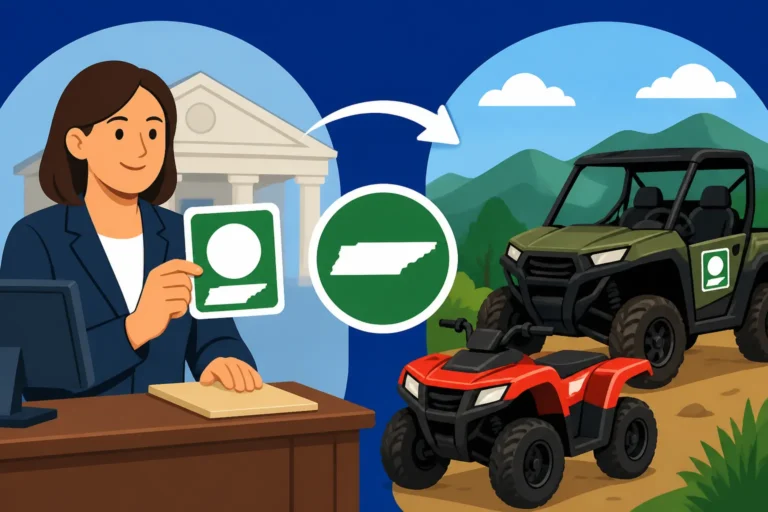
One key item you'll receive for each titled OHV is the [Tennessee's TDR Sticker Explained]. This sticker proves your machine has a valid Tennessee title. Each machine will get its own sticker, and as the name implies, it's issued by the Tennessee Department of Revenue (TDR). It's crucial to understand that [Why a Tennessee Sticker Dies With the Sale] of the machine, so when you title your newly acquired OHVs, you'll be getting fresh stickers for each, even if the previous owner had one.
Here’s a summary of the common documents you'll need for each OHV:
| Document Type | New OHV Purchase | Used OHV Purchase (In-State) | Used OHV Purchase (Out-of-State) |
|---|---|---|---|
| Proof of Ownership | Original MSO (Manufacturer's Statement of Origin) | Original Tennessee Title (signed over) | Original Out-of-State Title (signed over) |
| Proof of Purchase | Bill of Sale (itemizing each OHV) | Bill of Sale (itemizing each OHV) | Bill of Sale (itemizing each OHV) |
| Tax Information | Purchase Price on Bill of Sale | Purchase Price on Bill of Sale | Purchase Price on Bill of Sale |
| Identity | Valid Photo ID | Valid Photo ID | Valid Photo ID |
| Lien Release | (If applicable from prior owner, rare for new) | If title shows a lien, release form needed | If title shows a lien, release form needed |
Understanding the Fees for Multiple Titles
Titling two machines isn't just double the paperwork; it's generally double the fees. Each OHV is a separate transaction in the eyes of the state and the county, meaning you’ll pay the applicable fees for each title application. This can add up, so it's wise to budget accordingly before you arrive at the Anderson County Clerk's office.
First, there's the state title fee, which is part of [What a Tennessee OHV Title Costs]. This fee goes to the state for the processing and issuance of the official title document. You will pay this fee for your side-by-side, and then you will pay it again for your quad. There isn't a bundled rate for multiple titles. This is a consistent charge that applies to every titling transaction statewide, whether you're titling one machine or [Titling an Imported Machine in Tennessee] or two from a local dealer.
Next, you'll encounter the county clerk's fee. This is the fee that [What a Tennessee County Clerk Charges on Top] of the state fee, and it covers the administrative costs for the local office to process your paperwork. This fee also applies per machine. So, if the [Tennessee's $8.50 County Clerk Fee] is what Anderson County charges, you'll pay $8.50 for the first OHV and another $8.50 for the second. These local fees compensate the county for their part in the statewide titling system.
Sales Tax and Lien Fees Per Machine
Sales tax is arguably the largest financial component of titling an OHV, and it's calculated on the purchase price of each machine. As discussed earlier, your individual bills of sale will be crucial here. If you paid $15,000 for your side-by-side and $5,000 for your quad, the sales tax will be calculated on $15,000 for the first title and $5,000 for the second. Be prepared to pay these amounts in full at the time of titling. It’s not uncommon for people to underestimate the total cost when dealing with multiple purchases.
If you financed either of your machines, or both, there will be an additional [Tennessee's $11 Lien Fee] for each machine that has a lien placed against its title. This fee covers the recording of the lienholder's interest in your OHV. So, if your side-by-side is financed and your quad is financed, you'll pay two separate $11 lien fees. The county clerk will process this paperwork, and the lienholder's name will appear on each of your new titles. This is a crucial step for lenders to secure their investment, and it's processed right alongside your title application.
Here's a simplified breakdown of potential fees for each machine you title:
| Fee Type | Description | Applicable Per Machine? |
|---|---|---|
| State Title Fee | Fee for the state to issue the title | Yes |
| County Clerk Fee | Local administrative fee for processing | Yes |
| Sales Tax | Based on purchase price of each OHV | Yes |
| Lien Fee | If a loan is secured by the OHV | Yes |
| Notary Fee | If documents require notarization at counter | Yes (if applicable) |
Payment Methods at the County Window
Most Anderson County Clerk offices accept a variety of payment methods, but it’s always a good idea to confirm ahead of time, especially when you're making a larger payment for multiple machines. Generally, they will accept cash, cashier's checks, and often debit or credit cards. However, be aware that credit card transactions might incur a small processing fee.
When you're prepared to pay for both machines' fees and sales taxes, the total amount can be substantial. Ensure you have sufficient funds or your card limits are high enough to cover everything. It's a real bummer to get all the way through the paperwork, only to hit a snag at the payment counter. Think about the combined total of [Tennessee OHV Sales Tax at Titling] plus all the other fees for both machines. Having your ducks in a row financially will make your visit much smoother.
Remember that [Where Tennessee Title Fees Go] is generally split between state and county funds, supporting the infrastructure that allows for legal ownership and identification of your off-road vehicles. While it might feel like a lot of individual charges, each fee serves a purpose in ensuring proper documentation and legal standing for your new acquisitions.
Common Questions and Pitfalls When Titling More Than One
Even with all your ducks in a row, titling multiple OHVs can throw a curveball or two. It's helpful to anticipate some common questions or scenarios that might arise, especially when you're trying to streamline the process for two machines. The county clerk's office sees a lot of different situations, and being prepared for potential issues can save you time and frustration.
One frequent question revolves around VIN discrepancies. This is why [Checking a VIN Before a Tennessee Purchase] is so crucial for each machine. What happens if the VIN on your bill of sale for your quad doesn't exactly match the VIN stamped on the frame? This is a definite red flag. The clerk will likely halt the titling process for that specific machine until the discrepancy is resolved. This might mean contacting the seller for a corrected bill of sale or even a visit from a law enforcement officer to verify the VIN. It's a headache you can avoid by carefully inspecting both VINs before you complete your purchase.
Another common pitfall involves incomplete signatures or missing notarizations on used titles. When you’re dealing with two separate titles, there are two separate opportunities for this mistake to occur. Always double-check that the previous owner(s) have signed and dated both titles correctly, and if the title requires notarization for transfer, ensure that's been done as well. If you're [Selling an OHV in Tennessee], you'd want to be just as thorough for your buyer. A common mistake is to sign only one title fully, or to miss a necessary notary stamp on the second one.
The Tennessee TDR Sticker and What It Means
For each OHV you successfully title, you will receive a [Tennessee TDR Sticker Requirements] sticker. This unique sticker is affixed to the machine and signifies that it has been properly titled in Tennessee. It’s important to remember that these stickers are specifically tied to the titled machine and its ownership. This is why [Why a Tennessee Sticker Cannot Be Transferred] between machines or owners. Each OHV receives its own unique sticker.
Since you're titling two machines, you'll be getting two separate TDR stickers. Make sure you understand [Where the Tennessee TDR Sticker Goes] on each of your OHVs. Typically, it’s placed in a visible, easily accessible spot, like on the fender or frame. The clerk or staff member might even point out the ideal placement. It's not just a decorative item; it's proof of valid title if you're ever stopped or questioned about your machine’s legal status.
Furthermore, understand that [Why the Tennessee Sticker Cannot Be Renewed]. It's a one-time issuance linked to the title itself. If you were to sell one of your machines down the line, that specific TDR sticker would become void, and the new owner would need to title the machine in their name and receive a fresh sticker. This process underscores the individual nature of each OHV's titling and sticker.
What to do if something is missing
No matter how well you prepare, sometimes an unforeseen issue arises. Perhaps a document for one of your machines is missing, or there’s a small detail that needs correction. If you find yourself in this situation, don't panic. The county clerk's office is there to help, but they can only work with the information provided.
If a document is missing, the best course of action is to politely ask what steps you need to take to rectify the situation. It might mean making a call to the seller or dealer, or perhaps even a quick visit to a notary public if a signature needs to be attested. For instance, if you're [Titling a Homebuilt Machine in Tennessee], you might need specific affidavits or inspection forms that you hadn't anticipated.
The key is to handle each machine’s issue separately. If your side-by-side's paperwork is perfect but your quad's has a problem, they will typically process the side-by-side's title and provide you with instructions for resolving the issue with the quad. You won't necessarily have to delay both. Keep a calm demeanor, ask clear questions, and follow their instructions precisely. By doing so, you'll eventually get both your machines properly titled and ready for the trails around Anderson County and beyond.
Disclaimer
This article is for general informational purposes only and does not constitute professional advice. Laws, prices and regulations vary by location and change over time. Consult a qualified professional for guidance on your specific situation.