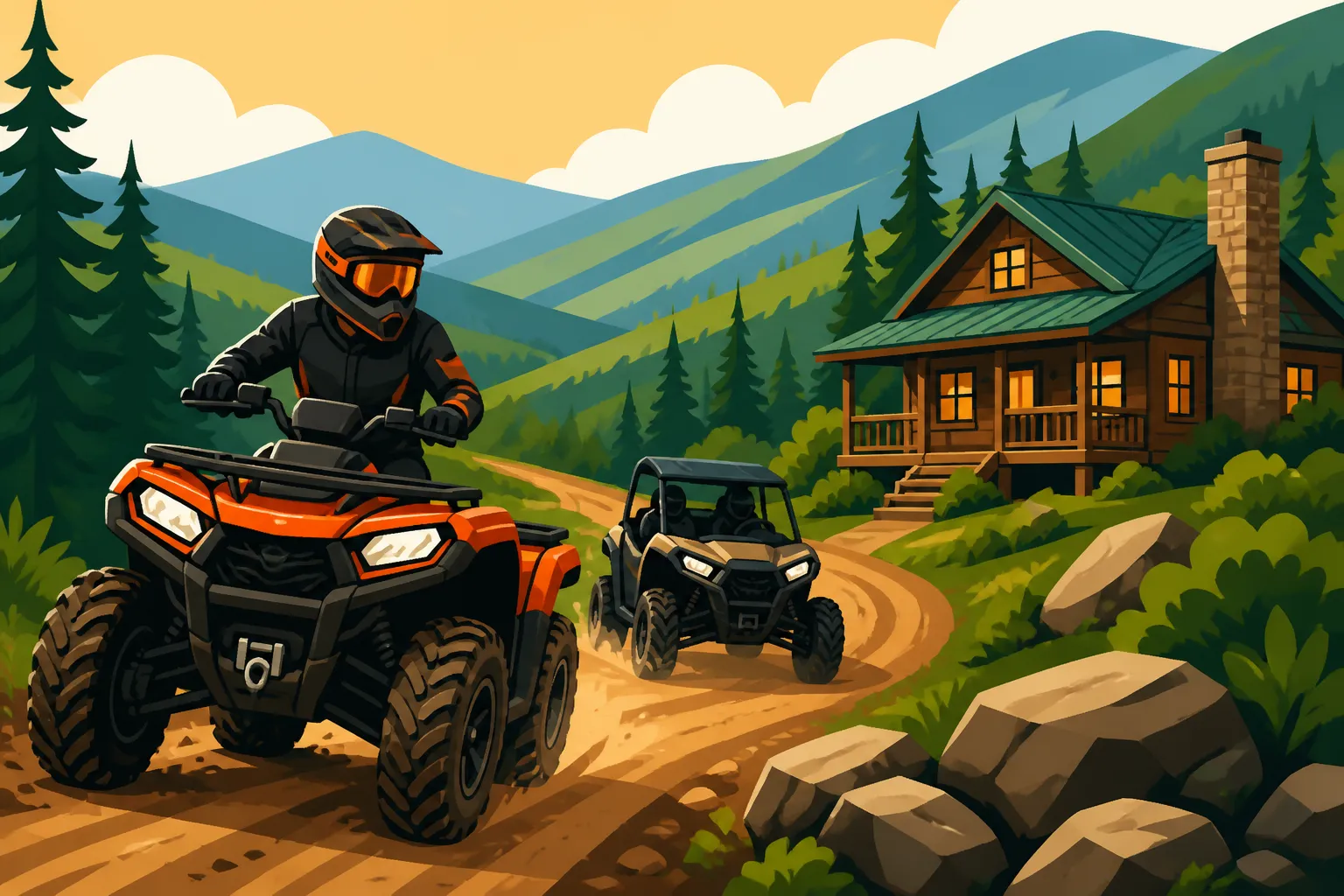
Tennessee Trails With Lodging on the Route
Finding a place to sleep after a long Tennessee trail day can be harder than choosing the trail itself. A cabin may look close on a map but still require a long road transfer, while a campground beside a riding area may have limited facilities or booking rules. This guide explains where to look around Windrock, Brimstone and Royal Blue, and how to plan an overnight ride without assuming lodging includes trail access.
How to Choose Tennessee Trail Lodging That Fits Your Ride
Understand what “on the route” really means
In Tennessee, lodging described as trailside or near a trail system can mean several different things: a cabin inside or beside a riding property, a campground at a trailhead, or a hotel or rental in a nearby town that requires you to trailer your ATV or UTV to the entrance. Those options can all work, but they create very different days.
Before booking, confirm the actual connection between the accommodation and the trails. Ask whether you can ride from your cabin or campsite to an approved trail, whether the route crosses a public road, and whether you need to load the machine for any part of the trip. A map can make two places look close even when a steep ridge, private boundary, closed gate or road rule makes the route impractical.
Also treat a place to stay and permission to ride as separate things unless the operator clearly says otherwise. A lodging reservation does not automatically guarantee a trail permit, access to every nearby property, or permission to ride after closing time. Review [Tennessee Trail Permits Explained] and the specific riding area’s current rules before you arrive.
Compare the main riding areas before you book
These areas are useful starting points for planning a ride-and-stay trip. They are not interchangeable: trail character, access arrangements and nearby services differ, and lodging availability or rules can change.
| Riding area | Nearby base to investigate | A practical fit | What to confirm before booking |
|---|---|---|---|
| Windrock Park | Oliver Springs and the Windrock area | Riders who want to spend several days exploring a large trail system | Whether lodging is on the property, how trail access works, and what permits are separate |
| Brimstone Recreation | Huntsville and the Brimstone area | Groups seeking a base near a managed riding area | Whether the stay is inside the riding area or requires trailering, plus permit and access details |
| Ride Royal Blue | Pioneer and the Royal Blue area | Riders looking for a base near the North Cumberland riding region | Which trails or units are accessible, what the accommodation includes, and where machines may be parked |
For a first-time trip, choose lodging based on the day’s first trail entrance rather than simply the nearest town name. You can compare the broader choices in [Tennessee Pay-to-Ride Parks Compared] and [Camping Near Tennessee ATV Trails], then contact the property and riding-area operator with specific questions.
Windrock Park and Oliver Springs
Where to stay around Windrock
Windrock is a well-known riding destination above Oliver Springs, and the surrounding area gives visitors several kinds of overnight options to investigate, including park-area stays, campgrounds and lodging in or around nearby communities. A stay close to the riding area can make early starts and multi-day plans easier, especially when your group is hauling machines and wants to avoid repeated long drives.
Coal Creek Campground is one name riders may encounter when researching places to stay near Windrock. As with any campground or cabin option, verify its current access arrangement directly: being close to the trail system does not necessarily mean the campground’s entrance connects to an open trail or that your reservation includes riding permission. Ask about machine parking, trailer space, hookup details, quiet hours and any restrictions on washing muddy machines.
If you are comparing cabins and campgrounds, think through your group’s actual routine. A family with children may value a kitchen, separate sleeping space and a predictable place to clean up. A group of friends hauling multiple machines may care more about secure parking, trailer turnaround space and how quickly they can reach the staging area. The right fit is the one that reduces friction after the ride, not just the one with the most appealing photos.
Plan Windrock days around trail access and services
Windrock’s terrain can make a short ride stretch into a full day, particularly when your group stops at overlooks, tackles slower technical sections or has to turn around because of weather. Build in time for getting from lodging to the trail entrance, checking in, displaying permits and fueling before you head out. For more background on the riding area, see [Windrock Park at Oliver Springs, Tennessee] and [73,000 Tennessee Acres at Windrock].
Ask the lodging host what happens if you return late or need help with a machine issue. Do not assume that every access road is open around the clock simply because a trail area has extensive routes. Confirm the relevant gate hours, after-hours procedures and emergency contact information before riding. When you are planning a longer loop, carry a paper or downloaded map and tell someone which general area you expect to ride.
A mapping app such as onX Offroad can be useful when you are comparing a lodging pin, trailhead and route options, especially if mobile coverage is unreliable. Use it as a planning aid, not as permission to cross a boundary or ride an unmarked route. Check the park’s own trail map and notices as well, and make sure any digital map you rely on is available offline before leaving service.
Brimstone and Royal Blue
Staying near Brimstone Recreation in Huntsville
Brimstone Recreation is associated with the Huntsville area in Scott County. When searching for lodging, look closely at whether a property is part of the riding operation, adjacent to it or simply located in the broader area. Those distinctions matter if you want to ride directly from your accommodation rather than trailer to the entrance each morning.
Brimstone-area trips can suit groups that want a base for more than one riding day. Before reserving, ask about the route from the lodging to the riding area, where trailers can be parked, whether guests can leave machines overnight, and whether the stay includes any riding access. Confirm the permit requirements for every rider and vehicle; a room or cabin booking should not be treated as a substitute for a riding permit. For an overview of the destination, see [Brimstone Recreation at Huntsville, Tennessee].
The surrounding roads and terrain can make travel time less obvious than the mileage suggests. If your party includes a new rider, a child or someone who tires easily, plan a shorter first day and identify a simple route back to your base. Trail difficulty can change quickly, and weather may affect how comfortable a route feels. Check [Tennessee Trail Conditions Before You Ride] before setting out, then ask the park whether any closures or notices affect your planned area.
Using Pioneer as a base for Royal Blue
Pioneer is a useful place to search when planning a stay near Ride Royal Blue. Riders may find lodging and resort-style options in the area, but the important question is how the specific property connects to the riding operation. Confirm whether your accommodation offers direct trail access, requires a short drive or requires you to trailer the machine to a designated staging point.
Ride Royal Blue can be a convenient base for a multi-day trip when your group wants to ride from the same general area rather than move lodging every night. Still, do not assume one accommodation’s access arrangement applies to another, or that a permit for one riding area works elsewhere. Review [Ride Royal Blue Resort in Tennessee] and [Ride Royal Blue Permit Requirements] as part of your planning, then verify details with the operator before departure.
An offline map can help you keep the lodging, fuel stops and planned ride area straight, but it cannot replace local access instructions. onX Offroad may help you review mapped routes and orient yourself when cell service drops; compare what you see there with official trail information and posted signs. If the map and the gate signage do not agree, do not ride through a closed gate or onto a route you cannot confirm is authorized.
Plan the Overnight Trip Before You Load
Ask the right questions before reserving
A few direct questions can prevent a frustrating arrival. Contact both the lodging provider and the riding-area operator if they are separate businesses. Ask whether the reservation includes a riding permit, where the machine can be parked, whether trailers fit, and whether the route from the property to the trails is approved for your type of vehicle.
Use this checklist when comparing options:
- Confirm the location. Ask for the exact address and the trail entrance or staging area you will use. Check the drive time with a trailer, not just the straight-line distance.
- Clarify access. Find out whether you can ride from the property, must trailer to the trailhead, or need to use a designated road.
- Check what is included. Ask whether permits, parking, machine storage or other services are part of the reservation or handled separately.
- Match the lodging to your group. Confirm bed arrangements, bathroom access, kitchen facilities, trailer space and any rules for children or pets.
- Ask about changes. Find out how the property handles severe weather, trail closures, late arrival and cancellation or rescheduling.
- Save directions and contact details. Download the route and keep the host’s instructions available offline in case coverage is weak.
For longer visits, it can also help to check the season and likely trail conditions. A rainy stretch can turn a route into a slower, more tiring ride, while a busy weekend may make nearby lodging harder to find. Read [Tennessee Trail Seasons and Closures] and [Tennessee Trail Closures to Check First] before locking in a detailed itinerary.
Build a realistic ride-and-stay schedule
Plan your first day conservatively. Arriving after a long drive, unloading machines, checking in and sorting out permits takes energy. A short familiarization ride gives everyone a chance to learn the trail markings, test equipment and figure out how long it takes to get back to the lodging. Save a longer loop for a day when you can start early and have a clear return plan.
Keep fuel, food and recovery needs in mind. Ask where the nearest reliable fuel stop is and whether it is accessible with a trailer. Pack water, basic tools and suitable layers, and avoid assuming that a phone will work throughout a remote riding area. If your group depends on digital navigation, download maps before leaving town and bring a backup. onX Offroad can be one part of that navigation setup, alongside the riding area’s own map and any posted trail notices.
Finally, make your lodging choice support the ride you actually want. A cabin with direct access may be ideal for a group that wants to ride multiple days without moving vehicles. A campground or rental in town may be better if you want restaurants, supplies or a quieter evening after a demanding route. Either way, confirm the details, secure the correct permits and follow the trail operator’s access rules. That small amount of planning can turn a tiring logistics problem into a smoother Tennessee riding weekend.
Disclaimer
This article is for general informational purposes only and does not constitute professional advice. Laws, prices and regulations vary by location and change over time. Consult a qualified professional for guidance on your specific situation.