Tennessee Rules for a Machine Over the Width Limit
A machine that fits your driveway may still be too wide for a Tennessee trail system. The key is that width limits can depend on the land you plan to ride, not just your ATV or UTV’s permit or vehicle category. Here’s how to check the rule, measure your machine, and avoid hauling to a trail where it cannot ride.
Which Tennessee width limit applies?
There is no single width limit that automatically governs every ATV and UTV trail in Tennessee. The land manager sets access rules for the property or trail system. A state permit, a private park permit, and permission to ride a particular route are separate matters.
On the North Cumberland OHV area, machines are subject to a 65-inch width limit. That figure is not a blanket rule for every trail in the state. A private riding park may set its own machine requirements, and rules for public roads are a different issue from rules for off-highway trails.
| Where you plan to ride | What to check |
|---|---|
| North Cumberland OHV area | Confirm the current 65-inch limit and any other machine requirements |
| A private off-road park | Check that park’s current width and vehicle rules |
| A wildlife management area or public trail | Confirm which authority manages the route and review its rules |
| A public road | Check the applicable road-use law; trail access rules do not grant road access |
Before you load, check the managing agency’s current rules and any notices posted for the riding area. A limit can be affected by temporary closures or site-specific restrictions. Tennessee Rules for Riding a WMA explains why access rules for wildlife management areas should be checked separately from private-park requirements. For North Cumberland, also confirm which unit you plan to enter and whether the route is open. Does One Permit Cover Every North Cumberland Unit? is useful if your trip crosses between units.
A permit does not necessarily make an otherwise ineligible machine acceptable. It generally addresses permission to use a particular area under its rules; it does not waive the vehicle’s width limit. The same principle applies to a park pass or proof that you paid for access. Check Tennessee Trail Permits Explained for the broader distinction between permits and riding access.
How to measure your ATV or UTV
Start with the machine’s specifications, but do not rely on a brochure figure without checking what it describes. A manufacturer may list a body dimension, wheel-to-wheel dimension, or width with a particular tire and wheel package. Your actual machine may differ because of accessories, replacement tires, wheel spacers, or other modifications.
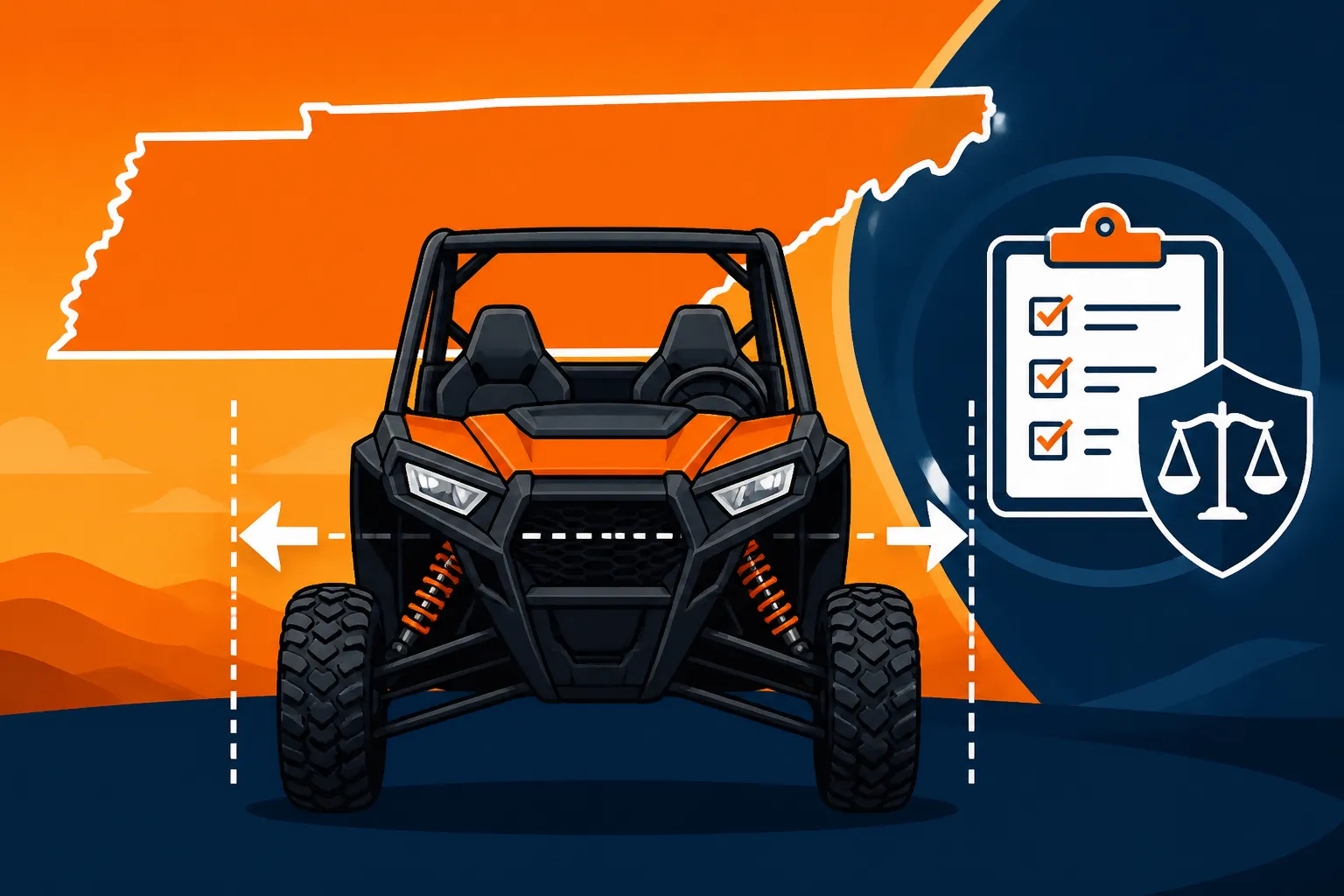
Measure the machine in its current riding configuration. Use a tape measure across the widest points and record the result. If the authority’s rules do not explain exactly how width is measured, ask the land manager whether the measurement includes tires, wheels, mirrors, or installed accessories. Do not assume that a measurement taken only across the body is the one officials will use.
A simple process helps avoid guesswork:
- Find the manufacturer’s stated width and note the configuration it applies to.
- Measure the actual machine at its widest points, including installed equipment that may affect the measurement.
- Compare the result with the current limit for the specific riding area.
- If you are close to the limit, contact the managing agency before traveling and ask how it measures width.
- Keep the answer or a copy of the relevant rule with your trip information.
A basic tape measure is usually enough for a preliminary check; one can be picked up locally or through Amazon. The important part is measuring the machine you will actually take, rather than relying on a listing for a different trim or tire setup.
If your measurement is close to the maximum, treat the uncertainty seriously. Measurement methods may not be obvious from a brief rule summary, and a few inches can determine whether a machine is allowed. Ask the agency for clarification rather than treating an estimated measurement as approval.
What to do if your machine is over the limit
If the machine exceeds the applicable limit, the safest plan is to choose a riding area whose rules allow it or use a narrower machine. Do not assume a ranger or park operator will make an exception because you have a permit, traveled a long distance, or arrived with a group.
Also avoid relying on a quick modification to make the machine appear narrower. Changing wheels or tires can affect handling, stability, clearance, and safe operation. Any modification should be suitable for the machine and should not create a new safety or compliance problem. Confirm the result with the land manager before you haul it.
If the width is uncertain rather than clearly over the limit, get confirmation before setting out. When you contact the park or agency, be ready to provide the make, model, year, tire setup, and measured width. A photograph showing how you measured can help explain the question, but it is not a substitute for the authority’s decision.
Keep in mind that different limits serve different purposes. The 80-inch figure associated with some Tennessee vehicle-category or road-use rules is not permission to ride an 80-inch-wide machine on every off-highway trail. Tennessee Rules for a Machine Over 80 Inches covers that separate issue. A machine can fit within one legal category and still be too wide for a particular trail system.
Likewise, a machine that is allowed on one property may be barred on another. Before booking a trip, check the vehicle requirements for each destination rather than assuming rules carry over. Why Tennessee Has No Statewide Trail Sticker gives context on why one permit or credential does not automatically provide access across unrelated riding areas.
Check width before you plan around a permit
Width should be part of trip planning, not something to check at the trail gate. Confirm the machine limit, permit requirements, operating dates, closures, and route access for the destination. If you plan to ride more than one property, verify each one separately.
For North Cumberland, check the current rules for the relevant unit and use official notices for changes. For a private park, read its own machine requirements and contact staff if your vehicle is near the stated maximum. Do not rely only on an old social media post, a retailer’s description, or what another rider says their machine was allowed to do.
A quick pre-trip checklist can prevent an expensive detour:
- Identify the exact riding area and the authority that manages it.
- Confirm the current width limit and how the authority measures it.
- Measure your machine as equipped for the ride.
- Check whether the required permit applies to that specific area.
- Review current trail closures and any additional vehicle restrictions.
- Ask for written clarification if your machine is close to the limit.
Permit reciprocity is not a substitute for checking vehicle eligibility. A permit for one system may not work at another, and a permit that is valid for a destination does not necessarily override its machine rules. Why a Tennessee Park Permit Does Not Travel explains why access credentials are not universal. For a wider overview of closures and pre-ride checks, see Tennessee Trail Closures to Check First.
If you are buying a machine mainly for Tennessee trail riding, verify the width of the exact model and trim before you commit. A listing may describe a narrower base model than the one fitted with wider tires or accessories. Ask the seller for the manufacturer specifications and, where possible, measure the machine itself. That small check can save you from discovering after purchase that your preferred riding area will not admit it.
Disclaimer
This article is for general informational purposes only and does not constitute professional advice. Laws, prices and regulations vary by location and change over time. Consult a qualified professional for guidance on your specific situation.