Does a Tennessee UTV Need a Plate for Roads?
One of the most common head-scratchers for UTV owners in Tennessee is figuring out what's required to legally take their machine from the trail to the asphalt. It's not always straightforward, and the rules often seem to shift like the Cumberland mud after a good rain. Many folks just want to know if they need a license plate, like a regular car, or if there's some other system in place. This guide is here to clear up that confusion, explaining Tennessee's specific requirements for UTVs on public roads and what you need to do to stay on the right side of the law.
Understanding Tennessee's Vehicle Classifications for Road Use
The biggest hurdle in answering "Does a Tennessee UTV need a plate for roads?" lies in understanding how Tennessee actually classifies these machines. It's not a simple yes or no, because a UTV isn't just a UTV in the eyes of the law; its legal status for road use depends on its design, speed capabilities, and crucially, its equipped safety features. Most UTVs are initially designed as off-highway vehicles, and that's a world away from something street legal.
The Standard Off-Highway Vehicle OHV Classification
For the vast majority of ATVs and UTVs rolling off the dealership floor, Tennessee classifies them as off-highway vehicles (OHVs). These fall under categories like [Tennessee's Class I OHV Definition] or [Tennessee's Class II OHV Definition], depending on their weight, width, and passenger capacity. When you purchase one of these machines, you'll go to your local [Titling at a Tennessee County Clerk] to get a title, and with that title, you'll receive a [Tennessee's TDR Sticker Explained]. This sticker, which often goes on the machine itself, serves as proof that your OHV has been properly titled in the state.
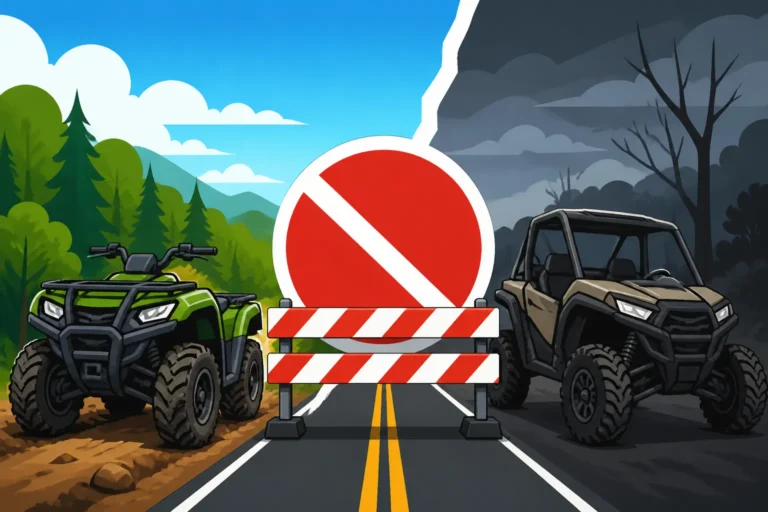
However, and this is a critical distinction, this TDR sticker is not a license plate for road use. It simply confirms ownership and titling for off-road purposes. Tennessee explicitly does not register typical off-highway vehicles for general street use, which is why you won't get a traditional vehicle registration or plate for a standard OHV. [Why Tennessee Does Not Register Off-Road Machines] for highway travel is rooted in the fact that these machines are not built to meet the same safety standards as cars or trucks, and their primary purpose is recreational or utility use off paved surfaces. Attempting to use a standard OHV with just a TDR sticker on a public road, outside of specific crossing rules or designated areas, can lead to fines and legal trouble.
Low Speed Vehicles LSVs and Medium Speed Vehicles MSVs
Now, this is where things get interesting and where a UTV can potentially become road-legal, and thus require a plate. Tennessee law provides for specific categories of vehicles that are permitted on certain public roads: Low Speed Vehicles (LSVs) and Medium Speed Vehicles (MSVs). These are distinctly different from standard OHVs. An LSV, for instance, is defined as a four-wheeled vehicle with a top speed of no more than 25 miles per hour. These are often what people refer to as "golf carts," but modified UTVs can sometimes fit this definition if they meet all the other safety requirements and speed limitations. [Tennessee's Low Speed Vehicle Category] details these specifics, often including criteria for lights, seatbelts, and a windshield.
Similarly, [Tennessee's Medium Speed Vehicle Category] covers vehicles that can travel between 25 and 35 miles per hour. This category is where many modified UTVs find their home when owners seek to make them street-legal. To qualify as either an LSV or an MSV, your UTV must be equipped with a whole host of safety features that most machines don't have stock. This includes headlamps, tail lamps, stop lamps, turn signals, mirrors (interior and exterior), a parking brake, and DOT-approved safety belts for all occupants. Often, aftermarket parts from reputable companies like SuperATV are essential for bringing a UTV up to these rigorous standards. Without these specific modifications and subsequent certification, your UTV simply won't qualify for these road-legal classifications, and therefore won't be eligible for a standard license plate.
The Road to Getting a Plate for Your UTV in Tennessee
If you're serious about taking your UTV on Tennessee's public roads, the path isn't just about wishing it were so; it involves significant modifications, a formal inspection, and proper registration. It's a process designed to ensure that these vehicles meet a minimum standard of safety before sharing the road with other traffic. Many UTV enthusiasts embrace this challenge, recognizing the convenience and expanded riding opportunities that come with a street-legal machine.
Essential Equipment and Modifications
The journey to a road-legal UTV, and subsequently obtaining a plate, begins with outfitting your machine with the necessary safety equipment. This isn't just a suggestion; it's a legal mandate. You'll need proper headlights, tail lights, and stop lights that are clearly visible. Crucially, your UTV must have functional turn signals, both front and rear, so other drivers know your intentions. Mirrors are also essential—typically one interior rearview mirror and at least one exterior rearview mirror on the driver's side are required to provide adequate visibility. And for occupant safety, DOT-approved seatbelts must be installed for every designated seating position. Without these, your machine simply won't pass muster as an LSV or MSV.
Beyond the basic lighting and mirrors, there are other often-overlooked requirements. A windshield made of safety glass is typically mandatory for an MSV, providing protection from debris. While some UTVs come with a factory windshield, ensuring it meets safety glass standards is key. Your tires also need to be Department of Transportation (DOT) approved, meaning they're rated for road use, not just off-road terrain. Many stock UTV tires are not DOT-approved, so this often means an upgrade. Furthermore, having a visible Vehicle Identification Number (VIN) is paramount for titling and registration. Companies like SuperATV specialize in providing comprehensive kits and individual components – from turn signal kits to DOT-approved windshields and mirrors – that help UTV owners meet these stringent requirements, transforming an off-road beast into a more versatile, road-ready machine.
Inspection and Titling Process
Once you've poured your time and resources into modifying your UTV to meet the LSV or MSV equipment standards, the next step is formal validation. This typically involves an inspection by a qualified authority, often a local law enforcement agency or a designated vehicle inspection station. The purpose of this inspection is to verify that all the required safety features are correctly installed and fully functional, and that your UTV's top speed aligns with the LSV (under 25 mph) or MSV (25-35 mph) definitions. This isn't just a quick glance; they'll check everything from the brake lights to the horn, ensuring your machine is safe for public road interaction. Without a successful inspection, you can't move forward to the next stage.
After your UTV passes the inspection and is certified to meet the LSV or MSV criteria, you can then proceed to your local county clerk's office. This is where you will apply for a new title and registration, specifically as an LSV or MSV, not as a standard OHV. Unlike the [Tennessee's TDR Sticker Explained] that off-road machines receive, this process will result in the issuance of a traditional license plate for your UTV. This plate is your official authorization to operate the vehicle on approved public roads, much like a car or truck. The process for [Titling a Side-by-Side in Tennessee] as an LSV or MSV will involve submitting all your inspection documentation along with the standard titling paperwork, and paying the applicable fees. This plate is the definitive answer to whether your UTV needs one for roads – if it's classified as an LSV or MSV, then yes, it absolutely does.
Navigating Road Use with a Plated UTV
Congratulations, you've gone through the effort of modifying your UTV and successfully titled it as an LSV or MSV, complete with a license plate! While this opens up new avenues for riding, it's crucial to understand that having a plate doesn't grant you carte blanche to ride anywhere. Tennessee, like most states, has specific rules governing where these special vehicles can operate, as well as requirements for the driver and the machine itself while on public roads. Disregarding these regulations can quickly lead to a citation, undermining all your hard work.
Where Can You Ride?
The primary limitation for plated LSVs and MSVs revolves around speed limits. Generally, Low Speed Vehicles (LSVs) are restricted to roads with a posted speed limit of 25 mph or less, while Medium Speed Vehicles (MSVs) can typically operate on roads with a speed limit of 35 mph or less. This means you can't just take your newly plated UTV onto any four-lane highway or major state route. You'll primarily be sticking to local streets, residential areas, and county roads that fall within these speed parameters. It's vital to pay close attention to the posted speed limits wherever you intend to ride. While [Tennessee's 45 mph Road Rule] exists for certain OHVs in specific counties under an adventure tourism district law, this doesn't automatically apply to all LSVs/MSVs. Always check the specific rules for your vehicle classification.
Furthermore, even with a plate, certain roads remain off-limits. Interstates, multi-lane state highways, and other high-speed thoroughfares are almost universally prohibited for LSVs and MSVs. While there might be specific provisions for [Tennessee Rules for Crossing a Highway] at a ninety-degree angle, prolonged travel on these roads is generally not allowed. The designation of [Tennessee Counties That Allow UTVs on Roads] specifically refers to the adventure tourism district law for unmodified OHVs under strict conditions, which is a different regulatory framework than the LSV/MSV classification. Your best bet is to understand the specific [Tennessee UTV Road Requirements] for your LSV/MSV and to also be aware of any local ordinances. Some municipalities or counties might have additional restrictions or designated routes for these types of vehicles, so it's always wise to check with local authorities.
Driver Requirements and Other Rules
Beyond the "where" of riding, there's also the "who" and "how." Operating a plated UTV on public roads in Tennessee means you are subject to many of the same rules as any other motor vehicle driver. First and foremost, a valid driver's license is required. You can't just be any age or have an off-road permit; you need a proper state-issued driver's license to be behind the wheel. For more details on this, look into [Tennessee Driver's License Rules for UTVs]. This is a significant difference from off-road riding, where age and license requirements can be less stringent depending on the property.
Secondly, just like any other road-legal vehicle, your plated UTV will need insurance. [Tennessee UTV Insurance Requirement] mandates that you carry liability insurance, at a minimum, to cover any potential damages or injuries you might cause in an accident. Always carry proof of insurance with you when operating on public roads. While helmet laws for OHVs can be complex, especially off-road, it's generally a good practice for all occupants, and in some cases, [Tennessee Helmet Law for ATV Riders] may still apply, particularly for younger passengers, even on roads. Finally, common road rules like obeying traffic signals, using turn signals, and not exceeding posted speed limits are all in effect. [Tennessee Rules for Riding After Dark] will require your UTV's headlights and tail lights to be fully functional and engaged. Being aware of these additional responsibilities ensures a safe and legal road experience with your plated UTV.
Here's a quick comparison of Tennessee's OHV classifications versus road-legal categories:
| Feature | Standard OHV (Class I/II) | Low Speed Vehicle (LSV) | Medium Speed Vehicle (MSV) |
|---|---|---|---|
| Plate Required? | No (TDR Sticker for title proof only) | Yes (Standard license plate) | Yes (Standard license plate) |
| Max Speed | No state-mandated limit for vehicle type | Generally 25 mph | Generally 25-35 mph |
| Road Use | Limited to specific crossings, designated areas, or private land | Roads posted 25 mph or less | Roads posted 35 mph or less |
| Required Equipment | Basic safety (e.g., brakes, lights for night) | Head/Tail/Stop Lights, Turn Signals, Mirrors, Seatbelts, Windshield | Head/Tail/Stop Lights, Turn Signals, Mirrors, Seatbelts, Windshield |
| VIN | Yes, for titling purposes | Yes, for titling and registration | Yes, for titling and registration |
| Driver's License | Not always required off-road | Yes, valid driver's license | Yes, valid driver's license |
| Insurance | Often recommended, but not always required for off-road use | Yes, liability insurance required | Yes, liability insurance required |
Disclaimer
This article is for general informational purposes only and does not constitute professional advice. Laws, prices and regulations vary by location and change over time. Consult a qualified professional for guidance on your specific situation.