Meeting a Coal Truck at Royal Blue
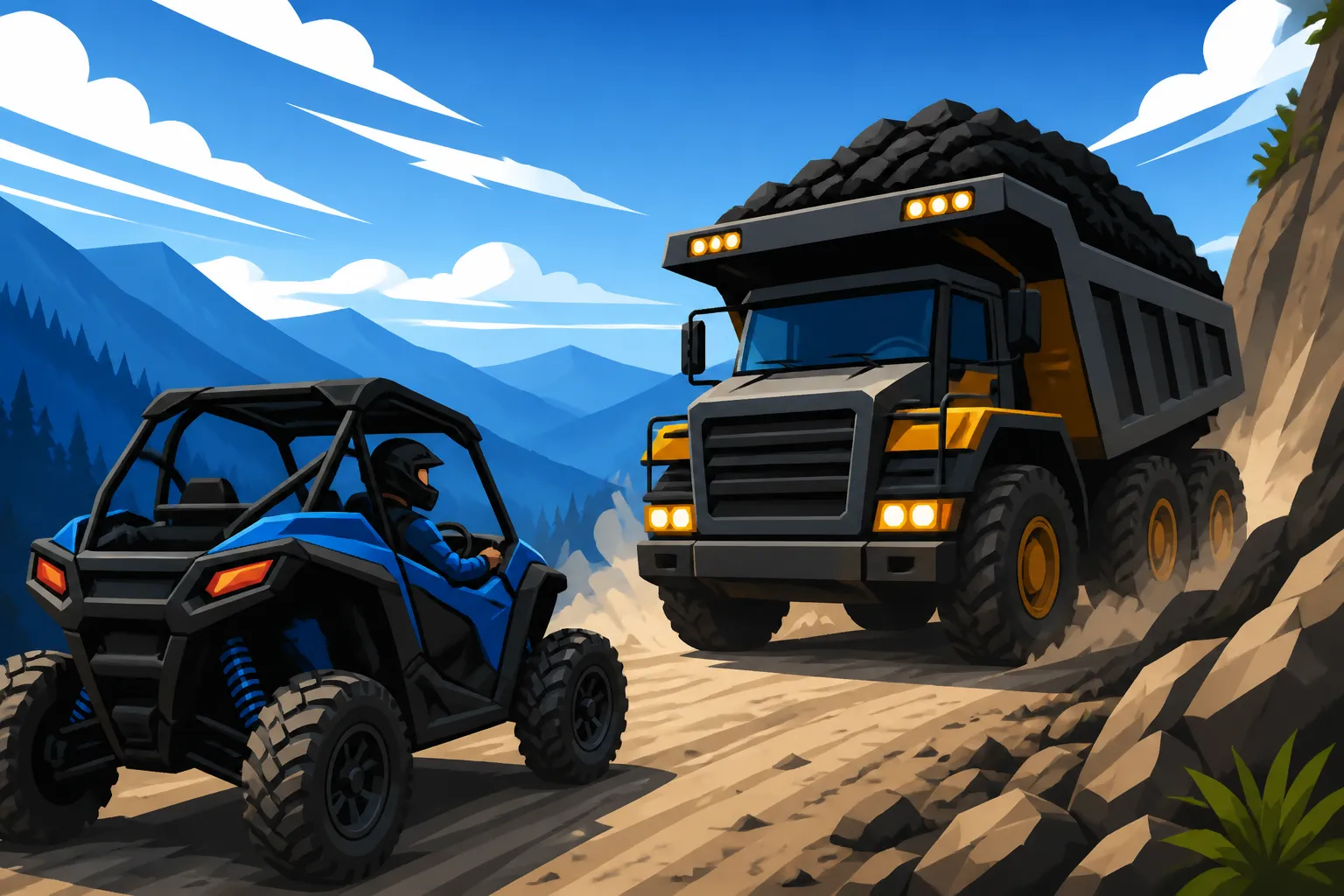
A coal truck can appear suddenly on a narrow ridge road at Royal Blue, leaving little room for an ATV or UTV to maneuver. The safest response is to slow down early, stay predictable, and make space without entering an unsafe shoulder or leaving a marked route. This guide explains how to prepare for heavy-vehicle traffic and handle a close encounter calmly.
Why coal trucks and trail riders may meet near Royal Blue
Treat every heavy vehicle as a serious hazard
Royal Blue is part of the North Cumberland riding area, where trail routes can pass through working landscapes and near roads used by large vehicles. A coal truck is wider, heavier, and slower to stop than your ATV or UTV. The driver may also have limited visibility close to the cab, especially on a bend, over a crest, or where dust obscures the road.
The truck’s size matters even when it is moving slowly. A trailer or load may swing wide around a corner, and loose material or dust can affect visibility behind it. A rider who is focused on picking a line over rocks may not hear the truck until it is close. On a group ride, the first person to see it should communicate the warning clearly and early.
Think of the encounter as a space-and-visibility problem, not a contest over who gets through first. Your priorities are to be seen, avoid sudden movements, and leave the truck enough room to pass or turn. The same caution applies to service vehicles and other large equipment, not just coal trucks.
Know which routes you are allowed to use
A trail map can help you understand the area, but a line shown on a map does not automatically mean every nearby road is open to recreational riding. Stay on routes that are marked and permitted for your use, and follow gates, signs, and posted instructions. Do not assume an industrial access road is a public trail because it appears to connect with one.
Before a ride, review [Tennessee Rules for Riding a WMA] and Riding the Sundquist Unit for useful context about riding in this broader area. Pay attention to the specific unit and route you plan to visit. Conditions and access can vary, and a route that appears passable may be closed or restricted.
If a road is clearly being used for active work, or you see signs indicating restricted access, do not ride onto it to get a closer look or find a shortcut. Turn around where it is safe and use an authorized route instead. When you are unsure whether a route is open to riders, stop somewhere safe and check the applicable park or land-manager information before continuing.
What to do when a coal truck approaches
Slow down early and make your intentions obvious
As soon as you see a large vehicle, reduce speed smoothly and create distance. Avoid a sudden brake check, a sharp turn, or an attempt to squeeze past before the truck reaches you. If you are riding in a group, signal the riders behind you to slow down and keep the group together. A simple, consistent hand signal or a clear verbal warning at a safe stop can prevent a chain reaction.
Look ahead for a place where your machine can be completely clear of the truck’s path. On a narrow road, that may mean waiting at a wider turnout rather than trying to pull onto a soft edge. Choose stable ground that will hold the machine without sliding, tipping, or dropping a wheel into a ditch. Stay out of the truck’s turning path and do not stop where the driver would need to cross the center of the road to get around you.
If you have enough room to pull fully aside, stop and let the truck pass. Keep your wheels and body clear of the traveled surface, and give the vehicle extra space where the road is uneven or the shoulder is loose. Do not wave the truck through unless you can see the full situation and are certain the driver has room. The truck operator may have a better view of the road ahead than you do.
If there is no safe place to pull off
Sometimes the shoulder is too narrow, sloped, soft, or blocked by rocks. Do not force your ATV or UTV into an unsafe spot simply to get out of the way. Instead, remain predictable and give yourself as much room as the terrain allows. If you are stopped, keep the machine stable and avoid moving suddenly while the truck is passing.
If you can safely reverse to a wider area, do so slowly and only when you have a clear view of the route behind you. Ask a riding partner to guide you if they can stand well away from the vehicle’s path and remain visible to you. Never back blindly around a bend or toward a drop-off. If moving backward would create a greater risk, stay put and wait for the truck driver to assess the space.
Do not attempt to pass a truck on a blind curve or crest, and do not follow close behind it through dust. The truck can hide hazards ahead, and you may not see another vehicle, a stopped machine, or a change in road surface until you are too close to react. A pause is inconvenient; a rushed maneuver can put the entire group in danger.
| Situation | Safer response | Avoid |
|---|---|---|
| You see a truck approaching on a wide, visible road | Slow down, move fully clear if the shoulder is stable, and wait for it to pass | Accelerating to beat it through a narrow section |
| The road narrows and the shoulder is poor | Stop predictably and use the safest available space; let the driver assess the clearance | Dropping a wheel into a ditch or onto a steep, loose edge |
| You meet a truck near a blind bend | Wait in a visible, safe spot and do not enter the blind section | Trying to pass or reverse without seeing the route |
| Dust blocks your view after a truck passes | Stay stopped until you can see clearly again | Following closely through the dust cloud |
| The route appears to be an active work road | Turn back unless riding access is clearly allowed | Treating a map line or tire tracks as permission |
Prepare before riding in the Royal Blue area
Plan the route, group, and turnaround points
A little planning makes it easier to respond calmly when conditions change. Review your route before unloading, identify wide places where the group can stop, and agree on what riders should do if the group encounters a truck. The lead rider can signal the group to slow down, while the last rider can make sure nobody is left in the road. Keep enough space between machines that one rider’s sudden stop does not cause a collision.
Use a reliable map to understand the route, but cross-check it with current trail notices and posted signs. Tools such as onX Offroad can help riders review mapped routes and orient themselves in the area. They are useful planning aids, not permission to ride a particular road or a guarantee that a route is open. Keep Tennessee Trail Maps Worth Carrying and Tennessee Trail Conditions Before You Ride in mind when preparing.
Choose a turnaround point before you reach a narrow or unfamiliar section. On a ride near Pioneer, for example, a group might agree to regroup at a broad, visible spot rather than stopping at a blind corner. Avoid splitting up to scout around a gate or investigate a work route. If the lead rider turns around, the rest of the group should follow the agreed signal and regroup safely.
Prepare for limited visibility and communication
Dust, fog, changing light, and tree cover can make it harder to see or hear a truck. A clean visor or goggles, functioning lights, and a sensible riding speed help, but they do not eliminate the risk. Increase following distance when visibility is poor, and avoid riding so close to another machine that dust from its tires blocks your view.
Cell service may be unreliable in parts of the North Cumberland area. Before you leave, make sure everyone knows the route, the planned turnaround time, and what to do if the group gets separated. Cell Dead Zones Across the North Cumberland WMA is a useful reminder not to rely on a phone as your only way to communicate. Keep your phone charged and protected, but agree on simple hand signals as well.
A navigation app such as onX Offroad may help you keep track of your position when reception is limited, especially if you have downloaded the information you need ahead of time. Still, screens can distract a rider at the exact moment attention should be on the road. Pull over in a safe place before checking a device, and never stop in a blind spot or active vehicle lane just to inspect a map.
Common mistakes to avoid around heavy traffic
Do not assume the truck can see or hear you
A rider may feel visible because the machine is colorful or noisy, but a large vehicle has substantial blind areas. Do not sit beside the cab, linger close to the rear of the truck, or ride alongside it while it is moving. If the driver begins a turn, the truck may need more space than its apparent position suggests. Give it room and remain outside its turning path.
Avoid relying on eye contact as proof that the driver has seen you. Glass, distance, dust, and cab height can make it difficult to judge where the driver is looking. The safest choice is to stop in a place where you are clearly visible, stay out of the truck’s path, and let it pass without trying to communicate through a risky maneuver.
Never tailgate a truck to stay out of dust or use it as a guide through an unfamiliar area. The truck may turn, stop, or enter a work site without warning. If you cannot see the route ahead, slow down or wait until the dust clears rather than following its taillights.
Do not let the group create a second hazard
A truck encounter can make riders focus on the vehicle and forget the people behind them. A rider who stops suddenly in a narrow section may leave no room for the rest of the group. Keep enough distance to react, and pass warnings back through the group as soon as it is safe. If there is a good place to stop, gather everyone there rather than letting riders bunch up around the truck.
Do not have one person stand in the road to direct traffic unless there is a clear, safe reason and they can remain well out of the vehicle’s path. A rider on foot may be hard for a truck operator to see, especially near the front or rear corners. If a partner is guiding a slow reverse, they should stay visible to the driver of the ATV or UTV and stand away from the truck’s route.
After the truck passes, wait until dust clears and the road is visibly open before moving again. Check that all riders are ready, then continue at a controlled pace. If the encounter happened on a route that appears restricted or connected to active work, do not continue farther to see where it leads. Turn back and choose a route with clearly permitted access. For more on this setting, see Meeting a Coal Truck on a Ridge Road and [Tennessee Rules for Riding a Closed Trail].
Disclaimer
This article is for general informational purposes only and does not constitute professional advice. Laws, prices and regulations vary by location and change over time. Consult a qualified professional for guidance on your specific situation.