Forty Cabins at a Tennessee Trail Resort
Planning a Tennessee ATV or UTV weekend is easier when your group can sleep close to the trails, but “forty cabins” does not mean forty identical stays or guaranteed trail access. This guide explains how to compare cabin layouts, confirm what riding access really includes, plan for different machines and riders, and avoid the common booking surprises that can turn a trail weekend into a logistics headache.
What a forty-cabin trail resort can mean
Cabin count does not tell you what is available
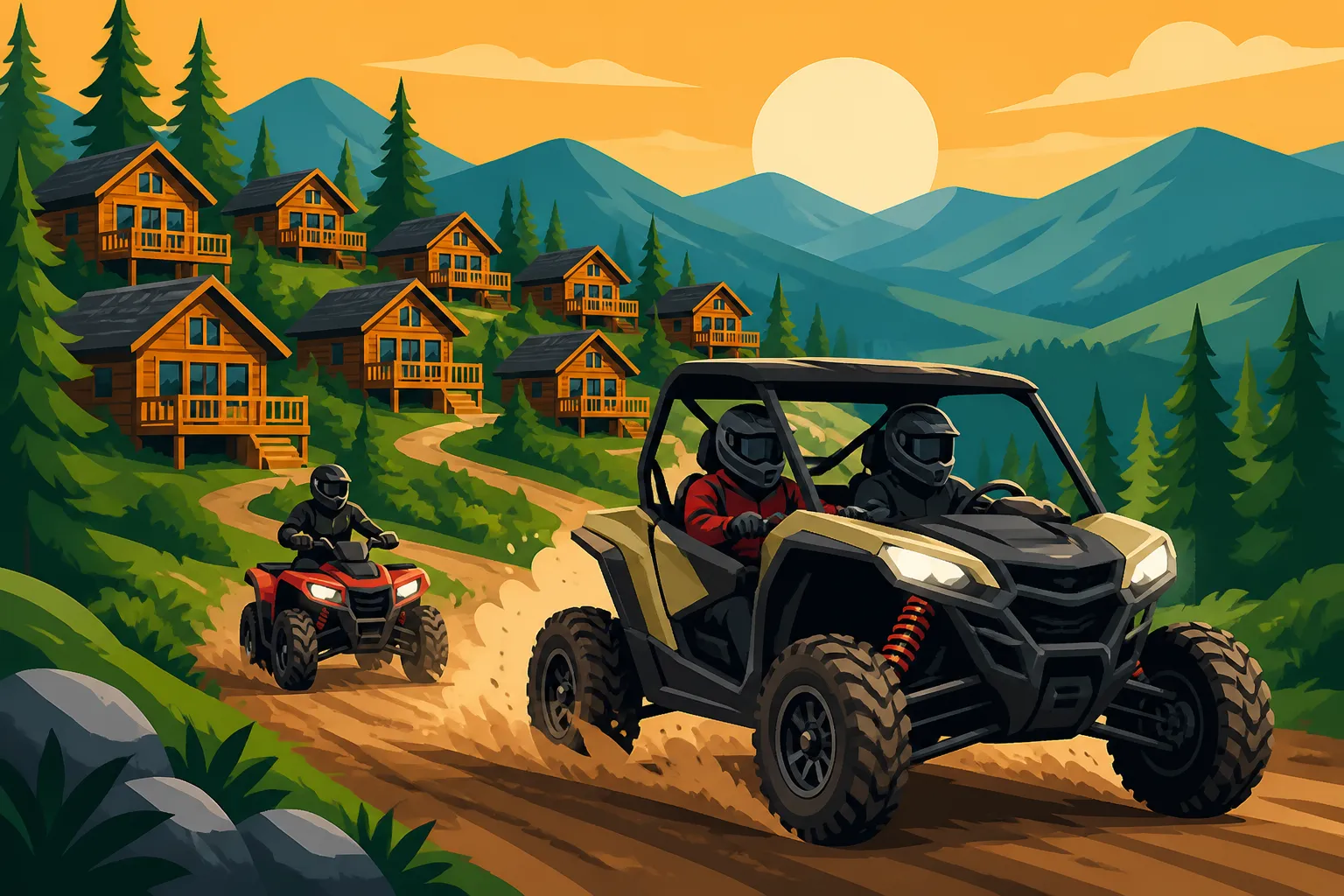
A resort with a large cabin inventory can sound like an easy solution for a family trip or group ride. In practice, the advertised count describes the property’s overall lodging capacity, not necessarily the number of cabins open on your dates. Some cabins may be reserved, undergoing maintenance, or set aside for a particular kind of booking. A holiday weekend, fall foliage period, or organized riding event can make availability especially tight.
The cabins may also differ in size, layout, location, and included amenities. One might work well for a couple bringing a small ATV; another may be better for a family that needs separate sleeping areas and room to dry riding gear. Before booking, ask for the exact cabin type, how many people it sleeps comfortably, and whether the listed capacity assumes shared beds or sofa beds.
It helps to treat “forty cabins” as a starting point for questions rather than a promise about your particular stay. Ask whether cabins are grouped together or spread across the property, whether parking is beside each cabin, and how far the lodging is from the trail entrance. A quick conversation can prevent the unpleasant surprise of arriving with two trailers and discovering that your cabin’s parking area is narrow or a long walk from the group’s other accommodations.
Trail access can mean different things
“Near the trails” and “direct trail access” are not always the same arrangement. A cabin may be located on a trail resort property but require you to trailer your machines to a separate staging area. Another property may let guests ride from designated lodging areas to approved routes, subject to the resort’s rules and the trail system’s boundaries. Confirm the details instead of relying on a map pin or a broad description.
Ask the property to explain where riding is permitted, whether there is a marked route between cabins and trails, and whether you may ride back to your lodging at the end of the day. Also ask whether any access road crosses a public road, private land, or a section that is closed to OHVs. Permission to use resort property does not automatically authorize riding on adjoining land or public roads.
This distinction matters at places such as Pioneer, Huntsville, and Oliver Springs, where trail systems, private property, and public roads may meet in a relatively small area. If you are comparing lodging options, [Tennessee Lodging With Trail Access] can help you think through what “access” should mean for your trip. For a broader look at places to stay while riding, see [Camping Near Tennessee ATV Trails].
Choose a cabin that fits the ride you are planning
Match the layout to your group
A cabin that sleeps a certain number of people may not feel comfortable for that many riders after a muddy day. Think about how your group actually uses the space: who needs a private room, who is comfortable sharing beds, and whether children need a quieter place to rest while adults are still sorting equipment. If you are traveling with another family, ask whether neighboring cabins can be requested, but do not assume the resort can guarantee adjacent units.
Consider the practical parts of the floor plan, too. A covered porch or entry area can be useful for boots and helmets, while a kitchen or refrigerator may make it easier to handle breakfasts and packed lunches. If the cabin does not have laundry facilities, ask whether the property offers shared laundry or whether you should bring extra riding clothes. Wet gear can become a real nuisance when everyone has nowhere to hang it.
For larger groups, it may be easier to book multiple cabins than to squeeze everyone into one unit. Separate cabins can give early risers and late sleepers a little breathing room, but they also create coordination questions. Find out how far apart the units are and whether the group can park machines and trailers together. If one rider is bringing a youth machine or a second vehicle, plan for that space before you arrive.
Check parking and machine logistics
A cabin booking is not automatically a trailer reservation. Confirm whether the property has room for your tow vehicle, trailer, and ATV or UTV, and ask about any restrictions on parking near the cabin. A long UTV trailer can be difficult to maneuver in a tight driveway, especially after dark or during wet weather. If you are hauling more than one machine, describe the setup clearly when you call.
Ask where trailers can be left while the group is riding. Some properties may have a designated staging or overflow area; others may expect guests to keep trailers at their lodging. Clarify whether the parking surface is paved, gravel, or grass, and whether the route to it is suitable for a loaded trailer. A narrow, steep, or muddy approach can turn arrival into a stressful exercise in reversing and repositioning.
Also consider security and weather. Find out whether there is a secure place to store helmets, tools, and riding gear, and whether machines can be covered or parked under a shelter. If you have a machine with a low windshield, roof accessories, or unusually wide tires, check the route into the property and any parking structures. A quick measurement can save a costly scrape or a late-night search for a different place to park.
| What to confirm | Why it matters | Useful question to ask |
|---|---|---|
| Cabin layout and sleeping arrangements | A listed capacity may not feel comfortable for every group | What beds are in this exact cabin? |
| Distance to trail access | Nearby lodging may still require trailering | Can we ride from the cabin to an authorized trail entrance? |
| Trailer parking | A cabin driveway may not fit a tow vehicle and trailer | Where can we park our trailer during the stay? |
| Machine rules | Property rules may differ from trail rules | Where may we unload, warm up, and move our machines? |
| Gear storage and drying | Muddy clothing can quickly crowd a small cabin | Is there a covered area or drying space? |
| Check-in and arrival instructions | Late arrival can complicate unloading | Where do we check in if we arrive after the office closes? |
Plan around the trail system, not just the cabin
Identify where you will ride each day
A cabin at a trail resort is most useful when its location matches the riding you want to do. Tennessee has distinct riding areas, and a resort’s proximity to one park or trail network does not mean it gives you access to every nearby route. Decide whether your group is aiming for a single destination or wants to travel between multiple riding areas. Then confirm which trail entrance, staging area, or unit you will use each day.
For a stay near Pioneer, for example, ask how your lodging connects with the Ride Royal Blue area and whether your planned route begins at the property or elsewhere. If your trip is centered on Huntsville, confirm the relevant access arrangements for Brimstone. Riders staying near Oliver Springs should establish where they will stage for Windrock and whether their accommodation is close enough to make repeated trailhead trips practical. The property can clarify its own arrangements, but you should check trail rules separately.
A cabin may save daily driving, but it does not replace planning. Build a simple route plan that includes your starting point, expected ride length, fuel needs, and a return time that leaves room for delays. Use a current map from the trail operator or land manager, and consider a dedicated navigation app such as onX Offroad to review your route and keep track of your position. Digital maps are useful, but download or save what you need before entering areas where mobile reception may be unreliable.
Understand permits, closures, and boundaries
Trail permission is often specific to a property or riding area. A permit that applies at one park may not be accepted at another, and a resort booking does not necessarily include a trail permit. Ask the lodging provider whether any riding permit is part of your reservation, then verify that directly with the relevant park or trail operator. If the answer is unclear, assume the lodging and trail permissions are separate until you have confirmed otherwise.
Before unloading, check for seasonal closures, weather-related restrictions, and special notices. A route shown on an older map may be closed or rerouted, and a gate may have rules that differ from what a guest heard on a previous visit. [Tennessee Trail Conditions Before You Ride] is useful background for making a pre-ride check part of your routine. Keep in mind that checking conditions at the resort is not a substitute for reading notices posted at the trailhead.
Respect boundaries even when a trail seems to continue naturally beyond a marked junction. A track can lead toward private land, a closed route, or an area where OHVs are not authorized. onX Offroad can help you orient yourself and compare your position with mapped routes, but a phone map should not be treated as permission to ride. Follow posted signs, stay on authorized trails, and ask the property or park staff when a boundary is uncertain.
For a practical overview of the lodging and riding combination, [Riding Royal Blue From Pioneer] offers a useful companion topic. If you are comparing several trail destinations, [Tennessee Trail Maps Worth Carrying] can help you decide what maps and backup navigation to bring.
Make the stay comfortable for riders and non-riders
Prepare for mud, weather, and tired people
Tennessee trail conditions can shift quickly with rain, heat, and seasonal changes. After a wet day, muddy boots, damp gloves, and dusty helmets can take over a cabin’s small entryway. Bring a plastic tote for dirty gear, a few old towels, and a separate bag for clothes that need washing. If the property has specific rules about cleaning machines or keeping mud outside, follow them; washing a vehicle in an unauthorized area can damage the property and create conflict with staff.
Pack for changing temperatures, especially if your group plans to ride early or return near dusk. A light rain layer, dry socks, and spare gloves often matter more than an extra casual outfit. For summer trips, bring plenty of drinking water and plan shade breaks. In cooler weather, warm layers and dry clothing make the ride back to the cabin much more pleasant. Ask whether the cabin has heating or air conditioning and whether the system is suitable for the season of your stay.
Think about quiet time and recovery, too. A long day on rough trails can leave riders tired, sore, and less patient than usual. Make sure everyone knows the expected departure time, breakfast plan, and where the keys or permits will be kept. If children or less experienced riders are joining, schedule breaks and avoid building a plan that depends on the entire group staying at the same pace all day.
Make room for different ages and riding experience
A group may include experienced riders, first-timers, children, and adults who would rather relax at the cabin. That is not a problem, but the itinerary should reflect it. Consider dividing the day into a shorter family ride and an optional longer loop for experienced riders, with a clear meeting point and return plan. Before separating, make sure everyone knows how to contact the group and what to do if someone has a mechanical issue.
If you are bringing children, ask about sleeping arrangements, quiet areas, and any property rules for youth riders. Do not assume a young rider can use every trail or machine simply because the cabin is family-friendly. Review the rules for the specific trail system, machine, and rider age. If your group is renting rather than hauling its own machines, verify the rental operator’s age and supervision requirements separately from the lodging rules.
Non-riders may appreciate a cabin with a comfortable common area, outdoor seating, or easy access to nearby food and services. Ask how far the property is from groceries, fuel, and restaurants, and whether the drive is straightforward after dark. Around rural trail communities, a short distance on a map may involve slower roads or limited services. Planning a grocery stop before arriving can spare the group from making an unnecessary trip once machines and gear are unloaded.
Book carefully and confirm the details
Ask specific questions before paying
Before you reserve, make a short checklist and get answers about the exact cabin, not just the resort in general. Confirm the dates, sleeping arrangement, parking, check-in process, cancellation terms, and whether taxes or other charges apply. For any named provider, review its own booking information for current policies and figures. Policies can differ by cabin type, date, and booking channel.
Ask what is included and what is not. For example, towels, kitchen equipment, firewood, linens, and cleaning arrangements may vary. Clarify whether the cabin has a full kitchen or only basic appliances, whether pets are permitted, and whether there are restrictions on cooking or outdoor fires. If you are arriving late, ask where to get keys and whether staff will be available to help with a parking or access issue.
It is worth keeping the answers in writing. Save the confirmation, property directions, and any messages about machine parking or trail access where your group can find them. Share the essentials with everyone traveling so the driver, cabin lead, and ride planner are not working from different assumptions. That small step can prevent a familiar arrival-night argument over where the trailer is supposed to go.
Build a backup plan for the trip
Even a well-planned weekend can be disrupted by heavy rain, a mechanical problem, a closure, or an unexpected change to the group’s schedule. Identify a reasonable alternative activity before you leave home. That might mean a shorter approved route, a relaxed day at the cabin, or a nearby place to eat and regroup. Do not treat a closed trail as a cue to find an unofficial way around the gate.
Check your machine before the trip, especially tires, brakes, lights, fluids, and recovery equipment. Carry basic tools and a first-aid kit, and make sure the group understands what to do if a vehicle stops on a remote route. If you are renting, ask who to contact for a breakdown and what the operator expects you to do before attempting a repair or recovery. Do not assume the cabin desk and the rental company handle the same issues.
Finally, plan the ride home as carefully as the ride out. Give yourself time to clean and secure equipment, check the trailer, and leave without rushing. If the weather turns or a machine needs attention, a flexible checkout plan is easier to manage when you have not scheduled a long drive immediately after the final ride. A cabin stay should make the riding weekend smoother, not force every decision into a tight timetable.
Disclaimer
This article is for general informational purposes only and does not constitute professional advice. Laws, prices and regulations vary by location and change over time. Consult a qualified professional for guidance on your specific situation.