Crossing a Two-Lane at a Right Angle
It can be incredibly confusing and even nerve-wracking trying to figure out the precise rules for riding your ATV or UTV on public roads in Tennessee, especially when all you want to do is get from one trail segment to another. The frustration of being uncertain about simply crossing a paved road, fearing a ticket or worse, is a very real concern for many riders. This guide is here to untangle the complexities of how to legally and safely cross a two-lane road at a right angle in the Volunteer State, ensuring you can connect your rides without unnecessary stress.
Understanding Tennessee's Road Use Regulations for OHVs
Tennessee has some truly incredible off-road riding opportunities, from the expansive landscapes of Windrock Park to the sprawling trails of Brimstone Recreation. But sometimes, these incredible riding areas are separated by paved roads, or you might need to access a small section of road to get to fuel, food, or another trail. This is where the law gets very specific, and frankly, a little complicated for many riders. It's not about prohibiting all road use, but rather regulating it to ensure safety and maintain public order. The state has made some strides to clarify things, particularly with recent legislation, but understanding the nuances is key.
The primary goal of these regulations is safety. ATVs and UTVs are not designed for sustained road use in the same way cars are. They often lack the same stability, braking capabilities, and visibility. Because of these differences, Tennessee law draws clear lines about where, when, and how these machines can interact with traditional roadways. Ignoring these rules isn't just about risking a fine; it's about putting yourself and others in danger. Many riders have stories of getting pulled over for what they thought was a quick, harmless hop across a road, only to learn the hard way about the very specific mandates.
The Evolving Landscape of Tennessee OHV Laws
For years, the rules around ATV and UTV road use in Tennessee were a patchwork, often left to individual counties or municipalities to interpret and enforce. This led to immense confusion, as what was legal in one county might land you a citation in the next. Imagine trying to plan a multi-county ride and having to check every local ordinance along your route – it was a logistical nightmare for riders who just wanted to enjoy their machines. The recent legislative efforts, particularly those aimed at creating "Adventure Tourism Districts," have sought to provide a more unified and rider-friendly framework, at least in certain areas.
These changes haven't made all roads open to OHVs, nor have they simplified every aspect of the law. Instead, they've introduced specific conditions under which certain road uses are permissible, often involving designated areas and strict rules. For instance, while some counties might now allow limited road riding, crossing state highways or multi-lane roads still falls under a different, much tighter set of regulations. It's a journey towards clarity, but one that still requires riders to stay informed and understand the specific language of the law to avoid issues. You can learn more about the broader context in [Tennessee Road Use Rules for ATVs].
The "Why" Behind Specific Crossing Rules
When you think about why the law is so particular about crossing at a "right angle," it really boils down to minimizing exposure and maximizing predictability. A traditional vehicle on a road moves in a linear fashion, and its path is generally easy for other drivers to anticipate. An ATV or UTV entering traffic from a trail or driveway, or attempting to ride along the shoulder, creates an unpredictable element that increases the risk of collision. The right-angle crossing rule is designed to get the off-highway vehicle off the paved surface as quickly and directly as possible.
Consider the physics: a straight, perpendicular crossing means the OHV is exposed to oncoming traffic for the shortest possible duration. It's not about turning onto the road and driving parallel to traffic, even for a short distance. It's about traversing the lanes as if drawing a straight line from one side to the other. This minimizes the time a relatively slow-moving, often less visible vehicle is in the path of faster-moving cars and trucks. This is a crucial distinction that can save you a lot of trouble, both with law enforcement and with potential hazards on the road.
The Specifics of Crossing a Two-Lane Road at a Right Angle
So, you've got a two-lane road separating you from the next section of trail or your buddy's driveway. How do you make that crossing legally and safely in Tennessee? The law is quite explicit that OHVs are generally prohibited from operating on public highways, but it makes specific exceptions for crossing. This exception is not a free pass to drive on the road, but a narrow allowance for essential movement between off-road areas. Understanding this distinction is paramount.
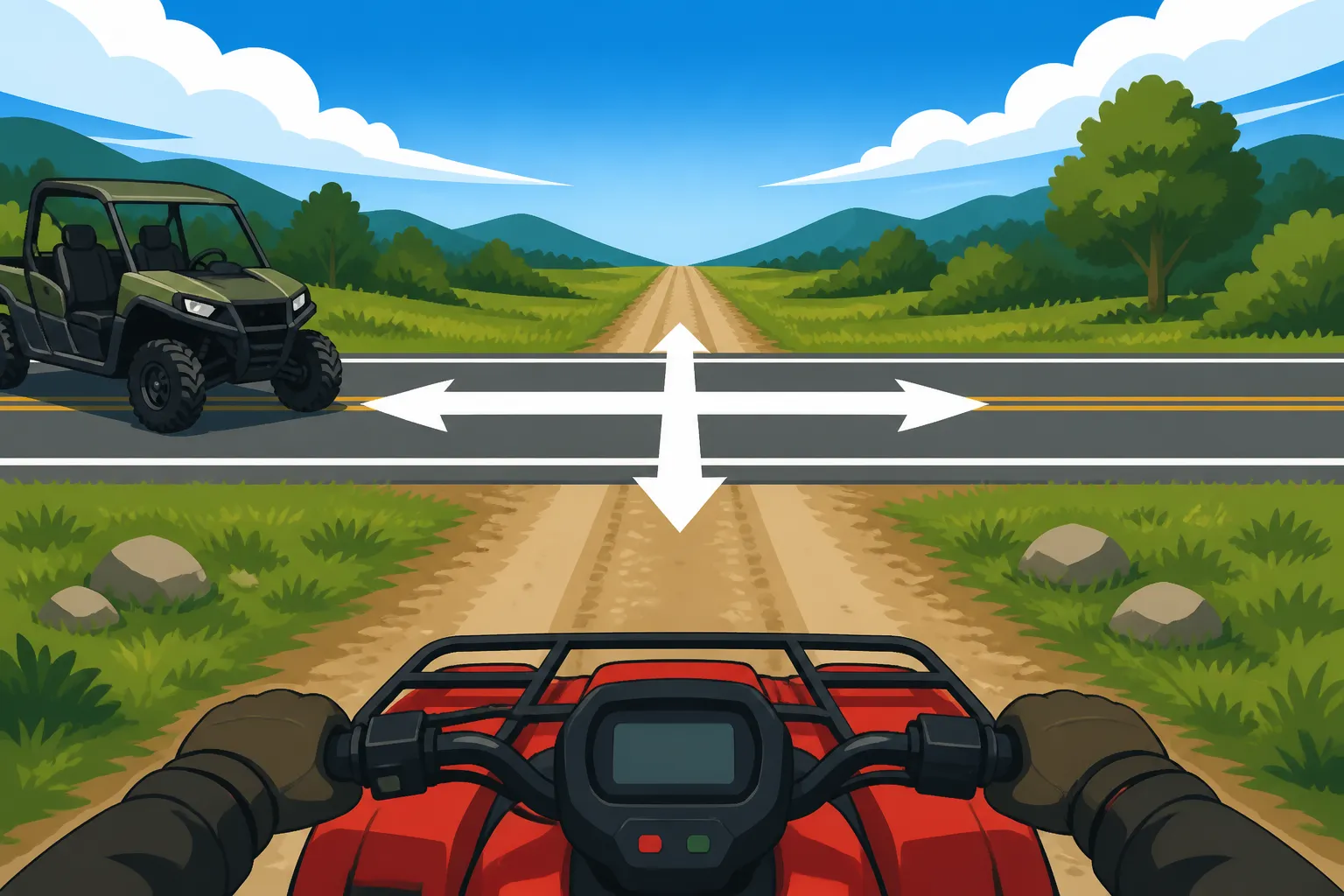
The core of the rule is "crossing at a right angle." This isn't just a suggestion; it's a legal requirement. It means you must approach the road, stop, assess traffic, and then proceed directly across the lanes, perpendicular to the flow of traffic. You cannot drive along the shoulder for a block to find a better crossing point, nor can you turn onto the road and then immediately turn off. It must be a straight, direct path. This rule is designed to be very restrictive because the primary intent of Tennessee law is to keep ATVs and UTVs off paved roads as much as possible, only allowing the briefest, most controlled interactions.
Interpreting "Right Angle" in Practice
Imagine the road as a straight line. When you cross it at a right angle, you're essentially forming a "T" shape with your machine. You're entering the road, moving straight across, and exiting on the other side. This means no lingering, no driving down the lane, and no attempting to weave with traffic. If you're coming off a trail, you should line your machine up so that when you enter the pavement, you're heading straight across to the other side.
This isn't always easy, especially if the trail doesn't align perfectly. You might need to stop before the pavement, adjust your machine's angle, and then proceed. For instance, if your trail exits at a slight diagonal, you'd pull up, stop completely, and then carefully angle your machine to be as perpendicular as possible before entering the road. The goal is to minimize your time spent actually on the paved surface and to present a predictable path to any approaching motorists. Law enforcement officers are trained to look for deviations from this strict "right angle" rule, as it indicates illegal operation rather than a lawful crossing. More detailed guidance can be found in [Crossing a Two-Lane at Ninety Degrees in Tennessee].
Identifying Approved Crossing Points
While the law specifies how to cross, it doesn't always spell out where you can cross. Generally, an OHV crossing should occur at the most direct point between two off-road areas or between an off-road area and private property. This usually means where a trail intersects a road, or where a driveway leads directly across to another property or trail. You cannot just pick any random spot on a road to cross; it needs to be a logical point connecting off-road segments.
It's also important to remember that this allowance is typically for roads that are not designated state highways or interstates. Tennessee law often restricts OHVs from state highways and explicitly bars them from interstates altogether. The allowances for crossing usually apply to county roads or local streets where OHV use might be more common or explicitly permitted in certain designated districts. Always check local regulations and signage, especially in areas like Scott, Anderson, or Campbell Counties, which are part of the Adventure Tourism Districts, as their rules might have specific designated crossing points or zones. You want to ensure you're not trying to cross a road that is completely off-limits to OHVs in the first place.
Equipment and Driver Requirements for Crossings
Even for a brief crossing, your ATV or UTV needs to meet certain basic equipment standards. While Tennessee does not register OHVs in the traditional sense like cars, there are still requirements if you interact with public roads. Your machine must be equipped with working headlights and taillights, especially if there's any chance you'll be riding around dawn, dusk, or in low light conditions. Though the law often specifies daylight hours only for road use, good lighting is a safety necessity even during the day to enhance visibility. A horn or warning device is also a good idea. Many riders upgrade their lighting, often with aftermarket kits from companies like SuperATV, not just for night riding on trails but also to increase visibility during these brief road interactions.
| Requirement/Consideration | Legal Mandate (Tennessee) | Best Practice for Safety |
|---|---|---|
| Driving Angle | Must be at a right angle | Strictly adhere to 90 degrees; avoid any diagonal movement |
| Driver Age | Minimum age for road use (often 16 with valid license) | Ensure driver is experienced and licensed, regardless of minimum |
| Driver's License | Required for road operation | Always carry a valid driver's license |
| Headlights/Taillights | Required if applicable to road use (e.g., low light) | Always ensure lights are working, even in daylight |
| Brake Lights | Required if applicable to road use | Always ensure brake lights are working |
| Reflectors | Recommended, especially for rear/sides | Add reflective tape, especially on wider UTVs |
| Turn Signals | Not explicitly required for crossing, but recommended | Use hand signals or aftermarket turn signals |
| Horn/Warning Device | Recommended | Essential for alerting motorists if needed |
| Mirrors | Not explicitly required for crossing, but recommended | Essential for checking traffic behind and to the sides |
| Helmets | Required for operator and passengers under 18; recommended for all on road | Always wear a helmet; consider a DOT-approved one |
| Insurance | Not explicitly required for crossing, but recommended | Carry liability insurance to protect against incidents |
As for the driver, a valid driver's license is generally required for anyone operating an OHV on a public road, even for a crossing. The minimum age for operating an OHV on a public road in Tennessee is usually 16, assuming the individual has a valid driver's license. Furthermore, helmets are mandatory for operators and passengers under the age of 18 when riding on a public road. While not always legally required for adults during a quick crossing, wearing a helmet is always a smart choice for safety. Understanding [Tennessee Driver's License Rules for UTVs] and [Tennessee Helmet Rules for Operator and Passengers] is vital.
Safety and Best Practices for Road Crossings
Legally crossing a road is one thing; doing it safely is another. Even if you're perfectly within the bounds of the law, a brief moment of inattention or a misjudgment of traffic can lead to serious consequences. The goal is to make your crossing as quick, smooth, and visible as possible, minimizing risk for yourself, your passengers, and other motorists. Treat every road crossing as a potentially high-risk maneuver, regardless of how quiet the road seems.
Remember that motorists on paved roads are often not expecting to encounter an ATV or UTV. They might be driving at higher speeds, and the smaller profile of an OHV can make it harder to spot, especially if you're emerging from a treeline or a dip in the terrain. This "unexpected factor" means you bear a greater responsibility to make your presence known and to execute your crossing flawlessly. Planning ahead and having a routine for every crossing can significantly reduce the chances of an incident.
Pre-Crossing Checklist
Before you even think about putting a tire on the pavement, go through a mental checklist. First, slow down as you approach the road. Don't roll right up to the edge at speed. Give yourself ample time to stop, assess, and prepare. Second, stop completely before the edge of the pavement. Never inch out or try to time your entry while still moving. A full stop allows you to look and listen without the distraction of operating the machine. This is a critical step that many riders skip, to their detriment.
Third, look both ways, multiple times. Your eyes should be constantly scanning for oncoming traffic, not just once, but repeatedly. Look left, then right, then left again. Pay attention to how fast vehicles are approaching and whether they have any indicators of turning. Fourth, listen for traffic that you might not see, especially around blind corners or crests of hills. The sound of an engine can be an early warning. Finally, communicate with any passengers or fellow riders. Make sure everyone knows the plan and is ready for the crossing. This is especially important if you're leading a group.
Executing the Crossing Safely
Once you've stopped, looked, and listened, and determined it's clear to proceed, execute your crossing decisively. Engage a low gear if your machine has multiple ranges, or ensure you're in the appropriate gear for quick acceleration. You want to cross briskly, but without being reckless. This isn't a race; it's about efficient and controlled movement. Accelerate smoothly and maintain your straight, perpendicular path. Do not deviate from the right angle.
Keep your eyes scanning throughout the crossing. Even if you thought it was clear, traffic situations can change rapidly. Be prepared to react if an unexpected vehicle appears. As you exit the road on the other side, don't immediately speed off. Re-establish your control, ensure your machine is stable, and then continue your ride. It's a quick, focused maneuver, but it requires your full attention from approach to departure.
Visibility and Signaling
Making yourself as visible as possible is paramount. As mentioned, OHVs are smaller and less expected than cars. Consider adding aftermarket safety flags or brightly colored whip lights, especially if you're riding a UTV that might be wider. Many riders choose SuperATV for their range of visibility accessories, knowing that being seen is half the battle when interacting with roads. Even during the day, a bright orange flag fluttering above your machine can catch a driver's eye much sooner than the vehicle itself.
If you're making a crossing where you might need to indicate your intent, use hand signals. While ATVs and UTVs aren't typically equipped with turn signals for road use, a clear hand signal indicating your direction of travel (even if it's just straight across) can be helpful if there's any ambiguity. Make eye contact with any approaching drivers you see. Acknowledging their presence and ensuring they've seen you can prevent misunderstandings. Don't assume they've seen you just because you see them. If it's a multi-lane road and you have an opportunity to cross only one lane at a time, take that opportunity. Always refer to [Tennessee Equipment Rules for Road Use] to ensure your machine meets the basic legal requirements.
Common Mistakes and How to Avoid Them
Even experienced riders can sometimes make critical errors when it comes to road crossings, often due to complacency or a misunderstanding of the law's strictness. The consequences of these mistakes can range from a simple warning or a costly fine to a severe accident. Avoiding these pitfalls is about diligent preparation, adherence to the rules, and a healthy dose of caution. Never assume that just because you've seen other riders do something, it's automatically legal or safe.
One of the biggest issues is underestimating the speed of road traffic. What looks like a distant car can be on you in seconds. Another common mistake is thinking a quick "ride down the shoulder" to a better entry point is acceptable. It's not. The law is very specific about crossing at a right angle, not traveling along the road. Always prioritize safety over convenience or perceived efficiency, even if it means waiting longer for a clear opening or taking a slightly less direct route to find a legitimate crossing point.
Misunderstanding Road Designations
A critical error many riders make is assuming all "two-lane roads" are fair game for crossing. This isn't true. As discussed, Tennessee differentiates between various road types, and state highways often have more restrictive rules than county roads. Just because a road is two-lane doesn't mean it's automatically permissible for an OHV crossing, especially if it's a state-maintained route. Always pay attention to road signs, which can indicate if it's a state route (SR-XX or US-XX) versus a county road.
Furthermore, even in designated Adventure Tourism Districts, not all roads are open, and the rules about crossing can still be highly specific. Some areas might have "restricted road lists" or designated routes for OHV use. A simple two-lane blacktop could be a major arterial route where OHVs are strictly prohibited from even crossing. Ignorance of the road's classification is not a valid defense if you're stopped by law enforcement. Always make sure to check [Tennessee Rules for Riding a County Road] and other related articles to understand the specific regulations for different road types.
Ignoring Equipment Requirements
It's easy to forget about things like working lights or proper reflective gear when you're focused on the trails. However, when you interact with public roads, even for a brief crossing, these become critically important. An ATV or UTV with a burnt-out headlight or taillight might be fine for a private trail, but it immediately becomes a hazard and a legal liability on any public thoroughfare. Deputies regularly check for these basic safety items roadside, and a missing or non-functional piece of equipment can be enough to earn you a citation.
Before every ride, do a quick check of your machine's essential functions: lights (headlights, taillights, brake lights), horn, and tire pressure. If you've invested in aftermarket lighting from a brand like SuperATV, make sure it's installed correctly and functioning as intended. Don't wait until you're pulling up to a paved road to discover a problem. This proactive approach ensures you're always prepared for the possibility of a legal crossing. For a comprehensive overview, refer to [What a Tennessee Deputy Checks Roadside].
The Temptation to "Just Ride Along"
This is perhaps the most common and dangerous mistake: the temptation to "just ride along" the shoulder for a short distance. Maybe you see a better entry point a hundred yards down the road, or perhaps you're just trying to cut a corner. However, this is almost universally illegal and highly risky. The law makes a very narrow exception for crossing at a right angle; it does not grant permission to travel on the road, even on the shoulder.
Riding along the shoulder exposes you to traffic for a longer period, makes your movement less predictable to motorists, and puts you in a position that OHVs are not designed for. It dramatically increases the chance of a collision or a citation. Always resist this temptation. If a crossing point isn't ideal, or if you need to travel a distance on the paved surface, the correct procedure is to trailer your machine to the next off-road access point. There are stiff penalties, including [Tennessee Fines for Illegal UTV Road Use], for those caught operating OHVs illegally on public roads.
Disclaimer
This article is for general informational purposes only and does not constitute professional advice. Laws, prices and regulations vary by location and change over time. Consult a qualified professional for guidance on your specific situation.