Ride Royal Blue and Polaris Adventures in Tennessee
Planning a Royal Blue ride can get confusing when trail access, rental bookings, permits, and pickup details are handled separately. Polaris Adventures may connect you with a local outfitter, but the exact machine, route, and included costs depend on the booking. Here’s how to plan the ride, confirm what you’re paying for, and avoid arriving at Pioneer with a missing permit or mismatched expectations.
How a Polaris Adventures Rental Fits a Royal Blue Ride
Ride Royal Blue is based in Pioneer, Tennessee, near the Royal Blue riding area. The name can refer to the trail destination as well as the local business and rental operation, so start by confirming exactly which company is handling your reservation. A booking associated with Polaris Adventures generally involves a local participating outfitter; it does not mean every detail is identical at every location or for every reservation.
Polaris Adventures is useful as a way to find or book a participating rental experience. The local outfitter is still the party to confirm practical details with: where to check in, what machine is assigned, what equipment is provided, where the ride may go, and what happens if weather or a mechanical issue changes the plan.
Do not treat the brand name as proof that a particular vehicle, route, guide, or permit is included. Those details can depend on the date, the machine category, the itinerary, and the provider’s current operating rules. If a listing is brief, contact the outfitter before booking or before traveling.
A good first step is to distinguish between three things:
- The rental booking: the reservation for the ATV or side-by-side, including the agreed rental period and any stated equipment or service.
- The riding access: permission to use the specific trails or land on the itinerary. Access can be controlled by a private operator, a public land manager, or more than one of them.
- The ride plan: whether you are riding independently, following a prescribed route, or accompanied by a guide.
These are connected, but they are not interchangeable. A rental reservation does not automatically answer whether the machine can travel on every trail nearby. A trail permit may not be included just because the machine is rented at a trail destination. And a guided outing is not the same service as simply picking up a machine and riding on your own.
Before choosing a date, read the booking details and ask the outfitter to confirm the specific arrangement. If you are comparing booking routes, Renting Through a Polaris Outfitter at Pioneer gives more context on how a local rental operation fits into the Polaris network. For the destination itself, Riding Royal Blue From Pioneer is a useful companion topic.
Confirm the operator and pickup location
Make sure the booking names the local outfitter and gives a clear pickup or check-in location. Do not rely only on a map pin or the general name of the riding area. Ask where you should go, when the pickup process begins, and whether you need to arrive early for forms, fitting equipment, or an orientation.
This matters especially if you are staying at a campground or cabin nearby. A rental listing may be associated with a resort or trail system without promising delivery to your lodging. If delivery is important, get an explicit answer before booking.
Match the vehicle to the group
The right rental is not just the machine with the most seats. Think about who will drive, who will ride as a passenger, how comfortable everyone is with rough terrain, and whether the vehicle is suitable for the route you hope to take. A two-seat side-by-side may be easy to plan around for a couple, while a family or group may need a larger configuration. Availability and age rules vary, so confirm both with the provider.
If you are considering an ATV rather than a side-by-side, check whether every rider has the experience and confidence to control one. An ATV does not offer the same passenger seating or protective structure as a side-by-side, and it may not be a practical choice for every group. For an overview of rental decisions, see Renting a Side-by-Side in Tennessee or Renting an ATV in Tennessee.
| Booking question | Why it matters | What to confirm |
|---|---|---|
| Who operates the rental? | The platform and local provider may have different roles | The outfitter’s name and contact details |
| Where is pickup? | A trail destination may cover a broad area | The exact check-in location and arrival time |
| What machine is reserved? | A category or image may not guarantee a specific model | Vehicle type, seats, and any substitution policy |
| What trails are included? | Nearby routes can have different access rules | The permitted riding area and any route limits |
| Is a guide included? | Independent rental and guided rides are different experiences | Whether a guide is part of the reservation |
| Are permits included? | Rental and trail access may be separate | Which permits, if any, are covered |
| What is charged separately? | Fuel, damage, and other items may not be in the base booking | Current charges and when they may apply |
The table is a checklist, not a promise about what a particular booking includes. Let the current listing and the outfitter’s written confirmation decide the details.
Permits, Trail Access, and Route Boundaries
One of the easiest planning mistakes is assuming that a rental location and a trail permit are the same thing. They are not. The machine may be rented at or near a riding area, but you still need to know which land the planned route uses and what access authorization applies there.
Royal Blue is associated with the North Cumberland riding area. Routes and land boundaries can matter because some riding may take place on managed public land, while other access can be subject to a private operator’s rules. A provider should be able to explain which area the rental is authorized to use and whether any separate permit is required for your intended ride.
Ask the outfitter directly:
- Does the reservation cover access to the route you plan to ride?
- Will the ride enter a wildlife management area or other land with separate permit rules?
- Is a permit included in the booking, or must you obtain it separately?
- Does the permit cover each rider, each machine, or another unit specified by the land manager?
- Are there restrictions on the route, time of day, machine width, or rider eligibility?
- If a route is closed, who provides the current approved alternative?
Do not assume that a permit from one park, resort, or riding area applies at another. In Tennessee, trail access rules can be specific to the land manager and location. The details in Tennessee Trail Permits Explained can help you understand why you should confirm the exact permit rather than relying on a general statement that a machine is “ready to ride.”
A rented machine also does not create permission to ride on a public road. Road use is governed by separate rules and can vary by road type and location. If your plan involves leaving the trail system, ask the outfitter whether that route is allowed and check the relevant rules before riding. Tennessee Rules for a Visiting Rider is a good starting point for visitors who are unsure how Tennessee access requirements apply.
Ask for an itinerary, not just a trail name
“Royal Blue” may be enough to identify the general destination, but it is not a complete itinerary. Ask whether the rental is limited to a particular trail network, whether you may explore independently, and how the operator communicates closures or route restrictions.
For a guided ride, confirm the planned duration, pace, group size, and whether the guide chooses the route based on conditions. For a self-guided rental, ask how routes are marked and what support is available if you lose your way or need help. A trail map or navigation app can be useful, but it does not replace following the operator’s permitted route and current closures.
Riders should also ask whether the operator’s guidance is based on the machine being rented. A route that works for one vehicle may not be appropriate for a wider or longer machine. If you have a larger side-by-side, mention its dimensions before booking and ask about restrictions. The outfitter can clarify its own requirements, while the land manager’s rules determine what is allowed on managed land.
Check current restrictions before the trip
Trail conditions and access can change. Weather, maintenance, land-management decisions, or other operational needs may affect routes. A booking confirmation from an earlier date is not a guarantee that every trail will be open when you arrive.
Check for updates close to the ride, and ask the operator what channel it uses for same-day notices. If you are traveling a long distance, confirm the reservation and the planned check-in instructions before setting out. For broader planning, Tennessee Trail Closures to Check First offers a useful reminder to verify conditions rather than treating an old route description as current.
What to Confirm Before You Book
A rental listing is a starting point, not a complete substitute for reading the terms. Before paying or committing to a date, review what is included and ask for clarification wherever the listing is vague. Keep important answers in writing, especially if they affect the machine, access, or total amount due.
Vehicle and rider requirements
Confirm the vehicle type, seating, and whether the booking reserves a specific model or only a general class. Ask whether the outfitter can substitute a comparable machine if the reserved vehicle becomes unavailable. If you have a preferred setup, such as a vehicle with a winch or a particular seating configuration, ask whether that feature is guaranteed or simply requested.
Check the operator’s rules for drivers and passengers. Minimum-age requirements, driver’s license rules, and rules for minors can differ by provider and by vehicle. Do not assume a child can ride in a particular seat just because the machine has enough seats. Ask about passenger age, height, and supervision requirements, and make sure the group’s actual ages are included when you request an answer.
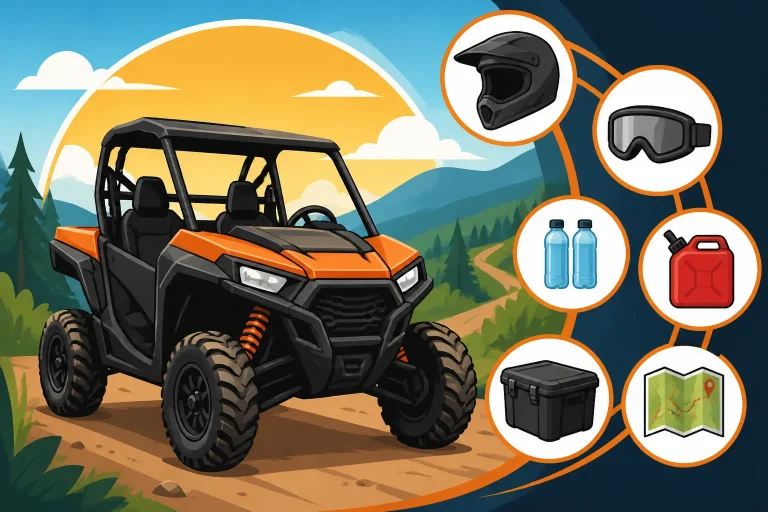
Also ask about helmets and other safety equipment. Find out what the outfitter supplies, what condition it expects equipment to be returned in, and whether you can bring your own gear. A helmet that fits properly is more useful than one that is merely available, so raise sizing needs before arrival.
Rental period, price, and additional charges
For a named provider, rental prices, deposits, and plan terms can change. Check the current listing or contact the outfitter for the figures that apply to your date. A quoted base price may not answer what the total will be once taxes, permits, fuel, damage protection, or other optional or required items are considered.
Ask for a clear breakdown of what is due at booking and what may be charged at pickup or return. Find out how the damage deposit or card hold works, when it is placed, what conditions can affect it, and how the provider handles its release. If you see a deposit amount mentioned in an older review or discussion, do not treat it as current. For background on how a Pioneer-area rental may handle a hold, see $1,500 Rental Deposit Held at Pioneer, then confirm the current terms directly with the operator.
Make sure you understand the fuel policy. Some rentals require the machine to be returned at a specified fuel level; others may have different arrangements. Ask whether fuel is available at the pickup point and whether the route has a practical place to refuel. Do not assume the machine will be handed over with a full tank or that fuel is included.
Cancellation, weather, and breakdowns
Read the cancellation policy before booking. Pay attention to the deadline for changing or canceling, what happens if the operator cancels, and whether weather closures are handled differently from a change of plans by the renter. Do not assume that rain automatically means a refund or that a ride will proceed in every weather condition.
Ask how mechanical problems are handled. Find out whom to call, what information to provide, and whether the operator will dispatch help, arrange a replacement, or give instructions for returning to the pickup point. A clear breakdown procedure is especially important when riding in remote areas with weak cell coverage.
Clarify your responsibilities if the machine becomes stuck, damaged, or unusable. Some situations may be handled by the outfitter; others may result in a recovery or repair charge under the rental terms. The wording of the agreement matters, so read it before accepting the keys rather than trying to interpret it after an incident.
Decide whether a guide is the right fit
A guided ride can simplify route-finding and help a group understand local expectations. It may suit first-time visitors, inexperienced riders, or people who would rather focus on the ride than navigation. A self-guided rental can offer more independence, but it puts more responsibility on the group to follow the permitted route and stay within the agreed riding area.
A guide is not a substitute for knowing the rental rules or following safety instructions. Ask whether the guide stays with the group, how the pace is managed, and what happens if a rider wants to stop or turn back. If your group includes riders with different skill levels, mention that before booking. The outfitter may be able to explain whether the planned route and pace are suitable.
For a wider comparison of guided outings and self-directed rentals, see Tennessee Guided ATV Tours by the Day. If you are still weighing whether to rent or bring your own machine, Tennessee Rentals Versus Buying a Machine can help frame that decision.
Arrival Day and a Safer Royal Blue Ride
A smooth pickup starts with being prepared. Bring the documents the outfitter requests, arrive at the stated time, and leave room in your schedule for check-in. A reservation does not necessarily mean you can skip orientation or paperwork.
Before leaving the pickup area, make sure every driver understands the controls, route limits, and emergency procedure. If anything is unclear, ask before moving. Confirm that you have the operator’s contact information and know what to do if the group gets separated or the machine has a problem.
Use this arrival checklist:
- Have your reservation confirmation and any requested identification available.
- Confirm that the vehicle matches the reservation and fits the riders.
- Ask whether the permit or access authorization is included.
- Review the route boundaries, trail closures, and any time restrictions.
- Check what safety equipment is supplied and whether it fits.
- Confirm the fuel level and the return fuel expectation.
- Photograph the machine before the ride, including visible damage.
- Ask how to report damage or a mechanical issue.
- Make sure all drivers know the route and communication plan.
- Follow the operator’s instructions about where the machine may be driven.
Photographs are a simple way to document the vehicle’s condition at pickup. Take clear images before riding, and report any existing damage to the outfitter before leaving. If you notice a new issue during the ride, stop when it is safe to do so and contact the operator using the agreed procedure. Do not try to repair or continue operating a machine if the problem could make the ride unsafe.
Ride within your group’s ability
Royal Blue riding can involve uneven ground, changes in traction, and routes that feel very different depending on weather and experience. Choose a route that fits the least experienced rider, not just the most confident driver. Keep a pace that allows the group to stay together and stop safely.
For side-by-side passengers, follow the vehicle’s seating and restraint instructions. Keep hands and feet inside the vehicle, use the provided restraints, and do not carry more passengers than the machine is designed to hold. For ATV riders, wear appropriate protective gear and leave enough space between machines to react to sudden stops or obstacles.
Avoid assuming that a familiar-looking trail is open or suitable. Follow signs and the outfitter’s directions, and turn back when a route is closed or conditions are beyond the group’s comfort level. Do not enter private property, drive around a closure, or use a public road as a shortcut without clear authorization.
Plan for communication gaps. Cell service may be unreliable in some riding areas, so tell someone outside the group where you expect to be and when you plan to return. Keep the outfitter’s contact information accessible, and ask what emergency process it recommends for the specific route.
Return the rental according to the agreement
Leave enough time to return the machine as instructed. Confirm the return location and closing time in advance, especially if you expect to be on the trails late in the day. Returning after the stated time can create avoidable problems even if the ride itself went well.
At return, follow the provider’s instructions for parking, refueling, and reporting any issue. Be direct about a collision, warning light, unusual noise, or damage. A prompt, accurate report gives the operator a chance to assess the vehicle and explain what happens next. Keep a copy of any incident report or receipt if the provider supplies one.
If your trip includes more than one destination, remember that a Royal Blue rental and access arrangement should not be assumed to apply elsewhere. Each provider and trail system can set its own rules. The guide Why One Park’s Permit Is Worthless at the Next explains why it is important to treat access as location-specific.
Frequently Asked Questions
Is a Polaris Adventures booking the same as booking directly with Ride Royal Blue?
Not necessarily. Polaris Adventures can connect riders with a participating local outfitter, while the local operator manages practical details such as pickup, vehicle assignment, and ride instructions. Confirm the named provider and all booking terms before you travel.
Does a rental automatically include a Royal Blue trail permit?
Do not assume it does. Ask whether the reservation includes access to the specific route and whether any separate permit is required. If the itinerary uses managed public land, check the applicable rules as well as the outfitter’s instructions.
Can a beginner rent a side-by-side at Royal Blue?
Possibly, but the provider’s driver requirements and the route’s difficulty both matter. Ask the outfitter about eligibility, orientation, vehicle options, and a suitable route for your group’s experience. A beginner-friendly booking still requires following the operator’s safety instructions.
What should I ask about the deposit?
Ask what amount applies to your booking, whether it is charged or held, what can affect it, and how the provider handles its release. Deposit terms can change, so confirm current details with the local outfitter rather than relying on an old listing or review.
Disclaimer
This article is for general informational purposes only and does not constitute professional advice. Laws, prices and regulations vary by location and change over time. Consult a qualified professional for guidance on your specific situation.