Tennessee Rules for Carrying Fuel
Running low on fuel far from a staging area can turn a Tennessee ATV or UTV ride into a long walk or a recovery call. Carrying a spare can help, but the right approach depends on where you ride, what the trail operator allows, and how you secure the gasoline. Here’s how to check the rules and reduce the risks.
Is It Legal to Carry Extra Fuel on a Tennessee ATV or UTV?
There isn’t one simple rule that answers every question about carrying a spare fuel can on every Tennessee trail. A machine’s public-land access rules, a park operator’s policies, fire restrictions, and the vehicle manufacturer’s instructions can all matter. Don’t assume that having a trail permit means every fuel container or storage method is allowed.
Start by identifying who manages the place where you plan to ride. A state-managed riding area, a private pay-to-ride park, and private land may have different requirements. For example, read Tennessee Rules for Riding a WMA if your route includes a wildlife management area, and check the operator’s current policies before taking a spare can to a private park. A permit issued by one riding area does not necessarily apply elsewhere; Tennessee Trail Permits Explained covers why permits and access rules are location-specific.
A useful distinction is that carrying fuel safely and being allowed to carry it are separate questions. A container can be appropriate for gasoline and firmly mounted yet still be prohibited by a specific trail operator. Conversely, a park’s general permission to ride does not mean it has approved every aftermarket container or mounting location.
Before loading up, check:
- Whether the land manager or park allows riders to carry spare fuel.
- Whether there are fire restrictions or temporary closures affecting your planned route.
- Whether the machine maker permits an auxiliary container and identifies suitable mounting points.
- Whether your route includes more than one managed area, each with its own rules.
- Whether the container can be carried without blocking the driver, passengers, controls, lights, or emergency equipment.
If the rule is unclear, contact the land manager or park directly before you leave. A call can also confirm whether a rule has changed because of dry conditions, a fire risk, maintenance, or a temporary trail closure. Check notices before riding as well; Tennessee Trail Conditions Before You Ride explains why a current trail check belongs in the planning routine.
| Situation | What to verify | Practical approach |
|---|---|---|
| Riding on a managed public area | Current land-manager rules, fire notices, and permit requirements | Ask whether spare fuel containers are allowed on machines |
| Riding at a private park | The operator’s fuel, vehicle, and fire-safety policies | Confirm rules for the specific park and riding date |
| Crossing between managed areas | Each area’s access and permit rules | Don’t assume one area’s permission carries over |
| Transporting a machine to the trailhead | Container instructions and safe transport practices | Secure fuel separately from people and prevent movement |
| Carrying fuel on the machine | Manufacturer guidance, mounting location, and operator policy | Use a suitable container and a secure, manufacturer-compatible mount |
Choose a Suitable Container and Secure It Properly
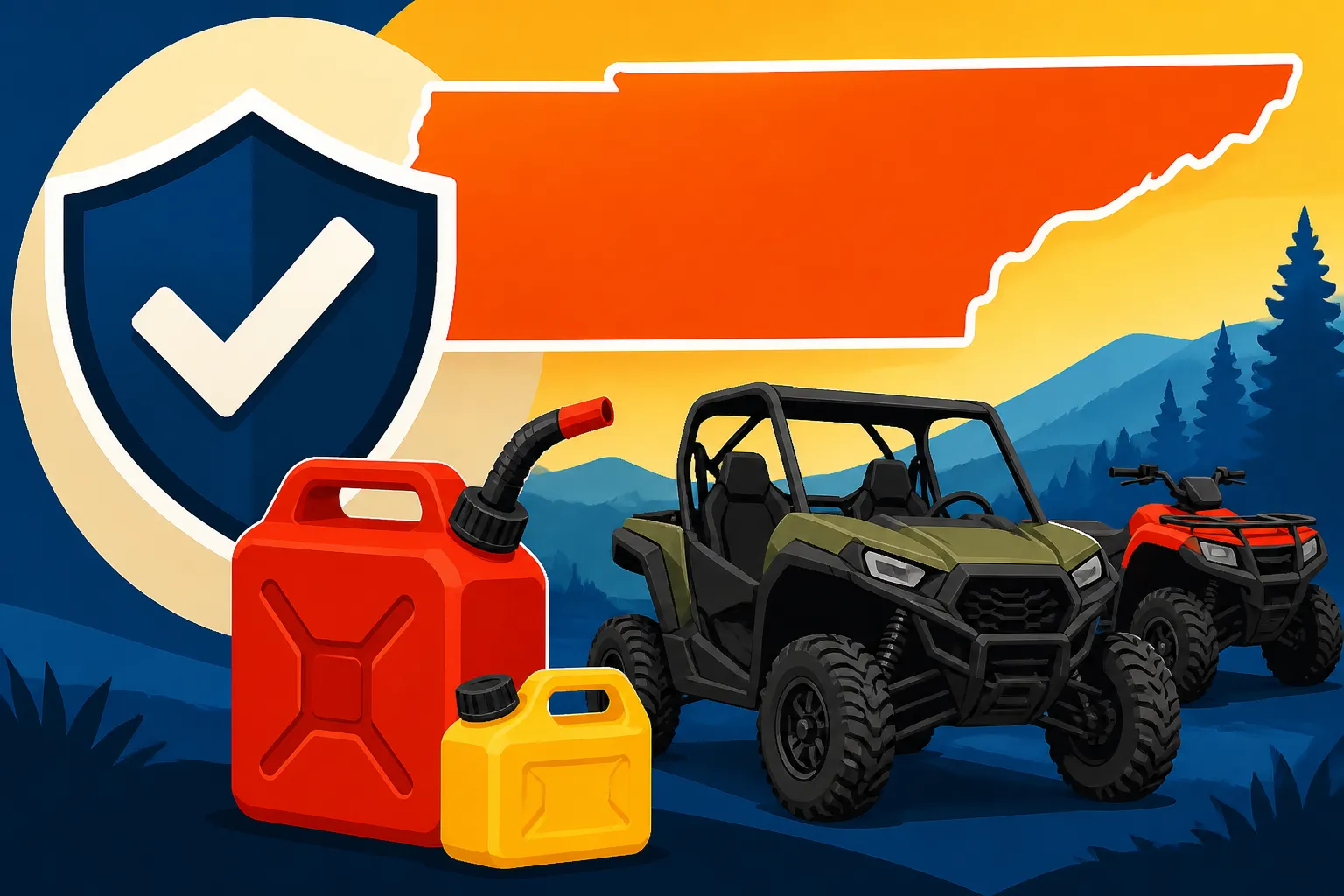
A spare fuel container should be designed and labeled for gasoline, compatible with the fuel you use, and in good condition. A bottle, household jug, or container that once held another chemical is not a safe substitute. Follow the container’s instructions for filling, storage, venting, and use. If you need to buy one, compare equipment from established outdoor or powersports suppliers, including options sold through Amazon, but check the product specifications rather than relying on appearance alone.
The container should be closed securely and kept upright as directed by its manufacturer. Inspect the cap, seals, body, and any vent before each trip. Do not use a container that is cracked, leaking, badly worn, or missing parts. Keep it away from flames, sparks, hot surfaces, and the exhaust system.
A loose can can shift, spill, or interfere with steering and passenger movement when a machine climbs, descends, or tips. A proper mount should hold the container in place over rough terrain without relying on a bungee cord alone. Follow the machine manufacturer’s guidance on accessory mounting and load limits. Avoid fastening a can where it could obstruct a seat belt, passenger handhold, cargo restraint, wheel travel, or a control.
Even a well-mounted container adds weight and changes how the machine handles. Fuel also increases fire risk if it spills near a hot engine or exhaust. Carry only the amount you reasonably need for the route, not the largest container that will fit. If the machine has no safe, approved place for a spare can, plan a shorter ride or arrange a refill instead of improvising a mount.
Keep the container separate from gear that could puncture it, and don’t store it where a rollover could trap a rider or expose the container to damage. A storage location that seems convenient in a parking lot may be unsafe once the vehicle is bouncing along a narrow or steep trail. Check it after a rough section or stop if you smell gasoline, see wet spots, or notice a loose mount.
Transporting fuel to the trailhead
Carrying a can to the riding area in a truck or trailer is different from mounting it on an ATV or UTV. Follow the container’s transport instructions, secure it so it cannot tip or roll, and keep it away from people, ignition sources, and items that could damage it. Avoid carrying gasoline in the passenger compartment. Don’t leave a fuel can in a hot vehicle or in direct sun for extended periods.
If you transport the can in a trailer or truck bed, make sure it is restrained and protected from shifting cargo. Keep it away from hot equipment and anything that could strike the container. If you smell fuel or find a leak, stop and address the problem in a safe place before unloading or starting the vehicle. Never pour fuel from a damaged can or ignore a persistent gasoline odor.
Plan Fuel Around the Route, Not Just the Tank
A spare can is not a substitute for estimating the ride. Trail distance alone may not predict fuel use: steep climbs, mud, low-speed crawling, tire choice, heavy loads, and frequent stops can all affect consumption. A long route may also take more time than expected if the group has to turn back, assist another rider, or wait at a closure.
Before the ride, estimate fuel needs using your machine’s normal use on comparable terrain, then build in a sensible reserve. If you are unsure how much a particular route will use, choose a shorter loop rather than relying on a guess. The goal is to finish with enough fuel to return to the staging area, not to see how far the tank can stretch.
A practical planning sequence:
- Confirm the route and access rules. Check the current map, permitted trails, closures, and any fuel restrictions. A route that crosses different land or park boundaries may involve different rules.
- Start with a full tank where appropriate. Refuel before entering the trail system, using a safe, designated area and following the machine and fuel-container instructions.
- Estimate use conservatively. Account for steep grades, mud, passengers, cargo, and detours. If conditions are uncertain, shorten the route or plan a return to the staging area.
- Set a turnaround point. Decide when the group will head back rather than continuing until the fuel gauge is nearly empty.
- Tell someone the plan. Share the route and expected return time with a person who is not riding with you.
- Check the machine and container at stops. Look for leaks, loose straps or mounts, and damage. If you smell gasoline, stop riding and investigate before continuing.
- Refuel only when it is safe. Stop the engine, move away from ignition sources, and let hot components cool as the machine and fuel-container instructions require. Do not smoke or refuel near a fire.
For a group, plan around the machine with the least usable range. A faster or larger UTV may not share the same consumption as a smaller ATV, and one rider’s fuel margin does not solve another rider’s shortage. Keep the group together and agree on where to stop before anyone is running low.
Don’t treat a roadside or trail crossing as a convenient place to transfer fuel. Use an appropriate, stable location away from flames and other ignition sources. Keep the funnel or spout clean, avoid overfilling, and close the container promptly. If fuel spills, keep people and machines clear, avoid starting engines nearby, and follow the park’s instructions for reporting or handling the spill.
What to Do When Fuel Rules or Conditions Change
Trail rules and fire conditions can change after you have planned a trip. Dry weather, a fire, maintenance work, or an emergency may lead a land manager or park operator to restrict access or suspend an activity. Check the current notice before leaving home and again at the entrance if posted information is available. A permit does not override a closure; see Tennessee Rules for Riding a Closed Trail for the importance of staying off closed routes.
If an operator says fuel cans are not allowed on machines, don’t conceal one or assume the restriction applies only to certain riders. Ask whether there is an approved alternative, such as refueling at the staging area or choosing a shorter loop. If there is no safe, permitted way to carry additional fuel, change the plan. A trip that depends on disregarding a safety rule is not a suitable trip.
If your machine runs low, avoid pushing it farther into a remote section in the hope of finding fuel. Stop in a safe location, notify your group, and use the plan you made before riding. Do not siphon fuel from another machine unless the fuel can be transferred safely with appropriate equipment and both machines are shut down in a suitable location. If the group cannot resolve the problem without creating a spill or fire risk, contact the park or land manager for assistance.
Pay attention to other equipment rules, too. A fuel container does not make a machine compliant with sound or fire-safety requirements; for example, check Tennessee Spark Arrester Rules if they apply to your machine and riding area. For riding on private property, permission from the owner still matters, and Tennessee Rules for Riding Private Property can help clarify that separate issue.
The simplest safe routine is to confirm the specific riding area’s rules, use a gasoline-approved container, mount it only in a safe and permitted location, and plan a route that does not depend on running the tank dry. If any part of that plan is uncertain, ask the operator before you load the machine.
Disclaimer
This article is for general informational purposes only and does not constitute professional advice. Laws, prices and regulations vary by location and change over time. Consult a qualified professional for guidance on your specific situation.