Tennessee Fines for Riding a Closed Trail
Riding a closed trail in Tennessee can turn a planned outing into a citation, an unexpected expense, or a dispute about where you were allowed to ride. The key complication is that there is no single fine that applies to every closed trail. The land manager, the reason for the closure, and the rule you allegedly broke all matter.
What counts as a closed trail in Tennessee
A trail can be closed temporarily or permanently, and its status may depend on who manages the land. A gate, sign, posted notice, official trail map, or closure announcement may indicate that riding is not allowed. Closures can apply to a whole area, a particular trail, or a stretch of route between two points.
A route may be closed for reasons such as maintenance, unsafe conditions, weather, resource protection, hunting activity, or a management decision. A trail that was open on your last visit may be closed now. Treat current notices as more important than old maps, social media posts, or what another rider remembers.
The rules also depend on the location:
- A wildlife management area has rules set by the responsible state land manager. A permit to ride there does not automatically authorize travel on a closed route. See Tennessee Rules for Riding a WMA for the broader permit and access context.
- A private riding park or resort can close routes under its own operating rules. A park permit does not make a closed trail available for use.
- A public road is not the same as an OHV trail. Road access has its own restrictions, and an ATV or UTV may not use a road just because a nearby trail is open.
- Private land requires permission from the landowner. A trail visible on a map or previously used by riders is not proof that access is currently allowed.
Do not assume a closure sign applies only to full-size vehicles, or that a narrow route is open because it looks passable. If the notice does not clearly explain whether ATVs or UTVs may proceed, stop and check with the manager before entering.
A closed route can also be different from riding off a marked trail. Both may violate land-use rules, but the exact rule and consequences can differ. For the related issue of leaving an authorized route, see [Tennessee Rules for Riding Off the Trail].
How fines and other consequences can vary
There is no reliable statewide dollar figure to quote for every closed-trail incident. The amount and type of consequence depend on the land, the managing authority, and the applicable law or park rules. A citation issued on a state-managed area is not necessarily handled the same way as a violation at a private park or unauthorized riding on someone’s property.
| Where the closure applies | Who sets or enforces access rules | What may follow a violation |
|---|---|---|
| State-managed riding area | The responsible state authority and applicable rules | A citation or other enforcement action under the rule that applies |
| Private off-road park | The park operator under its posted policies and terms | Removal from the property, loss of riding privileges, or charges allowed by the park’s policies |
| Private land outside a permitted park | The landowner and applicable law | A trespass complaint or other action, depending on the circumstances |
| Public road or road crossing | The authority responsible for the road and applicable traffic rules | A road-use citation if the conduct violates those rules |
The notice or citation should identify the alleged violation or provide a way to find it. Read it carefully rather than assuming the issue is simply “riding after a gate.” The allegation could involve entering a closed area, using an unauthorized route, violating a permit condition, or damaging property. If more than one rule applies, the situation may involve more than one issue.
A fine is not always the only possible cost. Depending on the land manager and the facts, a rider may also face court costs, park charges allowed by the operator, or a claim related to damage. A managing authority or private park may also take action under its access policies. These outcomes are not automatic; check the notice, the governing rules, and any written park terms to understand what is actually being alleged.
It is also important to separate a closed-trail violation from riding without a required permit. A rider can have a valid permit and still be on a closed trail. A rider can also be on an open trail without the permit required for that area. The consequences may come from different rules. For permit-related penalties, see Tennessee Fines for No Trail Permit.
Why the exact location matters
A trail network can cross land managed under different rules. Permits and access rights generally apply only where their terms say they do; they should not be treated as permission to ride anywhere nearby. For example, a permit for one park does not automatically cover another park or a nearby public area. Why One Park’s Permit Is Worthless at the Next explains why riders should check each property separately.
If you receive a citation, record the name of the land manager and the precise location identified. A trail name alone may not be enough if the route crosses a boundary or has multiple branches. Keep the citation and any closure notice, and use the instructions on the document to learn how to respond. Do not ignore a deadline or assume that paying a fine is the only possible step. If you dispute the allegation, get qualified legal advice about the process that applies to your situation.
What to do when you reach a closure
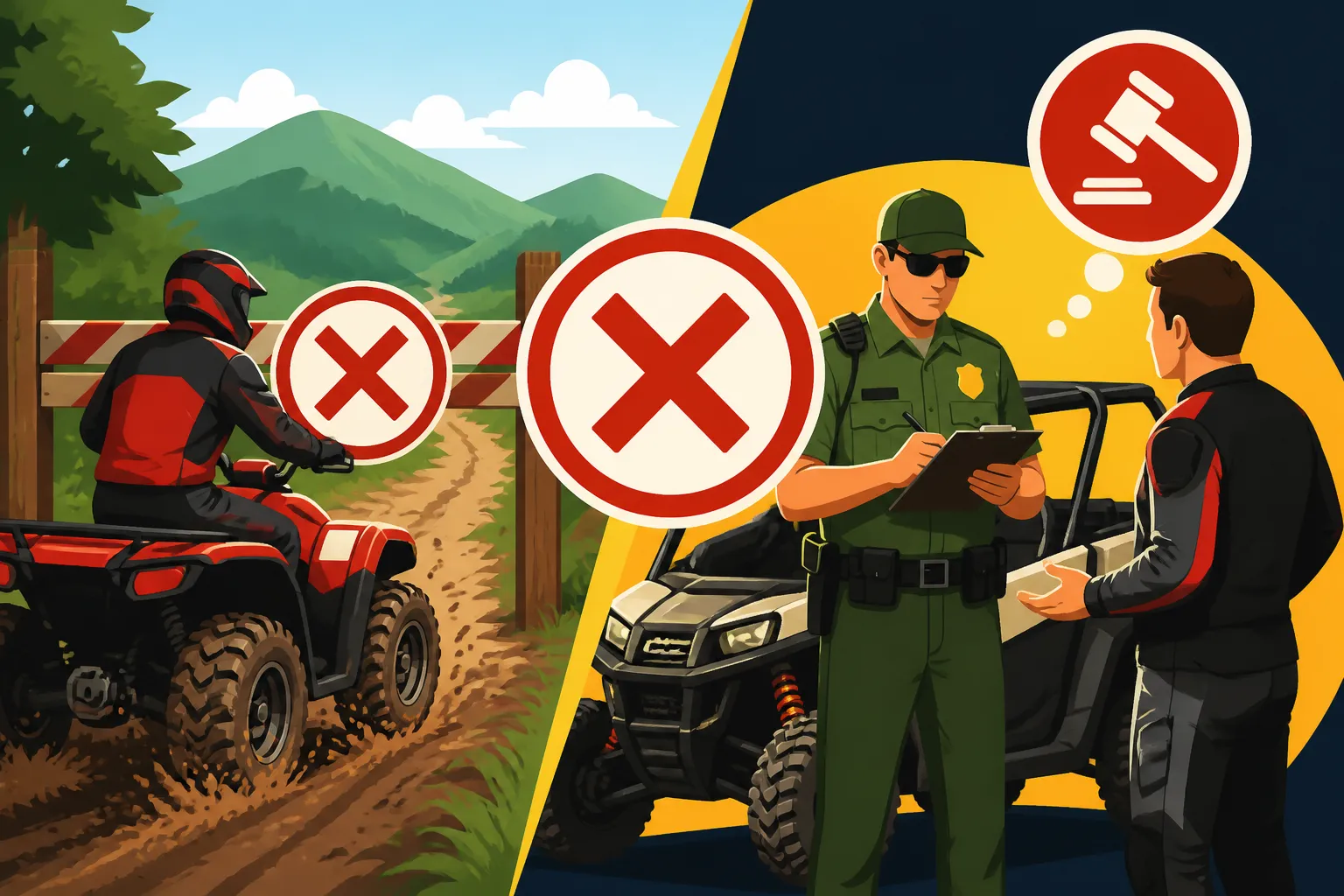
A barrier or closure notice is a reason to stop, not a puzzle to work around. Do not ride around a gate, move a barricade, use a side route to bypass a closure, or follow another group through. A trail may be closed because of a hazard or a restriction that is not visible from the entrance.
Use this process before continuing:
- Stop before the barrier or posted boundary. Avoid crossing the line while you are trying to read a sign or take a photograph.
- Read the full notice. Look for the affected area, route, dates, permitted users, and any instructions about alternate routes. If it is not clear that your machine is allowed, do not proceed.
- Check an official, current source. Use the land manager’s current trail information or contact the park or agency directly. A saved map, old post, or another rider’s advice may be out of date. Checking a Tennessee Trail Notice First covers what to verify before setting off.
- Follow the designated detour, if one is provided. Do not invent a detour across an unmarked trail, private land, or a closed section.
- If there is no safe legal route, turn around. Adjust the ride plan rather than treating the closure as optional.
- Keep a record of what you checked. A clear photo of the notice and a note of the location can help you remember the route status. It does not guarantee that a citation will be dismissed, but it can help you explain what happened accurately.
When a notice appears temporary or damaged, do not decide on your own that it has expired. Check with the manager. If a gate is open but a sign still says the trail is closed, the open gate alone is not reliable permission to ride. Conversely, do not assume that a closed gate means an entire area is closed if the official notice identifies only one route; confirm the permitted access before choosing another trail.
At a managed trail area, check the entrance board and current updates before unloading. Closures may change after rain, maintenance, or other conditions. A Gate Board With Today’s Rules in Tennessee and Tennessee Trail Closures to Check First are useful reminders to verify the information at the site, not just when planning at home.
How to avoid a closed-trail citation
The simplest prevention is to plan around current access information and leave room to change the route. A long ride with no time to turn back can tempt riders to ignore a closure. A flexible plan makes it easier to stop, return to a junction, and choose a route that is clearly open.
Before riding, check the area’s rules and the status of the trails you expect to use. Confirm that your permit applies to that property and that the trail is open to your type of vehicle. A permit is not a substitute for checking closures, and a map may show a route without confirming that it is currently available. Start with Tennessee Trail Permits Explained if you need to understand how permits fit into access planning.
While riding, watch for new signs, temporary barriers, and instructions at junctions. Do not remove or obscure a closure notice, and do not assume that a route is open because another rider has already gone through. If you are riding in a group, make sure everyone hears about the closure before the group reaches it. A lead rider should not make the decision for everyone by entering first.
If a closure appears unexpectedly, turn around where it is safe and use the approved route back. Avoid shortcuts that cross private property or an unmarked boundary. If a closure leaves you unsure how to exit, contact the park or land manager for instructions rather than pushing deeper into the closed area.
If an officer or park employee contacts you, stay calm and follow lawful instructions. Do not argue on the trail or attempt to leave to avoid the interaction. Ask where the alleged violation occurred and what rule or notice applies. If you receive written paperwork, keep it and follow the response instructions. The exact process depends on the authority involved, so get legal guidance if you are considering contesting the citation.
A closure is frustrating, especially when it disrupts a planned loop, but riding past it can create a much larger problem than taking a different route. Verify the rule, respect the boundary, and confirm current access before your next ride.
Disclaimer
This article is for general informational purposes only and does not constitute professional advice. Laws, prices and regulations vary by location and change over time. Consult a qualified professional for guidance on your specific situation.