Tennessee Rules for Riding a Closed Trail
A trail that appears open on a map can be closed by a gate, notice, temporary restriction, or changed park rule. In Tennessee, a riding permit is not permission to ignore that closure. Knowing who manages the route, how to check its status, and what to do when plans change can keep a ride safe and lawful.
What “closed trail” means in Tennessee
A closed trail is a route the land manager or property owner has not currently authorized for riding. The closure may apply to a short section, a whole trail, a particular type of vehicle, or an entire riding area. It may be temporary or continue until the manager says otherwise.
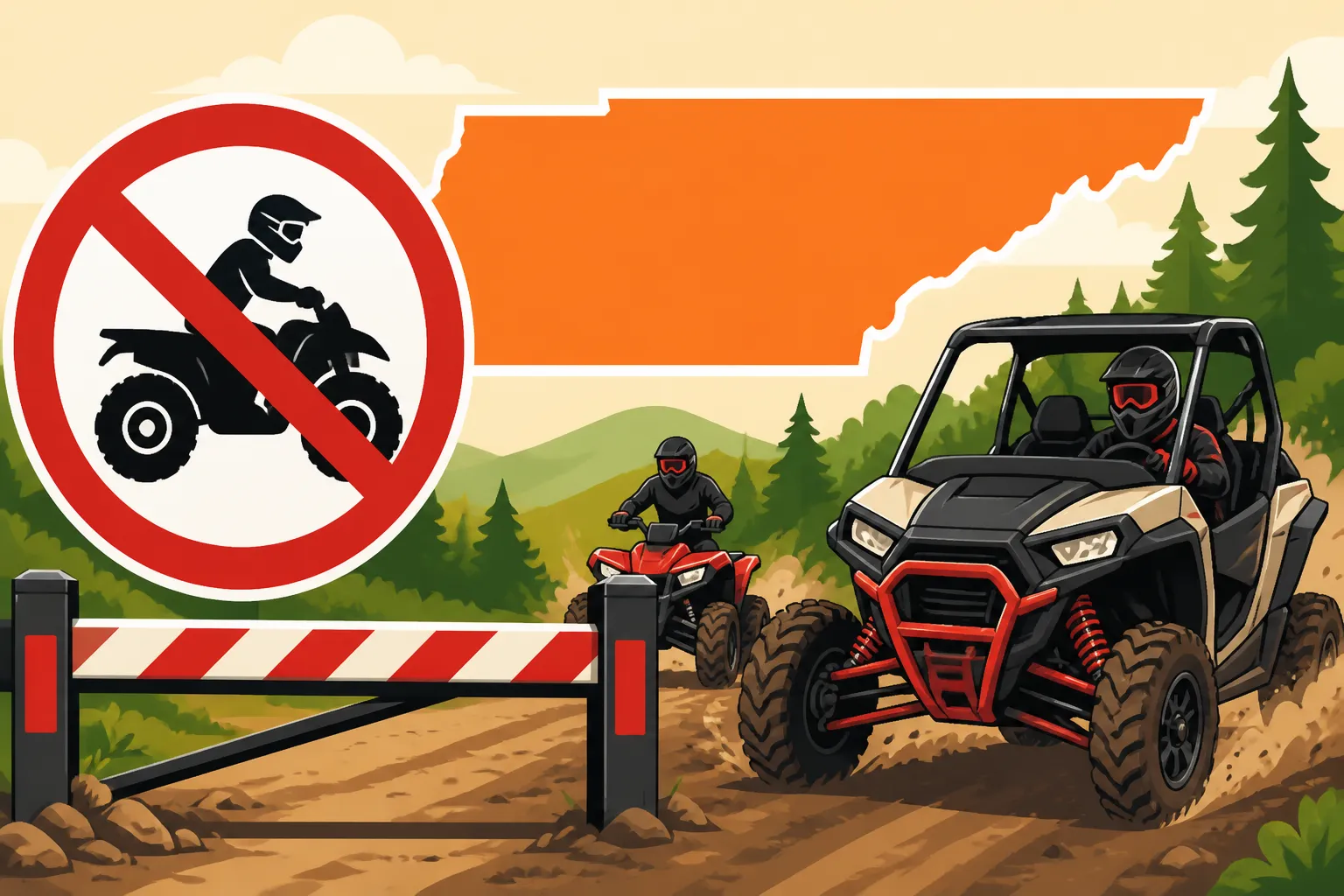
A closure can be marked with a locked gate, sign, barrier, trail-map update, park notice, or other direction from the person responsible for the land. Sometimes a route is physically blocked; sometimes it is not. The absence of a gate or sign at every possible entrance does not mean a trail is open. If a current notice says the route is closed, follow it even if the surface looks easy to ride.
The key distinction is between a trail being visible or physically passable and being authorized for use. A route on an old map, an app, or a previous trip may no longer be open. A permit confirms that you have met a park or land manager’s permit requirement; it does not grant access to every route or override a closure. Tennessee Rules for Riding a WMA explains the separate role of access rules on wildlife management areas.
Closure notices may apply to more than riding. A manager could close a trail to all users, or restrict only motorized use. Read the wording rather than guessing from the condition of the route. If the notice is unclear, ask the responsible office before continuing.
| What you encounter | What it tells you | Best response |
|---|---|---|
| A locked gate or barrier | Access is restricted at that point | Stop and do not go around it |
| A posted closure notice | The stated route or area is off limits under the notice | Follow its scope and directions |
| A route missing from the current open-trail map | It may not be available for riding | Confirm with the land manager |
| A washed-out or damaged trail | The route may be unsafe, and may also be closed | Do not ride around damage or create a bypass |
| Conflicting information from an old map and a new notice | Current directions may supersede older information | Follow the current notice and ask the manager if needed |
When in doubt, stop before entering the route. Riding a short distance to “take a look” can still put you inside a restricted area, and turning around may be harder or more dangerous once the trail narrows, crosses a slope, or reaches an obstacle.
Who controls the trail and its closure
Tennessee has riding areas managed by different owners and organizations. Rules are not interchangeable. A public wildlife management area, a private riding park, a club trail, and a route on private property may each have different access procedures and closure notices. A permit for one area does not automatically authorize riding somewhere else. Why One Park’s Permit Is Worthless at the Next covers why riders should treat permits as location-specific.
On a wildlife management area, follow the requirements of the agency responsible for that area, along with posted restrictions and current notices. A permit or other access document does not cancel a closure. For a broader look at permit responsibilities, see Tennessee Trail Permits Explained. Before riding, check Tennessee Trail Closures to Check for the kind of status information riders should verify.
At a privately operated park or resort, the owner or operator sets the conditions for access on its property. Trail status can change because of maintenance, weather, events, or safety concerns. A paid permit or day pass does not give a rider the right to enter a route the operator has closed. Use the park’s current map, notices, and staff directions rather than assuming that a trail is open because it was available on an earlier visit.
A club trail or route on privately owned land may have additional requirements, including permission from the landowner or club. A trail shown online or described by another rider may cross property where public access is not allowed. Check [Tennessee Rules for Riding a Club Trail] if your planned route depends on club access.
Roads and trails also differ. A route that looks like a road may have separate rules from a designated off-road trail, while a trail that meets a road does not necessarily authorize travel along the road. Do not use a closed trail as a reason to reroute onto an unapproved road or property. Check the rules for the specific type of route and the authority that controls it.
A practical rule is to identify the manager before you set out. Ask: Is this public land, a private park, club property, or another kind of site? Which office or operator provides the current trail status? Where are its notices posted? This avoids relying on a permit or map from the wrong place.
Why trails close and how status can change
Closures are not always permanent, and a familiar trail can change status between visits. Managers may close a route to protect riders, prevent further damage, carry out work, or address changing conditions. The reason may be obvious, such as a fallen tree or washed-out section, or it may not be apparent from the entrance.
Common reasons include:
- Weather and surface damage. Heavy rain, flooding, erosion, mud, or unstable ground can make a trail unsafe or vulnerable to further damage.
- Maintenance or construction. Crews may need to work on a trail, bridge, gate, or drainage feature. Riding through the work area can put riders and workers at risk.
- A damaged bridge or other structure. A crossing that appears usable may not be safe for an ATV or UTV.
- Wildlife or land management. Temporary restrictions may help protect habitat or support management activity.
- Hunting seasons or special events. Access and use may be limited for safety or operational reasons.
- Fire, emergency, or other hazards. A closure may be put in place quickly, sometimes before every map or sign is updated.
- Capacity or operating decisions. A park may close a section or area while it addresses congestion, staffing, or other conditions.
The reason for a closure does not determine whether it is optional. Do not decide that a closure is unnecessary because the weather has improved, work appears finished, or no one else is nearby. Only the responsible manager can confirm that the route is open again.
Trail information may be published in several places, and updates do not always appear at the same time. A printed map or saved phone screenshot can become outdated. Before leaving, check the manager’s current information and any alerts for your intended area. At the entrance, read posted signs and follow barriers. During the ride, pay attention to new signs or directions you encounter. Checking a Tennessee Trail Notice First offers a useful approach to treating notices as part of pre-ride planning.
If two sources conflict, do not choose the one that lets you continue. A current sign at a gate or trail junction may reflect a recent change that an older map has not captured. Contact the manager and ask which direction controls. If you cannot confirm that the trail is open, choose a route that is clearly authorized.
How to check trail status before and during a ride
A good trail-status check is more than a quick look at a map. It means confirming the right area, checking for recent changes, and having a backup route in case a section is closed. Build this into your trip planning, especially if you are traveling to a new park or relying on a long loop.
- Identify the land manager. Confirm the name of the park, public land unit, club, or property owner responsible for the route.
- Find the current source for closures. Check the manager’s current trail map, alerts, posted notices, or other official communication. If the information is incomplete, call or contact the manager.
- Check the exact route, not just the general area. An area may be open while one trail, crossing, or connecting section is closed.
- Review conditions close to departure. Status can change after you make plans. Check again before loading and traveling.
- Read signs at the trailhead and junctions. A notice posted on site may be newer or more specific than the map you brought.
- Plan an authorized alternative. Choose another open route or be ready to shorten the ride. Do not plan to bypass a closure.
- Share the plan with your group. Make sure everyone knows that a closure means turning around, not following a lead rider around a barrier.
- Keep enough daylight and fuel for a change of route. A closed section can make a planned loop impossible. Leave room to retrace your route safely.
If you ride with a group, agree before departure that nobody will continue past a closure to scout ahead. This matters when machines are spread out, riders are unfamiliar with the area, or the route has narrow or steep sections. A single person going ahead can leave the rest of the group unsure where to turn.
Phone navigation can be useful, but it cannot confirm that a route is currently open. Cell service may be limited, and downloaded maps may show an older trail network. Carry a current map in a form you can use without a signal, but treat it as a planning tool rather than the final authority on a closure.
When you reach a closed section, do not assume that the route becomes available again just beyond the sign. The restriction may cover a larger area than the marked point. Follow the notice’s directions, turn around where it is safe, and ask the manager if the boundary is unclear. A Gate Board With Today’s Rules in Tennessee and Calling a Tennessee Park Before You Load are helpful reminders to check the information available at the site and confirm uncertain details before setting out.
What to do when you reach a closed trail
Stop before entering the closed section. Keep your machine in a safe place, avoid blocking the trail or gate, and read the sign in full. Look for information about which trail is closed, whether the restriction applies to all users or motorized vehicles, and whether the notice provides an alternative route. Do not move, ignore, or go around a barrier.
If you are already on the trail when you discover a closure, do not ride farther in to find a way through. Turn back if there is a safe route to do so. If the terrain makes reversing dangerous, stop and contact the park or land manager for instructions. Avoid creating a new path around an obstacle; that can cause damage, expose riders to hazards, and take you onto land where you do not have permission.
A closure can disrupt a planned route, but the safest response is usually to retrace your route or use a clearly marked, open alternative. Do not rely on informal advice from another rider unless it can be confirmed with the manager. Even a well-intentioned suggestion such as “go around the hill” can lead to trespass, environmental damage, or a more hazardous route.
If you see a closure sign that appears to have fallen or a barrier that is damaged, do not treat that as permission to pass. Note the location and report the issue to the manager if practical. A damaged sign may not show the full restriction, and the trail may still be closed.
Riding off the marked route to avoid a closure can create a separate problem. It may damage vegetation or soil, cross private land, or violate the site’s riding rules. [Tennessee Rules for Riding Off the Trail] explains why leaving an authorized route is not a safe substitute for finding an open trail.
Possible consequences and common mistakes
The consequences of riding a closed trail depend on who manages the property, the rules that apply there, and the circumstances. A rider may be asked to leave, lose access, or face a citation or other action under applicable rules. Private operators may enforce their own access conditions. Do not assume that every closure carries the same penalty or that a permit protects you from consequences for ignoring posted restrictions. For state-specific enforcement considerations, see Tennessee Fines for Riding a Closed Trail.
There can also be practical costs that have nothing to do with a fine. Continuing past a closure can put a machine in a damaged or dangerous area, make recovery difficult, delay the group, and create conflict with property managers or other users. A closure may be in place because the route is unstable or because work is underway. Riding in despite the warning can put both riders and workers at risk.
Common mistakes include:
- Treating a closure as a suggestion. A route that looks rideable is not necessarily open.
- Assuming a permit covers every trail. Permits apply to specific places and do not cancel restrictions.
- Using an old map as proof of access. Maps can lag behind closures and route changes.
- Following tire tracks around a gate. Tracks show only that someone went through, not that they had permission.
- Relying on a friend’s earlier trip. A trail’s status may have changed since that ride.
- Assuming a short detour is harmless. Going around a barrier can still mean entering a closed area or leaving the authorized route.
- Continuing because the sign is unclear. Uncertainty is a reason to ask, not a reason to proceed.
- Confusing road access with trail access. Permission to use one kind of route does not automatically apply to another.
If a manager or officer tells you that a trail is closed, remain calm, follow directions, and explain your situation honestly. Do not argue that a permit, old map, or previous visit overrides the instruction. If you believe you received a citation or other formal notice in error, keep the paperwork and use the official process described on it rather than trying to resolve the dispute on the trail.
A simple habit prevents most problems: stop at the first sign of a restriction, confirm the status with the responsible manager, and choose a route that is clearly open. That may mean a shorter ride, but it is better than turning a trail-status question into a safety, property, or enforcement problem.
Frequently Asked Questions
Does a Tennessee ATV or UTV permit let me ride a closed trail?
No. A permit may satisfy an access requirement for a particular riding area, but it does not override a closure. Follow the land manager’s current directions.
If there is no gate, can I assume the trail is open?
No. A closure may be marked by a sign, map update, or other notice without a physical gate. Check current information from the manager.
Can I ride around a closed trail sign?
Do not go around a closure or barrier. The route beyond it may still be restricted, and leaving the marked trail can create additional safety, access, and land-damage problems.
What should I do if a map shows the trail as open but a sign says it is closed?
Stop and follow the current posted direction. Contact the manager if you need clarification; do not use an older map as permission to continue.
Disclaimer
This article is for general informational purposes only and does not constitute professional advice. Laws, prices and regulations vary by location and change over time. Consult a qualified professional for guidance on your specific situation.