Riding a Windrock Trail at 2 a.m.
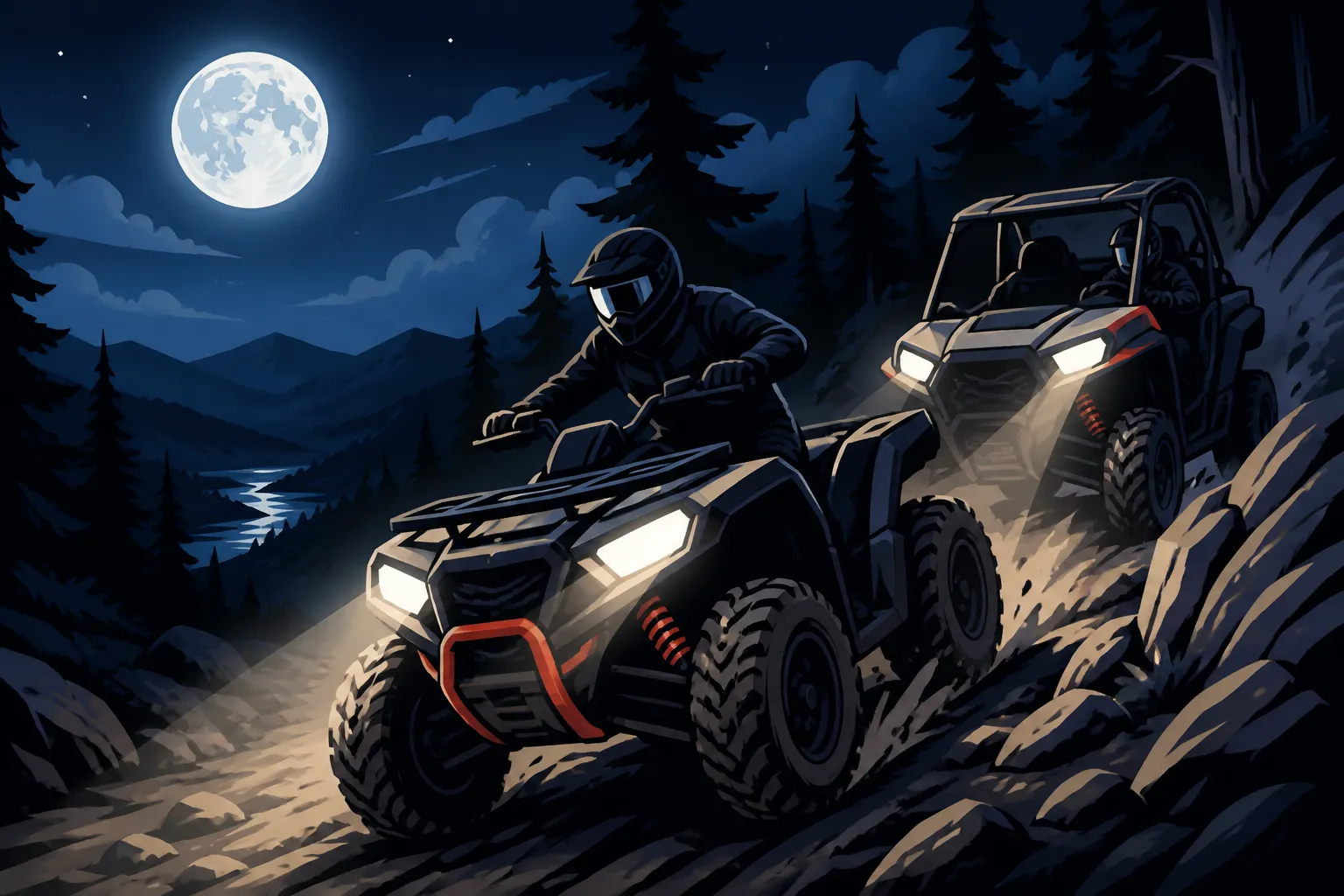
Riding a Windrock trail at 2 a.m. can feel very different from tackling the same route in daylight: visibility shrinks, familiar landmarks disappear, and a small mechanical problem can become much harder to handle. This guide covers what to check before a late-night ride, how to choose a sensible route, and how to prepare for the terrain and conditions around Oliver Springs.
Check that a late-night Windrock ride is actually allowed
Confirm the park’s hours, access rules, and trail status
Windrock is known for riding outside ordinary daytime hours, but don’t assume every trail, entrance, service, or facility is available whenever you arrive. The park’s general operating approach and an individual trail’s current status are not the same thing. Closures, weather, maintenance, events, or other restrictions can change where you’re allowed to ride.
Before unloading, check Windrock’s current rules and notices directly. Confirm that your planned access point is open, that your permit covers the ride, and that the route you want to use is open to your type of vehicle. The page [Windrock Open Around the Clock] is useful context, but for a particular night, use the park’s own latest information rather than relying on an old trip report or an assumption based on the park’s usual schedule.
A named route such as Trail 27 may be associated with after-hours riding, but that doesn’t mean every nearby trail is open or that conditions are suitable. Check [Trail 27 Open Around the Clock] alongside the current map and trail notices. If a sign, gate, or posted notice contradicts what you expected, follow the on-site direction and choose another permitted route.
Get the permit and night-riding rules straight
A park permit is not a blanket guarantee that every trail or activity is allowed. Review the details for the permit you need, who in your group must have one, and whether there are separate requirements for a passenger or a rented machine. Start with [Windrock's Trail Permits], then confirm the park’s specific rules before you set out.
Night riding deserves a separate rules check. Find out what lighting, sound, helmet, passenger, and vehicle requirements apply at the park, and whether any trails or areas have additional restrictions after dark. [Tennessee Rules for Night Riding at a Park] can help frame the questions to ask, but park rules and posted restrictions still matter for the ride you’re planning.
If you’re unsure about access or a rule, contact the park before loading your machine. It’s much easier to adjust your route while you’re still at home than to reach a gate in the middle of the night and discover that your plan depends on an assumption. Keep your permit information and any important instructions accessible, rather than buried in a bag or left in a vehicle you may not return to for hours.
Prepare your machine and gear for darkness
Make your lights and controls part of the pre-ride check
At 2 a.m., headlights are not just for seeing the trail ahead. They help your group stay oriented, spot changes in the surface, and notice other riders. Inspect the main headlights before leaving, and check any auxiliary lights you plan to use. Confirm that mounts are secure, lenses are clean, and the lights don’t flicker when the engine is running or the machine moves over bumps.
Test the controls you may need to use in a hurry, including the brakes, throttle, horn if equipped, and winch controls if your vehicle has one. A light that works in the driveway but points too high, too low, or off to one side can still make night riding harder. Take a few minutes in a safe, stationary place to see where the beam lands, and avoid aiming lights in a way that blinds your riding partners.
Carry backup lighting that doesn’t depend on the machine’s electrical system. A headlamp or handheld light can be useful if you need to inspect a tire, find a dropped tool, or walk a short distance away from the vehicle. Pack spare batteries or a charged backup power source where you can reach them without unloading everything. These small preparations are easy to overlook when the machine starts and the lights come on, but they matter if something fails miles from the staging area.
Pack for a breakdown, a delay, or a changing trail
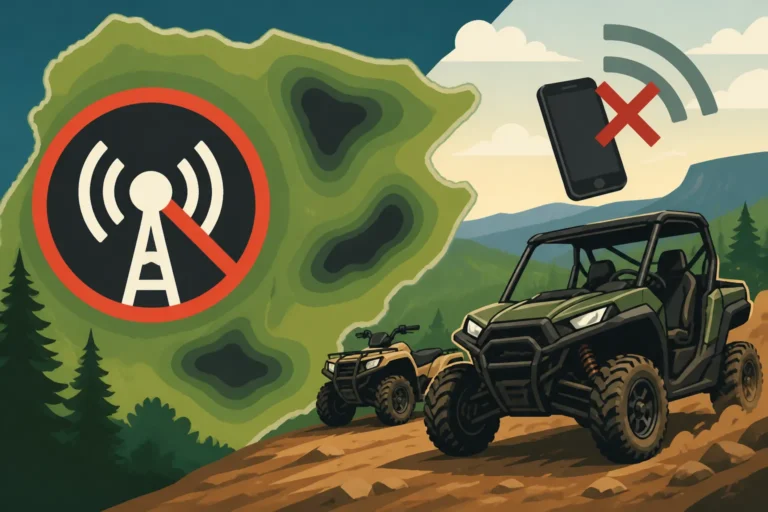
A late-night ride can take longer than the same loop in daylight. You may travel more slowly, stop to check a route, or need to help another rider. Bring enough water, warm layers, basic first-aid supplies, and the tools and tire-repair equipment suited to your machine. Keep a charged phone on you, but don’t plan as if you’ll always have service. [Cell Dead Zones Across the North Cumberland WMA] is a useful reminder that connectivity can be unreliable in this region.
Agree on a simple response plan before the group starts. Decide where everyone should stop if the group gets separated, who carries the first-aid kit, and what to do if a machine becomes disabled. Make sure each rider knows how to contact the others and where the group intends to regroup. If someone needs to stop, the rest of the group should not continue down the trail assuming they’ll catch up.
A little extra preparation can prevent a minor delay from turning into a long, uncomfortable night. Think through what you would need if you had to wait for assistance or walk back to a staging area. Keep essential items—such as a light, water, and communication device—on your person rather than only in a storage box that could be difficult to access after a breakdown.
| Before the ride | What to check | Why it matters at 2 a.m. |
|---|---|---|
| Park access | Current hours, entrance access, and posted restrictions | A familiar schedule may not reflect a closure or special restriction |
| Trail choice | Current map, route status, and vehicle suitability | Darkness makes wrong turns and unsuitable terrain harder to manage |
| Lighting | Headlights, auxiliary lights, mounts, and backup light | You need dependable visibility and a way to inspect a problem |
| Machine | Brakes, tires, controls, fuel, and basic repair supplies | A small mechanical issue can take longer to resolve after dark |
| Group plan | Regroup point, communication plan, and emergency supplies | Riders may become separated or lose phone reception |
Choose a route you can manage after dark
Make navigation simple before you leave
A route that feels straightforward in daylight can become confusing when familiar features are hard to see. Don’t rely on memory alone, especially if you haven’t ridden the area recently. Review the map while you still have good light, note important junctions, and agree on where you’ll turn around if the group is running late or the conditions become uncomfortable.
Digital mapping can help, but prepare for the possibility that your phone loses service or runs low on battery. If you use onX Offroad, download the information you’ll need before you reach the trail and check that it remains accessible without a connection. Bring a paper map or another independent backup, and make sure at least one other rider can follow the planned route. [Tennessee Trail Maps Worth Carrying] offers more guidance on building a reliable map setup.
Don’t treat a line on a screen as permission to ride a trail. Cross-check your navigation with the park’s official map and current closure information. If your device shows a route that conflicts with a gate, sign, or posted notice, stop and reassess instead of pushing ahead. A map helps you navigate; it doesn’t replace the park’s rules or judgment about whether a route is safe for your group.
Match the trail to your least-experienced rider
At night, the most capable rider in the group should not set the pace by default. Choose a route that the least-experienced person can handle in reduced visibility, and account for the machine with the least clearance, the smallest tires, or the least suitable setup. A group that is comfortable on a difficult climb in daylight may find it much less manageable when the surface and line choices are harder to read.
Consider what the trail is like when wet, not just what it looked like in a photo or on a previous visit. Rock, mud, ruts, steep grades, and water crossings can all become more demanding after dark. Check [Tennessee Trail Conditions Before You Ride] and pay attention to recent rain and park notices. If conditions are uncertain, pick a shorter or more familiar route instead of trying to prove that the group can finish a difficult loop.
Build a turnaround point into the plan. That might be a particular junction, a time, or a point after which the group heads back regardless of how much trail remains. A clear cutoff helps prevent the common late-night trap of continuing because you’ve already come this far. If a rider is tired, a machine is acting up, or the route is taking longer than expected, turning around is a sensible decision—not a failed ride.
Ride with a clear group plan and an exit strategy
Keep the group together without rushing
Before starting, agree on who leads and who rides last. The lead rider should use a pace that allows the group to stay together, while the last rider helps make sure nobody is left behind at junctions or after a stop. Choose a signal for slowing or stopping, and make sure everyone understands it before helmets go on.
Use a pace that leaves enough time to react to rocks, ruts, branches, and other riders. Avoid following so closely that dust, glare, or a sudden stop leaves the next rider with no room to respond. On a narrow or uneven stretch, let riders take turns through the difficult section rather than crowding the same line. If someone looks uncertain, stop in a safe place and check in before continuing.
Be mindful of sound as well as speed. A loud machine can carry a long way through the hills, particularly when the surrounding area is quiet. Keep the vehicle in good working order and avoid unnecessary revving or gathering near homes and other sensitive areas. The reference [86 Decibels at 50 Feet] provides context on sound considerations for riding in this region; check the park’s rules for the requirements that apply to your machine.
Know when to call the ride
A late-night ride should have a few clear reasons to stop: an injured rider, a mechanical problem that cannot be safely addressed, a route that is closed or unclear, worsening weather, or a group member who is too tired to continue confidently. Don’t let the fact that you planned the ride—or drove a long way to Windrock—pressure you into ignoring a real problem.
If a vehicle becomes disabled, move the group to a safe location if you can, make yourselves visible, and use your agreed communication plan. Avoid walking off alone in unfamiliar terrain. If you need help, share your location as clearly as possible and follow the park’s emergency guidance. Having a designated person who knows your route and expected return time can also make it easier for someone outside the group to notice if plans change.
For a first ride at Windrock, or a first ride after dark, keep the plan modest. A short, familiar route gives everyone a chance to understand how their lights perform, how the trail feels at night, and how well the group communicates. You can always plan a longer ride another time. The best 2 a.m. outing is one where the group returns together, with enough energy left to load safely and get home without rushing.
Disclaimer
This article is for general informational purposes only and does not constitute professional advice. Laws, prices and regulations vary by location and change over time. Consult a qualified professional for guidance on your specific situation.