Tennessee Trails Good for Kids
A family ride can sound easy until a child gets tired, a trail turns rocky, or the route takes longer than expected. Tennessee has several places to ride, but “kid-friendly” depends on the machine, the child’s experience, and the trail conditions that day. This guide explains how to choose a manageable ride, prepare your family, and avoid common trail-day surprises.
How to choose Tennessee trails that are good for kids
A trail that works well for one family may be a poor fit for another. A confident teen on a small ATV may be ready for a longer route, while a younger child riding as a passenger may be happiest with a short, smooth loop and plenty of breaks. Start with the people and machines in your group, then choose terrain to match.
Match the trail to your child’s experience
For a first ride, look for a route described by the park as easy or beginner-friendly. Favor shorter distances, gentle grades, wider paths, and places where your family can turn around safely if someone becomes uncomfortable. A trail’s length matters, but so does its character: a short, steep, rutted climb can be more challenging than a longer, gradual route.
Trail ratings are useful starting points, not promises that every stretch will feel the same. Rain can create muddy sections, wash out a crossing, or make a rocky slope slick. Even a route that felt manageable earlier in the season can become harder after changing weather or heavy use. Check the park’s trail information before you leave and again when you arrive.
If you use a digital mapping tool such as onX Offroad, treat it as a planning aid rather than permission to ride anywhere the map displays. Confirm that the route is open to your vehicle and allowed by the property owner or park. Keep a paper or downloaded map available too, since cell coverage can be unreliable in wooded valleys and on remote ridges.
Choose a machine your child can control
A child riding their own ATV needs a machine that fits their size and ability, not just one they are excited to try. They should be able to reach the controls, steer comfortably, and stop the machine in a controlled way. If a child cannot manage the controls confidently in a safe practice area, a challenging trail is not the place to learn.
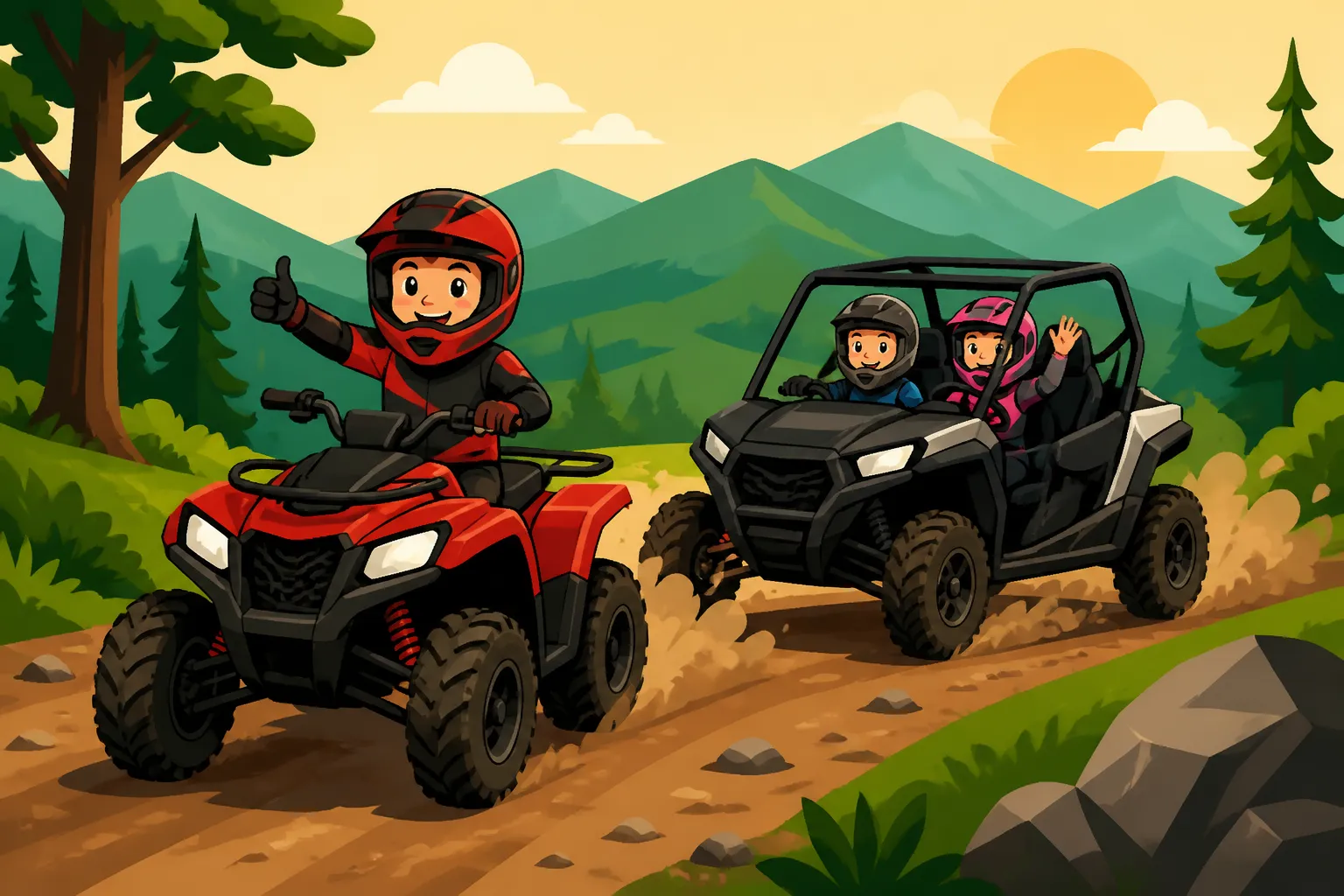
For younger children, riding as a passenger in an appropriate side-by-side may be a better option, provided the machine is designed for passengers and the child can sit securely with the required protective equipment. Confirm the park’s passenger rules and the vehicle manufacturer’s guidance. Never assume that a child can safely ride on any seat, rack, or improvised perch.
Before choosing a route, consider the whole group’s machines. A trail that is comfortable for a capable adult on a full-size UTV may be tiring or intimidating for a beginner on a small ATV. If the group includes different skill levels, plan around the least experienced rider and agree on a turnaround point before setting out.
Use a practical kid-friendly checklist
Use this comparison to narrow down the kind of ride to look for. It is a planning guide, not a substitute for current park maps or posted rules.
| Family situation | A better starting point | What to avoid at first |
|---|---|---|
| Child is new to riding | Short, easy route with a clear return point | Long loops, steep grades, and technical obstacles |
| Child is a passenger | Smooth route with room to stop and regroup | Rough sections that may jostle or unsettle the passenger |
| Family has mixed experience | Easy route everyone can complete together | Choosing a route for the most skilled rider |
| Weather has been wet | A route the park confirms is suitable and open | Assuming yesterday’s trail conditions still apply |
| First visit to a park | Staff-recommended beginner option | Following an unfamiliar route without checking access |
A useful planning read is [Tennessee Trails for Beginners]. If your family is still deciding where to go, compare the broader options in [Best Places to Ride an ATV in Tennessee] and [Tennessee Trail Difficulty Ratings].
Tennessee riding areas to consider with children
Tennessee’s riding areas vary widely in terrain, scale, and operating rules. A well-known destination is not automatically a good first ride for every child. Before loading the trailer, check whether the area has routes appropriate for your group, what vehicles are allowed, and whether the trails you want to ride are open.
Windrock Park near Oliver Springs
Windrock Park is a major East Tennessee riding destination near Oliver Springs, and its extensive trail network can appeal to families with different experience levels. The size of the riding area is also a reason to plan carefully: do not assume you can casually cover a large portion of it in a few hours, especially with children who may need frequent stops.
For a family outing, ask about the easiest suitable routes and how long a modest ride is likely to take. Make sure everyone understands the route before leaving the staging area. A loop that looks short on a map may feel much longer when a child is hungry, cold, or nervous about an unfamiliar section.
Windrock conditions can change with weather and use. Check closures and trail information with the park before your visit, and choose a conservative route if rain has affected the area. You can also use onX Offroad to help review your planned route, but compare it with the park’s own information and obey signs and closures on the ground. See [Tennessee ATV Trails Near Knoxville] and [Windrock Park at Oliver Springs, Tennessee] for related planning topics.
Brimstone Recreation near Huntsville
Brimstone Recreation near Huntsville offers another place to explore with a family, but the key is to identify a route that fits the least experienced rider. Don’t let the excitement of a large trail network turn into pressure to ride farther or harder than your child is ready for.
Call or check with the park before the trip to ask which routes are suitable for beginners and whether current conditions have changed access. Ask how to identify the route once you are on the property, and make sure the adults in your group know how to get back to the staging area. If the child is uneasy early in the ride, shorten the outing rather than treating the planned distance as a goal that must be completed.
Brimstone may be a better fit for families who are comfortable planning around a large riding area and following park-specific requirements. Check the rules for permits, passengers, children, and allowed vehicles before arrival. Related guides include [Brimstone Recreation at Huntsville, Tennessee] and [Tennessee Trails Good for Kids]—use the latter as a reminder to match the outing to your child rather than simply choosing the most famous destination.
Royal Blue and North Cumberland
The Royal Blue area and the broader North Cumberland riding region offer families additional options to research. These areas can involve remote terrain, so a child-friendly plan should include more than choosing a route on a map. Think about travel time, fuel, weather, communication, and how quickly your group could return to the vehicle if someone needs a break.
Before riding, confirm the exact area you intend to use and its current access rules. North Cumberland includes separate units and management requirements, so do not assume that a permit or plan for one riding area applies everywhere. Review [The Six Units of Tennessee's North Cumberland] and [Does One Permit Cover Every North Cumberland Unit?] while planning.
For a first visit with kids, ask whether there is a short, easier route that stays near a familiar staging location. If the answer is unclear, choose a destination where staff can explain beginner options and current conditions. A map app such as onX Offroad can help you think through distances and route choices, but it cannot replace a gate notice, park map, or staff direction.
How to plan a family ride in Tennessee
A smooth family ride usually starts before the truck leaves the driveway. A little preparation can prevent the familiar trail-day problems: a forgotten helmet, a child who is hungry an hour from the staging area, or a route that takes longer than anyone expected.
Check access, permits, and age rules
Tennessee does not have one universal set of access rules that automatically covers every trail or riding area. Requirements can differ between a private park, a public riding area, and a route on other managed land. Confirm where you are going, which permit or entry requirements apply, and whether your intended machine is allowed.
Also check rules for young riders, passengers, helmets, and supervision. Requirements may depend on the riding area and the child’s age. Do not rely on a rule you remember from another park, or assume that an adult’s permit covers every person in the group. The guides [Tennessee Rules for Young Riders Under 16] and [Tennessee Helmet Rules at a Trail Park] can help you identify questions to verify with the specific riding area.
Read the park’s rules before the trip and again when you arrive. Posted notices may address closures, weather-related restrictions, vehicle limits, or route changes. If anything is unclear, ask park staff rather than guessing. A few minutes spent checking can save a long backtrack—or keep your family off a closed or unsuitable route.
Pack for comfort, not just the ride
Children often reach their limit because of discomfort before the trail itself becomes difficult. Dress for the weather and expect conditions to feel different on an exposed ridge than they do in town. Bring properly fitted helmets and any other protective gear required by the park or recommended for your machine. Goggles can help with dust, while gloves and sturdy footwear improve comfort and control.
Pack water and snacks where they can be reached safely during a stop. Carry basic items your group may need, such as a first-aid kit, a charged phone, and a way to navigate if the signal disappears. Keep belongings secured so they cannot fall from the vehicle or interfere with controls. For longer rides, plan fuel with a buffer instead of assuming the nearest stop will be open or easy to reach.
Set expectations with children before the engine starts. Explain that the group will stop together, that no one should race ahead, and that they can tell an adult if they feel tired, scared, cold, or unwell. A child who knows they can speak up is less likely to hide a problem until it becomes urgent.
Build a short, flexible itinerary
For a first outing, plan a shorter ride than you think your family can handle. Start with a modest loop, take a break before anyone is exhausted, and leave time to return well before closing or the end of daylight. If the group feels good, you can consider another easy route; if not, the day is still a success.
Before starting, choose a meeting point and explain what to do if the group becomes separated. Keep a responsible adult near the front and another toward the back when the group is large enough to do so. Agree that nobody will pass the lead rider without permission, and stop in a safe place whenever the group needs to regroup.
Use your map to understand the route, but avoid making a child feel that the family must finish a particular loop. With onX Offroad or another mapping tool, mark the planned route and a simple way back, then compare that plan with posted information at the riding area. A flexible plan is especially helpful when the weather changes, a trail feels harder than expected, or a child simply needs to call it a day.
Safety habits that make riding with kids easier
A family ride should be enjoyable, but children depend on adults to set limits and make cautious decisions. The best safety plan is one everyone understands before entering the trail—not a last-minute conversation on a steep or crowded section.
Keep the group together and ride at the child’s pace
Let the least experienced rider set the pace. Leave enough room between machines to avoid dust and sudden stops, but keep the group close enough to communicate. On narrow or uneven routes, stop in a safe, visible place before checking on a child or discussing the next section.
Do not pressure a child to continue because the route is nearly finished. If they are tired, frightened, or struggling to control the machine, find a safe place to stop and reassess. Turning around early is a sensible decision, not a failed outing. A child who finishes feeling safe is more likely to enjoy the next ride.
Adults should also stay alert to changing conditions. Mud, loose rock, water, steep grades, and blind turns can make a familiar route feel different. If a section looks beyond your group’s ability, do not ride it simply because it appears on the map. Confirm whether there is a safe alternative or return by the route you know.
Teach simple trail communication
Agree on a few clear signals before leaving. Riders should know how the group will indicate a stop, a turn, or a problem. Keep directions simple enough for a child to remember, and repeat the plan at the staging area before the group separates into machines.
Show children how to recognize route markers and posted closures, but make it clear that adults are responsible for navigation and decisions. A child should never feel responsible for leading the group out of an unfamiliar area. If your family is using digital maps, review the route together without treating the screen as more authoritative than signs or staff instructions.
Talk through what to do if someone stops unexpectedly. The group should pull over only where it is safe, avoid blocking the trail, and wait for the lead rider or designated adult. If the group gets separated, the child should know to stay with their machine in a safe spot and wait for an adult rather than riding off alone to search.
Know when to end the ride
Watch for signs that a child has had enough: unusual quietness, repeated complaints about discomfort, trouble staying focused, or growing fear around ordinary trail features. Hunger, thirst, heat, cold, and fatigue can all affect judgment and coordination. Take breaks early rather than waiting for a child to become overwhelmed.
Conditions may also be the reason to stop. Heavy rain, poor visibility, a closure, a mechanical issue, or a route that is beyond the group’s ability are all good reasons to turn back. Check [Tennessee Trail Conditions Before You Ride] and [Tennessee Trail Closures to Check First] as part of planning, then follow the riding area’s updates and signs on the day.
A child-friendly ride is not measured by miles covered. It is measured by whether everyone had a manageable, safe experience and returned with enough energy to enjoy the rest of the day. Choose a route with room to adjust, and let your family’s comfort—not a checklist—decide when the ride is done.
Disclaimer
This article is for general informational purposes only and does not constitute professional advice. Laws, prices and regulations vary by location and change over time. Consult a qualified professional for guidance on your specific situation.