Ice and Snow on a Cumberland Bench Road
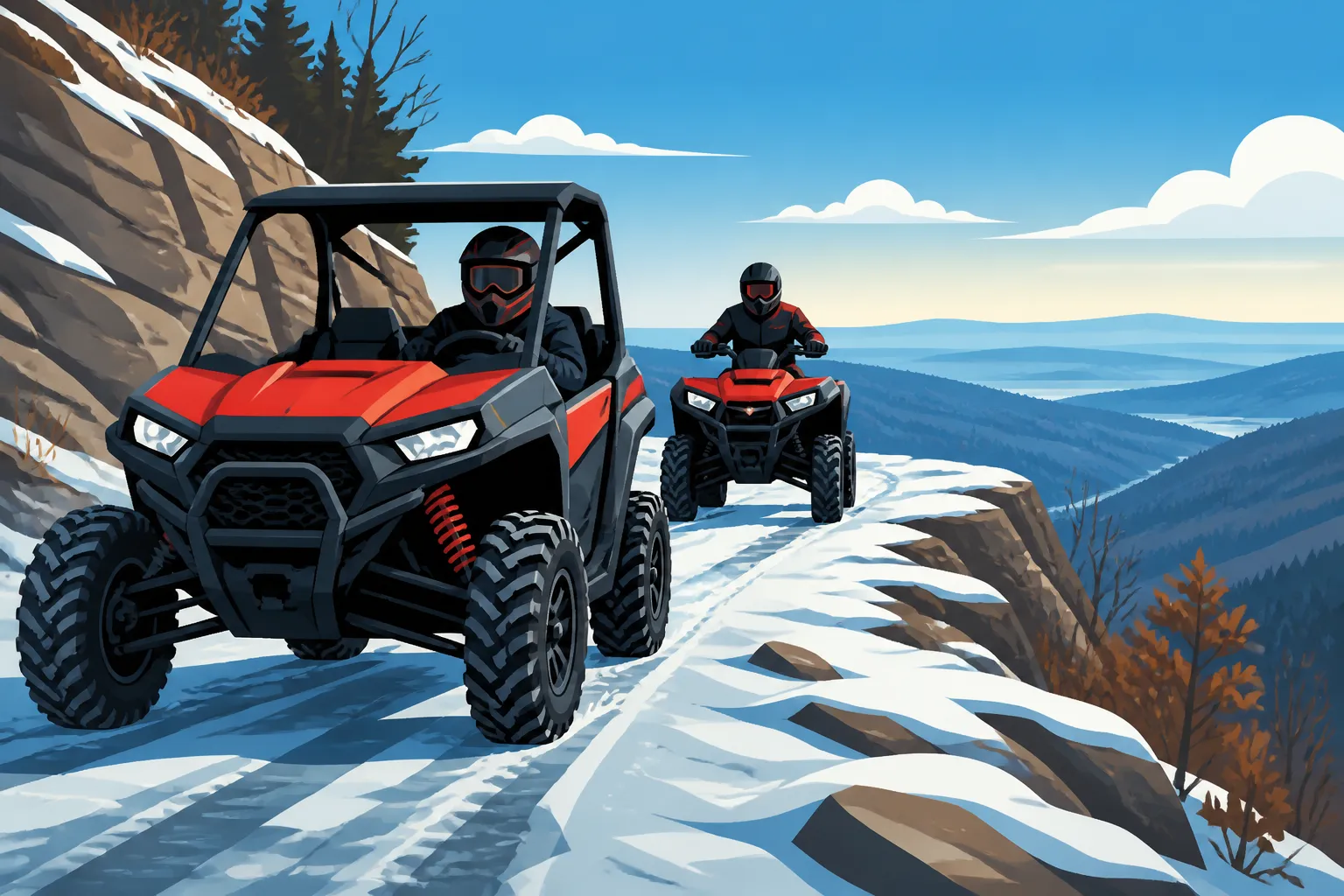
A Cumberland bench road can look merely dusted with snow while hiding polished ice in shaded corners, frozen ruts, and slick creek crossings. That mix can turn an ordinary ATV or UTV ride into a recovery problem fast. This guide explains how to assess winter conditions, prepare your machine and group, choose safer routes, and know when turning around is the smartest call.
Why Cumberland Bench Roads Get Treacherous in Winter
Shade, elevation, and changing temperatures create hidden ice
A bench road follows a relatively narrow shelf across a hillside. In places such as the North Cumberland area and around Windrock near Oliver Springs, these roads can run along exposed slopes, cut through shaded woods, and pass over hollows where cold air settles. A sunny trailhead is not a reliable preview of what you will find farther along the route. One section may be wet and soft, while a shaded bend around the next ridge remains frozen.
The most deceptive conditions often happen when temperatures rise during the day after a freezing night. Meltwater can run across a bench road, gather in wheel tracks, or spill from a bank. If the road stays cold or falls back into shade, that water can freeze into a thin, nearly invisible layer. A tire may grip on rough snow and then suddenly skate on ice beneath it. Even experienced riders can misread the surface because the change happens over just a few feet.
Pay close attention to places where water naturally crosses or drains onto the road: dips, culverts, seep lines, creek approaches, and the inside of bends. Ice also tends to linger beneath overhanging trees and on north-facing slopes. The risk is not limited to deep winter. A brief cold snap after rain can make a familiar route more slippery than a fresh snowfall.
Snow depth does not tell the whole story
A thin layer of snow can hide hard ice, rocks, ruts, or washed-out edges. Deeper snow can conceal a rut deep enough to pull a machine off line, especially where previous traffic has compressed the surface into uneven tracks. On a narrow shelf road, there may be little room to correct a slide before a tire reaches a bank or the downhill edge.
Snow that looks soft from the driver’s seat may also cover a firm, polished layer. Conversely, the top may crust over while loose snow beneath shifts under the tires. Neither appearance guarantees traction. Before committing to an unfamiliar section, stop somewhere stable and inspect it on foot if conditions allow. Keep well back from edges and do not step onto a slope or patch of ice that you would not trust a machine to cross.
Treat every blind corner and change in grade as a new surface until you can see it clearly. A route that was manageable on the way out may be worse on the return after temperatures drop, shade moves across the road, or traffic packs the snow down. A little snow does not necessarily mean a trail is unsafe, but it does mean that ordinary assumptions about traction may no longer apply.
Decide Whether to Ride Before You Leave
Check conditions at the riding area, not just at home
Weather in a nearby town can differ from conditions higher on the Cumberland Plateau. Check the forecast for the specific area you plan to visit, and consider overnight lows, daytime warming, precipitation, wind, and the time you expect to return. A forecast that calls for rain followed by freezing temperatures deserves particular caution because meltwater and runoff may refreeze on shaded sections.
Look for current notices from the riding area or land manager before loading the trailer. Trail availability can change with weather, maintenance, closures, or land-management decisions. A route visible on a map does not confirm that it is open or suitable for winter riding. Reviewing [Tennessee Trail Conditions Before You Ride] and [Tennessee Trail Closures to Check First] can help you build the habit of checking conditions and access information before setting out. If a notice is unclear, call the relevant office or park rather than assuming a gate will be open.
For route planning, a mapping tool such as onX Offroad can help you review the general area, mark a planned route, and prepare offline map access where available. Use it as one planning aid, not as proof that a road is open or safe. Cell service can be unreliable in parts of the North Cumberland area, so save the information you need before leaving coverage and carry a backup navigation method.
Use a conservative go-or-no-go decision
Make the decision based on the weakest part of the ride, not the easiest part. If your planned route includes a steep, shaded climb, narrow bench road, or creek crossing that could become icy, ask whether you could safely turn around there and return in worsening conditions. If the answer is no, shorten the route or choose a different day. The goal is not to prove that a machine can move forward; it is to make sure the group can travel both ways and get back safely.
| What you find | Why it matters | Safer response |
|---|---|---|
| Thin snow over a hard surface | Ice or ruts may be hidden | Stop in a stable spot and inspect before proceeding |
| Water running across a shaded road | It may freeze behind you or farther along | Avoid crossing if the surface is slick or the route is exposed |
| Deep, uneven tire tracks | Tracks can steer or tip a machine | Do not follow them automatically; assess the full road |
| A narrow shelf with a slippery edge | Little room exists to recover from a slide | Turn around before entering if traction is uncertain |
| A closure or unclear access notice | The route may be unavailable or restricted | Confirm with the land manager and choose an open route |
| Conditions worsening near sunset | Ice can form as temperatures fall | End the ride early and return by a known route |
A cancellation is a reasonable outcome of trip planning, not a failed outing. If freezing rain is expected, roads are already glazed, visibility is poor, or the group lacks winter riding experience, postpone the ride. Similarly, if a park or land manager closes an area, do not try to find an unofficial way around the closure. Conditions can affect both rider safety and the ground itself.
Prepare the Machine and Riders for Winter Surfaces
Check the ATV or UTV before loading
Cold weather can expose small maintenance problems that might go unnoticed on a mild day. Before the trip, inspect tires for cuts, damage, and appropriate pressure; check the brakes, steering, throttle, lights, battery, and fluid levels; and make sure the machine starts reliably. Tire condition matters more than aggressive-looking tread alone. Worn or damaged tires can make an already unpredictable surface harder to manage.
Carry basic tools and recovery equipment suited to your machine and route. A winch, straps, a shovel, and suitable attachment points may help with a recovery, but they do not make every slope safe to attempt. Know how your equipment works before you need it. Keep recovery gear secured so it cannot shift, and avoid placing hands or bodies in a tensioned line’s path. A machine stuck on an icy bench road can be difficult to recover without putting people near the edge or under additional machines.
Do not assume that adding more throttle will solve a traction problem. Sudden acceleration, sharp steering, and abrupt braking can break what little grip the tires have. If your machine has selectable drive modes or traction features, learn their operation before the ride and use the owner’s manual as your guide. Equipment cannot compensate for a route that is beyond the group’s ability.
Dress for waiting as well as riding
Winter riding gear should protect against wind, moisture, and cold without making it difficult to steer, brake, or use controls. Layering is practical because effort levels change during a ride: a rider may feel warm while moving, then cool quickly during a stop or recovery. Wear gloves that allow control operation, secure eye protection, and footwear that stays warm and gives stable footing. Bring dry layers in a waterproof bag.
Pack water, food, a first-aid kit, a charged phone, and a light source. A communication plan matters when riders become separated or a machine stops working. Tell someone who is not on the ride where you plan to go and when you expect to return. If your group uses radios, confirm that they work before leaving the staging area and agree on what to do if a rider loses contact.
Cold can make a minor delay feel much more serious. A flat tire, a stalled machine, or a route blocked by ice may mean standing outside longer than expected. Carry enough supplies to manage a wait without relying on a nearby business or cell signal. If you are riding in a remote area, review [Cell Dead Zones Across the North Cumberland WMA] and plan around the possibility that a call or map download will not work when you need it.
Ride With Traction and Space in Mind
Slow down and make each movement deliberate
On snow and ice, speed reduces the time available to recognize a problem and respond. Travel slowly enough to see the road ahead and stop before a hazard, keeping extra space between machines. That gap gives the lead rider room to assess conditions and helps prevent a following vehicle from sliding into a stopped machine. On a narrow road, use agreed stopping points rather than stopping unexpectedly where there is no room to pull over.
Keep steering inputs smooth. Avoid sudden throttle changes, abrupt braking, and sharp turns, which can make the tires lose grip. If the machine begins to slide, avoid a panicked correction. Make controlled inputs and follow the machine’s handling guidance, while prioritizing a safe place to stop. Do not race another machine through a slick section or assume that tracks left by a previous rider mark a dependable line.
A passenger changes how a UTV responds and can affect braking and balance. Make sure everyone is seated correctly, buckled in where applicable, and dressed for the conditions. Talk through the route and stopping plan before moving. For general route planning, [Reading a Tennessee Park Trail Map] can help riders understand how to orient themselves, but use the land manager’s signs and directions as the authority for access and closures.
Treat climbs, descents, and crossings as separate decisions
A frozen climb can become difficult even when the approach looks manageable. Before attempting one, consider the surface, grade, available visibility, and whether there is a safe place to stop or turn around. If you cannot see the top or know what lies beyond it, do not use momentum as a substitute for information. The same applies to descents: once a machine begins sliding downhill, a rider may have few safe options on a narrow bench.
Crossings deserve particular caution. Water over a road may conceal ice, loose rock, or a deeper channel, and snow can hide the edges of a culvert. If you cannot establish the depth and footing from a safe position, do not drive through simply because another machine did. A rider walking a crossing should stay clear of moving machines and avoid testing a steep, icy bank on foot.
If one member of the group is unsure, stop and reassess rather than pressuring them to continue. A different route, a shorter ride, or a return to the staging area may be the safest option. In areas managed as wildlife management lands, confirm applicable access and use rules before planning a route; [Tennessee Rules for Riding a WMA] provides a useful topic to review alongside local notices.
Know When to Turn Around and How to Finish Safely
Set turnaround points before the ride
Choose a conservative destination and a firm time to turn back before leaving. This is especially useful when daylight is short or temperatures are expected to drop. A planned turnaround prevents the group from continuing simply because it has already invested time in reaching a particular ridge or trail junction. Agree that any rider can call for a stop without having to justify it.
Turn back if the road narrows beyond your comfort level, the surface is more slippery than expected, visibility becomes poor, or a machine begins to struggle. Also reconsider the route if the group is moving much slower than planned. Delays can leave riders farther from the trailhead as the surface cools and daylight fades. Do not let the goal of finishing a loop override changing conditions.
Keep an eye on land-management notices and posted signs throughout the outing. A route’s presence on a map does not overrule a gate, closure, or instruction from the managing agency. If winter conditions affect access or permit requirements, check the relevant details before the trip; [Tennessee Trail Permits Explained] is a useful starting point for understanding that trail permits and park access can be separate from machine ownership or route planning.
Return to the staging area with a plan
The ride back deserves the same attention as the ride out. A road that was soft or wet earlier may now be frozen, especially where shade has spread across it. Revisit the route mentally before leaving a stopping point: identify the next safe place to pause, tell the group what to expect, and keep enough distance to avoid crowding. Do not rush to beat sunset by riding faster.
At the trailhead, account for every rider and machine before loading. Check for injuries, damage, or equipment left behind, and make sure the trailer is parked and loaded safely. If you need to leave a vehicle or trailer overnight, confirm that the location allows it rather than assuming the lot is available for extended parking. [Parking a Trailer at a Tennessee Trailhead] is a relevant planning topic when arranging winter staging.
After the ride, note what you encountered: icy corners, running water, deep ruts, or a section that became unsafe. Share useful observations through the appropriate park or land-manager channel, not as a guarantee that conditions will be the same for the next rider. Snow and ice can change quickly. A careful trip plan, a willingness to turn around, and respect for closures are more useful than trying to force a route through conditions the group cannot safely manage.
Disclaimer
This article is for general informational purposes only and does not constitute professional advice. Laws, prices and regulations vary by location and change over time. Consult a qualified professional for guidance on your specific situation.