Buying From an Anderson County Seller
Buying a used ATV or UTV in Tennessee can feel like a maze of paperwork and rules, especially when you're buying from someone in a specific area like Anderson County. You might find yourself wondering if the process is different, what documents you absolutely need, and how to avoid any nasty surprises down the road. This guide is here to walk you through every step of purchasing a pre-owned off-highway vehicle from an Anderson County seller, ensuring a smooth and legitimate title transfer without the headaches.
Understanding Tennessee's OHV Titling Process
So, you've found the perfect side-by-side or quad advertised by a private seller in Anderson County, perhaps somewhere around Oliver Springs or Clinton. It's exciting, I know! But before you hand over any cash, it's crucial to understand how Tennessee handles OHV ownership. Many folks get tripped up thinking it's like buying a car, but there are some key differences, especially with how our state views off-road machines.
Why Titling is Crucial Even for Off-Roaders
Here's the big one: Tennessee doesn't register ATVs or UTVs in the way it does cars or trucks for road use. You won't be getting a license plate or annual registration tags for your typical off-road machine, and that's often a point of confusion for new owners. The state clearly defines [Why Tennessee Does Not Register Off-Road Machines], focusing instead on off-highway vehicle permits for trail use. However, this doesn't mean your machine exists in some legal grey area. Far from it!
What Tennessee does require for most OHVs, regardless of whether you ever take it to a park, is a title. This title is your official proof of ownership, a vital document that establishes who legally owns that machine. Think of it as the birth certificate for your ATV or UTV. Without a proper title, proving you own the machine can be incredibly difficult, making future sales or even recovery after theft a nightmare. It also ensures you've paid the necessary sales tax. The entire process of getting this critical document is detailed in [Titling an OHV in Tennessee].
The Role of the County Clerk
Unlike vehicle registrations that might go through a central state department, titling your OHV in Tennessee is handled at the local level. This means you'll be dealing with your county clerk's office, not some larger state agency. If you're an Anderson County resident buying from an Anderson County seller, you'll visit the Anderson County Clerk's office to complete the transfer. If you live in a different county but are buying from Anderson County, you'll still process the title in your county of residence.
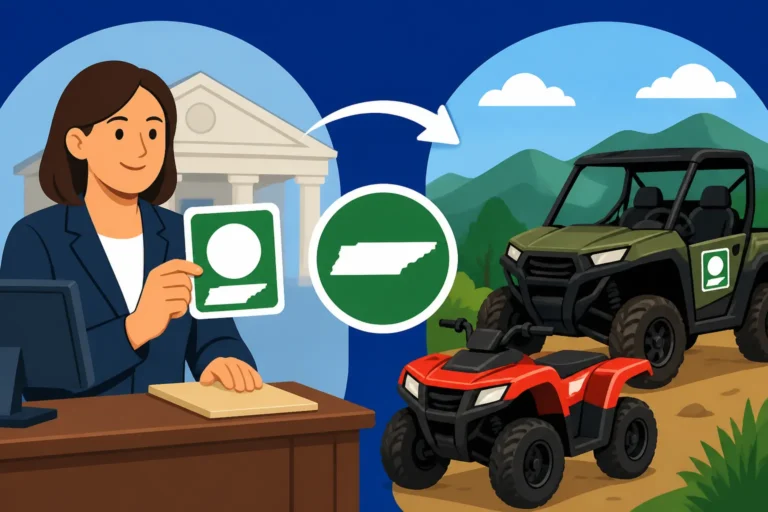
This local approach can be a bit different from what some people are used to, but it generally means a more personalized experience. The county clerk's office is your one-stop shop for getting that title in your name, paying sales tax, and sorting out any fees. They are the ones who ultimately issue your OHV title and the accompanying [Tennessee's TDR Sticker Explained] which proves the title's existence. Understanding that your local county clerk is the key player here, as explained in [Why a County Clerk Issues the Tennessee Sticker], will save you a lot of time and frustration.
Specifics of Buying from an Anderson County Seller
When you're looking at that used ATV or UTV advertised online or in a local paper, buying from a private seller always requires a bit more due diligence than buying from a dealership. This is especially true when it comes to confirming the machine's history and the seller's legitimacy. Let's dive into the specifics you need to watch out for when dealing with an Anderson County seller.
Verifying Ownership and Machine Details
Your first, and arguably most important, step is to verify that the person selling the OHV actually owns it and that the machine itself is legitimate. This means looking at the current title. The seller should be able to produce the physical title document. Check the name on the title – does it match the seller's identification? If there are multiple names on the title, all parties generally need to sign off on the sale.
Next, you need to find the Vehicle Identification Number (VIN) on the machine itself. This is usually stamped into the frame or a metal plate. Compare this VIN exactly to the VIN listed on the title document. Any discrepancy is a massive red flag. A mismatched VIN could indicate a stolen machine, a rebuilt machine with parts from different sources, or other issues that could leave you with a non-titleable machine. Don't skip this step! It's why [Checking a VIN Before a Tennessee Purchase] is absolutely essential. A good rule of thumb is: if the VINs don't match or the seller can't produce a title, walk away. It's simply not worth the risk.
The Bill of Sale and Its Importance
Once you've verified ownership and the machine's identity, the next critical piece of documentation is a Bill of Sale. While the title officially transfers ownership, a detailed Bill of Sale acts as a formal contract between you and the Anderson County seller. It records the specifics of the transaction, protecting both parties. Even for a private sale, this isn't just a friendly handshake; it's a legal safeguard.
A good Bill of Sale should include:
- The full names and addresses of both the buyer and seller.
- The date of the sale.
- The make, model, year, and most importantly, the VIN of the ATV or UTV.
- The agreed-upon purchase price.
- A statement that the seller is transferring the machine "as is" (unless otherwise agreed), confirming no warranties are implied.
- Signatures of both the buyer and seller. It's often a good idea to have this document notarized, though not always strictly required by the state for OHV transfers, it adds an extra layer of legitimacy.
Using a reliable template for your Bill of Sale can make this process much easier. Resources like LawDepot offer customizable templates for various legal documents, including a solid [A Tennessee Bill of Sale for an OHV]. Having a professionally drafted document from a service like LawDepot ensures that all the necessary legal language is present, protecting both your interests as the buyer and the seller's. This document is what you’ll present at the county clerk’s office alongside the signed-over title.
Navigating Sales Tax and Fees
Ah, the part nobody loves, but it's unavoidable: taxes and fees. When you purchase an OHV from a private seller in Anderson County, you will be responsible for paying Tennessee sales tax on the purchase price. This sales tax is collected at the county clerk's office when you go to transfer the title into your name. It's not paid directly to the seller.
The sales tax rate will depend on your county of residence and the state's current rate, so make sure to factor this into your budget. For example, if you live in Anderson County and buy within Anderson County, you'll pay the state sales tax plus any applicable local sales tax collected by the Anderson County Clerk. It's important to understand that [Tennessee Sales Tax at the Title Counter] is mandatory, and you won't be able to get a new title without paying it.
In addition to sales tax, you'll also encounter a few other fees at the county clerk's office:
- State Title Fee: This is a standard fee for the state of Tennessee to issue the title.
- County Clerk Fee: Your local county clerk's office will also charge a small fee for their services in processing the paperwork.
- Lien Fee (if applicable): If you're financing your OHV and a lien is being placed on the title, there will be an additional fee for recording that lien.
While I can't provide exact figures (as these can change), you can expect the total [Tennessee OHV Title Cost] to include these components. Always contact your local county clerk's office in advance to confirm the current fees and sales tax rate, so you're not caught off guard. Being prepared with the correct amount helps the process go smoothly.
Completing the Title Transfer in Tennessee
You've found the machine, verified the VIN, and you have a solid Bill of Sale. Now comes the moment of truth: getting that title officially transferred into your name. This step requires a trip to your local county clerk's office, and it's essential to arrive prepared with all the necessary documents to avoid multiple trips.
Required Documentation for the Clerk
To successfully transfer the title of your newly acquired ATV or UTV at the county clerk's office, you'll need a specific set of documents. Think of it as putting together a complete puzzle for the clerk. Missing even one piece can delay the process.
Here's a general checklist of what you'll need:
| Document Type | Description | Important Notes |
|---|---|---|
| Original Title | The physical title document from the seller, signed over to you. | Ensure the seller has signed in the correct "Seller" or "Transferor" section. |
| Bill of Sale | A completed and signed Bill of Sale from the transaction. | Essential for verifying purchase price and transaction details. LawDepot is a good source for templates. |
| Proof of Identity | A valid government-issued photo ID (e.g., driver's license, state ID). | This confirms you are the person purchasing the OHV. |
| Proof of Residency | Usually covered by your driver's license, but sometimes additional proof (e.g., utility bill) may be asked for. | To confirm you're a resident of the county. |
| Payment | Funds for sales tax, title fees, and any applicable lien fees. | Check acceptable payment methods (cash, check, card) with the clerk's office beforehand. |
| Lien Release | If the seller had a lien, a notarized lien release from their lender. | Critical to show the OHV is free of prior debt. See below for more details. |
It's always a good practice to call your specific county clerk's office ahead of time to confirm their exact requirements, as procedures can sometimes have minor variations from county to county.
The TDR Sticker and Its Purpose
Once you successfully complete the title transfer and pay all applicable taxes and fees, the county clerk's office will issue you a new title in your name. Along with this title, you will also receive a special sticker from the Tennessee Department of Revenue (TDR). This is not a registration sticker, nor is it a trail permit. Instead, [Tennessee's TDR Sticker Explained] serves a very specific purpose.
This sticker, often affixed directly to your title document, acts as official proof that your OHV has been properly titled in Tennessee. It essentially says, "Yes, this machine has gone through the formal ownership process with the state." While it doesn't give you permission to ride on public roads or trails (you'll need separate trail permits for that), it's an important validation of your ownership. It's clearly stated that it is [A Sticker That Proves a Tennessee Title Exists], reinforcing the legal standing of your machine. Keep this sticker safe with your title, as it's part of your official ownership record.
What to Do If There's a Lien
A common scenario, particularly with more expensive machines, is that the previous owner financed their OHV. This means there's a lien holder (usually a bank or credit union) listed on the title. If you're buying a machine that still has a lien on it, you need to be extremely careful. You cannot legally transfer the title free and clear until that lien is satisfied and released.
Here's how this typically works:
- Seller Pays Off the Loan: The seller must pay off the outstanding balance of their loan.
- Lien Release: Once the loan is paid, the lien holder will send the seller a "Lien Release" document. This is usually a notarized statement confirming that the debt has been satisfied.
- Title Sent to Seller: The lien holder will then send the original title, now marked "lien released" or with the lien holder's signature indicating release, directly to the seller.
You, as the buyer, should never pay off the seller's loan directly unless you have a very clear, ironclad agreement and the lien holder is fully involved in the transaction, agreeing to send the title directly to you or your chosen escrow. The safest way is for the seller to provide you with a title that already has the lien released. Trying to transfer [Titling a Machine With a Lien in Tennessee] can be complicated and should only be attempted with extreme caution and professional advice. Always ensure you receive a clear, unencumbered title or a formal [Releasing a Lien on a Tennessee Title] document along with the title from the seller. If they can't provide this, it's best to walk away or insist they handle it completely before you exchange money.
Potential Pitfalls and How to Avoid Them
Even with the best intentions, buying a used OHV can come with its share of potential problems. Knowing what to look out for and how to mitigate risks can save you a lot of grief and money down the line. When dealing with an Anderson County seller, or any seller for that matter, staying informed is your best defense.
Dealing with Lost or Missing Titles
One of the most common and immediate red flags you might encounter is a seller who claims they have lost the title. While a lost title can happen legitimately, it presents a significant hurdle for you as the buyer. Without the original title, you cannot transfer ownership into your name at the county clerk's office. The seller, not you, is responsible for obtaining a duplicate title.
If an Anderson County seller tells you the title is lost, politely but firmly explain that you cannot complete the purchase until they provide a duplicate. They will need to apply for a [Replacing a Lost Tennessee OHV Title] at their local county clerk's office (which, if they're in Anderson County, would be the Anderson County Clerk). This process can take some time, and it costs a small fee, which the seller should be willing to cover. Never accept a Bill of Sale as a substitute for a title, especially if the machine is still fairly new or valuable. A Bill of Sale alone, without an accompanying title, is almost certainly going to lead to issues for you trying to prove ownership.
Understanding Different OHV Classes
Tennessee classifies off-highway vehicles into different categories, primarily Class I and Class II. While these classifications mostly pertain to potential road use or specific regulations in certain areas, understanding which class your potential purchase falls into can be important for its future use.
- Tennessee's Class I OHV Definition: Generally includes ATVs and some smaller side-by-sides. These are typically designed for a single operator, or an operator and one passenger.
- Tennessee's Class II OHV Definition: This category usually covers larger, heavier machines like UTVs or multi-passenger side-by-sides, and sometimes custom-built machines like sand rails.
Why does this matter when buying from an Anderson County seller? While most of your riding will likely be off-road at designated parks like Windrock, knowing the classification of your machine could become relevant if Tennessee's laws regarding road access or specific trail rules ever evolve. For most trail riding, the classification won't directly impact your permit, but it's good to be aware of the characteristics that define your machine. Always check the machine's specifications against the state's definitions if you have any questions about its classification.
Post-Purchase Considerations
Once you've successfully titled your new-to-you OHV from the Anderson County seller, your journey isn't over! There are a few important considerations for responsible ownership:
- Insurance: While Tennessee doesn't mandate insurance for off-road use, it's a very smart idea to get it. Accidents happen, and having liability and comprehensive coverage can protect your investment and yourself from unexpected costs. If you ever plan to ride on any designated public roads (where allowed), insurance will likely become a requirement.
- Trail Permits: If you plan to ride at popular destinations like Windrock Park in Oliver Springs or Brimstone Recreation in Huntsville, you'll need to purchase the appropriate trail permits. These are separate from your title and are typically bought directly from the park or a state portal.
- Safety Gear: Always wear appropriate safety gear, including helmets, goggles, and protective clothing, regardless of whether you're on a trail or just riding around your property.
- Maintenance: A used OHV means you're inheriting its maintenance history. Schedule a thorough check-up and service with a reputable mechanic soon after purchase to ensure it's in top condition and safe to ride.
By following these steps and remaining vigilant throughout the purchasing process, you can confidently buy a used ATV or UTV from an Anderson County seller, ensuring you have a legitimate machine and a clear title in your name. Happy trails!
Disclaimer
This article is for general informational purposes only and does not constitute professional advice. Laws, prices and regulations vary by location and change over time. Consult a qualified professional for guidance on your specific situation.